Original Lens and publication context
Iran's strike on Ras Laffan has done more than damage a plant. It has confirmed the worst-case scenario for global gas markets: a simultaneous chokepoint blockade and supply-destruction event, with no buffer, no reserve, and no quick fix.
- Iran's retaliation for the Israeli strike on South Pars hit energy assets in three Gulf states, including Ras Laffan, which supplies about one-fifth of global LNG; a missile got through after four were intercepted and fires spread across QatarEnergy facilities; Abu Dhabi shut Habshan.
- Ras Laffan was already shut before the missiles: the Hormuz blockade trapped about half the available LNG tanker fleet inside the Gulf, so there were no ships to load, and QatarEnergy declared force majeure. Gulf exports are about 20% of global LNG supply.
- There is no strategic reserve for LNG anywhere, no spare fleet outside the Gulf, and no producer able to absorb a 20% supply shock in weeks; Indian Navy escorts and Chinese rerouting produce optics, not volume. Near-term relief is limited to 10–15 pre-loaded cargoes.
- Price is bilateral with no middle path: if the Strait reopens within weeks, JKM and TTF settle at a lasting premium to pre-crisis levels; if it stays blocked or Iran strikes again, prices climb until demand destruction clears the market over six to eighteen months.
- Position: long JKM and TTF spot and near-dated futures, non-Gulf LNG producers and exporters, LNG shipping and diversified European utilities; short Asian ammonia, methanol and fertilizer producers on spot gas. Industrial curtailment in South Korea, Japan and Bangladesh is the signal to cut longs.
I. TRIGGER
What Actually Happened
The escalation sequence that broke global LNG markets unfolded across seventy-two hours. An Israeli air strike targeted Iran's South Pars natural gas field — the world's largest, shared with Qatar — destroying gas infrastructure and petrochemical facilities. The strategic logic was direct: natural gas accounts for 79% of Iran's total power generation, and disrupting it degrades both civilian infrastructure and the energy inputs that support Iranian oil production.
Iran's response was calibrated for maximum market damage rather than military symmetry. Tehran declared energy assets across three Gulf states to be legitimate targets: Saudi Arabia's Samref refinery and Jubail petrochemical complex, Qatar's Ras Laffan industrial city, and the UAE's Al Hasan Gas Field. All three were subsequently struck.
A retaliatory attack on Ras Laffan is exactly what the global natural gas market feared the most.
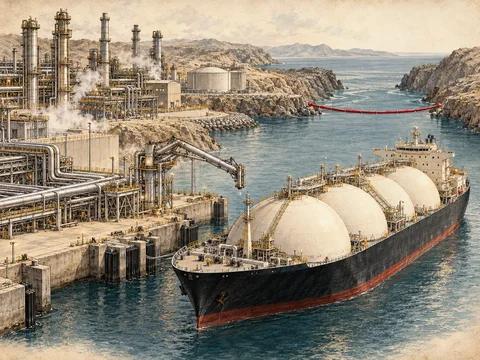
Qatar confirmed that its Ras Laffan industrial city — which accounts for approximately one-fifth of global LNG supply — was struck by an Iranian missile after four others were intercepted. A subsequent early-morning attack ignited fires across multiple QatarEnergy LNG facilities. Abu Dhabi shut its Habshan gas processing complex — one of the world's largest onshore facilities with 14 production trains and daily output sufficient to supply all of South Korea — after it was struck by debris from an intercepted attack. Saudi Arabia's defense apparatus intercepted a drone strike on an eastern-region gas facility, though shrapnel from a ballistic missile reached the vicinity of a Riyadh refinery.
Qatar has since contained the Ras Laffan fires, and no casualties have been reported across the three countries. President Trump stated the US would retaliate against any further attacks on Qatari LNG infrastructure. The physical damage, however, is only part of the problem. The deeper issue was already in place before the first missile was launched.
II. FLOW
The Fleet Mathematics That Make This Unsolvable
The Strait of Hormuz blockade, which preceded the Ras Laffan strikes, had already frozen approximately half the available global LNG tanker fleet inside the Persian Gulf. The fleet math is stark and worth stating explicitly.
GLOBAL LNG TANKER FLEET | ~800 VESSELS TOTAL |
|---|---|
Vessels trapped in Persian Gulf | 17 carriers (≈ half of the available fleet) |
Gulf share of global LNG exports | ~20% of total global supply |
Qatar's share of global LNG | ~20% of global supply (Ras Laffan) |
Chinese-owned LNG vessels | 32 vessels (3–4% of global fleet) |
Chinese-flagged LNG vessels | 3 vessels |
Indian-owned / Indian-flagged | Zero — none exist in the global fleet |
Qatar-to-Shanghai voyage | ~14 days each way; 1-month round trip |
China's monthly LNG imports | ~80 cargoes/month |
Qatar-origin share to China | ~20 cargoes/month (historically) |
Several dynamics compound the blockade beyond raw headcount. Ras Laffan's LNG production was already halted before the missile strikes — a forced shut-in caused by the absence of available tankers to load output. QatarEnergy declared force majeure on deliveries, throwing Asian buyers, particularly in Japan, South Korea, and China, into scramble mode. The strikes on Ras Laffan have now added physical damage to an already inoperative facility.
Unlike oil’s IEA-coordinated emergency stock mechanism, LNG supply has no equivalent globally coordinated reserve system. National gas stocks and LNG storage still provide buffers of differing size and accessibility.
India attempted to negotiate exemptions through back channels with Tehran, resulting in Indian Navy escorts for several stranded tankers. JPMorgan's assessment of this development is precise: it will not materially ease the disruption. Of the 17 LNG vessels currently inside the Persian Gulf, only two are Chinese-owned; at least one is unloaded; both are UK-insured. The Indian negotiation produces optics, not volume.
The Pacific basin rerouting scenario — in which China redirects its 32 owned vessels from Australian and other Pacific LNG sources to prioritize Qatari cargoes — fails on operational logistics. Those vessels are currently embedded in Pacific-basin supply chains. Redirecting them takes weeks. The market does not have weeks. And even if the rerouting succeeded, JPMorgan concludes that Qatar would not restart LNG production to serve such constrained volumes under medium-term uncertainty.
III. RISK
Why There Is No Quick Fix
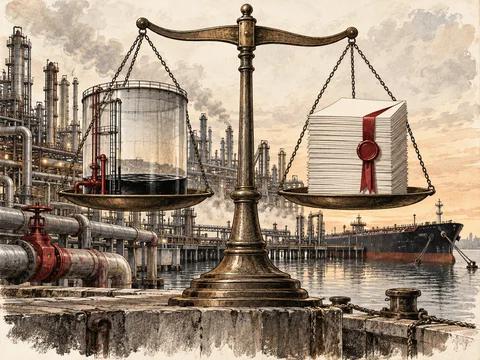
The standard crisis-response playbook for energy disruptions relies on one of three mechanisms: strategic reserve drawdown, supply rerouting, or accelerated production elsewhere. None of the three is available here in any meaningful form.
- Strategic reserve drawdown: The global LNG market has no equivalent of the Strategic Petroleum Reserve. LNG cannot be stored onshore at the scale required. Bernstein's energy-research desk stated it plainly: 'There is no strategic reserve for LNG.' European storage is at seasonal lows and cannot substitute for Asian spot disruptions.
- Supply rerouting: The only producers outside the Gulf with significant spare capacity — Australia, Malaysia, Indonesia, Papua New Guinea, Brunei — have not developed meaningful shipping fleets. They rely on Chinese and third-party vessels already committed elsewhere. Spot charter rates are spiking with no corresponding vessel availability.
- Production acceleration elsewhere: US LNG export terminals are running at or near nameplate capacity. African projects (Mozambique, Senegal) remain offline or at ramp-up scale. No alternative producer can absorb a 20% global supply shock on a timeline measured in weeks.
- Iranian attack risk: Tehran has demonstrated both the willingness and the precision to strike Gulf LNG infrastructure again. QatarEnergy cannot justify restarting production while the threat of renewed strikes remains active, regardless of physical repair timelines.
The punchline from JPMorgan: Qatar is unlikely to restart LNG production to serve limited exemption volumes while medium-term feasibility of any arrangement remains uncertain. Physical repair is necessary but not sufficient.
The only near-term relief valve is the 10–15 pre-loaded cargoes already inside the Gulf that might receive sailing exemptions through the Strait. Everything beyond that scenario requires the Strait to reopen — an outcome determined by geopolitical settlement, not market mechanics.
IV. PRICE
The Bilateral Outcome
Goldman Sachs has flagged upside risks to its existing price forecasts, specifically identifying prolonged Hormuz disruptions and persistent production damage as the two primary drivers. Gas-market analysts described the Ras Laffan strike as unambiguously bullish for gas prices when markets opened Thursday. The price structure reflects a bilateral outcome with no middle path.
Path A — Straits reopen within weeks: Asian JKM spot prices and European TTF stabilize at a significant premium to pre-crisis levels, reflecting permanent demand reallocation and elevated risk premia. The structural cost of the crisis is baked into the forward curve. Energy exporters outside the Gulf — US LNG terminals, Australian producers, Norwegian pipeline gas into Europe — reprice their contracted and spot volumes upward.
Path B — Straits remain blocked or Iran re-strikes: LNG prices continue their vertical ascent until demand destruction terminates the move. Demand destruction in LNG is not equivalent to demand destruction in crude. Industrial gas consumers in Asia, particularly ammonia, methanol, and fertilizer producers, and power utilities operating gas-fired plants cannot absorb spot prices at 3–5x historical averages indefinitely. The sequence — price spike, industrial curtailment, broader energy substitution, and ultimately recession transmission — plays out over six to eighteen months depending on the severity of the supply gap.
There are exactly two exit paths from this market structure: the Strait reopens, or demand destruction does the clearing. Demand destruction in LNG is not a soft landing.
V. POSITION
Buy-Side Implications
The buy-side position set emerging from this crisis is not complex in direction, but it is complex in sequencing and risk management. The following themes are active.
Long LNG Spot & Near-Dated Futures
Asian JKM and European TTF are the primary expressions. JKM is most directly exposed to Qatari supply disruption given the proximity and historical cargo flows. TTF reflects the secondary demand shift as European buyers compete for Atlantic basin LNG cargoes against Asian demand.
Figure 01 · Conceptual framework
Three conditions for an LNG cargo to reach its buyer
Long Non-Gulf LNG Producers and Exporters
US LNG terminal operators and equity holders are direct beneficiaries of the supply vacuum. US LNG exporters with long-term offtake agreements are exposed to basis spreads that widen materially in this environment. Australian integrated gas producers hold a secondary benefit as Pacific-basin buyers redirect purchasing enquiries.
Long LNG Shipping: Freight and Charter Rates
Daily freight rates are spiking with no clearing mechanism in sight. LNG shipping equities — particularly operators with vessels positioned outside the Persian Gulf — are experiencing revenue tailwinds. The trapped fleet, paradoxically, benefits owners if and when exemption windows open, as stranded vessels command extraordinary spot rates.
Long European Gas Storage and Utilities with Diversified Sourcing
European utilities that secured long-term Norwegian pipeline contracts or US LNG offtake agreements prior to the crisis hold structural advantages versus spot-dependent peers. Storage operators benefit from widening seasonal spreads as summer injection economics improve against elevated spot.
Short: Demand-Destruction Candidates
Ammonia, methanol, and fertilizer producers in Asia with heavy spot gas procurement exposure face severe margin compression. Power utilities in Japan and South Korea operating older, less efficient gas-fired generation also face structural margin pressure as fuel costs outpace regulated tariff recovery timelines.
Monitoring: Demand Destruction as Macro Signal
Industrial gas demand curtailment in South Korea, Japan, and Bangladesh will be the leading indicator that demand destruction is clearing the market. This signal, when it arrives at scale, marks the inflection point for reducing long exposure across the complex. It will also precede broader Asian manufacturing slowdown data by four to six weeks — a tradeable lead indicator for regional risk assets.
BOTTOM LINE
Ras Laffan was already offline before the first Iranian missile struck it. The report described 17 carriers trapped in the Gulf, approximately half of the then-available uncommitted fleet—not half of all LNG carriers. The strikes did not create the crisis — they confirmed it is structural, not transient. With no strategic reserve, no viable fleet rerouting, no production acceleration alternative, and no repair timeline that addresses the underlying security environment, this market has two exit paths. Geopolitical settlement or demand destruction. There is no third option, and there is no hedge that makes the gap disappear.
The global LNG market is not experiencing a supply shock. It is experiencing a simultaneous destruction of the three preconditions for supply recovery: available vessels, operable production, and a navigable transit corridor.
Position accordingly.