Original Lens and publication context
How Iran's Control of One Narrow Strait Is Redrawing Global Energy, Money, and Power — and What It Means for Every Major Economy
- Hormuz is a switch, not a valve: 33 km wide at its narrowest, it carries 21 million barrels of oil a day and about one-fifth of global LNG trade. Iran need only make closure credible, and the insurance market has already crossed that threshold.
- If Hormuz becomes unreliable, land corridors come back: the Kirkuk–Baniyas pipeline moved 1.4 million barrels a day and is decommissioned, not destroyed. Oil crosses Iraq and Syria to the Levant coast, stages through Cyprus and moves on Greek tankers, 20% of the world fleet.
- Winners and losers: Germany, importing 98% of its oil, is the most exposed economy; Italy and Greece become transit and logistics hubs; the US, a net exporter, is the structural winner; China, 75% import-dependent with 40% via Hormuz, has the most to lose.
- India is the most complex player: 85% of crude is imported, over 60% from the Gulf; a 20% Brent rise adds $20–25 billion to the import bill; 9 million nationals in the Gulf send home $50 billion; Russian oil, 35–40% of imports, is the hedge.
- What is mispriced: tanker rates on Hormuz-avoiding routes have a structural floor, the Brent–Dubai spread is the early-warning gauge, Lloyd's war-risk premiums assume mean reversion, US LNG and Eastern Mediterranean infrastructure are strategic assets, and Gulf and Pakistani sovereign debt carry too little war risk.
TRIGGER IRAN WEAPONISES HORMUZ | FLOW SEA ROUTES → LAND CORRIDORS | RISK FIXED, FRAGILE, NO DETOUR | PRICE INSURANCE & FREIGHT RESET | POSITION ATHENS, INDIA, EASTERN MED |
|---|
Start Here: The 90-Second Version
Think of it this way: the global energy system is like a river that has one bridge. Everyone uses the bridge because it is the cheapest and fastest route. But the owner of the land on one side of the bridge — Iran — has slowly realised that it can charge a toll, or threaten to blow up the bridge entirely. The moment that realisation becomes credible, every city downstream starts asking: is there another route? And the answer, it turns out, is yes — but it goes overland, across Iraq, Syria, and Lebanon, and it terminates on the Mediterranean coast, which changes everything about which countries matter.
This report follows that chain of consequences — step by step, country by country.
PART 1
The Strait — Why Hormuz Is the World's Most Dangerous Bottleneck
Iran's position is unique. It does not need to close the strait to extract leverage. It needs only to make closing it credible. That distinction is critical. A credible threat changes behaviour without a shot being fired: shipping companies reroute, insurance premiums spike, buyers diversify supply, and over time the entire infrastructure of energy transit begins to adjust.
Iran has three specific tools. First, it has a navy and a missile arsenal that can threaten tankers. Second, it has laid mines in the Gulf before (in the 1980s). Third, it has deep water at Kharg Island — its main oil export terminal — which is sheltered inside the Gulf and cannot be easily interdicted without triggering a major conflict. Iran exports its own oil regardless. The Gulf states do not.
Iran does not need to win a war. It needs only to make the cost of using Hormuz high enough that the economics of alternative routes become attractive. That threshold has already been crossed in the insurance market.
What is new in the current period is not the geography — that has never changed — but the political environment. U.S. security guarantees in the Gulf are being questioned. The Abraham Accords restructured Arab-Israeli relations. The Saudi-Iran normalisation brokered by China in 2023 did not eliminate competition but changed its character. In this environment, Iran's leverage is credible in a way it has not been since the 1980s Tanker War.
PART 2
The System That Was — How Dubai Rose and Beirut Fell
The key point is that these two systems — the old Levantine land-based system and the new Gulf maritime system — were not separate accidents of history. They were sequential responses to the same underlying economic logic: route the cheapest, most reliable corridor. In the 1970s and 1980s, the sea became dramatically cheaper because of containerisation and because the U.S. Navy effectively policed the sea lanes for free. The land corridors became irrelevant.
But the cost structure of the sea-based system rested on one critical assumption: Hormuz is neutral. The moment that assumption becomes unreliable, the economics of the old land-based corridors become competitive again. Not by design. By default.
Historical pipeline corridors exist, but existence does not establish operating condition. EIA describes substantial damage and rehabilitation needs; restarting a route would require engineering work, investment and political agreement.
PART 3
The New Routes — How Energy Would Move If Hormuz Closes
If the cost of transiting Hormuz rises — through higher insurance premiums, the risk of Iranian interference, or outright closure — the economics of overland pipelines flip. Suddenly, fixing a decommissioned pipeline that runs from Iraq through Syria to the Lebanese coast is cheaper than paying for a heavily insured tanker voyage around the Arabian Peninsula.
This is not a new idea. In 1970, a Lebanese politician named Maurice Gemayel proposed exactly this — a corridor linking Lebanon to Saudi Arabia. He was laughed at. He collapsed and died in the parliament chamber hours later. The idea was ahead of its time because the economics did not yet favour it. They are beginning to now.
The missing piece that makes this system viable — and that is consistently underappreciated — is the Greek shipping fleet. Greece controls approximately 20% of the world's total merchant fleet by tonnage and a dominant share of the global tanker fleet. When energy reaches the Eastern Mediterranean coast, it does not matter unless someone can redistribute it. The Greeks can. They are not a participant in this system. They are its final infrastructure layer.
Control of the Eastern Mediterranean coastline — Haifa, Beirut, Tripoli, Baniyas, Latakia — is control of the system's endpoints. Whoever controls the ports controls where the corridor terminates. That is where the geopolitical competition converges.
PART 4
The Map Changes — Sykes-Picot Dissolves
What this means practically: the political fragmentation of Syria, Iraq, and Lebanon — which most analysts treat as a crisis — is actually the early stage of a rationalisation. Smaller, more homogeneous entities with clear territorial control can maintain pipeline security far more reliably than centralised states whose authority is contested everywhere. Every segment of a land corridor requires only one thing: a credible local authority that has an economic incentive to keep the pipe flowing. The fee structure creates that incentive automatically.
This does not require agreement between the entities. It requires only that each segment calculates that the income from an operational corridor exceeds the income from sabotage. That calculation is not ideological. It is arithmetic.
PART 5
Who Gets Hit — Europe, Asia, and the Americas
EUROPE
Germany Most exposed large economy | Germany imports approximately 98% of its oil and most of its gas. The post-2022 energy shock from losing Russian pipeline gas has already forced a structural reset. A Hormuz disruption compounds that reset. Germany's industrial competitiveness is directly tied to energy input costs. Any sustained spike in Brent or LNG prices — driven by Hormuz risk premiums — hits German manufacturers harder than any other G7 economy because of its high industrial energy intensity. |
France Energy hedge, but exposed on LNG | France's nuclear fleet (70% of electricity) gives it partial insulation from oil shocks. But it imports LNG for industrial and heating use, much of which transits through or is priced off Hormuz-linked benchmarks. More importantly, France has direct strategic interests in Lebanon and has historically acted as guarantor of the Levantine system. A corridor shift reactivates French strategic engagement in the Eastern Mediterranean. |
Italy & Greece Structural winners | Italy sits at the natural European termination point for Eastern Mediterranean pipelines. The Trans-Adriatic Pipeline is operating infrastructure; Poseidon is a pipeline proposal. Greece is the maritime operator of the entire redistribution layer — its shipping sector controls the tanker fleet. Both countries move from peripheral energy importers to central transit and logistics hubs in a corridor-dominated system. Athens is the most structurally undervalued capital city in this scenario. |
UK Financial exposure, strategic distance | The UK's direct energy exposure is lower — North Sea output remains meaningful. But as the home of the Lloyd's insurance market, London is the entity that prices Hormuz risk globally. If war-risk premiums reprice structurally upward, Lloyd's is on both sides of that trade — it profits on premium income but faces catastrophic claims if a major tanker incident occurs. The City of London is also the primary offshore financing centre for Greek shipping and Gulf sovereign wealth. |
ASIA
China Biggest loser from Hormuz disruption | China imports roughly 75% of its oil, of which approximately 40% comes from Middle East producers transiting Hormuz. Saudi Aramco's largest customer is China. A sustained Hormuz disruption hits China harder than any other major economy in absolute barrels per day terms. China's response has been threefold: building strategic petroleum reserves (now the world's largest), funding overland pipeline alternatives (China-Pakistan Economic Corridor, Central Asian pipelines), and brokering the Saudi-Iran normalisation in 2023 precisely to reduce the probability of a Hormuz closure. China's entire Gulf strategy is a hedge against Hormuz risk. |
Japan Zero domestic production, maximum exposure | Japan produces virtually no domestic hydrocarbons. Nearly 90% of its oil imports transit Hormuz. Japan has almost no alternative sourcing structure. A Hormuz closure would force Japan to bid against China for Atlantic Basin and Russian oil simultaneously, at a premium that would be severe. Japan's strategic vulnerability here is existential in the short term — it has roughly 90 days of strategic reserve cover. |
South Korea Similar to Japan, with chaebols at risk | South Korea's oil import profile mirrors Japan's. Additionally, Korean shipbuilders — Hyundai, Samsung, DAEWOO — are the world's dominant constructors of LNG carriers and VLCCs. A structural shift in tanker demand patterns (shorter Eastern Med routes vs. long-haul Gulf voyages) would negatively impact orderbook economics at Korean yards even as tanker day rates rise. |
ASEAN Split picture | Vietnam, Thailand, and Indonesia have growing domestic production that partially offsets import exposure. Singapore, as the world's largest bunkering hub, is the maritime infrastructure node for Asia and would face volume and routing disruption if Hormuz traffic declines. The city-state's entire economic model is built on maritime flow — which is now structurally at risk in the long run if Eastern Med routing displaces Gulf-to-Asia volumes. |
AMERICAS
United States Structural winner — with conditions | The U.S. shale revolution means America is now the world's largest oil and gas producer and a net energy exporter. A Hormuz disruption drives Brent and WTI prices up, which benefits U.S. producers enormously. American LNG — from Gulf Coast terminals — becomes a direct substitute for Hormuz-transiting LNG, expanding U.S. market share in Europe and Asia simultaneously. The conditions: U.S. financial markets still absorb global risk-off shocks, and U.S. policy credibility in the Gulf is being tested. If the disruption occurs partly because of a perceived U.S. withdrawal from Gulf security commitments, the market gains are offset by strategic credibility losses. |
Canada Secondary energy winner | Canada's oil sands production becomes more competitive as global Brent prices rise. Increased LNG export capacity from British Columbia (LNG Canada Phase 1 operational) positions Canada to supply Asian markets that are scrambling for non-Hormuz alternatives. Canada is not a primary player in Eastern Mediterranean corridor politics but benefits on the supply side. |
Brazil Pre-salt insulation | Brazil's deepwater pre-salt production is Atlantic-facing and entirely disconnected from Hormuz transit. Petrobras becomes a geopolitically prized supplier to Europe and Asia seeking diversification. Brazil's strategic positioning in a post-Hormuz disruption world is underappreciated. |
Latin America Broadly Commodity tailwinds, financial turbulence | Higher oil prices benefit commodity exporters (Colombia, Ecuador, Mexico, Venezuela) but hurt energy importers (most of Central America and the Caribbean). The financial turbulence from a global oil shock would raise dollar funding costs globally, which hits emerging-market Latin American borrowers hard through currency depreciation and capital outflow. |
PART 6
G7 and G10 — Country-by-Country Scorecard
The G7 (USA, UK, Germany, France, Italy, Japan, Canada) and the broader G10 (which adds the Netherlands, Belgium, Sweden, and Switzerland in financial contexts, or alternatively includes Russia in the political G8 predecessor) have asymmetric exposures to the corridor shift. The table below maps each economy across three dimensions: energy exposure, financial exposure, and strategic positioning.
COUNTRY | ENERGY EXPOSURE | FINANCIAL EXPOSURE | STRATEGIC POSITION |
|---|---|---|---|
USA | Low — net exporter. Benefits from higher prices. | High — dollar is global reserve, absorbs flight-to-safety inflows but also transmits shock globally. | Pivotal. U.S. posture toward Iran determines whether disruption is contained or structural. |
UK | Low-Moderate — North Sea hedges exposure. | High — Lloyd's prices global war risk. City finances Gulf and shipping sectors. | Strategic interest in Eastern Med via Cyprus (UK bases on island). |
Germany | Very High — near-total import dependence, industrial energy intensity. | Moderate — DAX weighted toward industrials hurt by energy costs. | Limited hard power, deep economic stake. Corridor shift is a strategic priority for Berlin. |
France | Moderate — nuclear hedges electricity, LNG exposure remains. | Moderate — Total Energies has Gulf assets. | High — historical Levantine role, Paris could re-emerge as Eastern Med diplomatic hub. |
Italy | High — major LNG importer, key European pipeline terminus. | Moderate — ENI has deep North Africa and Eastern Med exposure. | Winner. Italy is the natural European endpoint of any Eastern Med corridor. |
Japan | Critical — 90%+ oil through Hormuz, 90-day reserve cover. | Very High — Japanese institutions are among the largest holders of Gulf sovereign bonds. | Exposed with no hard power option. Japan is entirely dependent on U.S. guarantees. |
Canada | Low — major exporter, benefits from higher prices. | Low-Moderate — exposed through USD volatility and trade linkages. | Indirect beneficiary. LNG Canada directly competes for displaced Hormuz LNG markets. |
Netherlands | High — Rotterdam is Europe's largest oil refining hub and LNG import centre. | High — ING, Rabobank, Shell are all major players in energy finance. | Critical infrastructure. If corridor flows via Eastern Med, Rotterdam's role evolves. |
Sweden | Low — high renewables penetration, modest hydrocarbon imports. | Low — financial exposure limited to global equity market contagion. | Minor direct exposure. |
Switzerland | Low — energy neutrality via hydro and nuclear. | Very High — Swiss banks and commodity traders (Vitol, Trafigura, Gunvor all Geneva-headquartered) are at the centre of every oil-price dislocation. | The commodity trading capital of the world reprices every barrel in this scenario. |
PART 7
India — The Most Complex Player in the New Map
India's position in the Hormuz-to-Athens transition is uniquely multidimensional. It is simultaneously an energy importer with existential exposure to Gulf disruption, a diaspora economy with 9 million nationals in the Gulf whose remittances form a critical component of the current account, a geopolitical actor with competing pressures from the U.S., Russia, China, and the Gulf states, and — increasingly — an infrastructure pivot that could serve as an alternative corridor anchor. No other country sits at so many competing intersections at once.
Figure 01 · Conceptual framework
From a corridor idea to usable supply
INDIA'S ENERGY EXPOSURE
India imports approximately 85% of its crude oil. Gulf states — Saudi Arabia, UAE, Iraq — collectively supply over 60% of that. Almost all of it transits Hormuz. A sustained 20% Brent price increase from Hormuz disruption adds roughly $20–25 billion to India's annual import bill. This widens the current account deficit, puts pressure on the rupee, raises inflation, and forces the RBI into a reactive tightening cycle that slows growth.
India has been strategically smart about one hedge: it has dramatically expanded Russian oil imports since 2022 (now 35–40% of total crude imports), creating a non-Hormuz supply line that did not exist before. This was criticised by the West as opportunistic. From a pure energy security standpoint, it was foresighted. India is not fully Hormuz-dependent in the way Japan is. But the dependency is still large enough to cause significant macro pain.
India's Russian oil gambit is not just about price. It is about building a supply corridor that does not pass through the one strait Iran controls. In hindsight, it will look like the most strategically sophisticated energy decision any emerging economy made in the 2020s.
INDIA AND THE GULF — THE REMITTANCE ECONOMY
There are approximately 9 million Indian nationals in the Gulf — the largest diaspora community in the region. They send home roughly $50 billion annually. This remittance flow is one of India's largest single sources of foreign exchange, exceeding the net export earnings of most individual Indian industries. Any significant destabilisation of Gulf economies — caused by Hormuz closure, oil revenue collapse, or political instability — directly threatens that remittance flow.
India is also a partner in the proposed India-Middle East-Europe Economic Corridor (IMEC), announced at the G20 in New Delhi in 2023. This is a rail and shipping corridor connecting India through the UAE, Saudi Arabia, Jordan, and Israel to Europe — a direct competitor to China's Belt and Road. If the Hormuz situation destabilises the Gulf states, the IMEC corridor — in which India has invested enormous diplomatic capital — loses its transit nodes.
INDIA–CHINA: ENERGY COMPETITION AND STRATEGIC RIVALRY
China's CPEC (China-Pakistan Economic Corridor) runs from Xinjiang through Pakistan to the port of Gwadar on the Arabian Sea — designed explicitly as a non-Hormuz energy corridor. If Gwadar becomes operational as an oil import terminal, China partially insulates itself from Hormuz. India sees CPEC as an existential threat: a Chinese logistics and military footprint running through Pakistani territory that borders India and that terminates on the Arabian Sea — India's natural sphere of influence.
In the Eastern Mediterranean corridor scenario, India and China compete for influence over the same transit countries: Iraq, potentially Syria, and the broader Levant. China's BRI has invested in Iraqi oil infrastructure. India has no comparable presence. The corridor shift is also a moment of strategic opportunity for India to establish influence in countries where it has been absent.
INDIA–PAKISTAN: HORMUZ DISRUPTION AS A STRATEGIC WILDCARD
Pakistan's vulnerability to Hormuz disruption is acute and structurally different from India's. Pakistan imports nearly all of its oil and has far smaller foreign exchange reserves to cushion an energy price shock. Pakistan's economy has been in near-continuous IMF programme cycles since 2019. A sharp Brent spike would push Pakistan toward default faster than any other large emerging economy.
The geopolitical implication: a Pakistan in severe economic stress is a Pakistan with more incentive to play spoiler — activating proxies, destabilising borders, and seeking Chinese financial lifelines that come with strategic strings. For India, a Hormuz-induced Pakistani economic collapse is not a clean geopolitical win. It is a source of refugee flows, cross-border instability, and nuclear risk on the western border.
China's role here is critical: Beijing has consistently bailed out Pakistan at moments of extreme fiscal stress (CPEC financing, currency swaps, deferred debt repayment). A Hormuz shock that economically devastates Pakistan is simultaneously an opportunity for China to deepen its structural grip on a nuclear state on India's western border. India watches this dynamic with extreme discomfort.
For India, the worst-case Hormuz scenario is not an oil price spike. It is an oil price spike that collapses Pakistan's economy, hands China a deeper foothold at Gwadar, and forces New Delhi to manage two simultaneous crises — economic and border — with a destabilised neighbour armed with nuclear weapons.
INDIA–RUSSIA: THE OIL TRADE THAT CHANGED EVERYTHING
Before 2022, India bought almost no Russian crude. After Western sanctions following the Ukraine invasion, Russia needed buyers and India needed cheap oil. The result was a trade that now accounts for 35–40% of Indian crude imports, typically at a discount of $10–15 per barrel to Brent. This has saved India billions annually and dramatically diversified its supply base.
The mechanics: Russian Urals crude now reaches India primarily via two routes. First, through the Black Sea and Suez Canal — which passes near the Eastern Mediterranean corridor and is exposed to any regional disruption. Second, via the Arctic route and direct Indian Ocean transit, bypassing the Middle East entirely. India has quietly invested in shipping capacity and payment infrastructure (rupee settlement mechanisms) to make this trade resilient.
The strategic dimension is more complex. India does not want to be seen as a Russian client. Its position is Non-Alignment 2.0 — transacting with everyone, aligning formally with no one. The Russian oil trade is simultaneously an energy security hedge, a foreign policy statement of strategic autonomy, and a source of friction with the U.S. and EU. India navigates this with considerable diplomatic skill, but the tension is real and will intensify if Russia-West conflict escalates.
INDIA–AMERICA: STRATEGIC PARTNERSHIP UNDER STRESS
The India-U.S. relationship — formalised through the Quad, defense technology agreements, and the IMEC corridor — rests on a shared concern about Chinese power in the Indo-Pacific. But it is under stress from multiple directions. The U.S. has consistently pressured India to reduce Russian oil purchases. India has consistently refused. The IMEC corridor runs through Israel, which has complicated relations with Arab partners following the Gaza conflict. U.S. tariff policy under the Trump administration (2025–) has not exempted India from broad trade actions.
In the Hormuz scenario, India's interests partially align with the U.S. — both want Hormuz open, both are concerned about Iranian escalation, both benefit from Gulf stability. But India's method of achieving that stability (engage Iran, buy Russian oil, avoid confrontation) differs fundamentally from the U.S. approach (sanctions, military deterrence, containment).
The bottom line for the India-U.S. equation: India is strategically indispensable to the U.S. as a counterweight to China in the Indo-Pacific. That makes India a difficult partner to discipline. Washington knows it cannot afford to push New Delhi into Beijing's arms. India knows it. This asymmetry gives India strategic latitude that almost no other U.S. partner enjoys — and India uses it continuously on the energy question.
India is not a U.S. ally in the traditional sense. It is a strategic partner with autonomous interests, and the Hormuz situation reveals exactly where those interests converge and where they diverge from Washington's.
PART 8
Russia and China — Beneficiaries with Competing Agendas
RUSSIA
Russia is an unambiguous short-term beneficiary of Hormuz disruption. It is the world's second-largest oil exporter and a major LNG producer. Any sustained Brent price spike increases Russian export revenues — even at the discounted prices Russia charges India and China under sanctions. Russia also benefits geopolitically: a Middle East in crisis drains U.S. and European attention and resources away from Ukraine.
Russia's longer-term interest, however, is more nuanced. A complete reorganisation of Middle Eastern energy flows through land corridors would create competing pipelines to Europe — which Russia has historically viewed as its exclusive market. An Eastern Mediterranean corridor carrying Iraqi or Saudi gas to Europe is directly competitive with Russian pipeline gas. Russia therefore has an interest in Hormuz being just disrupted enough to raise prices — but not so disrupted that it permanently restructures European energy supply away from the Russian model.
Russia Tactical beneficiary, strategic ambivalence | Higher oil prices offset sanction discounts. Geopolitical distraction serves Ukraine interests. But a functional Eastern Med corridor to Europe is a long-run competitive threat to Gazprom's residual European market ambitions. Russia wants chaos — not a new order. |
CHINA
China's position is the most consequential and the most fraught. As the world's largest oil importer and the country most dependent on Hormuz transit, China has the most to lose from disruption. This is precisely why China brokered the Saudi-Iran normalisation deal in March 2023 — the first significant Chinese diplomatic intervention in Middle Eastern bilateral politics. Beijing's calculation was simple: the best way to protect Hormuz is to make the two powers most capable of disrupting it less antagonistic to each other.
That calculation is now being tested. If Iran escalates despite the normalisation, China faces an uncomfortable reality: it has no military capacity to protect Hormuz, and the one power that does — the U.S. — is a strategic rival. China's response has been to accelerate overland alternatives: CPEC through Pakistan to Gwadar, the BRI rail network through Central Asia, and pipeline agreements with Russia (Power of Siberia 2, when/if built).
China Largest loser, most active hedger | 75% oil import dependence, 40% from Middle East through Hormuz. SPR is the largest buffer. Saudi-Iran normalisation was Beijing's insurance policy. CPEC and Central Asia pipelines are the alternative architecture. A Hormuz closure is a near-existential economic shock for China's industrial economy — and Beijing knows it. |
PART 9
What Actually Changes — Markets, Money, and Trade
Every structural geopolitical shift eventually resolves into a set of tradeable signals and capital allocation decisions. The Trigger → Flow → Risk → Price → Position framework identifies five specific categories where the market is currently mispriced.
TANKER FREIGHT RATES | VLCC AND SUEZMAX RATES ON HORMUZ-AVOIDING ROUTES STRUCTURALLY ELEVATED. GREEK TANKER OPERATORS WITH ATLANTIC AND MEDITERRANEAN EXPOSURE ARE THE MOST DIRECTLY POSITIONED BENEFICIARY. THE CYCLE IS NO LONGER PURELY CYCLICAL — IT HAS A STRUCTURAL FLOOR. |
|---|---|
Oil price benchmarks | Brent-Dubai differential widens as Hormuz-transiting Gulf crude carries a rising risk premium versus Atlantic Basin grades. Watch this spread as an early-warning indicator of market pricing of Hormuz risk. |
Marine insurance | Lloyd's war-risk premiums are still priced on a mean-reversion model. If the disruption is structural rather than episodic, current premiums materially understate expected losses. Reinsurers with Eastern Med expansion are the beneficiaries. |
U.S. LNG export contracts | American Gulf Coast LNG — Sabine Pass, Corpus Christi, Freeport — is the direct substitute for Hormuz-transiting LNG. European buyers accelerate long-term offtake agreements. U.S. LNG operators are structural winners. |
Eastern Med infrastructure | Cyprus EEZ hydrocarbon development, Greek LNG terminal capacity (Alexandroupolis, Revithoussa), Israeli EastMed pipeline proposals — all currently priced as speculative. In a corridor scenario they are core strategic assets. |
Indian rupee | A sustained Brent spike is the single most reliable macro-negative trigger for INR weakness. Watch INR/USD as a real-time Hormuz tension indicator. |
Gulf sovereign credit | GCC sovereign bonds (Saudi, UAE, Bahrain) are priced with minimal war-risk premium. If Hormuz disruption is sustained, the fiscal model of Gulf states — which depends entirely on oil export revenues transiting through the Strait — faces structural stress. |
Pakistan sovereign debt | Already in IMF programme. An oil shock raises import costs, widens the current account, depletes reserves, and accelerates the trajectory toward default. Pakistani Eurobond spreads are a direct proxy for how the market prices contagion risk. |
Swiss commodity traders | Vitol, Trafigura, Gunvor, Mercuria — all Geneva or Zug-headquartered. Every barrel rerouted, repriced, or redirected flows through their books. Commodity trading houses are the infrastructure of price dislocations. They benefit from volatility regardless of direction. |
Final Synthesis: The Seven Things to Remember
This report has covered a great deal of ground. Below is the distilled version — seven structural facts that, once understood, make every subsequent news headline about the Middle East legible.
Companion edition: Initial brief
The Architecture of the New Map
Original Lens and publication context
From Hormuz to Athens: How Iran's Chokepoint Leverage Rewires the Global Energy System
- Iran's monetisation of Hormuz, through which 20% of global oil and about 20% of global LNG trade pass, is dismantling the maritime-first energy model dominant since Beirut's fall in the 1970s; the Gulf depends on the route, Iran can control it, and once visible that is priced.
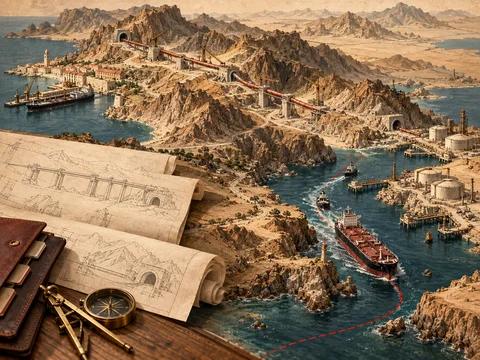
- The replacement is rehabilitation, not invention: the Kirkuk–Baniyas pipeline once moved 1.4 million barrels a day and the Trans-Arabian line ran from Dhahran to Sidon; the land corridor runs Gulf production through Iraq and Syria to the Lebanese coast, Cyprus, and the Greek tanker fleet.
- Land routes are vulnerable everywhere and the corridor has zero redundancy from Basra to Tripoli, but segment-by-segment transit fees align incentives for stability; the Sykes-Picot map gives way to smaller entities each extracting rent from its stretch.
- Markets price a cyclical risk premium where the shift is structural; the dislocations are marine insurance, Gulf real estate and sovereign credit, Eastern Mediterranean energy infrastructure, and Greek shipping, with the Brent–WTI spread, tanker spot rates and Suez transit volumes as the first signals.
- Position in three horizons: near term, long Greek tanker operators on Hormuz-avoiding routes, reinsurers and the Brent–Dubai spread; medium term, Cyprus EEZ, Greek LNG terminals and Levant reconstruction; long term, capital gravity shifts from the Gulf to Athens, Nicosia, Haifa and Beirut.
TRIGGER IRAN ACTIVATES HORMUZ LEVERAGE | FLOW SEA → LAND CORRIDOR SHIFT | RISK FIXED ROUTES; ZERO REDUNDANCY | PRICE INSURANCE + FREIGHT REPRICING | POSITION ATHENS / CYPRUS / EASTERN MED |
|---|
EXECUTIVE SUMMARY
The global energy architecture is undergoing a structural transition that most market participants are still pricing as a temporary disruption. It is not. The monetisation of Hormuz by Iran — grounded in two millennia of Persian strategic geography — is dismantling the maritime-first model that organised global energy flows since the fall of Beirut in the 1970s. What replaces it is not chaos. It is a reassertion of land-based corridors across Iraq, Syria, and Lebanon to the Eastern Mediterranean — a system that already existed in fragment, waiting for the economics to make it rational.
The endpoint of that system is Greece. Not as a passive recipient of redirected flows, but as the controlling node of the maritime layer that ultimately redistributes energy once it reaches the sea. Greek shipowners control the largest tanker fleet on earth. The Eastern Mediterranean is their home water. This is not coincidence. It is structural.
The fall of Beirut and the rise of Dubai are not separate stories. They are the same story told through different geographies. The question now is which geography wins the next fifty years.
This report applies the Buy Side Lens framework — Trigger, Flow, Risk, Price, Position — to construct the analytical architecture of this transition and identify where capital should be looking.
I. TRIGGER
THE PERSIAN LEVERAGE ACTIVATION
Persia's structural leverage over its neighbours is not a modern invention. It is the output of a geographic and institutional architecture that has persisted across 2,500 years of dynastic collapse, foreign conquest, and systemic reorganisation. From Cyrus II's Achaemenid unification around 550 BCE through the Safavid consolidation of Shia identity as state infrastructure in 1501, Iran has consistently reproduced one strategic fact: it controls the plateau that commands the chokepoints.
The Strait of Hormuz is the contemporary expression of that leverage. Through it flows approximately 20% of global oil and about 20% of global LNG trade. The Gulf states — Saudi Arabia, the UAE, Kuwait, Iraq — have no alternative seaborne export route of comparable capacity. Iran's export infrastructure at Kharg Island sits inside a layered defensive perimeter that makes interdiction asymmetrically costly for any attacker. The result: Iran cannot be economically isolated from Hormuz without destroying the infrastructure of its adversaries simultaneously.
The asymmetry is absolute. The Gulf depends on the route. Iran has the capacity to control it. Once that reality is visible, it is monetised.
The activation of this leverage is not a sudden geopolitical event. It is a graduated process: freedom of navigation is questioned, insurance markets respond, shipping reroutes incrementally, and within months the behavioural change becomes structural. The route is no longer free. It is priced. Access becomes conditional. The system has already begun this adjustment.
Historical parallel: The Sasanian dynasty (224–651 CE) controlled trade arteries between Rome and the East for four centuries not through perpetual war but through the credible threat of interdiction. The strategy is older than Islam, older than the caliphate, older than the nation-state system that the Gulf monarchies inhabit. Iran is executing the same playbook.
II. FLOW
THE RETURN OF LAND CORRIDORS
The maritime system did not always dominate. Before the Suez Canal, before containerisation, before U.S. naval hegemony secured the sea lanes, energy and goods moved across land. The Levantine corridor — Iraq to the Mediterranean through pipelines terminating at Baniyas, Tripoli, and Sidon — was not a nostalgic fantasy. It was the operating infrastructure of the region for decades.
That system did not fail because it was inefficient. It disappeared because the sea became cheaper. Containerisation from the 1960s compressed maritime freight costs by over 90%. U.S. naval security presence meant that piracy, interdiction, and chokepoint risk were effectively zeroed out. The economics made land routes irrational. That logic is now reversing.
The infrastructure exists in fragments. EIA reported a historical estimated capacity of about 700,000 barrels per day for the Kirkuk–Banias/Tripoli pipeline system, which it listed as non-operational. The Trans-Arabian Pipeline that once ran from Dhahran to Sidon carried Saudi crude across the Arabian desert to Lebanese ports. These are historical routes requiring engineering and commercial assessment. EIA describes substantial damage and rehabilitation needs; the relative cost of rehabilitation has not been established here.
This is not invention. It is rehabilitation. Once rehabilitation begins, the direction of flow becomes inevitable: energy moves toward Europe, crosses Iraq, crosses Syria, crosses Lebanon, reaches the Eastern Mediterranean, passes through Cyprus, and into Greece.
The corridor from the Gulf to the Eastern Mediterranean recreates the map that Lebanon's Maurice Gemayel proposed in 1970 before the Lebanese parliament — and that parliament rejected. He collapsed and died within hours in that chamber. The idea did not die with him. It merely waited for the economics to become irresistible.
Flow sequence: Persian Gulf production → Iraq transit (Basra/Kirkuk) → Syrian corridor → Mediterranean coast (Tripoli/Sidon in Lebanon; Baniyas in Syria) → Eastern Mediterranean → Cyprus redistribution node → Greek tanker fleet → European consumption.
III. RISK
THE STRUCTURAL FRAGILITY OF FIXED ROUTES
Sea routes are vulnerable at chokepoints. Land routes are vulnerable everywhere. This is the fundamental risk asymmetry of the corridor thesis, and it must be priced correctly before any position is constructed.
The Eastern Mediterranean land corridor has zero redundancy. From Basra to Tripoli, the route is fixed, visible, and exposed. A disruption anywhere — in the Iraqi marshlands, in the Syrian interior, in the Bekaa Valley — stops the entire system. There is no detour. There is no floating reroute equivalent to shifting tanker paths around the Cape of Good Hope. It either functions fully, or it does not function at all.
This fragility introduces a second-order dynamic that is actually stabilising in the long run: revenue monetisation of each corridor segment. Every kilometre becomes a revenue point. Iraq extracts a transit fee. Syria extracts a corridor fee. Lebanon extracts a port fee. Cyprus extracts a redistribution margin. The economic logic creates aligned incentives for stability. Sabotage destroys future income — for the saboteur as much as for the operator.
You do not eliminate risk. You price it. And when it is priced correctly, the system protects itself.
The political economy risk is the Sykes-Picot constraint. The existing map — centralised states imposed over ethnically and sectarian-fragmented societies — was designed for a different system. Lebanon is a product of that arrangement. Syria's territorial coherence is contested. Iraq's federal structure is perpetually negotiated. Continuous, secure corridors cannot be maintained by states whose internal authority is fragmented.
The resolution is not political reconciliation. It is the emergence of smaller, more coherent entities along sectarian and ethnic lines, each controlling a segment of the corridor and extracting rent from it. The old Sykes-Picot order does not collapse in a single dramatic rupture. It becomes irrelevant. The map adjusts to fit the system, not the other way around.
IV. PRICE
WHAT MARKETS ARE MISREADING
The market is pricing the Iran-Hormuz dynamic as a cyclical geopolitical risk premium — elevated during tension episodes, mean-reverting toward historical norms during negotiation windows. This is the wrong framework. What is being mispriced is the structural, non-mean-reverting shift in the geography of energy transit.
Four specific pricing dislocations are visible:
1. Marine insurance: P&I clubs and war risk underwriters are still pricing Hormuz passage with a cyclical volatility model. If the corridor shift is structural, current premiums understate the long-run expected loss.
2. Gulf real estate and sovereign credit: Dubai's emergence as a financial hub is contingent on the maritime system remaining dominant. If energy flows reroute to land, the case for Gulf-centric capital accumulation weakens at the margin.
3. Eastern Mediterranean energy infrastructure: Cyprus's EEZ hydrocarbon assets, Greek LNG import capacity, and Israeli pipeline proposals are priced as speculative optionality. If the corridor scenario materialises, they are core strategic assets.
4. Greek shipping: The sector is priced on tanker day-rate cyclicality. The structural argument is that Greek-owned fleets control the redistribution layer of any Eastern Mediterranean energy corridor — a position that commands a structural premium, not a cyclical multiple.
Greece is not just a geographic gateway. It is the dominant force in the mechanism that ultimately moves energy once it reaches the sea. Greek shipowners do not participate in the system. They are the system.
The Brent-WTI spread, tanker spot rates, and Suez Canal transit volumes will be the first observable signals of corridor shift. None of these require the corridors to be operational. The signal is visible at the level of behavioural change in routing decisions, even before a single pipeline is repaired.
V. POSITION
WHERE THE CAPITAL GRAVITY MOVES
The position thesis is not a single trade. It is a framework for reorienting capital allocation as the corridor transition proceeds through its phases. Three time horizons, three layers.
NEAR-TERM (0–18 MONTHS)
TANKER FREIGHT RATES | ELEVATED HORMUZ RISK PREMIUM SUSTAINS VLCC AND SUEZMAX RATES ON ROUTES AVOIDING THE STRAIT. LONG GREEK TANKER OPERATORS WITH ATLANTIC/MEDITERRANEAN EXPOSURE. |
|---|---|
Marine insurance | P&I and war risk specialists repricing Gulf-corridor exposure. Reinsurers with Eastern Med expansion. |
Brent spreads | Watch Brent-Dubai differential for structural widening as Hormuz-dependent grades carry rising risk premium. |
Iraqi fiscal position | Iraq's 95%+ oil export dependence through Basra/Hormuz makes it the most structurally vulnerable sovereign in the corridor shift scenario. |
MEDIUM-TERM (18 MONTHS – 5 YEARS)
CYPRUS EEZ | APHRODITE FIELD DEVELOPMENT AND REGIONAL LNG HUB THESIS GAIN STRATEGIC BACKING FROM CORRIDOR ECONOMICS. REGULATORY AND PIPELINE INFRASTRUCTURE PLAYS. |
|---|---|
Greek energy infrastructure | Alexandroupolis LNG terminal, TAP pipeline, Revithoussa terminal — all positioned at the European entry point of Eastern Med energy flows. |
Levant reconstruction | Lebanon, Syria corridor assets: port rehabilitation, pipeline rights-of-way, logistics infrastructure. High risk, early positioning window. |
Athens financial services | Capital follows energy. Athens as a regional financial hub for Eastern Mediterranean corridor economics — legal, banking, shipping finance. |
LONG-TERM (5+ YEARS)
The long-term position is a structural reallocation away from Gulf-centric financial architecture toward Eastern Mediterranean capital centres. This is not an event. It is a gravity shift. The city that services the corridor earns the fees. The port that receives the flows captures the value. The fleet that redistributes the product commands the margin. Athens, Nicosia, Haifa, Beirut (if stability returns) are the endpoints of that gravity.
The historical precedent is Beirut itself. From the 1950s through the early 1970s, Beirut accumulated regional wealth not because it was politically stable — it was not — but because it sat at the intersection of flows. The same structural logic reasserts itself wherever the new intersections form.
Capital does not move to stability. It moves to where flows intersect. And the flows are moving east to west, from the desert to the sea, from Hormuz to Athens.
VI. ANALYTICAL SYNTHESIS
The Iran-Hormuz-Eastern Mediterranean thesis is not a single-variable trade. It is the convergence of five structural forces that have been building independently and are now reinforcing each other:
1. Persian structural leverage: Two millennia of geographic and institutional persistence. Iran does not need to close Hormuz. It needs only to make closing it credible. That credibility is already established.
2. Gulf system fragility: The Dubai-centric maritime model is optimised for a world in which Hormuz is a neutral corridor. The moment it becomes a controlled chokepoint, the entire system reprices.
3. Land corridor rehabilitation economics: The infrastructure exists in fragments. Rehabilitation costs are a fraction of new-build. The economics become rational before politics fully align.
4. Sykes-Picot dissolution: The map is already changing. The corridor does not create this change. It accelerates and monetises it.
5. Greek structural position: Greek shipowners controlling the global tanker fleet is the missing piece that completes the system. Without the maritime redistribution layer, the land corridor terminates at the coast. With it, Europe becomes the consumption endpoint of the entire architecture.
The Buy Side Lens framework identifies a structural regime change in global energy transit that is priced as a cyclical risk event. The analytical edge is in recognising the difference. The position edge is in acting before the repricing is complete.