Original Lens and publication context
In one day, Iran hit three tankers, Washington cancelled Iran's oil permit, and American jets launched the biggest strikes of this war. The ceasefire is finished in everything but name. Here is what happened, and what it means for your money.
- The US bombed Iran overnight with a strike package four to five times bigger than the one in late June. The trigger: Iranian missiles and drones hit three tankers in the Strait of Hormuz on Tuesday.
- Hours before the bombs fell, the US Treasury cancelled the permit that let Iran sell its oil. That permit was the main reason Iran agreed to talk in the first place. Both halves of the peace deal are now dead in practice.
- The UK's maritime watchdog logged three separate tanker attacks in one day, and the Joint Maritime Information Center raised its threat level for the region to Severe — its highest reading.
- Ship traffic through the strait has crashed from about 60 crossings a day to just 13. Owners are either waiting it out or sailing with their trackers switched off.
- What to do: stay overweight energy, own oil futures further out on the curve rather than spot, and keep some volatility protection. Oil at $76 is still cheap for a waterway that is being shot at.
TRIGGER
Three Tankers, One Cancelled Permit, One Strike Package
Just after midnight Tehran time on 08 July, US Central Command announced fresh strikes on Iran. A US official described the operation as four to five times larger than the strikes ten days earlier, and said it would run for hours. The reason was Tuesday's attacks at sea. Iranian missiles and drones hit three commercial ships in the Strait of Hormuz: a fully loaded Qatari gas tanker, a Saudi crude tanker, and a third vessel struck by a drone. Some trackers believe as many as five ships were hit. The US military called it a clear violation of the ceasefire and said the strikes were the price Iran would pay for shooting at civilian ships.
Supplied archive exhibit · original publication context.
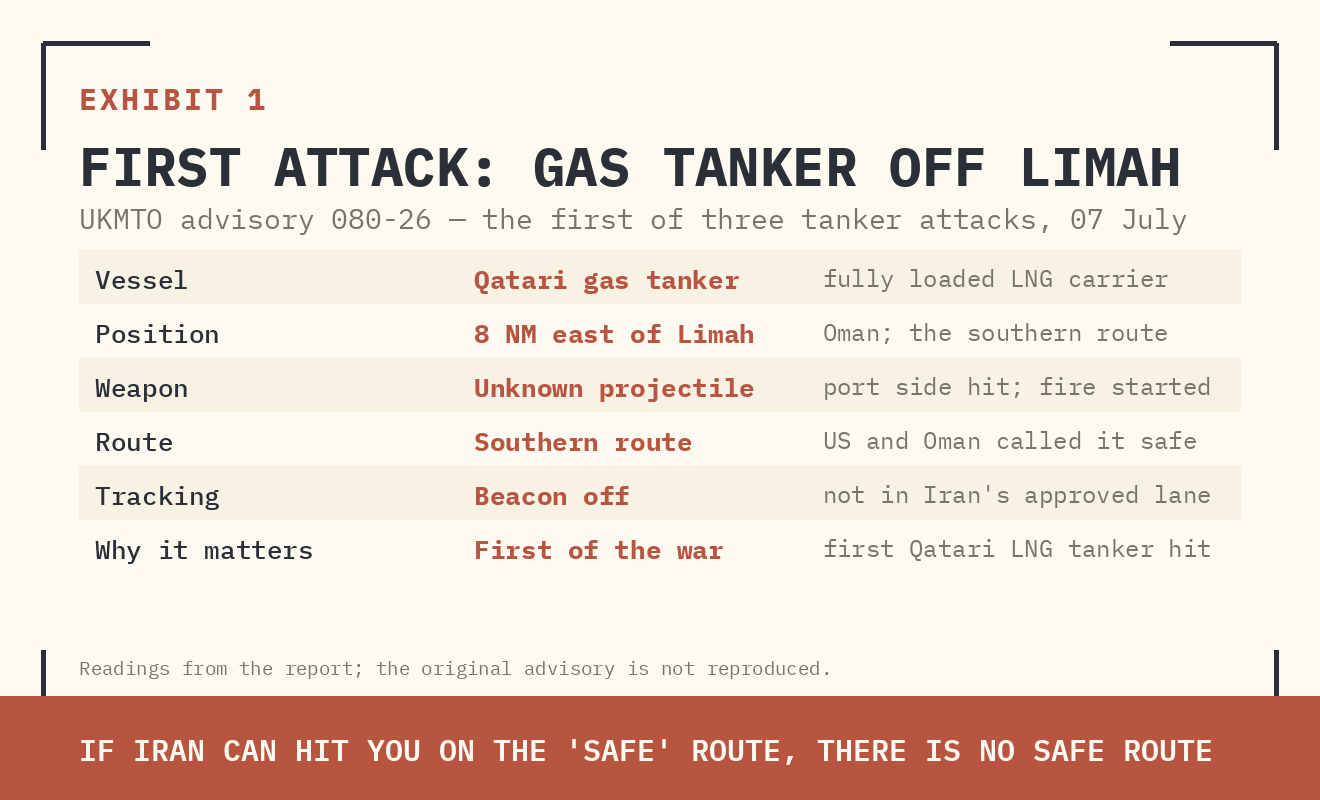
The first attack: a gas tanker hit 8 nautical miles east of Limah, Oman. An unknown projectile struck the ship's port side and started a fire. The location matters. This vessel was sailing the southern route that the US and Oman had told shipowners was safe.
Supplied archive exhibit · original publication context.
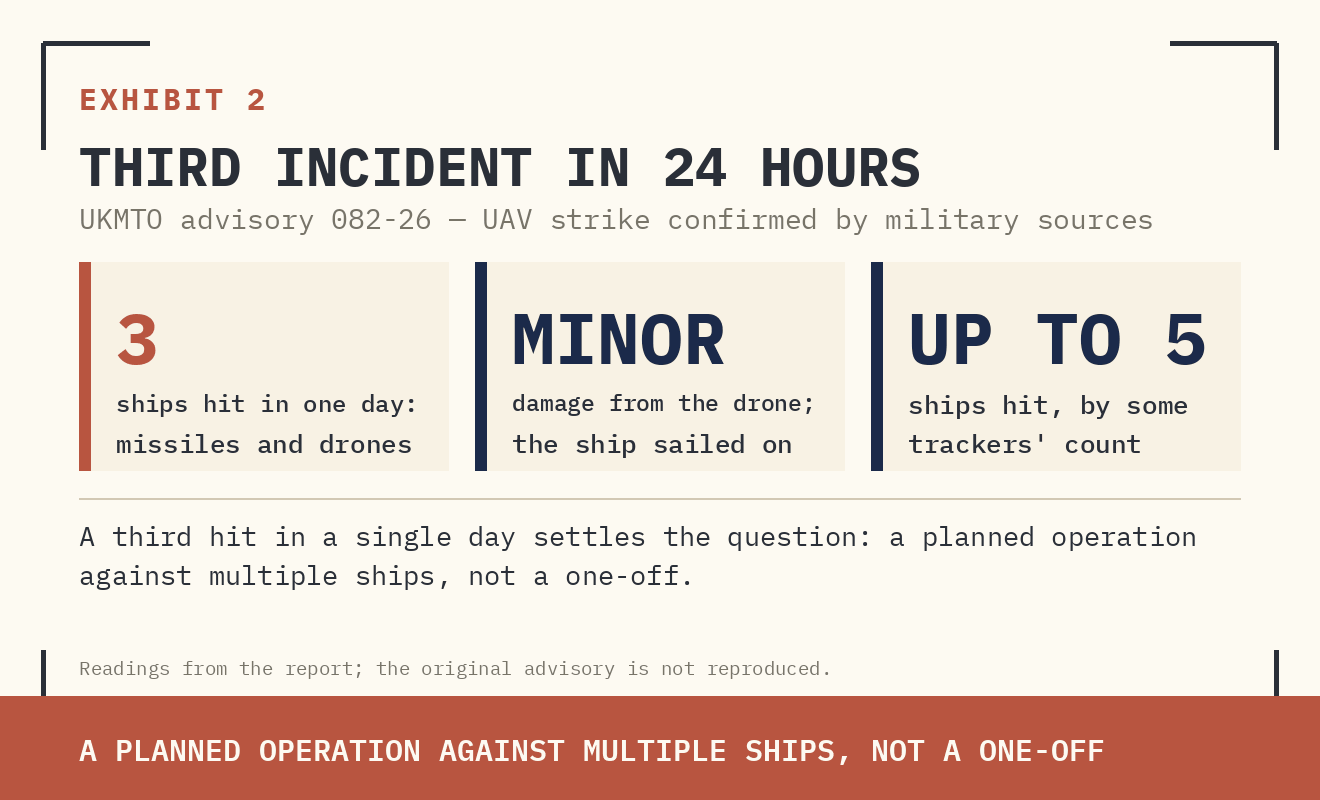
The third attack in 24 hours: a drone strike, confirmed by military sources. The damage was minor and the ship sailed on. But a third hit in a single day settles the question — this was a planned operation against multiple ships, not a one-off.
Supplied archive exhibit · original publication context.
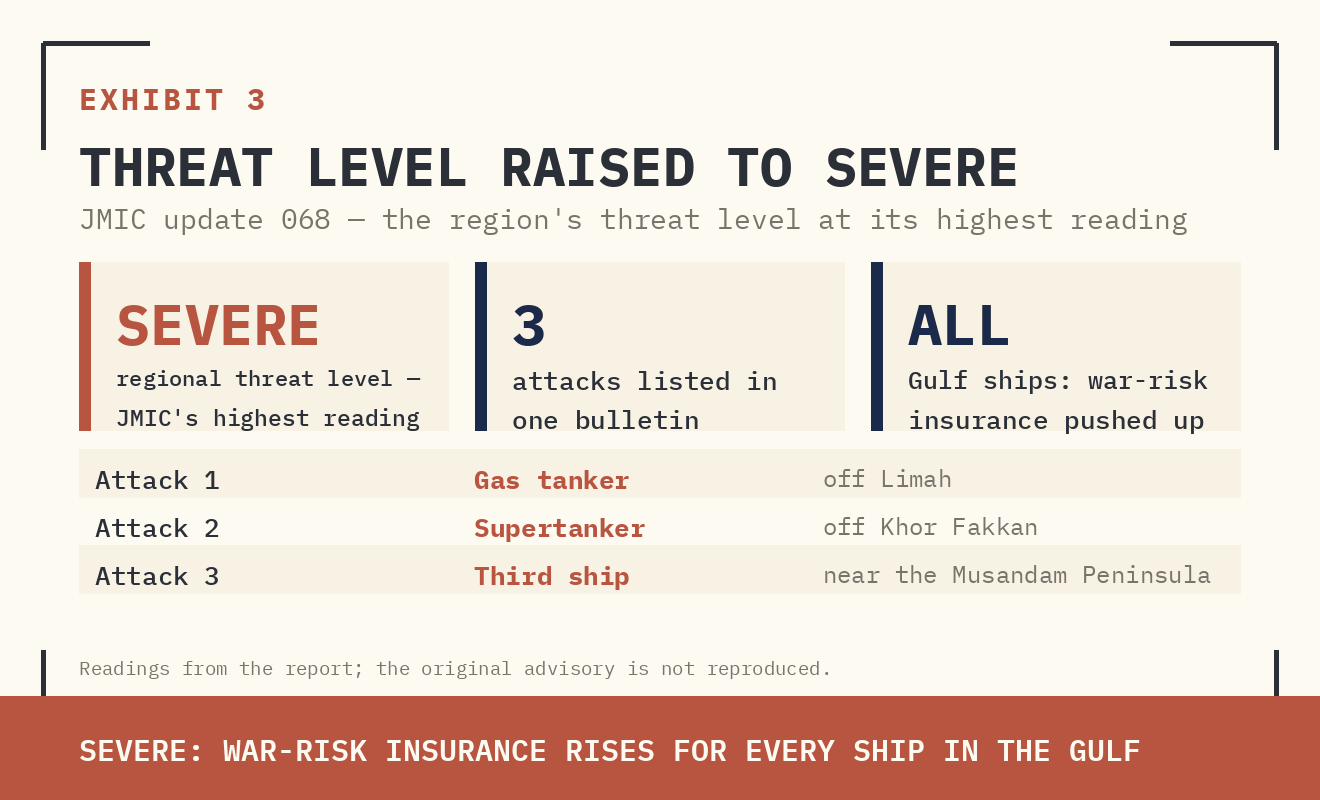
The official maritime threat level for the region is now SEVERE. This bulletin lists all three attacks: the gas tanker off Limah, a supertanker off Khor Fakkan, and a third ship near the Musandam Peninsula. A Severe rating is what pushes up war-risk insurance for every ship in the Gulf.
The strikes were only half the story. Hours earlier, Washington had already pulled the economic heart out of the peace deal. The Treasury cancelled the 21 June permit that allowed Iran to sell oil openly, giving buyers only until 17 July to finish deals already signed. That permit was the main prize Iran got for coming to the table. Brent jumped about five percent toward $76 a barrel on the news. So in one day, both sides of the bargain collapsed: Iran can no longer sell its oil, and ships can no longer count on safe passage.
The timing inside Iran makes this more dangerous, not less. These are the first American strikes since the funeral of Ayatollah Ali Khamenei began, and his son Mojtaba has only just taken over as Supreme Leader. President Pezeshkian cut short the funeral rites in Iraq and flew home as the bombs fell. Iranian TV reported explosions on Qeshm Island and near Sirik Port, the two places from which Iran physically controls the strait. Iranian media also claimed missiles and drones were fired at US Navy ships in the Sea of Oman, though no one else has confirmed that yet. Meanwhile Israeli jets struck southern Lebanon the same night, hinting at a possible second front.
Iran's oil money and the world's safe passage both died on the same night. The ceasefire still exists on paper. Nowhere else.
FLOW
What the Ships and the Prices Are Telling Us
The water tells the truth faster than the screens do. Ship traffic through the strait fell all through Tuesday, and even that number flatters reality, because more and more ships are switching off their tracking beacons before crossing. Less visible traffic, and less trust. One loaded Qatari gas carrier made a U-turn before the strait and started circling. The tanker that got hit had its beacon off and was outside the lane Iran approves of. Iran had warned over the weekend that it would shoot at ships using the American-backed route along the Omani coast. On Tuesday it did exactly that. The lesson for shipowners is simple: if Iran can still hit you on the 'safe' route, there is no safe route.
Supplied archive exhibit · original publication context.
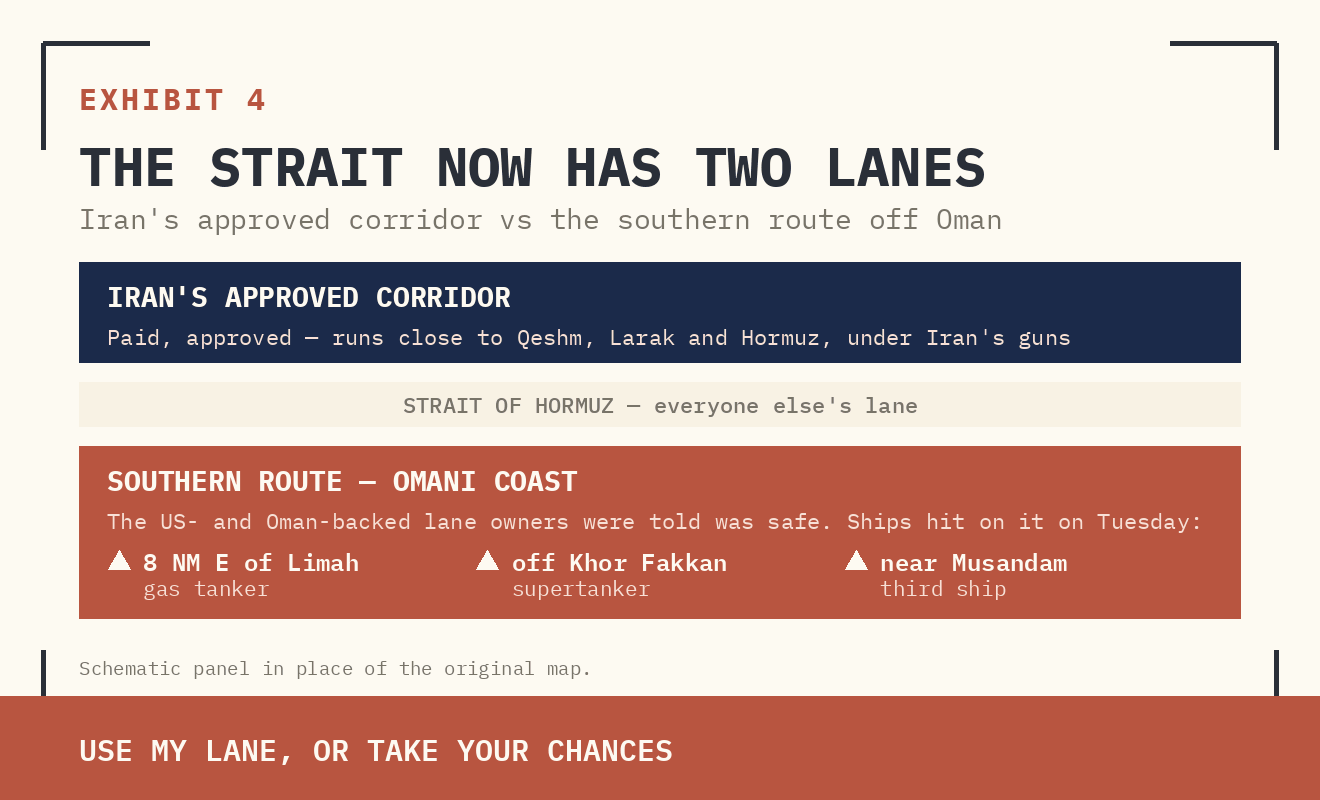
The strait now has two lanes: Iran's approved corridor, and everyone else's. Iran's paid, approved corridor runs close to its own islands — Qeshm, Larak, Hormuz — under its guns. The warning triangles mark where ships were hit on the alternative route near Oman. The attacks are Iran drawing the map: use my lane, or take your chances.
Supplied archive exhibit · original publication context.
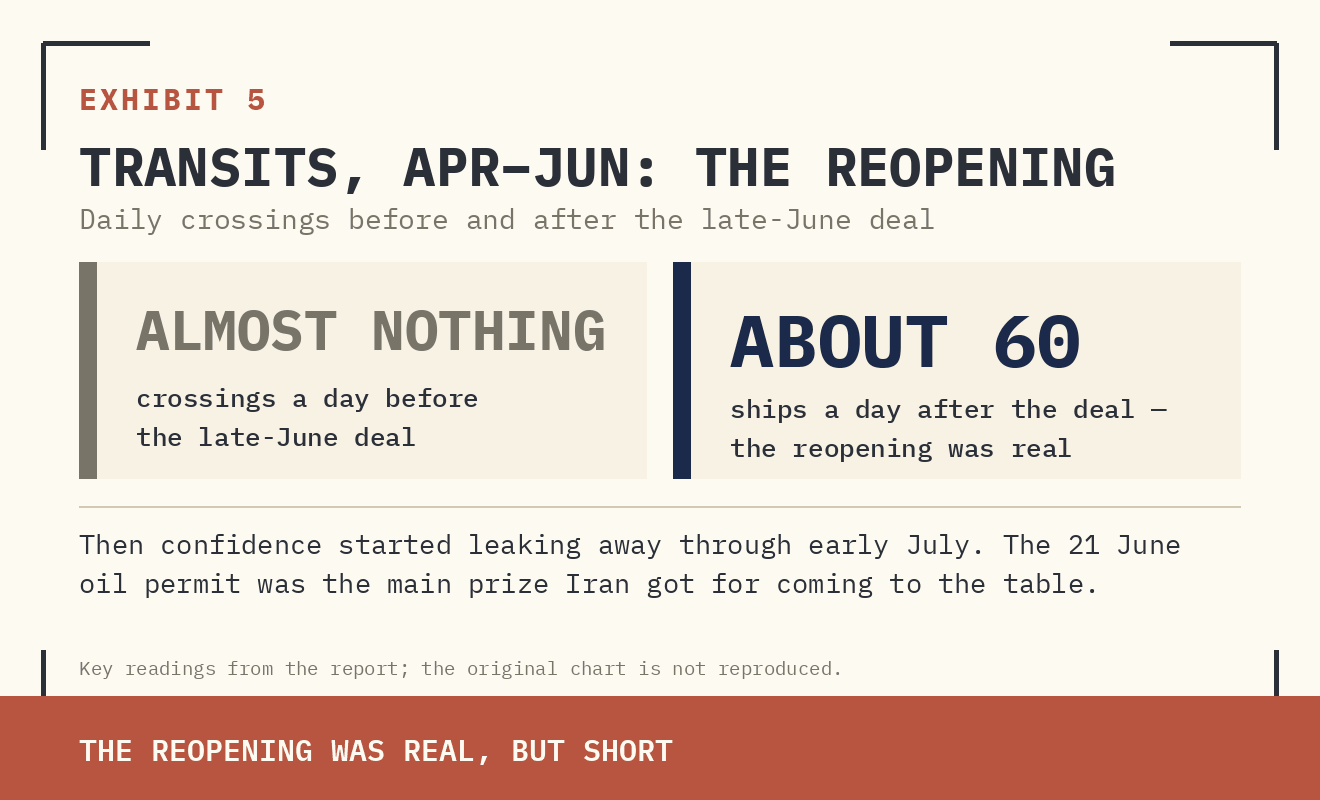
The reopening after the peace deal was real, but short. After the late-June deal, crossings jumped from almost nothing to about 60 ships a day. Then confidence started leaking away through early July. Keep that 60 in mind when you read the next chart.
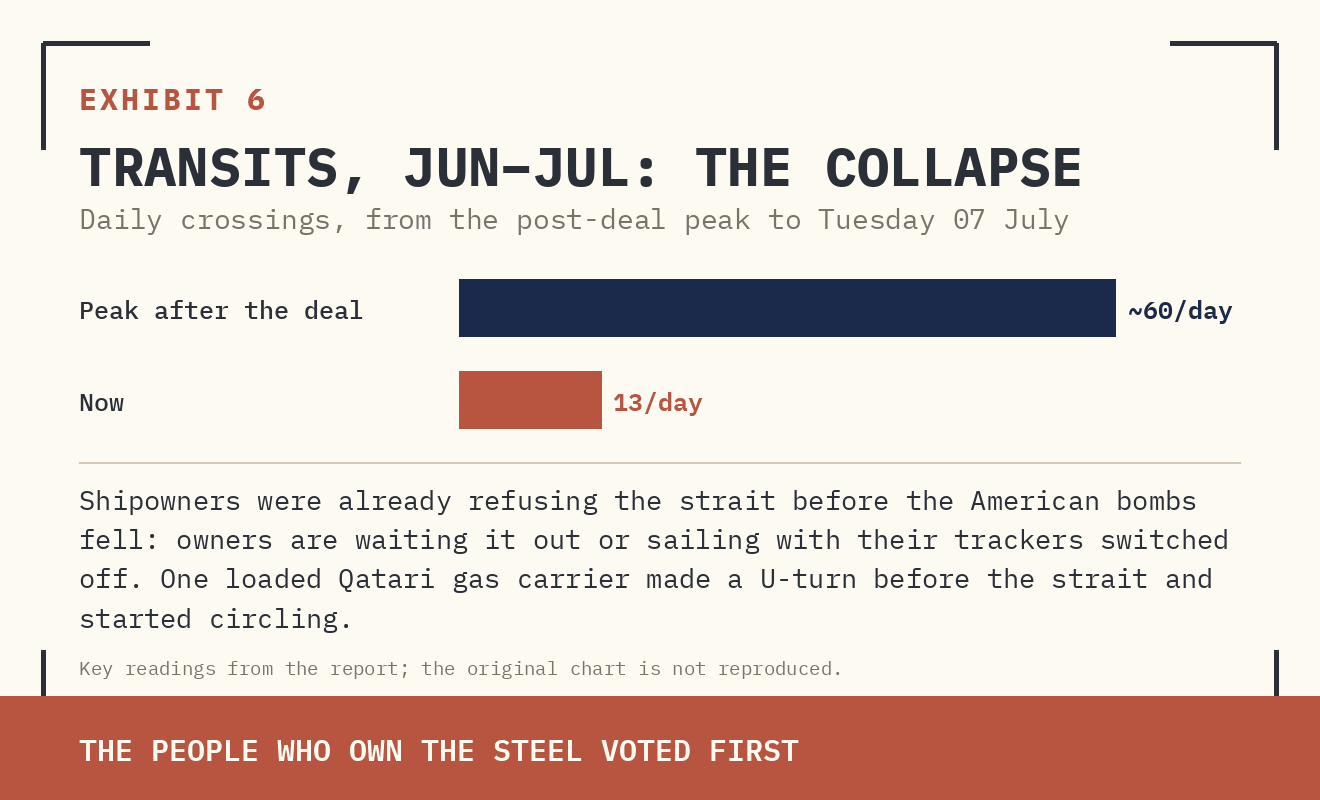
Supplied archive exhibit · original publication context.
Down to 13 crossings a day. From a peak near 60 to just 13. Shipowners were already refusing the strait before the American bombs fell. The people who own the steel voted first.
Prices did what you would expect. Brent pushed from about $73 to nearly $76 after the permit was cancelled. European gas jumped as much as six percent, because this was the first Qatari gas tanker hit in the whole war, and Qatari gas was the one flow everyone assumed was safe. France trimmed its growth forecast and blamed the conflict. The odd one out was gold, which fell again, below $4,120. Gold is supposed to love a crisis. It is not loving this one, and that tells you something about what is really driving markets right now: interest rates, not fear.
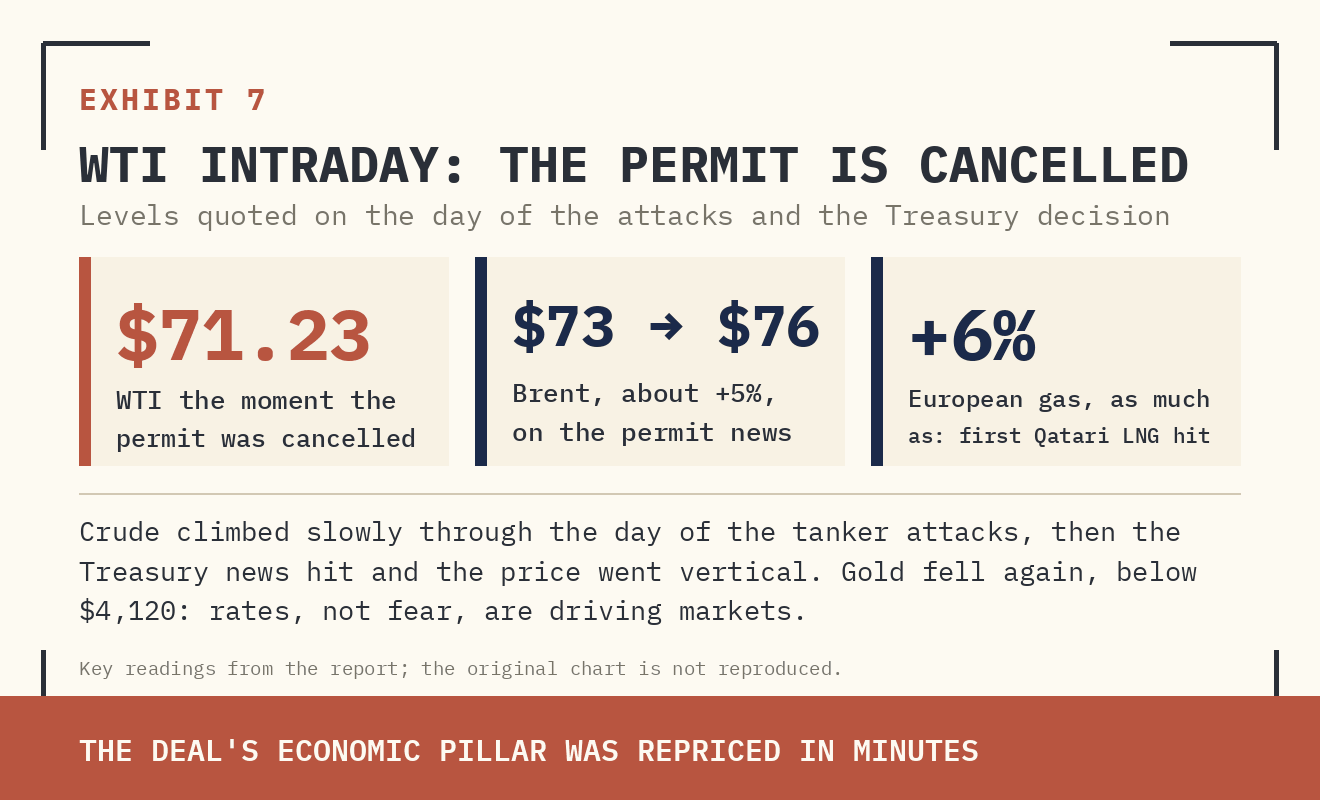
Supplied archive exhibit · original publication context.
WTI jumped to $71.23 the moment the permit was cancelled. Crude had climbed slowly through the day of the tanker attacks. Then the Treasury news hit and the price went vertical. The market repriced the death of the deal's economic pillar in minutes.
Two details show how deliberate Iran is being. First, on the same day it was firing at tankers, Iran was loading its own tankers at Kharg Island. It attacked the strait and used the strait in the same session. Second, Iran has its own problem: the oil it was finally allowed to sell has struggled to find buyers within the deal's 60-day window. Indian state refiners were still only talking, waiting to see if the permit would be extended. Iran's real leverage was never the oil. It was always the strait. Now that the permit is gone, the strait is the only card Iran holds, and that argues for more attacks on ships, not fewer.
Iran shot at tankers and loaded its own tankers on the same day. That is not chaos. That is bargaining, done with missiles.
RISK
Figure 01 · Conceptual framework
How a maritime shock reaches a market price
How This Gets Worse, and How It Gets Better
The ways this escalates are easy to list. American warships are standing by to restart the blockade of Iranian ports. British and French plans to clear mines from the strait are now in doubt. Iranian TV is claiming the US hit civilian areas; if that sticks, it becomes politically impossible for Tehran to back down. And the new Supreme Leader is weeks into the job. A young leadership cannot afford to look weak, which makes climbing down harder. The single most dangerous headline would be a confirmed Iranian hit on a US Navy ship. That would turn a controlled exchange into open war, with Lebanon possibly opening as a second front at the same time.
But do not ignore the path down. Both sides still want the deal. Iran wants money, America wants oil flowing, and neither is getting what it wants right now, which is exactly why the deal keeps breaking and exactly why both keep coming back to it. Qatar has brokered a restart once already and says talks will resume. If a follow-on deal restores the oil permit and safe passage within a few weeks, the fear premium drains out of oil and the energy trade gives back its gains. That is the honest risk to this report's positioning, and it is a real one.
PRICE
Oil Is Still Not Priced for What Is Actually Happening
Step back and look at the numbers. Oil near $76 is barely above where it stood before this war began, and well below its wartime peak. Against that price you have: the world's most important oil chokepoint under a Severe threat rating, Iran's oil permit cancelled, the biggest US strike package of the war underway, and ship traffic at a fraction of normal. The fear premium in today's oil price is small compared with the facts on the water. Oil contracts dated further out, which carry about a $5 premium over their pre-war level, are telling the more honest story, and that premium has room to grow. Gas is the sharpest expression of all, because the one cargo everyone treated as untouchable, Qatari LNG, just got touched.
The spot oil price believed the ceasefire. The futures market believed Iran. Overnight, the futures market was proven right.
POSITION
What to Own, in Plain Terms
Stay overweight energy. Energy stocks were already the best-performing sector on the first tanker headlines, before the bombs and before the permit was cancelled. The sector gets paid twice: once from the immediate jump in prices, and again from the longer-lasting premium in the futures curve.
Prefer oil futures dated months out over spot exposure. That further-out premium is the market's honest measure of unresolved risk. If things escalate, it widens. And even if a deal is patched together, shipowners will return to the strait slowly. Confidence at sea is rebuilt in months, not in press conferences.
Keep volatility protection. This is a binary week: a strike campaign in progress, unconfirmed claims of attacks on US warships, and a NATO summit in Ankara with Iran at the top of the agenda. Markets priced for calm plus a week like this is the classic setup where insurance is worth more than a directional bet.
Skip gold. It sounds like the obvious crisis hedge, but gold has been falling all year because real interest rates are rising, and this crisis pushes rates up, not down. The hedge that fits this moment is energy and volatility, not bullion.