Original Lens and publication context
A viral thread says that handing Iran the Strait of Hormuz would kill the dollar. Five months of a contested strait have already run that experiment. This note explains, from first principles, what the market actually answered — and where the bill is really being paid.
- A widely shared post argues that if the United States lets Iran control the Strait of Hormuz, the dollar loses its status as the world’s reserve currency — and the underlying source, a former Goldman Sachs commodities head, is a serious market voice rather than a fringe one.
- The scenario is no longer hypothetical: Oman has formally proposed a regional mechanism that would let Iran collect transit fees on the strait, Gulf states have reportedly supported it, and Tehran has rejected it only for being insufficient.
- Five months of a contested strait have delivered the opposite of the predicted currency outcome — the dollar index sits near a thirteen-month high around 101.5, while Brent trades near $88 against the $150 that was warned about.
- Reserve-currency status rests on market depth, the absence of a credible substitute, and invoicing habit; a navy protects the flow of goods through a waterway, not the stock of assets the world chooses to save in.
- The cost of a lost chokepoint is therefore showing up in the price level and the discount rate rather than the exchange rate, which is why we retain refining margin over crude flat price, the front end of the curve over duration, and bullion sized as insurance.
Where this started
A post on X, viewed more than a hundred thousand times, asks a blunt question. Does anyone seriously believe the war is over, and that the United States would simply hand the Strait of Hormuz to Iran? It stacks up two supporting exhibits. Larry Fink of BlackRock warning that if Iran remains a threat to the strait after the fighting stops, the world could face years of oil above $100 and closer to $150, with what he called a probably stark and steep recession. And Jamie Dimon of JPMorgan saying that getting this finished successfully matters more than what the stock market does in the short run.
Behind the thread sits a longer argument from the former head of commodities research at Goldman Sachs. His line is the sharpest of the three: give Iran the strait, and the dollar dies. Not weakens. Dies.
That is a large claim, and it deserves a proper test rather than a retweet. It is also, unusually, a testable one — because the world has spent the last five months living inside a version of the scenario. This note takes the claim apart, keeps what survives, and prices what is left.
What has actually happened, in order
It helps to lay the sequence out flatly, because the timeline is what makes the claim testable.
- 28 February 2026. The United States and Israel launched surprise airstrikes on Iran. Iran’s Supreme Leader was killed. Iran retaliated against Israel, US bases and Gulf states, and shipping through Hormuz was effectively blocked.
- March. A US air campaign began on 19 March specifically to reopen the waterway. Crude spiked; the intraday high for the year was set on 9 March.
- 8 April. A ceasefire framework was announced and Washington declared the strait open again. This is the date of the viral post — written at the moment of maximum official optimism.
- 13 April. Talks failed and the United States imposed a naval blockade on Iranian ports.
- June. A memorandum of understanding was signed that was meant to end the war and reopen the strait.
- July. Iran resumed threatening and attacking vessels, seeking to impose its own routes, protocols and transit fees. Ships were attacked on 6–7 July, the President declared the truce over on 7 July, and the blockade restarted on 14 July. Strikes were suspended again late on Friday 24 July.
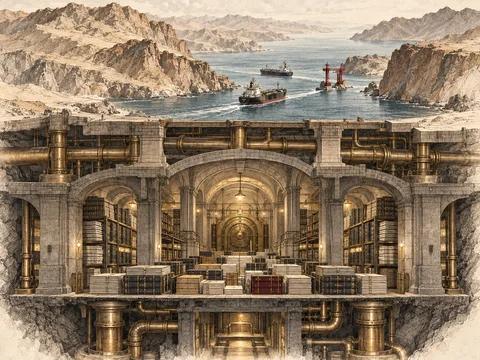
The important detail for our purposes is not the fighting. It is that Iran created a body — a Persian Gulf Strait Authority — to define a supervision area and administer passage, and that Oman has now formally proposed a regional mechanism under which Iran would collect transit fees. Gulf states have reportedly been receptive. Tehran has rejected the proposal, but only because it wants more: full control of the inbound lane and part of the outbound.
The bargain the whole argument rests on
The case begins with a deal struck in 1945 and it is worth restating in ordinary language, because most people have never had it explained to them properly.
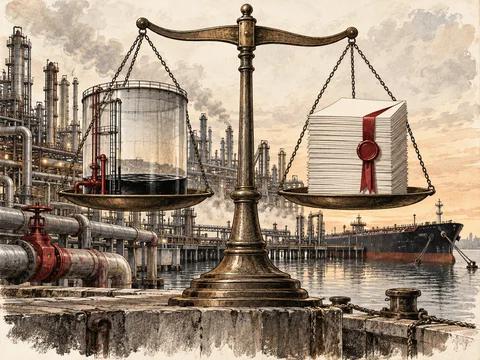
The United States told the rest of the world, in effect: we will use our navy to keep every important shipping lane open, for everyone, including our competitors. In exchange, you will trade in our currency and park your savings in our financial system. Oil was the commodity that made the arrangement bind, because oil is the one thing every economy must import or else stop. When Nixon severed the dollar’s link to gold in 1971, the same bargain simply changed clothes and became what people now call the petrodollar system.
The prize for America is what a French finance minister once called the exorbitant privilege. Because everyone needs dollars, America can borrow more cheaply and consume more than it produces without the usual punishment. The argument makes the point concretely: the United States currently spends around seven per cent more than it produces. Remove the world’s forced demand for dollars, and that gap stops being a privilege and becomes a bill.
From there the chain is short. If Washington walks away and lets Iran and Oman administer the strait under any fee structure, the world concludes that the protector has quit. Every other chokepoint on earth becomes negotiable. The US Fifth Fleet would need Iranian permission to leave its own base in Bahrain. And the historical clincher: no previous hegemon — not Britain, not Spain — was pushed out of the world’s most important sea lanes and stayed the hegemon. You can retreat to defending the Western Hemisphere, or you can keep the reserve currency. Not both.
What we are throwing away, and why
The thread that carried this argument to a hundred thousand people wraps it in a different story. It attributes the war to what it calls the Epstein class, an unnamed financial elite that supposedly wants the fighting to continue, and it reads Dimon’s and Fink’s comments as instructions from that class rather than as opinions from two men whose institutions lose money in a recession.
We discard that layer entirely, and it is worth being explicit about the reason, because it is a discipline rather than a political preference. An actor who is invisible, unaccountable and capable of causing any outcome explains every event equally well and therefore forecasts none of them. If the war escalates, the cabal wanted it. If it de-escalates, the cabal wanted that too. A model that cannot be wrong cannot be traded.
Strip the story away and something useful survives: a mechanical claim about naval control, oil invoicing and reserve status, made by a man who spent decades inside the commodity market. That claim can be checked against prices. So we check it.
The experiment has already been running
Here is what makes this situation analytically valuable. We do not have to imagine what happens if the United States loses effective control of Hormuz. Since 28 February, traffic through the strait has been blocked, contested or conditional. Iran has stood up its own administering authority. Iran has told counterparties that passage depends on political alignment and, in some reporting, on settling oil in Chinese yuan rather than dollars. A regional fee mechanism is being negotiated in which Tehran collects the money.
That is not the full reserve-currency scenario, but it is a large and sustained instalment of it. So what did markets do?
Reading 1 · The dollar
The dollar index closed 28 July near 101.5. It touched roughly 101.8 in late June, a thirteen-month high. It is up about three per cent so far this year and up between two and three per cent over twelve months. Whatever else the last five months have done, they have not produced a run on the dollar. If anything, each escalation produced a bid for it.
Reading 2 · Oil
Brent traded near $87.5 on 28 July, after a session low in the mid-$84s. The peak of the crisis was far higher — the yearly intraday high was set on 9 March, with WTI printing near $119 — and the twelve-month range for Brent runs from roughly $59 to $126. But five months into a contested strait, crude sits well under the $150 that was flagged as the recession trigger, and roughly eighteen per cent above where it was a month ago rather than double.
Figure 01 · Qualitative comparison
Two clocks of geopolitical risk
| Channel | Near-term evidence | Longer-term evidence |
|---|---|---|
| Trade routes | Cargo delivered, freight and insurance | Alternative ports, pipelines and security arrangements |
| Currency prices | Dollar funding and safe-haven demand | Not sufficient alone to measure reserve status |
| Reserve currency use | Liquidity and collateral demand | Reserve shares, invoicing and settlement infrastructure |
Reading 3 · Gold
Gold trades around $4,030 an ounce, having eased about a per cent on a firmer dollar ahead of the Federal Reserve meeting. That is a historically extraordinary level and it is the one instrument that does support part of the bearish case. But note what it is telling you: gold is high alongside a strong dollar, which is a hedge against policy and inflation, not a vote against the dollar as a unit of account.
Reading 4 · The place the pain actually went
This is the reading that matters most, and it is the one the viral thread misses entirely. American consumer inflation ran at 4.2 per cent in the May print, its highest since April 2023, driven substantially by a 3.9 per cent monthly jump in energy. The Federal Reserve is holding at 3.50–3.75 per cent and the market is pricing a meaningful probability of a rate rise in September — the discussion is about hiking, not cutting, in the middle of a war.
Read those two facts together. The chokepoint crisis did not devalue the dollar. It raised the price level, and it forced the central bank to keep money expensive to contain the consequences. The bill arrived — it simply arrived in the inflation data and the discount rate rather than in the exchange rate.
Why the dollar did not break
The thesis is right that the navy is part of the bargain. Its error is treating it as the whole of it. Reserve-currency status stands on three legs, and the fleet is only one of them.
- Depth. The world does not save in dollars because of aircraft carriers. It saves in dollars because the US Treasury market is the only place on earth deep enough to absorb trillions of foreign savings at any hour without moving the price. No navy created that, and no naval retreat removes it.
- The absence of a substitute. The dollar accounted for around 57 per cent of global central bank reserves last year. The euro was near 20 per cent, the yuan around 2 per cent. Only 3.7 per cent of cross-border trade was settled in yuan in 2024, up from under 1 per cent in 2012. That is real growth off a base so small it cannot yet absorb the flows involved. Money leaves a currency for another currency, not into thin air.
- Invoicing habit. Roughly 80 per cent of oil transactions are still settled in dollars. Contracts, credit lines, hedges and clearing systems are all denominated in that habit. Habits of that size change over decades of small decisions, not in a quarter.
Two clocks, not one wrong answer
It would be lazy to declare the thesis simply wrong, and we do not. The honest reconciliation is that the thesis and the tape are running on different clocks.
On the short clock — days to quarters — a geopolitical shock is a safe-haven event. Money runs toward the deepest, most liquid market it can find, which is the United States. The dollar rises precisely because the crisis is frightening. That is what we have watched since February and it tells you almost nothing about the structural question.
On the long clock — years to decades — erosion of reserve status is measured in reserve share, invoicing share and settlement plumbing, not in a currency chart. The dollar’s share of reserves has in fact been drifting down for years. What the thesis describes is a plausible acceleration mechanism for that slow drift, not a switch that flips.
The practical consequence is that anyone who traded the reserve-currency thesis directly — by shorting the dollar into the Hormuz crisis — has lost money while being intellectually defensible. That is the most expensive kind of correct there is, and avoiding it is most of what risk management means.
What would change our mind
A view without a falsification test is an opinion. These are the specific things we watch, in rough order of importance.
- Gulf invoicing. The de-dollarisation trigger is Saudi Arabia and the United Arab Emirates, not Iran. Iran has been outside the dollar system for years and its choices carry little information. If a Gulf producer begins invoicing a material share of crude in yuan, that is the signal.
- A fee regime with a non-dollar unit of account. If the Omani mechanism is agreed and transit fees are denominated in something other than dollars, the plumbing changes even if the volumes are trivial at first. Watch the unit of account, not the amount.
- Reserve share below the halfway mark. Dollar holdings falling under 50 per cent of allocated global reserves would mark a genuine regime change rather than a drift.
- The confidence signature. The unmistakable tell of a country losing reserve status is bond yields rising and the currency falling at the same time. Today yields are firm and the dollar is firm, which is a tightening story. If those two ever decouple in that direction, the thesis changes immediately.
- Bahrain. If the Fifth Fleet’s freedom of movement from its own base becomes conditional in practice rather than in rhetoric, the symbolic content the thesis describes becomes real, and we would expect the allied-currency and defence complex to reprice before the dollar does.
Positioning
We express this at sector and factor level only. The conclusion is a reaffirmation of the substitution framework we set out last week rather than a new departure — but the reasoning underneath it has now been tested by five months of live data rather than assumed.
- Own the cost of insecurity, not the collapse of the dollar. The tradeable consequence of a contested chokepoint is scarcity and re-routing, which lands in refining margin, product cracks, tanker rates and marine insurance far more reliably than in crude flat price. Crude carries the political headline risk; the margin captures the physical dislocation.
- Curve over duration. The risk being generated is inflationary and term-premium driven, not a growth shock. With inflation above four per cent and the market pricing hike risk, we prefer the front end and steepener expressions to lengthening duration.
- Bullion as insurance, sized as insurance. Gold near $4,030 is doing its job as a hedge against policy error and inflation persistence. It is not a de-dollarisation position and should not be sized as one.
- Avoid the dollar short as a geopolitical expression. The safe-haven bid dominates on any horizon short enough to matter for a portfolio. The structural argument does not pay on a tactical clock.
- Treat maritime security as structural. Escort, mine countermeasure, drone and naval logistics capability is being consumed at a rate that implies replacement demand regardless of how the current negotiation ends. That is a multi-year budget story rather than a headline trade.
The bottom line
The viral post is right that Hormuz is a genuine red line and right that the people running the largest pools of capital in the world are treating it as one. It is wrong about the mechanism and wrong about the timing.
America can lose the strait and still keep the dollar, because the dollar is held for the depth of American capital markets and the absence of anything better, not for the presence of American destroyers. What America cannot do is lose the strait for free. The price of insecurity is not a currency collapse. It is a permanently higher cost of energy, a permanently higher cost of moving goods, a central bank that cannot ease when it wants to, and an interest rate structure that resets upward across the whole economy.
That is the bill. It is being paid right now, in the inflation print and in the front end of the curve. Investors looking for it in the exchange rate are looking in the wrong place.