Original Lens and publication context
How Morocco Engineered a Football Superpower — the Overperformance Evidence, the Economics of the 2026 Run, Africa's Investment Wave, and the Playbook India Can Adapt for 2036
- Morocco's 3–0 Round-of-16 dismantling of co-host Canada on 4 July made it the first African nation to reach the World Cup quarterfinals twice — the payoff of an eighteen-year, state-directed football industrialisation programme, not a run of luck.
- The engine is institutional: the 2008 Skhirat sports conference, the Mohammed VI Academy (2009, ~€13m), the €60m Mohammed VI Complex (2019), a federation-mandated club academy system, diaspora recruitment, and continuous leadership under Fouzi Lekjaa lifted Morocco from 95th in the FIFA rankings in 2010 to 6th in 2026.
- The Overperformance Potential Score confirms the pattern quantitatively: Senegal (0.7) and Morocco (0.7) top Africa because football capital and institutional capital — not GDP — are the binding constraints on World Cup overperformance.
- The economics compound off the pitch: a $4bn drive to add 25,000 hotel rooms before co-hosting 2030, ~20m tourists and $14.8bn receipts in 2025, tourism at 9% of GDP — but the 2025 Gen-Z protests over World Cup spending show the social licence is priced, not free.
- For India's 2036 Olympic ambition, the transferable playbook is a decade of institutional continuity, one anchor residential academy model replicated regionally, coach-pipeline funding, diaspora capture, and capital-stack sport selection — Khelo India Mission (Budget 2026–27) is the vehicle; Morocco is the template.
I. Houston, 4 July: The Scoreline That Was Not an Upset
Azzedine Ounahi scored twice and Soufiane Rahimi added a stoppage-time third as Morocco beat World Cup co-host Canada 3–0 in Houston in the Round of 16 on 4 July, sending the Atlas Lions into the quarterfinals for the second consecutive tournament — the first African nation ever to reach the last eight more than once. Morocco next meets France in Foxborough on Thursday. The result ended Canada's best-ever run and followed Morocco's penalty-shootout elimination of the Netherlands in the previous round, which handed the Dutch their earliest World Cup exit.
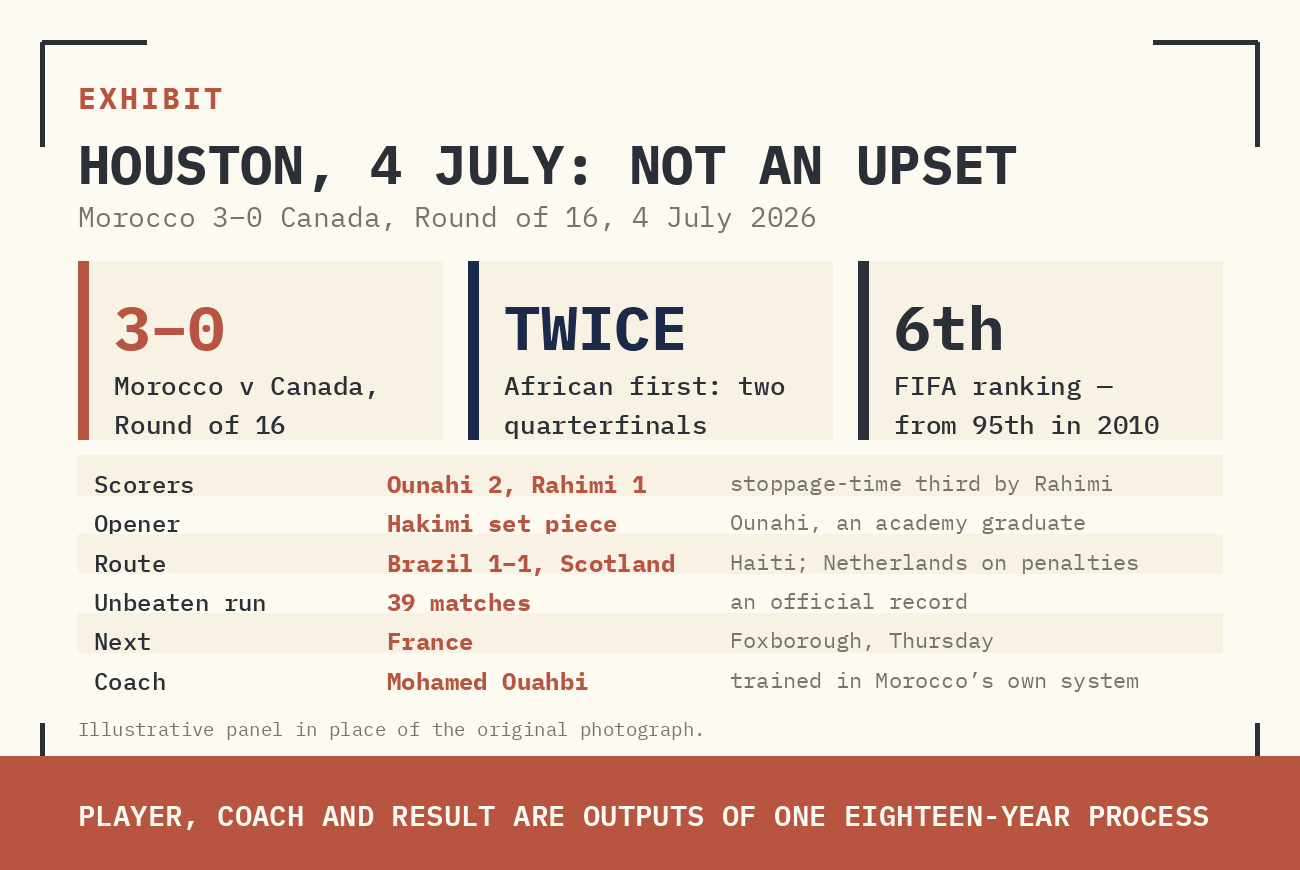
Supplied archive exhibit · original labels. Read alongside the editorial corrections.
Houston, 4 July 2026. Morocco's players salute a wall of red after the 3–0 Round-of-16 win over co-host Canada. The travelling support is itself a programme asset: a global Moroccan diaspora that fills stadiums on three continents, converts every fixture into a home game, and doubles as the recruitment pool examined in Section II. Within minutes of this whistle, Casablanca's Corniche Boulevard was gridlocked with celebration.
Two details from Houston matter more than the scoreline. First, the goalscorer: Ounahi is a graduate of the Mohammed VI Football Academy — the product of a production system, not a lottery ticket. Second, the coach: Mohamed Ouahbi, who declared after the match that Morocco is no longer a surprise but a major contender, was himself trained and developed inside Morocco's domestic coaching structure. Player, coach and result are all outputs of the same eighteen-year industrial process. Canada coach Jesse Marsch claimed his side had outplayed the seventh-ranked team in the world; Ouahbi's reply — that it takes nerve to claim superiority after losing three-nil — was the sound of a programme that now expects to win.
Entering this tournament Morocco was ranked sixth by FIFA — up from 95th in 2010 — and officially carried a record 39-match unbeaten run. It drew 1–1 with Brazil in the group stage, beat Scotland, dispatched Haiti, then eliminated the Netherlands and Canada. In 2022 it became the first African and Arab side to reach a World Cup semifinal, defeating Belgium, Spain and Portugal on the way. Within minutes of Saturday's final whistle, thousands poured onto Casablanca's Corniche Boulevard. That street celebration is the visible layer. The analytical question of this report is what sits beneath it — and it is answerable with unusual precision.
II. The Machine Behind the Miracle: How Morocco Actually Did It, 2008–2026
Morocco's transformation was not a golden generation appearing by chance. It was a sequenced, state-anchored capital-allocation programme with a datable start, a governing institution, an anchor asset, a replication mechanism and a continuity of leadership that most emerging-market reform programmes never achieve. The components:
1. A founding charter: the 2008 Skhirat National Sports Conference
Federation president Fouzi Lekjaa consistently dates the project to the royal message delivered to Morocco's first National Sports Conference in 2008, which laid the foundations and defined a roadmap for professionalising football governance, infrastructure and training. This matters analytically: the programme predates every trophy by more than a decade. The 2022 semifinal arrived fourteen years after the charter — a duration that maps almost exactly onto one full youth-development cycle, from a ten-year-old entering an academy to a 24-year-old peaking at a World Cup.
2. An anchor asset: the Mohammed VI Football Academy (2009)
With Moroccan football at a low point — no World Cup qualification between 1998 and 2018 — King Mohammed VI funded a residential football academy near Rabat at a cost of roughly €13 million, operational from 2010. The design choices are the lesson. The academy pairs elite football training with a full academic curriculum across ten classrooms and a sports-medicine department; roughly 90% of entrants come from low-income families; and it has maintained a 100% high-school graduation rate over the past decade. It has produced 26 players who reached Morocco's top division and around 30 graduates now playing in Europe, including Youssef En-Nesyri, Nayef Aguerd and Ounahi. Four graduates were in the 2022 semifinal squad; at least five feature in the current one. The academy is simultaneously a talent factory, a social-mobility instrument and a political-legitimacy asset — three returns on one balance sheet.
3. A governing operator with tenure: Fouzi Lekjaa and the FRMF
Lekjaa, an agronomy engineer who has chaired the Royal Moroccan Football Federation since 2014 and served as budget minister since 2021, is the programme's chief executive. His stated development doctrine is triangular — facilities, talent and qualified personnel — and he has argued that all three must exist simultaneously for the system to compound. Under his tenure the federation rebuilt and constructed stadia nationwide (enabling Morocco to host the 2025 AFCON across nine international-standard venues), mandated that every professional club establish a youth academy modelled on the national one, built regional academies across the country's twelve regions, embedded talent detection in schools through a sports-studies programme with the Ministry of National Education, and systematically recruited European-born players of Moroccan descent. He is now, remarkably, being courted by two major political parties to run for prime minister ahead of the 23 September parliamentary vote — a subject Section V returns to.
4. Scale-up capital: the Mohammed VI Football Complex (2019)
In December 2019 the King inaugurated a 30-hectare integrated national football complex in Salé at a cost exceeding 630 million dirhams (~€60 million) — one of the largest sports investments in the kingdom's history. Its explicit purpose was consolidation: housing all 25 national teams (men's, women's, youth, futsal) in one FIFA-standard facility to end fragmentation. The complex has since become continental infrastructure in its own right — FIFA opened its Africa regional office inside it in July 2025, and it hosts international youth tournaments drawing Boca Juniors, Palmeiras, Villarreal and Qatar's Aspire Academy. For 2030 it will serve as a training base and technical coordination hub.
5. The replication and cascade mechanism
The single most under-appreciated feature of the Moroccan model is that the anchor academy was cloned, not worshipped. Regional academies replicate the national template at smaller scale in each of the twelve regions; clubs were obliged — not encouraged — to build youth foundations; and the school system was wired into detection so that raw talent could be captured at age ten. Lekjaa's own framing is that Morocco's job is to add maximum footballing value to abundant raw talent from age ten onward. The result is a funnel, not a bottleneck: youth teams win (the U-20 side beat Argentina 2–0 to win the 2025 U-20 World Cup), the women's programme surged (AS FAR won the 2022 CAF Women's Champions League; the Atlas Lionesses reached the 2023 Women's World Cup Round of 16 after Lekjaa directed FIFA's $500,000 COVID grant entirely into the women's game), and futsal became a new frontier.
Figure 01 · Conceptual framework
How an institution turns talent into a system
6. Diaspora capture and coach production
Morocco systematically converted its European diaspora into a second talent pool, recruiting players born, raised and trained in Europe's best systems. The captain is the emblem: Achraf Hakimi, born in Madrid to Moroccan parents, developed inside Real Madrid's academy, now at Paris Saint-Germain and rated among the finest right-backs in world football, chose Morocco — and it was his set-piece delivery that Ounahi converted for the opening goal in Houston. Goalkeeper Yassine Bounou, born in Canada to Moroccan parents, whose diving save shut the door on the co-hosts, is the second exhibit. Simultaneously the federation invested in coach education so the system could staff itself: Ouahbi, the current national coach, came through Morocco's own coaching pathway, as did the U-20 world-champion staff. A production system that manufactures its own management layer is no longer dependent on imported expertise — the final stage of import substitution.
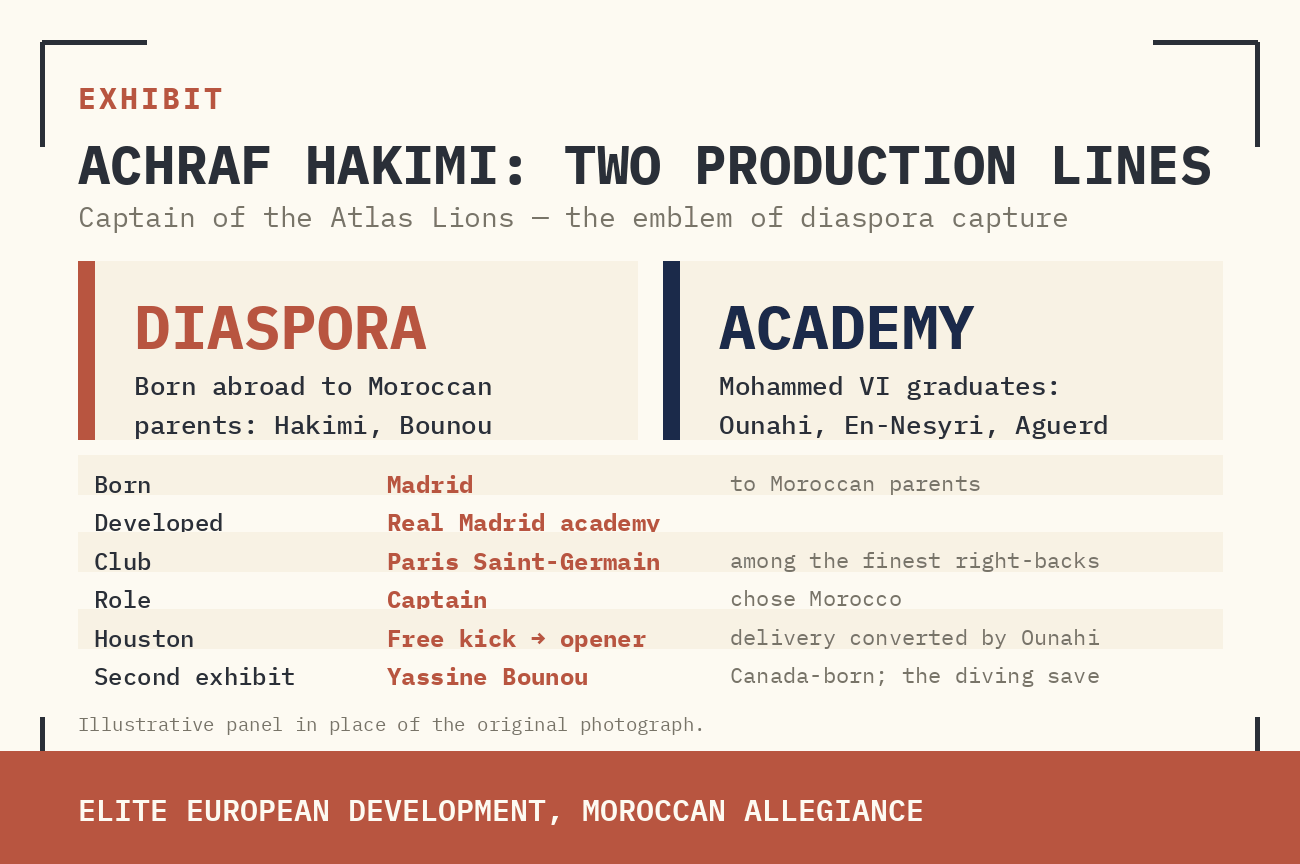
Supplied archive exhibit · original labels. Read alongside the editorial corrections.
Achraf Hakimi — captain of the Atlas Lions. Madrid-born to Moroccan parents, a Real Madrid academy product and Paris Saint-Germain star, Hakimi personifies the diaspora-capture strategy: elite European development, Moroccan allegiance. His free kick created Ounahi's opener against Canada. One national team, two production lines — the academy at home and the diaspora abroad.
Chronology is the argument: charter 2008, academy 2009, operator 2014, complex 2019, semifinal 2022, continental titles 2024–25, back-to-back quarterfinals 2026, co-hosting 2030. Nothing in that sequence is luck. It is a capital-expenditure schedule with a trophy cabinet attached.
III. The Overperformance Model: Quantifying Why Morocco and Senegal Overperform
In June 2026, days before kickoff, a published economics framework ranked Africa's nine World Cup participants (plus peers) by their capacity to exceed expectations — the Overperformance Potential Score (OPS). The model is worth deep attention because it independently validates, with data, the anatomy of the Moroccan build described above.
The framework's construction
The OPS combines four pillars of national 'capital', each built from standardised indicators. Because every input is converted into a z-score — the number of standard deviations a country sits from the peer-group mean — the pillars are comparable despite measuring entirely different things, and the overall score is a weighted average of those standardised readings. A score of zero is the African peer average; +1.3 means 1.3 standard deviations above the peer-group mean; –2.1 is a severe outlier below it. The four pillars:
Football capital — the stock of elite playing talent: players in Europe's big-five leagues, squad market value, and participation in UEFA club competition. This is the direct measure of a country's export-grade talent pipeline.
Demographic capital — population size and youth share: the raw-material base from which future talent can be drawn.
Institutional capital — World Cup appearances, AFCON performance and federation strength: the quality of the governing machine that converts raw talent into competitive teams.
Economic capital — GDP per capita and infrastructure: the financing capacity and physical plant underneath the system.
Reading the table
RANK | COUNTRY | FOOTBALL CAPITAL | DEMOGRAPHIC CAPITAL | INSTITUTIONAL CAPITAL | ECONOMIC CAPITAL | OPS |
|---|---|---|---|---|---|---|
1 | Senegal | 1.3 | 0.5 | 0.5 | -0.8 | 0.7 |
2 | Morocco | 1.3 | -0.5 | 1.3 | 0.5 | 0.7 |
3 | Côte d'Ivoire | 0.9 | 0.5 | 0.5 | -0.5 | 0.6 |
4 | Ghana | 0.2 | 0.3 | -0.4 | -0.2 | 0.1 |
5 | Algeria | 0.3 | -0.8 | -0.1 | 0.8 | -0.1 |
6 | Egypt | -1.0 | 0.8 | 0.4 | 0.2 | -0.1 |
7 | DR Congo | -0.1 | 1.1 | -0.9 | -2.1 | -0.1 |
8 | Tunisia | -0.7 | -1.3 | 0.5 | 0.4 | -0.5 |
9 | South Africa | -1.3 | -0.2 | -0.3 | 0.8 | -0.6 |
10 | Cape Verde | -0.9 | -0.5 | -1.5 | 0.8 | -0.7 |
Overperformance Potential Score (OPS) = weighted average of standardised (z-score) indicators across four capital pillars. Indicators include players in Europe's big-five leagues, squad market value, UEFA club participation, population and youth share, World Cup appearances, AFCON performance, federation strength, GDP per capita and infrastructure. Framework: Overperformance Potential Score, June 2026.
Senegal ranks first at 0.7, narrowly ahead of Morocco at the same headline score, with Côte d'Ivoire third at 0.6 on the strength of a deep talent pool and a young, growing population. The framework's summary was that Senegal and Morocco pair elite football talent with favourable demographics and strong institutional foundations. But the component structure is where the intelligence lives:
Morocco is the institutional outlier. Its institutional-capital score of 1.3 is the highest single institutional reading in the table — the statistical fingerprint of the FRMF machine, the academy system and two decades of federation-led professionalisation described in Section II. Morocco pairs it with football capital of 1.3 and positive economic capital (0.5). Its only negative pillar is demographic (–0.5): at 37 million people it is smaller and older than Sub-Saharan peers. Morocco's overperformance is therefore manufactured, not inherited — it compensates for a modest demographic base with the best institutions and a top-tier talent stock. That is precisely what a well-run production system looks like in z-scores.
Senegal is the talent-and-youth model. Identical football capital (1.3), positive demographics (0.5) and solid institutions (0.5) — the legacy of its famed private-academy ecosystem (Génération Foot, Diambars) feeding Europe — but negative economic capital (–0.8). Senegal overperforms despite its economy, not because of it.
DR Congo is the natural experiment. The best demographic score in the table (1.1) — an enormous, young population — combined with the worst economic score (–2.1) and weak institutions (–0.9) nets out to just –0.1. Raw human potential without institutions and financing converts to nothing. DR Congo is what Morocco would look like if the 2008 charter had never been written.
South Africa and Cape Verde invert the lesson. Both post the strongest economic capital in the lower half (0.8 each) yet sit at the bottom of the table (–0.6 and –0.7), dragged down by weak football capital (–1.3 and –0.9) and, in Cape Verde's case, the weakest institutional reading in the sample (–1.5). The model flagged exactly this: strong economic indicators cannot offset weak football and institutional foundations. Money without a machine does not produce football.
Egypt and Algeria show single-pillar fragility. Egypt has a weak football-capital score in the table (–1.0) despite decent demographics and institutions — its stars play at home rather than across Europe's big five, capping the elite-exposure channel. Algeria's economy scores well (0.8) but demographics (–0.8) and institutions (–0.1) leave it flat.
The model's core finding, in one line: the pillars that predict World Cup overperformance are football capital and institutional capital — players exported to elite leagues and a federation that functions. GDP is the weakest predictor in the table. That is an empirical rebuke to the assumption that sporting success is bought; it is built.
The tournament has since stress-tested the model in real time. Senegal, the top-ranked overperformer, produced the first five-goal match by an African side at a World Cup (5–0 over Iraq) and reached the knockouts; Morocco eliminated the Netherlands and Canada; South Africa and DR Congo exited early, as their scores implied. A June 2026 companion analysis noted that Morocco was on the cusp of the knockout rounds with a record unbeaten streak, having been officially named African champion after Senegal's title was stripped earlier in the year. A model published before kickoff that correctly orders outcomes is rare in sports economics; that it does so using institutional variables is the finding India should study most closely.
IV. The Economic Picture: Morocco's Football-State Complex
Morocco's football programme is not a cost centre with patriotic dividends. It is the visible tip of an integrated tourism-infrastructure-soft-power complex, and the 2026 run is compounding its returns in five channels.
1. Tourism: the direct monetisation channel
Morocco was Africa's top tourist destination for the second consecutive year in 2025, recording nearly 20 million visitors and roughly $14.8 billion in receipts. Tourism employs about 900,000 people in a country of 37 million and accounts for 9% of GDP. Ahead of co-hosting the 2030 World Cup with Spain and Portugal, the state tourism agency SMIT is coordinating a $4 billion investment drive to add 25,000 hotel rooms — expanding national capacity by a fifth across roughly 700 projects, three-quarters funded by domestic investors, with international brands managing at least 15% of new capacity. SMIT's chief, Imad Barrakad, has described it as one of the largest and fastest expansions the kingdom has ever undertaken, and has framed the strategy as a pivot from volume to quality and impact — targeting the right investors rather than all investors.
2. Infrastructure: hosting as a forcing function
The 2030 co-hosting rights — themselves a product of footballing credibility earned in Qatar — have become the deadline that disciplines a national capital-expenditure programme: stadium construction and renovation (including the ~115,000-capacity Grand Stade Hassan II project, positioned to stage the 2030 final), high-speed rail extensions, and airport expansion. Hosting converts sporting prestige into a hard budget constraint with a fixed delivery date — the same mechanism that made the 2025 AFCON a dress rehearsal across nine stadiums.
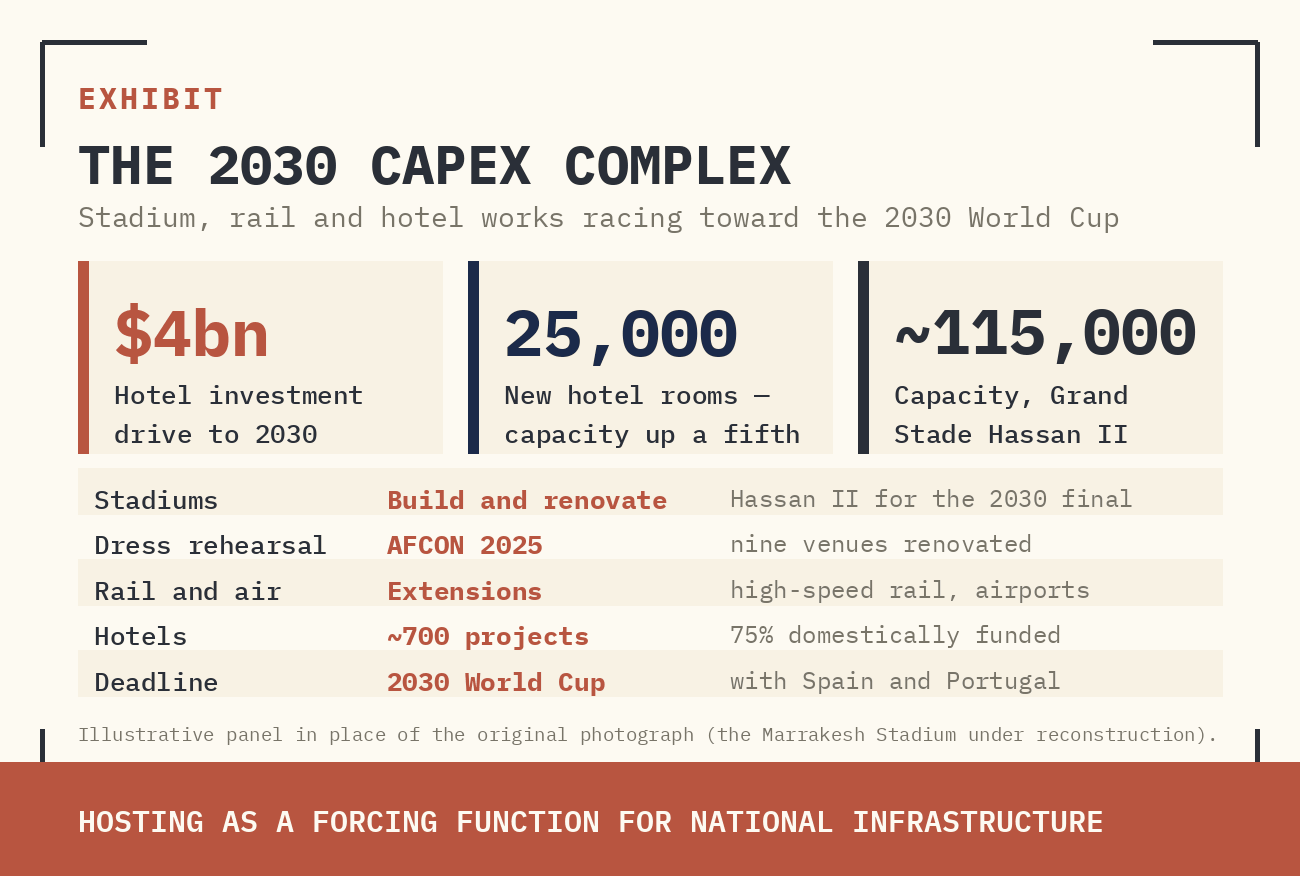
Supplied archive exhibit · original labels. Read alongside the editorial corrections.
The Marrakesh Stadium under reconstruction. One node in the stadium–rail–hotel capital-expenditure complex racing toward 2030, when Morocco co-hosts the World Cup with Spain and Portugal. The same works programme that renovated nine venues for AFCON 2025 now runs on a fixed FIFA delivery date — hosting as a forcing function for national infrastructure.
Figure 02 · Qualitative comparison
The hosting bargain
| Potential benefit | Delivery requirement | Risk to monitor |
|---|---|---|
| Tourism and visibility | Transport, accommodation and service quality | Capacity that cannot earn a return |
| Talent development | Academy access and qualified coaches | Prestige assets without grassroots use |
| National coordination | Clear delivery ownership | Cost overruns and fragmented agencies |
| Public support | Visible social benefits | Health, education and employment trade-offs |
3. Macro resilience: tourism as shock absorber
The macro context makes the tourism bet strategic rather than decorative. Morocco is an energy importer facing imported cost pressure from the Gulf conflict's effect on oil and gas prices; tourism and fertiliser exports have historically been its two shock absorbers. The IMF sees growth of 4.4% in 2026 after 4.9% in 2025, supported by a $5 billion Flexible Credit Line. Barrakad has acknowledged the war's knock-on risks — higher construction and operating costs, slower capital inflows, investor substitution toward other destinations — while noting no direct impact on the pipeline so far, with only 162 cancelled flights in a month. Every quarterfinal broadcast is, in effect, free global advertising for a sector that carries the external accounts.
4. Human capital and social mobility
The academy system doubles as social policy: 90% of Mohammed VI Academy entrants from low-income households, a 100% graduation rate, and a visible pathway from provincial poverty to European club wages. Player exports also generate remittance-like flows — transfer fees and FIFA solidarity payments (fixed percentages to clubs that trained a player between ages 12 and 23) recycle European football revenue back into the domestic training ecosystem, the same economic model that sustains Senegal's and Ghana's academies.
5. Soft power and institutional export
FIFA's decision to place its Africa regional office inside the Mohammed VI Complex in July 2025 — negotiated over a year with CAF and FIFA leadership — makes Morocco the administrative capital of African football. Combined with AFCON 2025 hosting, the U-20 world title, and the continental-champion designation, Morocco has converted football into diplomatic infrastructure across Africa, a lower-cost complement to its established fertiliser-and-banking soft-power channels.
The Lekjaa candidacy: from budget office to ballot box
Supplied archive exhibit · original labels. Read alongside the editorial corrections.
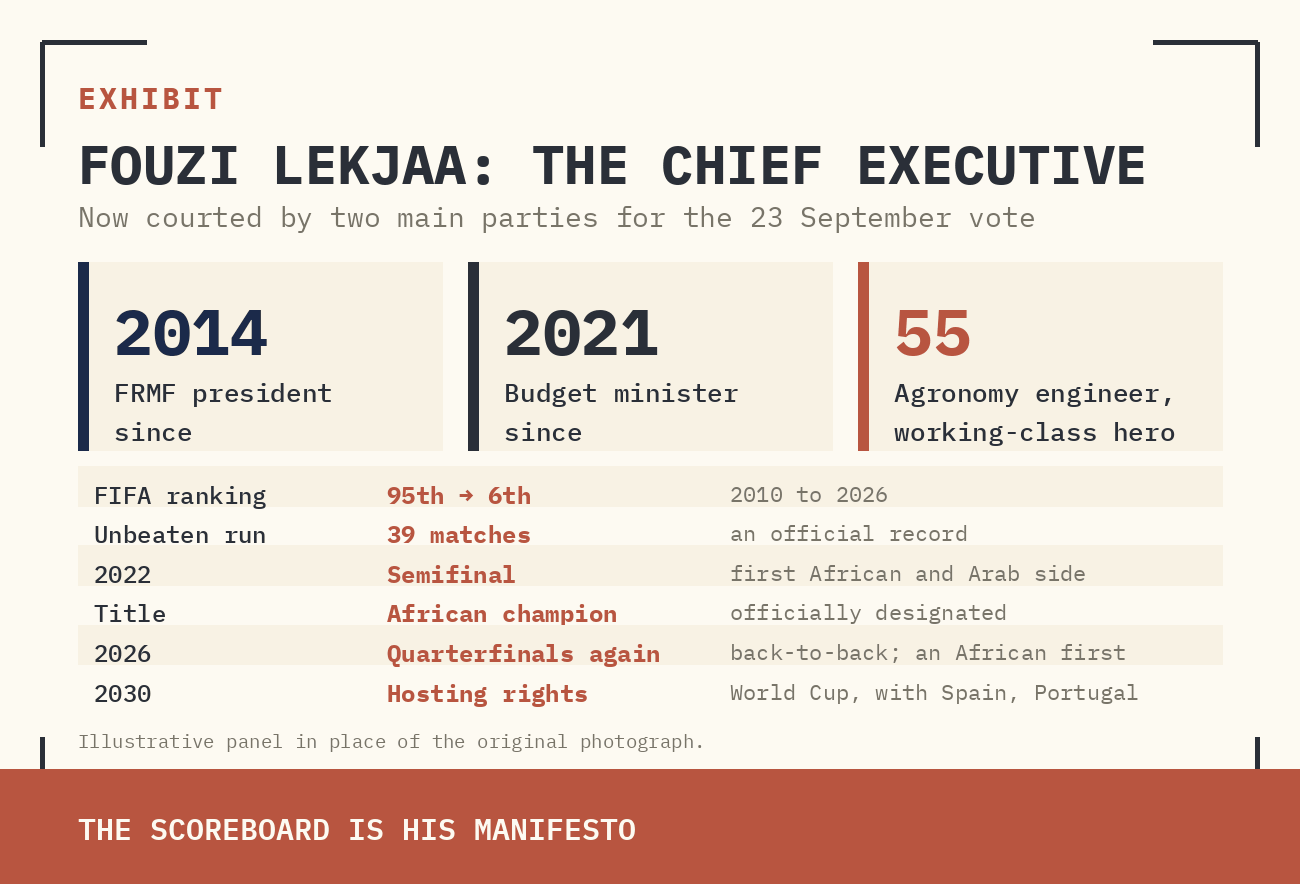
Fouzi Lekjaa on the pitch. President of the Royal Moroccan Football Federation since 2014, budget minister since 2021, agronomy engineer, 55 — the programme's chief executive, portrayed by local media as a working-class hero. Two of the kingdom's main parties now want him to lead them into the 23 September parliamentary election as their prime-ministerial candidate.
The complex now feeds directly into politics. Per 22 June press reporting, two of the kingdom's main parties are publicly courting Lekjaa to become their leader ahead of the 23 September parliamentary vote: the liberal Popular Movement, whose chief Mohamed Ouzzine counts him among Morocco's national assets, and the rival Authenticity and Modernity Party, whose leader Fatima-Zahra Mansouri says his positions broadly align with hers. The field is unusually open: current premier Aziz Akhannouch — one of Morocco's richest businessmen, a billionaire — has said he will not run again and is backing another candidate from his Independents National Rally, while the Justice and Development Party, the Islamist bloc crushed in 2021, is attempting a comeback. Lekjaa himself has said publicly he is non-partisan and does not plan to seek election; neither he nor the courting parties have commented further.
Why is a football administrator the most sought-after candidate in the kingdom? Because he holds the only asset the political class cannot manufacture: earned, measurable, universally legible success. The scoreboard is his manifesto — FIFA ranking from 95th in 2010 to sixth today, a record 39-match official unbeaten run, the 2022 semifinal, the African champion designation, back-to-back quarterfinals, and 2030 hosting rights secured. His biography compounds the appeal: an agronomy engineer of modest origins who rose through the budget directorate rather than business or dynasty — the working-class-hero framing is the precise inverse of the billionaire-premier profile he would replace. And the structural conditions favour a fame candidate: political participation has fallen, many voters view elections as a charade in a system where King Mohammed VI holds sweeping powers, and this is the first ballot since the Gen-Z protests. In a low-turnout, low-trust election, the candidate with genuine mass affection — in a football-mad country of almost 40 million, most of them young — starts with an advantage no party machine can replicate. If he entered, he would be formidable; that both major liberal parties are bidding for him is the market's own assessment.
What it would mean. The premier's office in Morocco is an implementation role beneath the palace, not a rival centre of power — the assembly's authority is limited, and elections function more as a bellwether of sentiment than a transfer of sovereignty. But the specific portfolio fit is unusual: a Lekjaa premiership would place the architect of the football complex in charge of the government delivering the 2030 World Cup — stadiums, rail, airports, the $4bn hotel programme — with the budget ministry experience to run it. It would also be the establishment's most direct answer to the Gen-Z generation: a leader whose signature institution takes poor ten-year-olds and graduates professionals. The equal risk: it would fuse the football project's prestige to the government's fortunes completely — every stadium overrun, every protest, every early exit would then be a governing liability, not a federation matter. The courtship itself is already the analytical signal, whatever he decides: with participation depressed and the elite bench thin, football success is now the scarcest political currency in Morocco, and both sides of the liberal establishment are bidding to rent it.
The bill for that currency arrived in September–October 2025, when Gen-Z-led protests — Morocco's largest since 2011 — erupted over precisely the World Cup spending programme described above, framed against unemployment, inequality and underfunded health and education. Three protesters were killed; hundreds were detained; criminal cases were documented against at least 270 people. The finance minister called the unrest a wake-up call and promised jobs-first reform, conceding that every dirham must sit closer to young people's opportunities. This is the risk leg of the Moroccan trade: stadium capital expenditure is politically deductible only while the team wins and while grassroots dividends — academies, jobs, mobility — remain visible. The September election, held in the afterglow of the World Cup run and the shadow of the protests, is effectively a referendum on whether the football-state complex has kept that bargain. Any country copying the model must copy the lesson: the social licence for prestige spending is real, priced, and revocable.
V. Africa's Broader Bet: The Continent's Football Investment Wave and What It Is Chasing
Morocco is the most complete case, but it sits inside a continental repricing. The expanded 48-team 2026 format nearly doubled Africa's berths — up to nine or ten federations now share FIFA's participation payments and prize pool, against five previously — democratising revenue that had been concentrated in the perennial qualifiers (Morocco, Senegal, Ghana, Nigeria, Cameroon, Tunisia). Cape Verde qualified for the first time; DR Congo returned after five decades; Senegal's Génération Foot and Diambars, Ghana's Right to Dream and Côte d'Ivoire's ASEC Mimosas continue to run the academy-to-Europe export model built on transfer fees plus solidarity payments. Each qualification buys exposure that compounds into sponsorship, broadcast value and player market capitalisation — a new commercial ecosystem, not just a cheque.
What are these countries chasing? Three returns, in ascending order of ambition. First, cash-flow: FIFA money, transfer receipts and solidarity payments are material hard-currency inflows for small federations. Second, nation-branding: Senegal's group-stage demolition of Iraq did more for its global visibility in ninety minutes than years of investment promotion; Morocco's 2022 run measurably preceded record tourism years. Third — and this is where Morocco stands alone — institutional graduation: converting sporting credibility into hosting rights, FIFA/CAF governance positions, and a permanent seat at the sport's administrative table. The Overperformance table doubles as a diagnosis of who can make each jump: countries with football capital but no institutions (much of the qualifying cohort) can harvest cash-flow; only those with institutional capital can graduate. The gap between exporting talent and building an ecosystem — where a child in Kinshasa can turn professional at home, in a full stadium, in a solvent league — remains the continent's unfinished business, and Senegal's own fiscal stress (public debt restated to roughly 119% of GDP after a 2024 audit) is a warning that football capital cannot outrun a broken sovereign balance sheet forever.
VI. The India Playbook: Translating the Atlas Lions Doctrine for 2036
India has declared the ambition — an active bid for the 2036 Olympic Games centred on Ahmedabad (proposed budget ₹34,700–64,000 crore), the 2030 Commonwealth Games as a staging event, the Khelo Bharat Niti 2025 targeting top-ten sporting-nation status by 2036 and top-five by 2047, and a Budget 2026–27 that raised the sports ministry allocation to ₹4,479.88 crore and launched the decade-long Khelo India Mission for training centres and coaches. The task-force led by Pullela Gopichand has already proposed a TOPS-style scheme for coaches. The architecture, in other words, is being drawn. Morocco's value to India is that it is the cleanest recent proof of which lines in that architecture actually carry load. Ten transferable principles:
1. Write the charter, then hold it for twenty years. Morocco's returns arrived fourteen to eighteen years after the 2008 Skhirat charter. The Khelo India Mission's ten-year horizon is the right instinct; the harder discipline is continuity — the programme, its targets and its operating institution must survive electoral and administrative cycles the way the FRMF project survived coaching changes, ministerial turnover and even mid-World-Cup manager transitions. India should legislate the mission's mandate and metrics so that 2036 preparation is insulated from annual budget renegotiation.
2. Build one anchor academy per priority sport — residential, education-integrated, and deliberately pro-poor. The Mohammed VI Academy's design is the core intellectual property: full schooling alongside elite training, sports medicine on site, ~90% low-income intake, 100% graduation. This solves the single biggest constraint on Indian sports participation — parental fear that sport forecloses education and employment. India's National Centres of Excellence should be rebuilt to this template: a child who fails to medal must still graduate employable, or families will keep withholding their most talented children.
3. Clone the anchor; mandate the cascade. Morocco replicated the national academy across twelve regions and obliged professional clubs to run youth academies. India's equivalents are states and franchise leagues: accreditation, hosting rights and central funding for state units and leagues (IPL, ISL, PKL, hockey) should be conditioned on operating certified residential youth academies to the anchor template. Voluntary cascades do not happen; mandated ones did.
4. Wire detection into the school system. Morocco's sports-studies programme with its education ministry catches talent at ten and adapts the timetable around training. India's KIRTI assessment centres (174 and counting) are the detection layer; the missing piece is the Moroccan-style adapted-schooling pathway so that detected talent has somewhere structured to go. Integration with the National Education Policy exists on paper in Khelo Bharat Niti; it needs the operational plumbing.
5. Fund the coach pipeline as seriously as the athlete pipeline. Lekjaa's triangle — facilities, talent, qualified personnel — failed nowhere because all three were funded. Morocco now wins with home-produced coaches. The Gopichand task-force's TOPS-for-coaches proposal is precisely the Moroccan move and should be the mission's first funded line item: India cannot import enough elite coaching for a continental-scale talent base, so it must manufacture it.
6. Capture the diaspora. Morocco converted European-born players of Moroccan descent into a second, pre-trained talent pool — Bounou, born in Canada, saved the quarterfinal berth. India's 35-million-strong diaspora includes athletes developed in American, British, Australian and Gulf systems. Eligibility facilitation, scouting cells in diaspora hubs and clear dual-pathway rules (within citizenship constraints, via OCI-eligible sports where federations permit) are near-zero-cost capacity additions.
7. Select sports by capital stack, not sentiment. Apply the Overperformance framework to India itself: score each Olympic discipline on India's talent stock (football capital analogue), demographic depth, institutional quality of the national federation, and infrastructure economics. Concentrate 2036 resources where at least three pillars are positive — shooting, badminton, wrestling, boxing, hockey, archery, athletics' throwing events, weightlifting — rather than spreading capital across all disciplines. DR Congo's row is the caution: demographic capital alone converts to nothing without institutions.
8. Treat federation governance as the binding constraint. Morocco's decisive z-score is institutional capital: 1.3, the best in Africa. India's federations are its weakest pillar — the recurring governance disputes across several national sports bodies are the equivalent of a negative institutional z-score that no athlete stipend can offset. The National Sports Governance framework should be enforced with the same conditionality logic as point 3: funding follows governance compliance, professional management and published performance metrics.
9. Use hosting as a forcing function — and sequence it. Morocco's ladder was AFCON 2025 → World Cup 2030: a continental dress rehearsal before the global event, each with hard delivery dates that disciplined infrastructure spending. India's 2030 Commonwealth Games in Ahmedabad plays the AFCON role for 2036 and should be treated explicitly as the systems test — venues, transport, athlete services, event operations — with published post-Games audits feeding the Olympic delivery plan.
10. Buy the social licence before the bill arrives. Morocco's Gen-Z protests are the counterfactual India must engineer away: prestige spending without visible grassroots dividends becomes a lightning rod for every other grievance. The 2036 programme should be communicated — and budgeted — grassroots-first: every stadium announcement paired with academy seats, coach jobs and school-sport funding in the host region, with public dashboards. The Moroccan model survived its protests because the academy pipeline gave the spending a defensible social return; the spending alone would not have survived.
Morocco's lesson for India is not 'spend on sport'. It is: charter a mission, appoint an operator with tenure, build one excellent pro-poor academy, clone it under mandate, fund coaches like athletes, capture the diaspora, pick sports where the capital stack is already positive, fix the federations, sequence hosting as rehearsal — and keep the grassroots dividend visible enough that the public defends the budget.
VII. Trigger → Flow → Risk → Price → Position
TRIGGER — Morocco 3–0 Canada (4 July): second consecutive quarterfinal, first African nation to do it twice; Lekjaa courted for premier ahead of the 23 September vote; India's Khelo India Mission funded in Budget 2026–27 with the 2036 bid live.
FLOW — Capital is moving into African sport at scale: $4bn Moroccan hotel drive (25,000 rooms, 700 projects, 75% domestically funded), 2030 stadium and rail capex, expanded FIFA payments now reaching up to ten African federations, and academy-transfer-solidarity flows recycling European football revenue into African training systems.
RISK — Social licence (2025 Gen-Z protests; three dead; the September election as referendum), imported energy-cost pressure on an importer economy, construction-cost inflation from the Gulf conflict, and — continent-wide — sovereign balance sheets (Senegal's debt restated to ~119% of GDP) that football receipts cannot repair.
PRICE — Tourism receipts ~$14.8bn on ~20m visitors (2025), sector at 9% of GDP employing ~900,000; IMF growth 4.4% (2026) vs 4.9% (2025); hotel capacity +20% by 2030; FIFA ranking as the leading soft-power indicator: 95th (2010) → 6th (2026).
POSITION — Thematic and sector-level: constructive on Morocco's tourism-hospitality-infrastructure complex into 2030 hosting; monitor the September election and protest recurrence as the invalidation triggers. For India-focused allocators: the sports-economy build-out (infrastructure, sports goods manufacturing, coaching services, event operations) ahead of CWG 2030 and a potential 2036 award is an early-stage decade theme. Logged in the Thesis Ledger; grade OPEN, review 31 December 2027.