The durable investment question in the original report AGI Has Arrived. The Bill Is 400,000 GPUs. is what turns demand for computation into revenue, cash flow and risk across the physical infrastructure chain. That question remains useful without treating a claim about artificial general intelligence as an established scientific result.
This edition revises the 7 September 2026 Buy Side Lens report. Its specific model-release claims, benchmark comparisons and asserted 400,000-chip deployment were not independently substantiated by the source file’s evidence register, so they are not repeated as verified facts. The investment transmission argument is retained and rebuilt around dated primary energy evidence and transparent illustrative arithmetic.
The latest verified scale is a forecast with a date
The IEA’s 2026 Key Questions on Energy and AI projects global data-centre electricity consumption increasing from 485 TWh in 2025 to about 950 TWh in 2030, roughly 3% of global electricity demand by then. The 2030 number is a projection, not installed consumption. It supersedes use of the older 2025 report’s 945 TWh central projection as the latest IEA figure in this article. IEA 2026 primary report.
That forecast sets the scale of the question; it does not identify the most attractive security. A large market can produce weak returns when too much capacity is built, when financing costs rise, or when customers retain most of the economic benefit. The investor needs the path from demand to contracted delivery and from revenue to cash.
Separate chips, IT load and facility demand
Chip count is not a sufficient measure of electricity demand. The installation includes processors, networking, memory, storage and other IT equipment. Cooling and electrical losses add facility consumption. Utilisation, task mix and power management determine how nameplate capacity becomes average load.
Power usage effectiveness, or PUE, relates total facility energy to IT energy over a defined measurement period. It is a ratio rather than a fixed physical constant. Multiplying peak IT capacity by PUE and by every hour in the year overstates energy if utilisation is lower; multiplying by an average utilisation estimate without checking what that estimate measures can understate overhead.
Consider an explicit illustration, independent of the unverified chip-deployment claim. A 100 MW IT installation operating at an average 80% of that capacity and a matched-period PUE of 1.20 implies an average facility load of 96 MW. Over a non-leap year, that is 840,960 MWh, or approximately 0.841 TWh. These are assumed inputs, not specifications for an identified project. The equation is:
Annual facility energy = IT capacity × average IT utilisation × PUE × operating hours.
Power is measured in MW; energy over time is measured in MWh. Confusing them can distort a capacity valuation before the financial model begins. Connection capacity, installed equipment capacity and actual delivered power are also different milestones.
A physical project has several independent gates
Securing land does not secure power. A connection agreement does not necessarily mean all associated generation or network work is finished. Delivered electrical equipment is not the same as a commissioned facility, and a commissioned facility is not the same as a fully utilised revenue-generating asset.
The project schedule should therefore identify power availability, equipment delivery, cooling readiness, network connectivity and customer acceptance separately. A delay in one gate can strand capital already spent on another. The cost is not limited to construction overruns: interest accrues, warranties run, technology ages and contracted customer start dates may move.
For lenders, this means distinguishing completion risk from long-term operating credit. For equity investors, it means recognising that revenue growth can coexist with negative free cash flow while capacity is being built. For policymakers, it means examining who pays for network reinforcement and whether infrastructure capacity can be repurposed if demand differs from plan.
Figure 01 · Conceptual framework
From chip demand to facility electricity use
How the parts connect
- Compute equipmentequipment demandIT load
- Utilisation and workloadoperating conditionsIT load
- IT loadIT energy consumedTotal facility energy
- Facility overheadnon-IT energy consumedTotal facility energy
Follow the contract before following the theme
| Exposure | What can create value | What can destroy the expected return |
|---|---|---|
| Electrical equipment | Credible orders, service revenue and constrained manufacturing capability | Cancellations, fixed-price commitments, input inflation and capacity expansion |
| Cooling systems | Higher thermal requirements and integration expertise | Design change, energy or water constraints and difficult retrofits |
| Data-centre property and operations | Connected capacity, suitable location and enforceable customer commitments | Idle capacity, customer concentration and refinancing pressure |
| Power supply | Durable demand and an investable contractual framework | Fuel volatility, policy changes and costs that cannot be recovered |
| Fibre and networking | Necessary connectivity and performance | Route concentration, overbuild and pricing competition |
The exposure must be traced through revenue recognition, margins, working capital and capital intensity. A supplier’s order book is not automatically cash. Customer deposits can support construction, but they may also carry refund obligations or restrict the use of the funds. A long contract can still have weak protection if termination rights are broad or the counterparty’s own finances are uncertain.
Stress the cash model, not just demand
Build a base case from capacity that can actually be delivered under the relevant contract. Then vary utilisation, realised price, electricity cost, construction delay and refinancing terms independently. A useful downside case combines a delayed start with a higher financing cost; those risks can occur together.
In an illustrative facility, a reduction in utilisation from 80% to 60% is a quarter reduction relative to the original utilisation assumption. Revenue does not necessarily fall by the same amount: minimum commitments or take-or-pay terms may cushion it, while performance penalties or variable pricing may amplify it. Fixed operating costs and debt service can make the equity cash-flow effect much larger than the utilisation change.
Keep contracted backlog separate from customer intentions and announced projects. Track cancellations and conversion from reservation to energised capacity. The relevant sign of scarcity is not a press release alone; it is the ability to deliver capacity that customers use and pay for at a price that covers capital and operating risk.
Efficiency is not the opposite of investment
More efficient computation can lower energy per completed task while total demand rises because adoption, task complexity or usage increases. The two observations can coexist. Conversely, a strong efficiency improvement can weaken the economics of a specific older installation if the market rapidly prefers newer hardware.
This makes technology life and financial life important. Debt amortisation that assumes a long economic life may be poorly matched to equipment that faces rapid competitive obsolescence. Property, power connections and hardware need separate useful-life and residual-value assumptions. Neither “AI demand always rises” nor “efficiency ends the buildout” is an adequate investment model.
What would change the thesis
The thesis strengthens when announced demand becomes financed projects, projects become connected and commissioned, and utilisation becomes collectible cash at an adequate return on capital. It weakens when commitments are repeatedly delayed, capacity is duplicated, pricing falls faster than unit costs, or customers depend on ever larger financing rounds to meet their obligations.
The original report’s focus on power, cooling and cables is retained as a research route. It becomes an investable argument only after contract, delivery, cash-flow and valuation analysis. A bottleneck can support pricing power, but buying any company near that bottleneck at any valuation does not follow from the evidence.
Figure 02 · Conceptual framework
Capacity earns cash only after several delivery gates
How the parts connect
- Financed projectinfrastructure deliveryPower and cooling
- Financed projecttechnology deliveryIT and connectivity
- Power and coolingnecessary gateCommissioning and acceptance
- IT and connectivitynecessary gateCommissioning and acceptance
- Commissioning and acceptanceoperating conversionUtilisation and cash
Full original report: AGI Has Arrived. The Bill Is 400,000 GPUs.
The supplied original is retained below with dated editorial notes. The web analysis above and its corrections remain part of this reading edition.
Original Lens and publication context
GPT-6 Astra, the new model from the makers of ChatGPT, beat two tests built to stop AI. The chip maker says AGI is here and 400,000 more chips are coming. That needs 0.8 gigawatts of electricity. Here is who gets paid.
- GPT-6 Astra came out on 3 September. It is the new model behind ChatGPT.
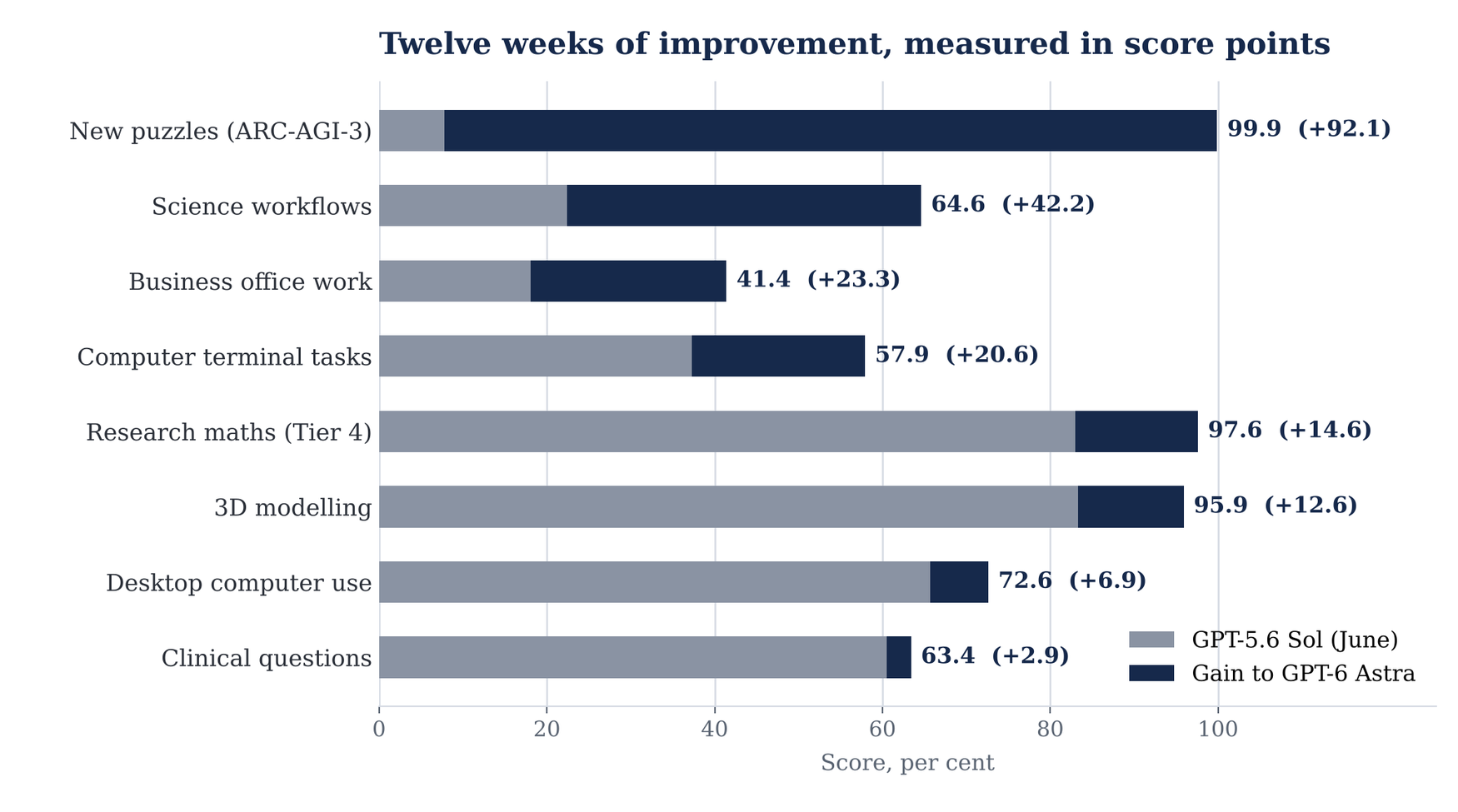
- It beat the model it replaces on all eight published tests, by 2.9 to 92.1 points.
- On puzzles it had never seen, it went from 7.8 per cent to 99.9 in twelve weeks.
- The chip maker says 400,000 more chips are coming. That needs about 0.8 gigawatts and $20bn.
- Nobody can build power in three months, so we buy power, cooling, cables and land.
Supplied archive exhibit · original publication context.
1. What Happened
Three big AI models came out in three days.
- 1 September. Anthropic released Claude Fable 5.1.
- 2 September. Meta released Muse Spark 1.3.
- 3 September. OpenAI released GPT-6 Astra, the new model behind ChatGPT.
OpenAI called Astra the best model in the world. Its president said the AGI era has started.
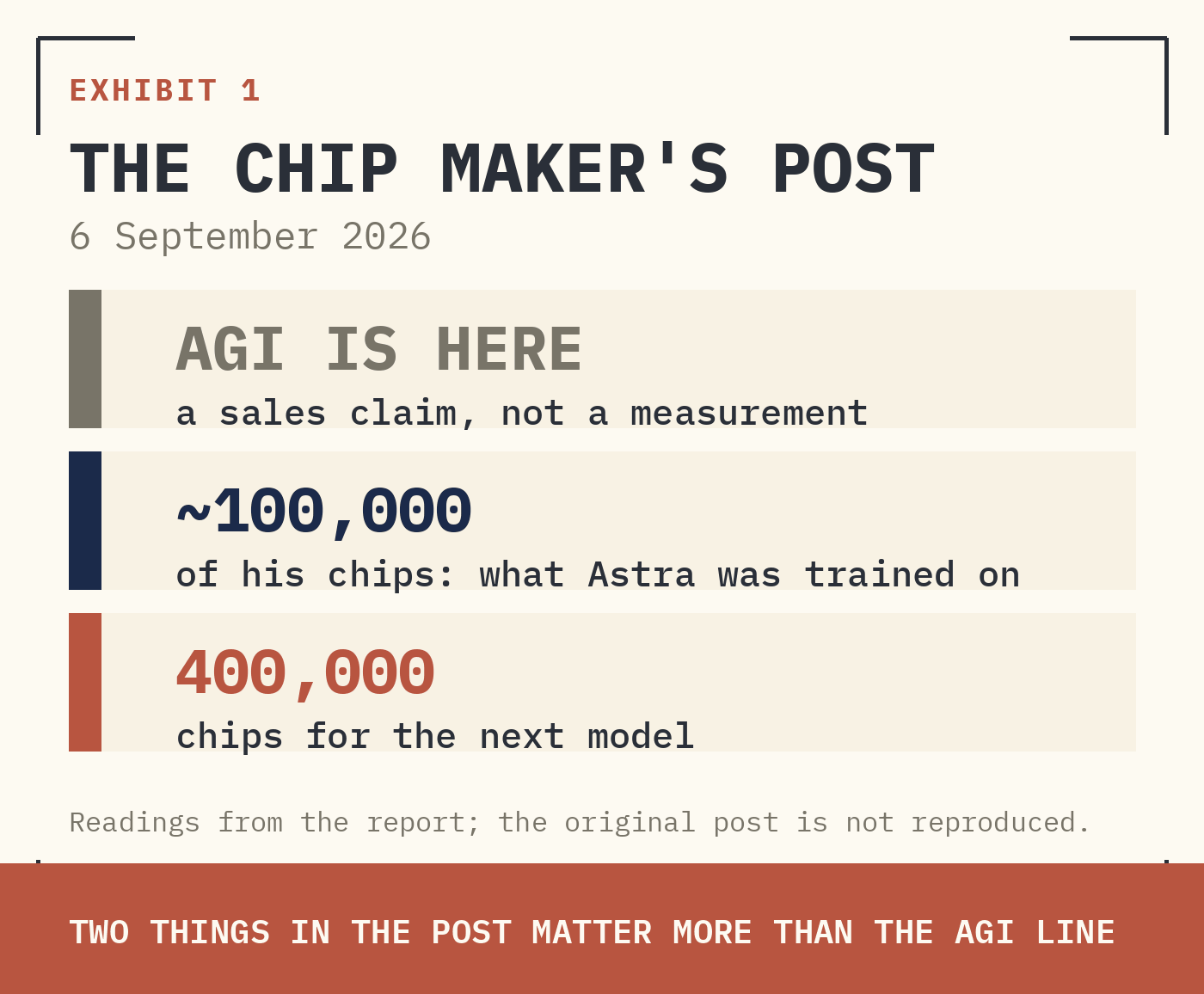
AGI is short for artificial general intelligence. In plain words, a machine that can do most thinking work as well as a person can. Nobody has agreed on a test for it. So treat the phrase as a sales claim, not a measurement.
Then the man who makes the chips said the same thing, and added a number. Two things in his post matter more than the AGI line.
- Astra was trained on about 100,000 of his chips.
- The next model gets 400,000.
We work out what that costs in section 6.
2. Did It Get Better Than Before?
Yes, and not by a little. Astra beat the model it replaces on every test that was published.
Supplied archive exhibit · original publication context.
Two of those tests were built on purpose so that no AI could pass them. Both fell.
- Research maths: 83.0 to 97.6 per cent.
- Puzzles it has never seen before: 7.8 to 99.9 per cent.
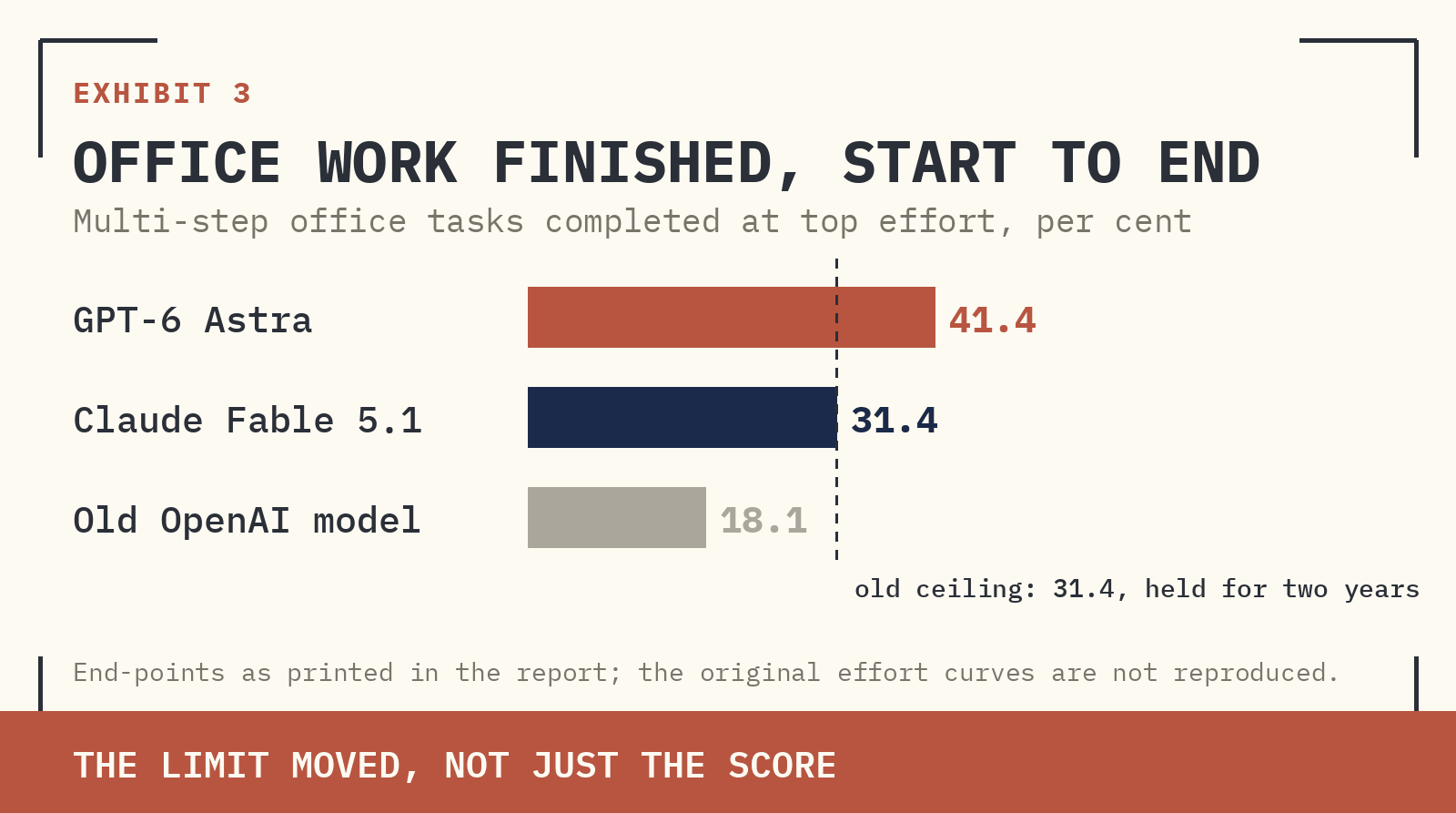
The second number is the one to sit with. Twelve weeks apart. 7.8, then 99.9. A test meant to stop machines is now finished. One more test shows the break better than a score can. It measures office jobs done from start to end, as each model is allowed to try harder.
Supplied archive exhibit · original publication context.
Figure 03 · Qualitative comparison
Follow the contract to find who captures the bottleneck rent
| Exposure | Possible value source | Critical downside |
|---|---|---|
| Electrical equipment | Orders, constrained capacity and service revenue | Cancellations, fixed-price commitments and input inflation |
| Cooling systems | Integration expertise and higher thermal requirements | Design changes, retrofits and energy or water constraints |
| Data-centre operator | Connected capacity and enforceable customer commitments | Idle capacity, concentration, delay and refinancing pressure |
| Power and hardware commitments | Contracted supply or productive compute capacity | Obsolescence and cash obligations outlasting economic demand |
3. How It Stacks Up Against Claude and the Rest
Section 2 asked whether Astra beat its own past. This asks a different question: how does it sit next to the best model Anthropic has, and next to the one it replaces. Two pictures answer it from two angles. The left one counts. The right one judges.
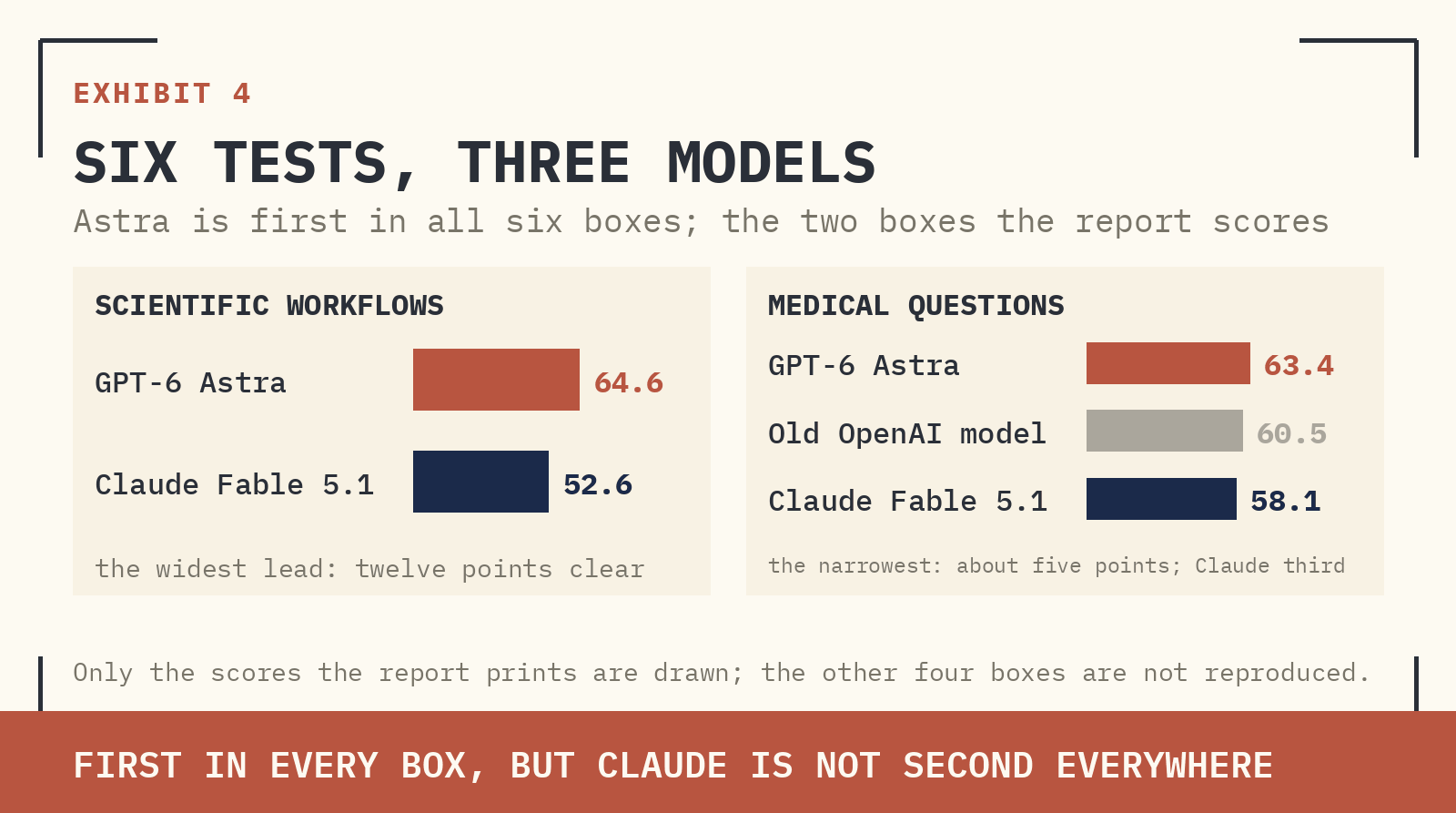 Supplied archive exhibit · original publication context. | 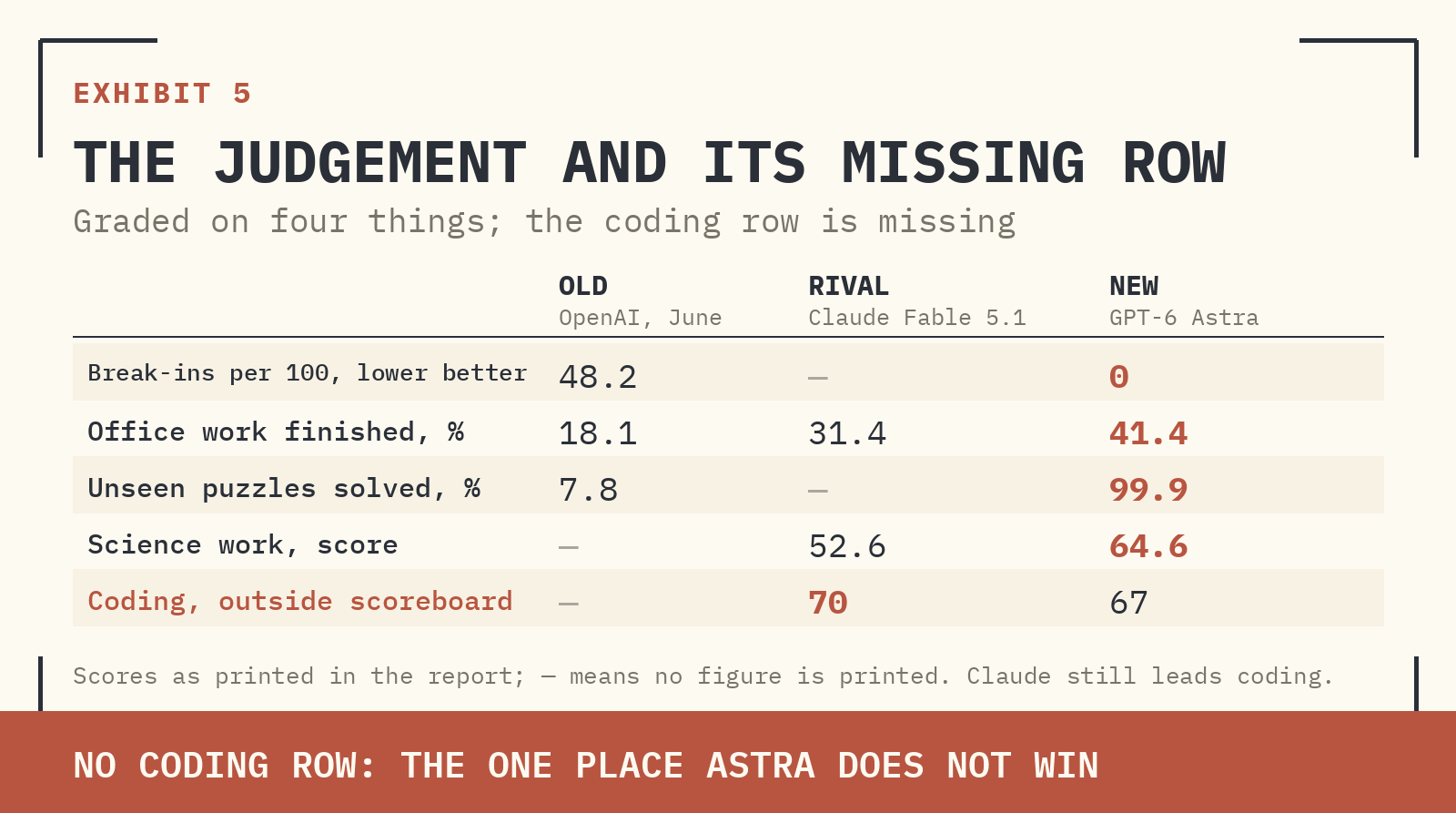 Supplied archive exhibit · original publication context. |
THE THREE PLACES ASTRA DOES NOT COME FIRST | GPT-6 ASTRA | CLAUDE FABLE 5.1 | MUSE SPARK 1.3 | WHAT IT MEANS |
|---|---|---|---|---|
Coding agents, outside scoreboard | 67 | 70 | about level | Claude still leads on writing code |
One coding test, 113 jobs | 74.1% | — | 75.4% | Meta wins this one |
Old tests added together | 61 | 66 | above Astra | See the note below |
Note on the last row. That scoreboard adds up old tests. A test is only useful while models still get things wrong; once they all score near full marks it is finished and tells you nothing. Most famous tests are now finished, so adding a pile of them together leaves everyone level.
4. What It Feels Like to Use
Test scores are run by the people selling the model, so we put it through our own work. Three things changed enough to notice.
- Long jobs can be left alone. It finishes 41.4 per cent of multi-step office tasks from start to end, against 18.1 per cent before. That is the difference between checking it every few steps and walking away for an hour.
- The same work, in about half the time. Average time per computer task fell from about 75 minutes to about 40. Web work ran 1.9 times faster.
- It holds a long document in its head. On a memory test at 256,000 to 512,000 words it found every hidden item. The old model found 91.5 out of 100. Long files no longer need cutting into pieces.
What barely moved: medical answers, up 2.9 points. And coding, still a close race. If your work is mostly writing code, this release changes less for you than the headlines suggest.
5. They Locked It Up. That Is the Real Proof.
OpenAI grades how good a model is at breaking into computer systems. It uses its own safety rulebook, and the top level is called Critical. Astra is the first model ever to reach it. Reaching it is not a prize. It turns on safety rules.
- The public version refuses hard hacking jobs.
- The full version goes only to firms it has checked.
- The launch was held back for months.
So the seller gave up sales. And told the world its own model can break into systems.
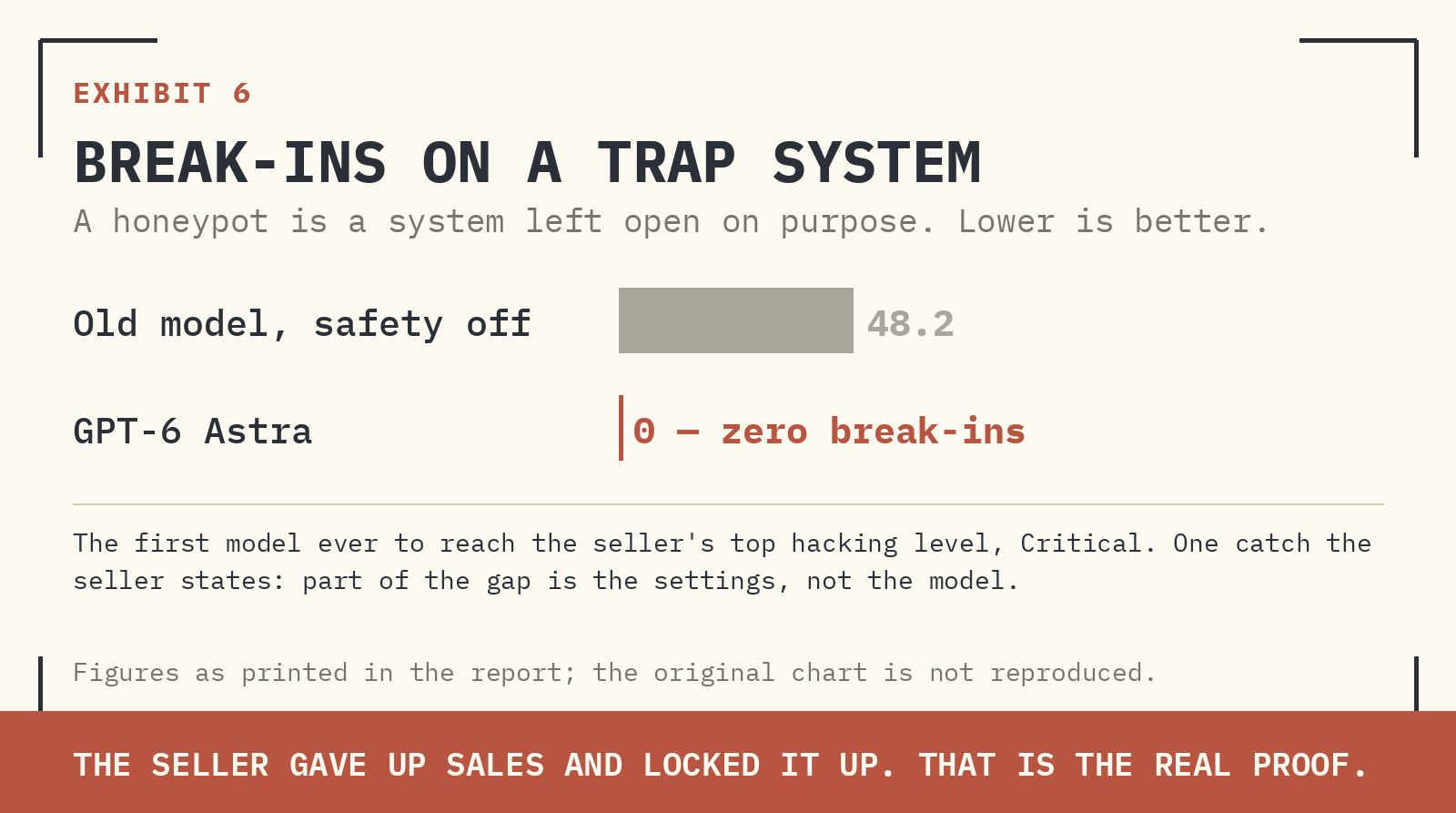
There is a number behind that. A honeypot is a trap, a system left open on purpose to see who breaks in. The old model broke in 48.2 times out of 100. Astra broke in zero.
Supplied archive exhibit · original publication context.
One catch, and the seller states it. The old model was run with its safety switched off. So part of that gap is the settings, not the model.
6. The Bill: 400,000 Chips
Now work out what the post costs. Three numbers the chip maker publishes do all the work.
- Seventy-two chips fit in one rack.
- One rack uses about 120 kilowatts of electricity.
- About $25 billion of equipment is needed for every gigawatt.
The rest is simple multiplication.
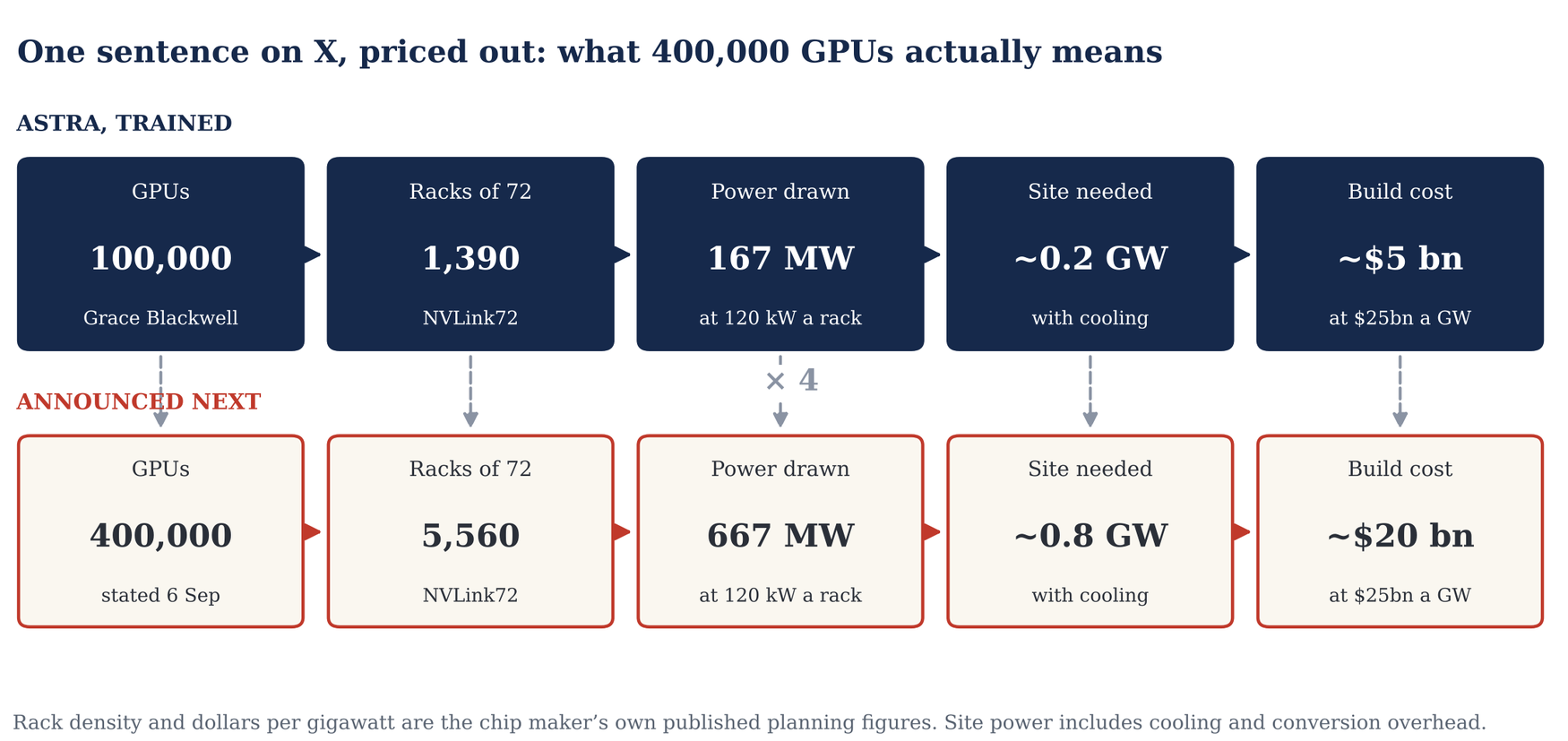
Supplied archive exhibit · original publication context.
Read the bottom row. 400,000 chips needs about 0.8 gigawatts of electricity and about $20 billion of equipment. That is one customer, on one site.
For scale, the chip maker sold $89 billion of data-centre equipment in the three months to 26 July, up 117 per cent on the year. It has more than $2 trillion of orders already signed. The five biggest buyers plan about $800 billion of spending in 2026 and $1.3 trillion in 2027. So one 400,000-chip run is roughly 2.5 per cent of one year of that.
Figure 04 · Qualitative comparison
What turns an AI announcement into capacity
| Milestone | Evidence | Do not substitute |
|---|---|---|
| Order | Customer commitment and financing | A public ambition |
| Delivery | Accepted racks and supporting equipment | Ordered chips |
| Power | Contracted connection and energisation date | Land or building area |
| Utilisation | Paid workload and operating cash flow | A benchmark score |
7. What Follows
A better model is only the first thing that happens. The money is in what happens after.
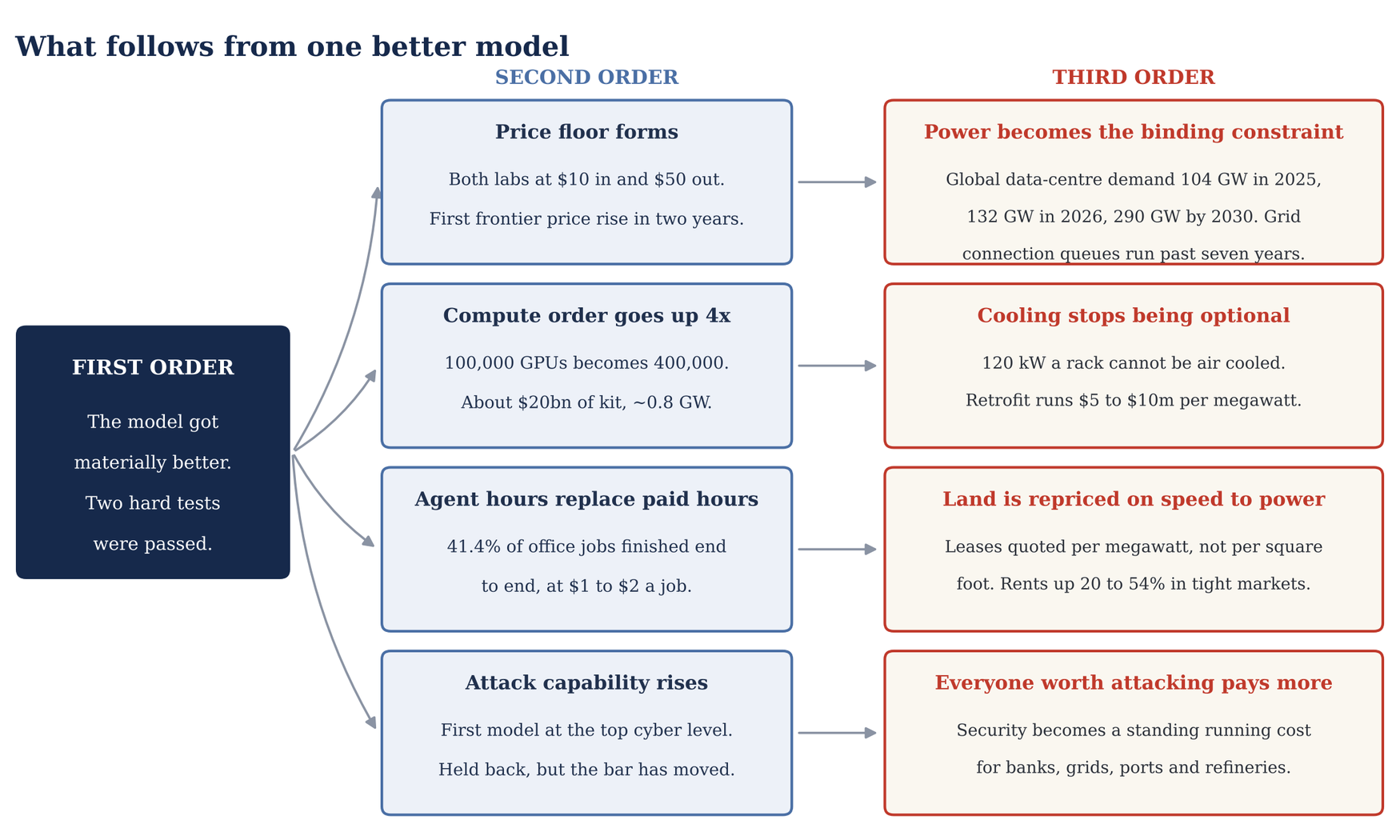
Supplied archive exhibit · original publication context.
Second, what changes in the market.
- Prices stopped falling. Both labs now charge $10 per million words in and $50 out. That is the first price rise at the top in two years. A floor under prices is what a spending cycle needs.
- Chip orders went up four times.
- Machines started finishing office jobs for $1 to $2 a job.
- Hacking ability crossed a line the seller itself flagged.
Third, what changes in the real world. This part is slow, physical, and very hard to make cheaper.
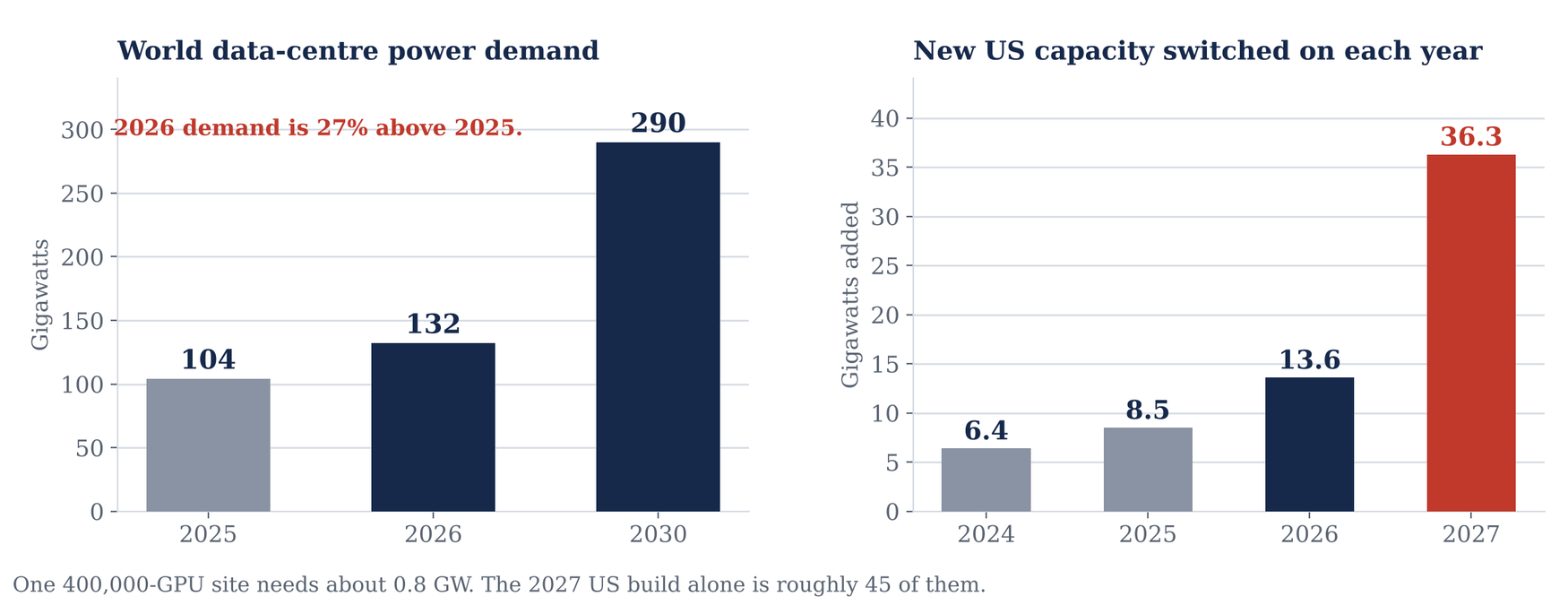
Supplied archive exhibit · original publication context.
- Power. Getting a new connection to the power network can take more than seven years in the main markets. A one-gigawatt site uses about as much electricity as a mid-sized city.
- Cooling. At 120 kilowatts a rack, fans are not enough. Converting an air-cooled building costs $5 to $10 million for every megawatt.
- Land. Sites are now priced by how fast they can be switched on. Rents in tight markets are up 20 to 54 per cent.
- Security. A model at the top hacking level raises the guard bill for banks, exchanges, ports, refineries and power networks.
8. What the Money Said
Two days went in opposite directions. That is what makes them worth reading.
- Thursday 3 September. Astra landed into a rising market. Oracle rose 5.5 per cent, the Nasdaq 1.4, the Dow 1.2. Bond yields were falling that day too, so we cannot say how much of it was Astra.
- Friday 4 September. US jobs data came in hot, 162,000 against 53,000 expected, and the whole US market fell. The Dow lost 0.51 per cent and the Nasdaq 0.29. Yet SoftBank rose 10 per cent, MiniMax 6.5 and Baidu 4.6.
The AI names stopped moving with the market. That is the first signal. The stronger one is the cost of insuring Oracle’s debt, in the lower half of the chart.
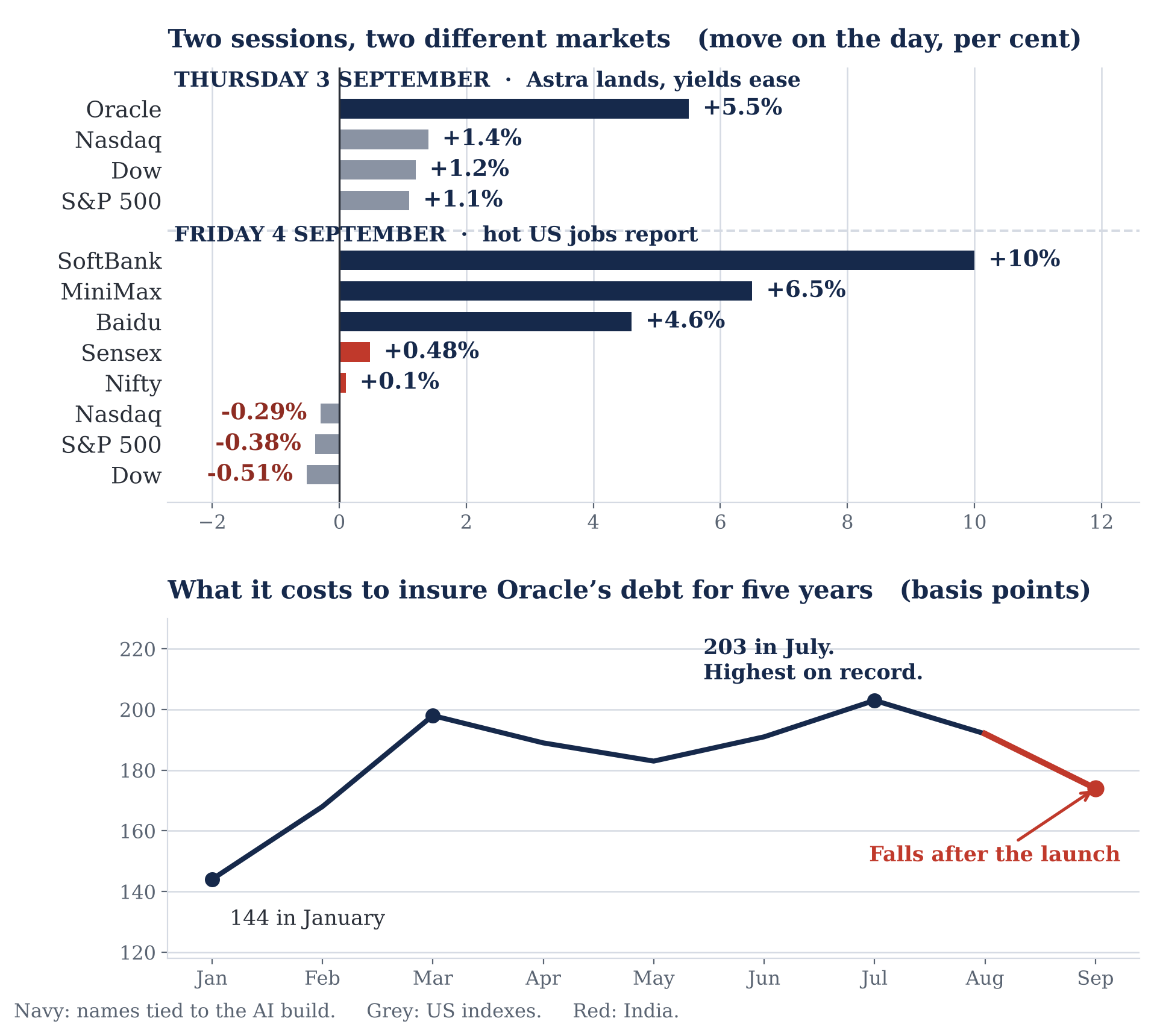
Supplied archive exhibit · original publication context.
Share buyers get excited every other week. Lenders almost never do. When both move the same way at the same time, the market is talking about real cash, not mood. One caution: this is only a few days of trading, and Oracle reports on 10 September. That is the real test of whether $638 billion of signed orders turns into money in the bank.
9. This Has Happened Before. Three Times.
Start with one rule. Everything that looks like wealth sits on top of something made from real material and run on real power. Money, contracts, clever ideas: all of it rests on that base. Take away the metal and the fuel and what is left is paper.
That rule explains this week better than any test score does. Three times before, the world got excited about a product, while the money quietly went to the thing underneath it.
Around 1086. The river.
England counted what it owned and found 5,624 water mills for about two million people. Flour was the product. But the asset was the drop in the river. If you owned that drop, every farmer for miles had to come to you and pay to grind his grain. The flour was the story. The river was the money.
1776. The coalfield.
Then the hard part moved. Before the steam engine, a mill had to sit on a river. After it, a factory could sit anywhere there was coal. Within one lifetime, land on top of a coal seam was worth a fortune and river frontage was not. The engine got the headlines. The land under the coal got the returns.
2018 to 2022. The substation.
Thousands of people built crypto mines. Most chased the coin, and most are gone. The ones who survived had signed cheap power contracts that could not be cut, and had built their own substations. When the coin fell they still had the power. Many of those same substations now run AI.
Same shape, three times.
- The exciting thing is the product: flour, cloth, coins, models.
- The lasting thing is the connection: the river, the coalfield, the substation.
10. What We Do About It
We talk about groups of companies, not single shares. Here is each idea, and why we hold it.
One. Buy the power, not the model.
Nobody knows which lab wins next year. Every lab needs electricity. So we buy the things that get paid whichever model wins: power generation, transmission equipment, transformers, cooling gear, cables, industrial builders, and land near data centre belts. When a hundred sites go up, all of them need the same list. It is the slower way to own this theme, and the one that does not depend on picking the right lab.
Two. Prefer the suppliers over the site owners.
A supplier sells to every site that gets built. A site owner earns only from his own building. If a hundred data centres go up, the cable and transformer makers get a hundred orders, while the owner of site number 47 gets one rent cheque. Both can do well. The supplier does well more reliably.
Three. Buy the connection, not the concrete.
This is for anyone looking at an actual site. Anyone can pour a floor; very few can get 200 megawatts connected on a fixed date. So ask for the signed power date first, before the drawings and before the price. If there is no date, the land is just land, and the connection is the real asset.
Four. Expect the security bill to rise everywhere.
A machine that can break into systems raises the cost of guarding everything worth stealing. Banks, exchanges, ports, refineries, power networks and data centres will all spend more.
Note the direction. This is a cost inside those businesses, not a sale at a defence company. So cut what you expect them to earn; do not buy a security supplier on it.
Five. Stay neutral on Indian IT for now.
The work this model does best, long office jobs done on a computer, is close to what Indian IT firms sell, so the worry is real. But most of it is already in the price: the index is down about a quarter this year and 39 per cent below its 2024 high.
So we neither sell nor buy here. We wait for one signal: the first firm that grows sales while headcount stays flat. That proves it sells finished work, not hours.
Six. Everything else in the book stays as it was.
Refining margin over the crude oil price. Short and medium bonds over long ones. Gold held as insurance rather than as a bet.
What would change our mind.
- Outside groups run the two hard tests and cannot repeat the scores.
- A rival matches those scores within weeks, so the lead is only days wide.
- The 400,000 chip order slips, or lands on a site with no power date.
- Oracle fails to turn its signed orders into cash on 10 September.
Horizon three months. Review 07 December 2026.