Original Lens and publication context
The Iran war has turned Gulf desalination infrastructure into a geopolitical flashpoint. With three plants already struck and Riyadh's water supply a single missile from collapse, markets are only beginning to price the real strategic risk.
- Trump's 48-hour ultimatum of 22 March threatens Iran's power plants; Iran's military command answered by naming the region's energy, IT and desalination infrastructure as targets, and state-linked media published a map of power and desalination sites across Saudi Arabia, the UAE, Qatar and Kuwait.
- Three plants were hit before the map: a desalination plant on Qeshm Island on 7 March, a Bahraini plant near Muharraq, and Dubai's 2,060-megawatt Jebel Ali power and desalination station on 1 March. This is an active targeting doctrine, not a risk scenario.
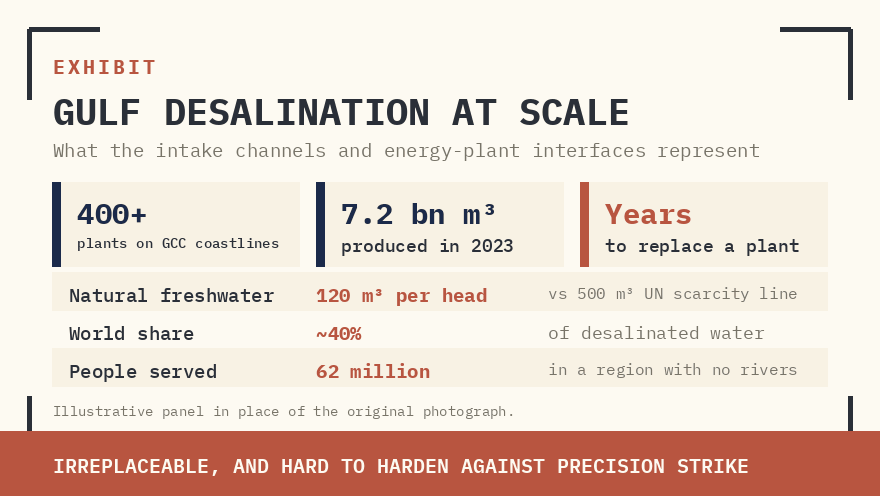
- In the Gulf, power and water are the same infrastructure: 62 million people in a region with no rivers depend on 400-plus desalination plants that produced 7.2 billion cubic metres in 2023; drinking-water dependence exceeds 99% in Qatar and 90% in Bahrain and Kuwait.
- The single point of failure is Jubail, which supplies over 90% of Riyadh's drinking water through a 500-kilometre pipeline; a 2008 US embassy cable judged the capital would have to evacuate within a week if it were seriously damaged. Tehran is itself near Day Zero.
- Markets price an oil shock, not a water shock: Brent $113, gold down 6.4%, Treasuries in a third week of losses. Base case (45%): Hormuz closed, no new strikes; a Jubail-class hit (15%) sends crude to $140-plus; a multi-plant strike is a 5% tail.
I. THE ULTIMATUM — FROM POWER PLANTS TO DESALINATION TARGETS
Trump's 48-Hour Warning
Late Saturday, 22 March 2026, US President Donald Trump posted on Truth Social: 'Iran must FULLY OPEN THE STRAIT OF HORMUZ — or America will hit and obliterate their various POWER PLANTS, STARTING WITH THE BIGGEST ONE FIRST!' The ultimatum set a 48-hour deadline. The Strait of Hormuz had been effectively closed since the war began on 28 February 2026. The US position: reopen it, or the lights go out in Iran.
The logic behind the threat was straightforward. Iran's Revolutionary Guard controls the country's major power infrastructure. Under US legal framing, that makes it a dual-use military target. Destroy the power grid, degrade the IRGC's operational capacity. Treasury Secretary Scott Bessent confirmed all options remained on the table.
'Iran must FULLY OPEN THE STRAIT OF HORMUZ — or America will hit and obliterate their various POWER PLANTS, STARTING WITH THE BIGGEST ONE FIRST!' — President Donald Trump, Truth Social, 22 March 2026.
Iran's Counter-Threat: Specific, Public, and Mapped
Iran's response came within hours — and it was not vague. Parliament Speaker Mohammad Bagher Ghalibaf posted on X: 'Immediately after power plants and infrastructure in our country are targeted, vital infrastructure as well as energy and oil infrastructure across the entire region will be considered legitimate targets and will be irreversibly destroyed.' He added that oil prices would rise 'for a long time.'
Iran's military command Khatam al-Anbiya — the operational headquarters of the Iranian armed forces — was more precise in its public statement carried by semi-official Iranian media: 'Following previous warnings, if Iran's fuel and energy infrastructure is violated by the enemy, all energy, information technology and desalination infrastructure belonging to the US and the regime in the region will be targeted.'
Desalination infrastructure. Named explicitly. For the first time in this conflict, Iran's military command stated publicly that the water supply of the Gulf — the infrastructure keeping 62 million people alive in the world's most water-scarce region — was on the retaliation list.
Iranian state-linked media went further. It published a map marking major power plants across Saudi Arabia, the UAE, Qatar, and Kuwait — with the caption: 'Say goodbye to electricity.' The agency noted that 70 to 80% of the region's major power plants are located along the Persian Gulf coastline. Since Gulf power plants and desalination plants share the same grid and are physically co-located, darkness and waterlessness are the same event.
Iran's military command named desalination infrastructure explicitly as a retaliation target. Iran's state media published a map. The targets are no longer theoretical — they are enumerated.
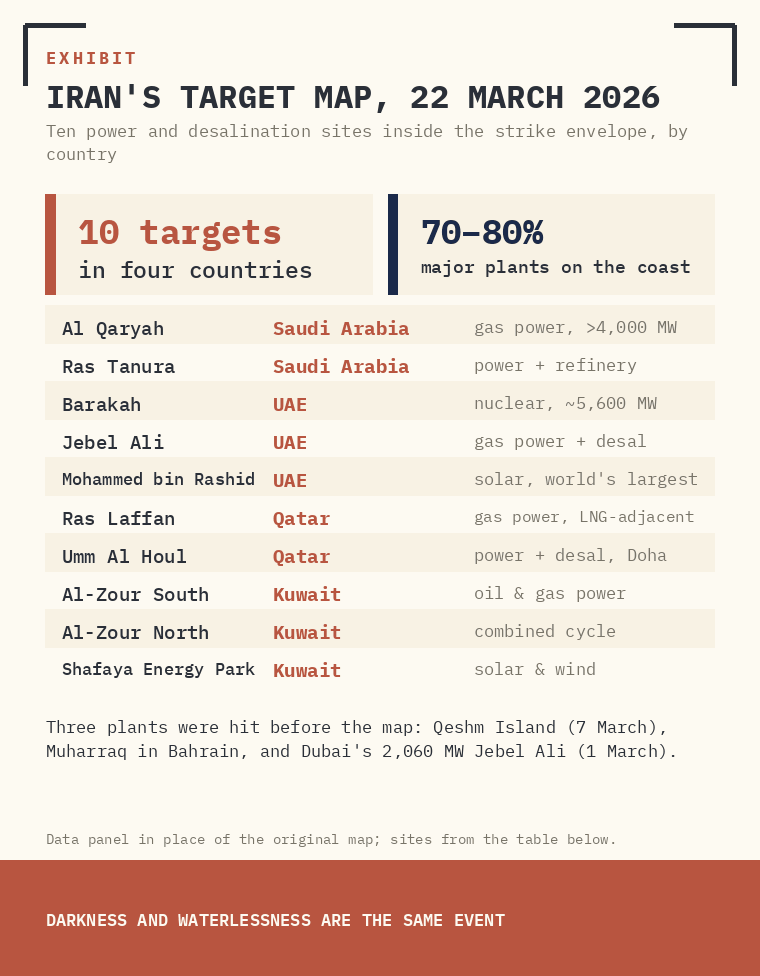
Supplied archive exhibit · original labels. Read alongside the editorial corrections.
LOCATION | COUNTRY | FACILITY TYPE | CAPACITY / NOTE |
|---|---|---|---|
Al Qaryah — Persian Gulf coast, near Al Khobar | Saudi Arabia | Gas power plant | Over 4,000 MW |
Ras Tanura — Eastern Province | Saudi Arabia | Oil & gas power plant + refinery | Saudi Aramco's largest export terminal |
Barakah — Al Dhafra region, Abu Dhabi | UAE | Nuclear power plant | ~5,600 MW across four units (Arab world's only nuclear plant) |
Jebel Ali — South Dubai | UAE | Gas power & desalination plant | Several thousand MW; UAE's largest combined facility |
Mohammed bin Rashid Solar Park — South Dubai | UAE | Solar power plant | World's largest single-site solar project |
Ras Laffan — North Qatar | Qatar | Gas power plant | Qatar's largest power plant; adjacent to LNG facilities |
Umm Al Houl — South Doha | Qatar | Gas power & desalination plant | Several thousand MW; primary Doha water supply |
Al-Zour South — South Kuwait | Kuwait | Oil & gas power plant | Very high capacity |
Al-Zour North — South Kuwait | Kuwait | Combined cycle power plant | Several thousand MW |
Shafaya Energy Park — West Kuwait | Kuwait | Solar & wind renewable facility | Kuwait's largest renewable energy project |
Iran's Revolutionary Guards added a final condition: the Strait of Hormuz would be completely and permanently closed if Trump executed his threat — and would not reopen until Iranian power plants are fully rebuilt. The IRGC commander simultaneously announced that Iran's military doctrine had shifted from defensive to offensive. 'War equations are shifting rapidly,' said Brigadier General Zolfaghari. 'Expect surprises.'
Three Plants Already Struck: The Precedent That Preceded the Map
The ultimatum exchange of 22 March did not emerge from a clean slate. It was the culmination of a three-week pattern of infrastructure targeting. On 7 March, Iran accused the US of striking a desalination plant on Qeshm Island, cutting water to thirty villages. The US denied it. Twenty-four hours later, Bahrain confirmed an Iranian drone struck one of its desalination plants near Muharraq. In Kuwait, debris from an intercepted projectile sparked a fire at the Doha West power and water complex. On 1 March, Iran struck the Jebel Ali power station in Dubai — the UAE's largest combined power and desalination facility at 2,060 megawatts. Three plants hit before Ghalibaf's tweet. Before the Iranian target map. Before the Khatam al-Anbiya statement.
The UN University's water expert Kaveh Madani warned publicly on 22 March that desalination plants could be struck again 'within the next few days.' Independent assessments held that systematic strikes could lead to a large-scale humanitarian and economic crisis. Human-rights monitors cautioned that attacks on water and electricity systems could constitute war crimes.
Three plants hit before the ultimatum. A map published. A military command statement naming desalination. This is no longer a risk scenario — it is an active targeting doctrine.
This is the context for everything that follows. The dependency data, the Jubail pipeline, the 8-million-person capital with a week of water supply — these are not background colour. They are the reason the map matters. Understanding what a desalination plant does, and what the Gulf looks like without it, is now a prerequisite for understanding the war.
II. THE GEOGRAPHY OF THIRST — WHY DESALINATION IS THE REAL STORY
The Gulf war has been covered primarily as an energy conflict. Oil at $113 a barrel. The Hormuz chokepoint. LNG flows disrupted. These are real and material. But the Iranian target map, the Ghalibaf tweet, and the Khatam al-Anbiya statement have shifted the centre of gravity to something markets have not priced: the physical water supply of a 62-million-person region that has no rivers.
To understand why Iran's targeting threat matters more than almost any other development in this conflict, you need to understand one structural fact: in the Gulf, power and water are the same infrastructure. Destroy the power grid, and desalination stops. When desalination stops, water stops. When water stops in a region with no rivers, no lakes, and no groundwater reserve sufficient for urban populations, the humanitarian clock starts — measured in days, not weeks.
III. FLOW
CAPITAL AND COMMODITY MARKETS UNDER STRESS
The market response as of 23 March 2026 is not a panic — it is structured de-risking. Asian equities fell 3.7%, on course to enter a correction. European and US futures extended those losses. The MSCI All Country World Index is down nearly 4% year-to-date. Gold, historically the haven of choice, has reversed its year-to-date gains entirely, dropping over 6% in a single session. This is not a gold crash — it is a liquidation cascade as leveraged positions meet rising margin requirements across a simultaneous bond selloff.
The bond market is the more dangerous signal. US Treasuries are posting a third consecutive week of losses. Short-duration notes led the rout. The Fed, which had been expected to cut, is now being priced as a potential hiker if the oil shock proves inflationary and persistent. Brent above $100 for a sustained period is not an inflation nudge — it is an inflation shock, with second-order effects running through diesel, freight, fertiliser, and food.
Gold has reversed its entire year-to-date gains in a single session. This is not panic — it is structured de-risking under stagflationary pressure.
The commodity flow picture is asymmetric. Brent and WTI have surged over 70% this year. Silver has entered a disorderly range. The dollar is strengthening, compounding pressure on EM currencies already absorbing the energy shock. India's rupee has hit a record low — a direct consequence of import cost expansion in an economy that runs a structural current account deficit on crude. The Hormuz closure has forced a fundamental repricing of tail risk across all asset classes that pass through the Gulf.
ASSET / INDICATOR | LEVEL | MOVE |
|---|---|---|
Brent Crude | $113/bbl | +0.9% session; +70% YTD |
WTI Crude | $100.40/bbl | +2.2% session |
Gold (spot) | $4,205/oz | −6.4% session; erased YTD gains |
10Y US Treasury | 4.42% | +4bps; highest in months |
MSCI Asia Pacific | −3.7% | Third consecutive day of losses |
South Korean Won | Lowest since 2009 | Safe-haven flight underway |
Indian Rupee | Record low | Crude import shock transmission |
Bitcoin | $67,763 | −0.6% |
IV. RISK
THE DESALINATION CHOKEPOINT
A Geography Without Rivers
The structural risk that markets have not yet fully priced is not the oil shock — it is the water shock. The foundation of that risk begins with a basic geographical reality: the Persian Gulf states have no permanent rivers. None. From Bahrain to Saudi Arabia, Kuwait to the UAE, these are desert nations whose only natural freshwater sources are seasonal wadis — channels that carry water only during rare rainfall events — and groundwater reserves that are being depleted faster than they can be replenished.
Supplied archive exhibit · original labels. Read alongside the editorial corrections.
This is not a recent problem. It is a structural condition that the oil wealth of the 1970s and beyond was deployed to solve — through desalination. The technology worked. Cities that had no right to exist at their current scale — Dubai, Riyadh, Doha, Kuwait City — were built on the back of seawater conversion. The Gulf's leap into modernity was, in the most literal sense, built on desalinated water. And that infrastructure is now under fire.
The Scale of the System: 7.2 Trillion Litres
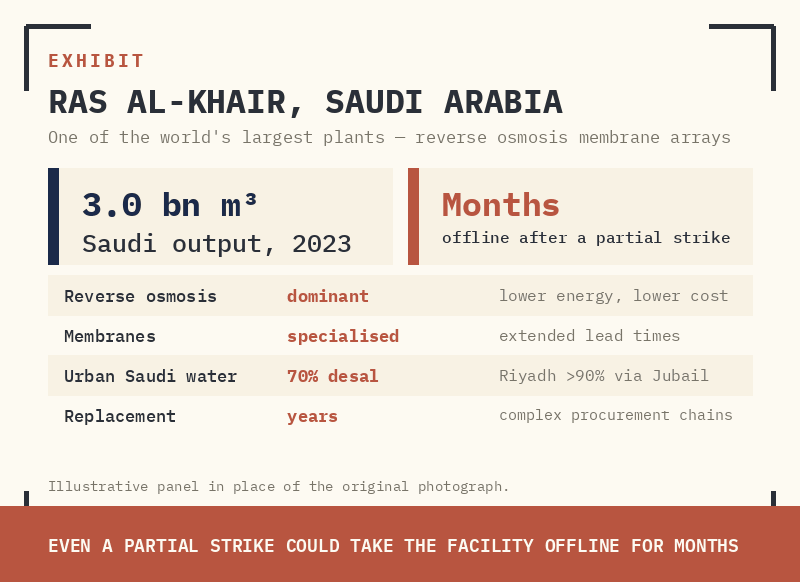
The six GCC states — Bahrain, Kuwait, Oman, Qatar, Saudi Arabia and the UAE — operate more than 400 desalination plants along their coastlines, producing roughly 40% of the world's total desalinated water. In 2023 alone, they collectively produced 7.2 billion cubic metres — approximately 1.9 trillion gallons — of freshwater through this process. Saudi Arabia led output at 3 billion cubic metres, followed by the UAE at 1.9 billion, Kuwait at 0.8 billion, Qatar at 0.7 billion, Oman at 0.5 billion, and Bahrain at 0.3 billion.
Supplied archive exhibit · original labels. Read alongside the editorial corrections.
These numbers represent the entire water security architecture of a 62 million-person region. The UN threshold for absolute water scarcity is 500 cubic metres per capita per year. With average natural freshwater availability of only 120 cubic metres per capita, the GCC runs at roughly one-quarter of the scarcity threshold before desalination is factored in. The plants are not a supplement — they are the system.
State-by-State Dependency: Where Disruption Becomes Catastrophe
The degree of exposure varies significantly across GCC states, but the direction is uniform: for drinking water, all six are critically dependent on desalination. The chart below maps total water supply by source for each state. Qatar leads at 61% desalination dependency for total supply — but its drinking water dependency exceeds 99%. Bahrain sits at 59% total, with drinking water above 90%. Kuwait at 47% total, but near-entirely dependent for potable supply. The UAE balances desalination against groundwater, but Dubai — its largest city — relies on desalination almost exclusively.
Supplied archive exhibit · original labels. Read alongside the editorial corrections.
COUNTRY | DESALIN. SHARE OF TOTAL WATER | DRINKING WATER DEPENDENCY |
|---|---|---|
Qatar | 61% | >99% of drinking water |
Bahrain | 59% | >90% of drinking water |
Kuwait | 47% | Near-total; 90% per independent estimates |
UAE | 41% | High; Dubai near-fully dependent |
Oman | 23% | Significant urban reliance |
Saudi Arabia | 18% (total); 70% (urban) | Riyadh: >90% via Jubail pipeline |
Why These Plants Are Both Essential and Fragile
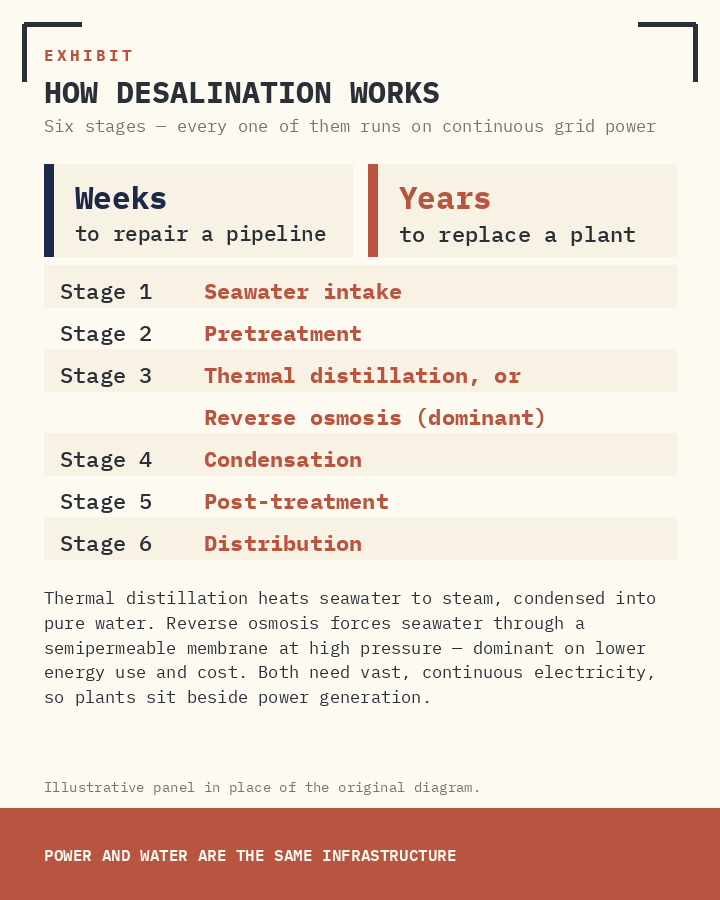
Understanding the vulnerability requires understanding the technology. Desalination operates primarily through two methods: thermal distillation, which heats seawater to produce steam that is then condensed into pure water, and reverse osmosis, which forces seawater through a semipermeable membrane at high pressure. Reverse osmosis has become dominant due to its lower energy requirements and cost efficiency. Both methods require vast, continuous electricity supply — which is why desalination plants are almost invariably co-located with power generation facilities.
Supplied archive exhibit · original labels. Read alongside the editorial corrections.
This co-location is the operational vulnerability. Iran struck a power station in Fujairah, UAE, that keeps one of the world's largest desalination plants running. A direct hit on the desalination plant is not required — degrading the power infrastructure produces the same result. The recovery timeline is also asymmetric: repairing a damaged pipeline may take weeks, but replacing a destroyed desalination plant requires years and complex procurement chains that most Gulf states cannot currently access without international partner involvement.
Supplied archive exhibit · original labels. Read alongside the editorial corrections.
Supplied archive exhibit · original labels. Read alongside the editorial corrections.
The Jubail Chokepoint: A Single Pipeline Supplying a Capital City
The Jubail desalination plant on the Saudi Persian Gulf coast deserves specific attention. It supplies Riyadh — a city of over 8 million people — with more than 90% of its drinking water via a 500-kilometre pipeline. A 2008 US embassy cable stated explicitly that Riyadh would have to evacuate within a week if Jubail, its pipelines, or associated power infrastructure were seriously damaged. That same cable concluded: the current structure of the Saudi government could not exist without the Jubail plant.
The current structure of the Saudi government could not exist without the Jubail desalination plant. — US Embassy Riyadh cable, 2008.
This is not an abstract vulnerability. It is a single-point-of-failure in the institutional architecture of the world's largest oil exporter. The Saudis have since reinforced their water network and built some redundancy, but the fundamental geometry has not changed: a capital city of 8 million, supplied by a coastal plant, connected by a 500-kilometre pipeline, all within range of Iranian ballistic missiles. The strategic reserve buffer for most Gulf states is measured in days, not weeks.
Iran's Internal Water Collapse: The Aggressor Is Also the Victim
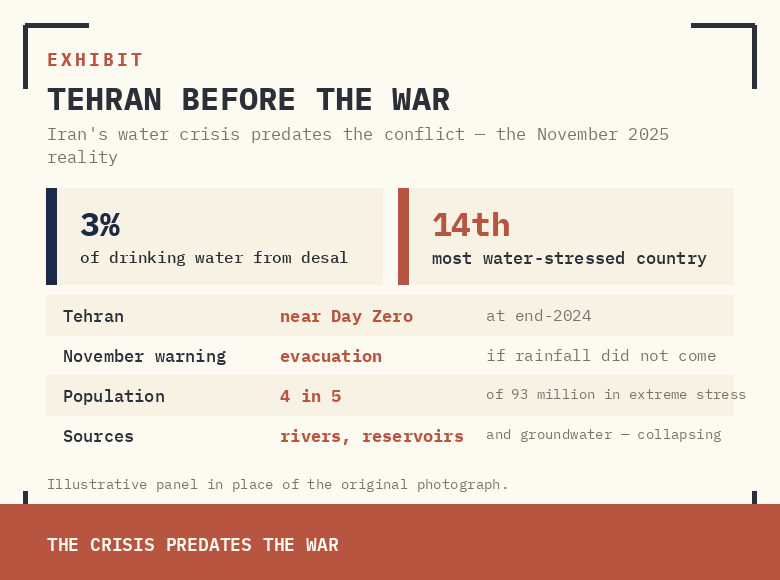
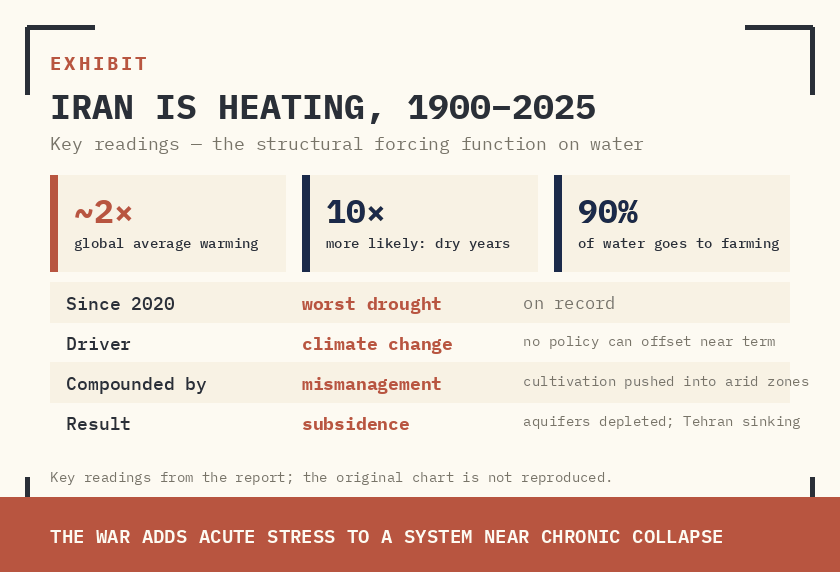
Iran's own water position is, paradoxically, equally precarious — though structured differently. Unlike Gulf states, Iran draws only 3% of its drinking water from desalination, relying instead on rivers, reservoirs, and groundwater. But those sources are collapsing. Tehran was approaching Day Zero for water at end-2024. President Pezeshkian issued an unprecedented public warning in November that the capital may need to be evacuated if rainfall did not materialise. Iran is ranked the 14th most water-stressed country globally, with over four-fifths of its 93 million people facing extremely high water stress.
Supplied archive exhibit · original labels. Read alongside the editorial corrections.
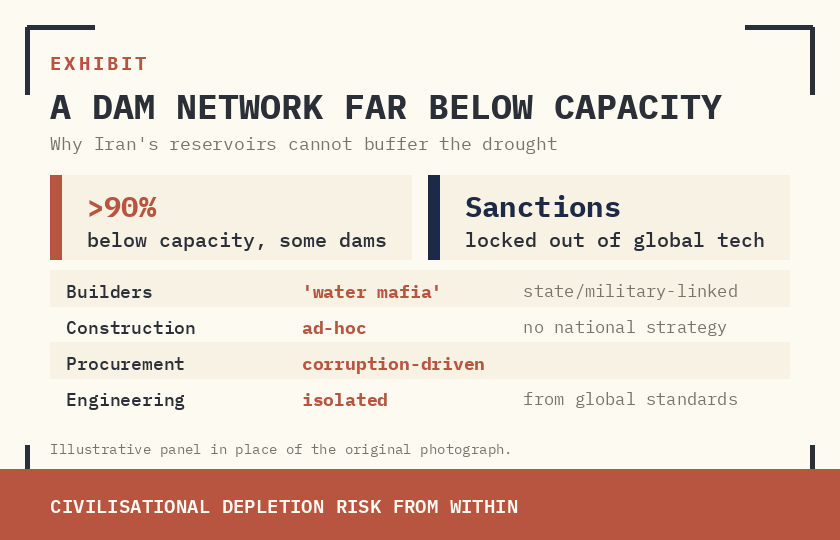
Since 2020, Iran has experienced its worst drought on record. Years with very little rain are now ten times more likely than before industrialisation, according to climate-attribution studies. Climate change is the structural driver — but Iran's internal mismanagement has compounded the crisis. The country's so-called 'water mafia' — a network of contractors tied to the state and military that built infrastructure with no cohesive national strategy — left a legacy of dams and reservoirs operating more than 90% below capacity in some cases. International sanctions barred multinational technology companies, locking Iran out of global desalination and water infrastructure advances.
Supplied archive exhibit · original labels. Read alongside the editorial corrections.
The conflict is unfolding in the world's most water-stressed region. The consequences are not symmetric: Gulf states face infrastructure destruction risk from outside, while Iran faces civilisational depletion risk from within. Both converge on the same outcome — an inability to sustain urban populations at their current scale in a prolonged confrontation.
Supplied archive exhibit · original labels. Read alongside the editorial corrections.
Farming consumes 90% of Iran's water. The current regime has prioritised agricultural self-sufficiency, expanding cultivation into arid zones that require disproportionate irrigation — depleting aquifers, tapping groundwater, and triggering land subsidence in Tehran and other cities. This is not a problem that ends with the war. It is a multi-decade reckoning that the war is accelerating.
V. PRICE
WHAT IS AND IS NOT IN THE MARKET
Current market pricing reflects an oil-and-inflation shock thesis. It does not reflect a water-infrastructure destruction thesis. These are categorically different scenarios with different asset implications.
The oil shock is visible: Brent at $113, WTI at $100, 70%-plus gains year-to-date, with inflationary second-order effects already being telegraphed in bond markets. The Fed pivot has been unwound. Central banks globally are being forced to lean hawkish even as growth slows. This is textbook stagflation — the worst policy environment, because rate hikes slow demand but do nothing for supply-side energy shocks.
The water shock is not priced. If Iranian forces were to execute a coordinated strike on Gulf desalination infrastructure, the consequences would cascade well beyond the immediate humanitarian crisis. Saudi Aramco's production capacity depends on a functioning state capable of operating and protecting its oil fields. A Riyadh evacuation scenario — however low its probability remains — is an existential threat to global crude supply, not merely a regional water crisis. Fertiliser producers dependent on Gulf gas, shipping lanes dependent on Gulf stability, and emerging market importers already absorbing the Hormuz closure would face a secondary shock of an entirely different magnitude.
The oil shock is in the price. The water shock is not. A coordinated desalination strike would trigger an existential threat to Saudi Aramco's operational architecture — and that risk has near-zero probability priced in.
Gold's 6% single-day drop signals forced liquidation rather than a rational reassessment of its haven properties. Under a genuine water-infrastructure escalation, gold's reassessment as a store of value in a world with disrupted commodity supply chains would likely be significant. The current selling reflects margin calls and portfolio rebalancing — not a loss of haven premium.
VI. POSITION
ANALYTICAL FRAMEWORK FOR PORTFOLIO AND RISK DESKS
The Buy Side Lens framework resolves to the following positioning framework under the current scenario:
SCENARIO | PROBABILITY* | ASSET IMPLICATION |
|---|---|---|
Base: Hormuz closed; no new desal strikes | 45% | Crude $100–120; stagflation premium in rates; EM FX weak |
Bull: Ceasefire / partial reopening within 2 weeks | 20% | Crude retraces to $75–85; bond rally; EM recovery |
Stress: Jubail or equivalent major plant struck | 15% | Crude spike to $140+; Saudi political risk premium; food shock |
Tail: Coordinated multi-plant strike across Gulf | 5% | Non-linear crude; global food and fertiliser crisis |
Extended standoff: Iran hunkers down, attrition | 15% | Slow-burn stagflation; dollar strength; EM debt distress |
* Probability estimates are analytical judgements, not market-derived. Scenario definitions are proprietary to the Buy Side Lens framework.
Energy. Long crude remains the consensus trade. The more important question is duration: how long does the Hormuz disruption persist? Iran's stated strategy — survive, outlast, treat survival as victory — implies an extended standoff. The Saudi pipeline alternative (East-West pipeline to Yanbu) is operational but cannot substitute for Hormuz volume at scale, particularly for LNG.
Rates. The Fed is paralysed. A rate hike into a growth slowdown is politically and economically toxic, but tolerating sustained oil-driven inflation is equally untenable. The bond market has made its call: three consecutive weeks of selloff, short-duration leading. Duration risk remains elevated. Steepening trades have rationale in a stagflationary regime.
EM. India is the most exposed large emerging market. The rupee is at a record low, reflecting crude import costs, Hormuz disruption, and reduced inflows. India's LNG dependency and crude import volume position it as the primary EM transmission mechanism for this shock. Defensive positioning in INR-denominated assets is warranted until Hormuz resolution becomes visible.
Tail risk hedging. Options markets are expensive but not irrational given the scenario distribution. The water-infrastructure escalation risk is a non-linear, low-probability, extreme-consequence event. Portfolio managers with Middle East energy exposure should examine whether current option premia reflect the Jubail scenario. They almost certainly do not.
Iran's strategy is to survive. Survival, in Tehran's calculus, is victory. That implies duration — and duration is the variable markets are consistently underpricing.
CLOSING ASSESSMENT
Water was always the silent variable in Middle Eastern geopolitics. The CIA identified it in the 1980s. Saddam weaponised the logic in 1991. The Iran war of 2026 has brought it back to the centre of the strategic equation. Three desalination plants struck, a 48-hour ultimatum on the table, and Riyadh's entire water supply sitting on a single pipeline. Tehran's own reservoirs going dry. A region heating at twice the global average.
The market is pricing an oil shock with inflationary consequences. It is not pricing the institutional fragility of the world's largest oil exporter sitting downstream of a deliberately targetable water chokepoint — nor the internal water collapse of the country doing the targeting. The Buy Side Lens assessment is that the base case remains an extended standoff with continued crude premium, but the tail risk distribution has shifted meaningfully towards non-linear outcomes. That shift is not yet reflected in volatility surfaces or credit spreads.
Duration, desalination, and dollar strength are the three variables that will determine whether this resolves as a contained regional shock or a structural inflection in global commodity and monetary architecture. Oil is essential. Water is irreplaceable.