Original Lens and publication context
Eighty-one listed Chinese suppliers, a 20% revenue jump, and a stockpile asymmetry that has flipped against Washington — with India sitting inside the same envelope.
- Eighty-one mainland-listed Chinese firms now disclose work on the two state primes' missile programmes, more than double the 2013 count. Their 2025 revenue hit ¥189bn (~$28bn), up 20% against a contracting CSI 300, and ~40% reported their best year of the Xi era.
- The Pentagon puts China's arsenal at 3,150 ballistic and 300 ground-launched cruise missiles, up 147% and 50% since 2015 — a stockpile build that coincides with the US precision-munitions drawdown from the Iran campaign. The asymmetry has flipped against Washington.
- India sits inside the same DF-26 envelope with an unverified, definition-sensitive ballistic inventory estimate and hypersonics one generation behind, but a ~$79bn defense budget growing 13%, a 509-item indigenization list, a $2.5bn export run-rate and Operation Sindoor's combat validation drive a parallel rerating.
- Risks: China's 2026 outlay grows only 7%, the Rocket Force purge could reintroduce execution drag, and US Entity List expansion compresses optionality for USD-mandated capital. Thursday's Trump-Xi summit in Beijing is the binary near-term catalyst.
- Position, six to eighteen months: overweight India's indigenous defense complex — primes, sub-component makers, drone and simulation names; stay long US munitions primes for a replenishment cycle longer than order books imply; add Japanese and Korean primes; hedge Taiwan risk into the summit.
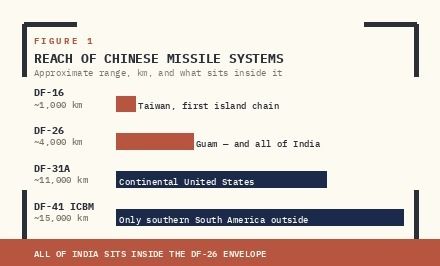
Before the numbers, the surface area. China's Dongfeng family covers Taiwan and the first island chain at ~1,000 km (DF-16), Guam at ~4,000 km (DF-26), the contiguous US at ~11,000 km (DF-31A) and out to the limits of intercontinental range with the DF-41. All of India sits comfortably inside the DF-26 envelope — the same “Guam Express” class that defines the second-island-chain threat for the United States.
FIGURE 1 · REACH OF CHINESE MISSILE SYSTEMS
Supplied archive exhibit · original labels. Read alongside the editorial corrections.
TRIGGER
THE VISIBLE TIP OF AN OPAQUE BUILDUP
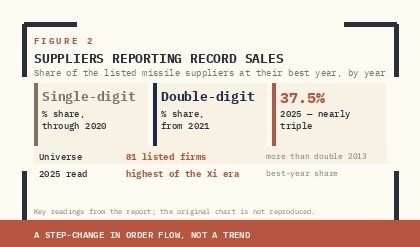
Eighty-one mainland-listed firms now disclose involvement in the missile programmes run by the two state primes — CASIC and CASC. That number has more than doubled since 2013. Within that universe, ~40% reported 2025 as their best revenue year of the Xi era — the highest such share of any year in his tenure. Aggregate 2025 sales hit ¥189bn (~$28bn), up 20% YoY against a contracting CSI 300. First-quarter 2026 data extends the trajectory: supplier revenue +20% YoY versus +2.4% for the broader index.
FIGURE 2 · SHARE OF SUPPLIERS REPORTING RECORD SALES
Supplied archive exhibit · original labels. Read alongside the editorial corrections.
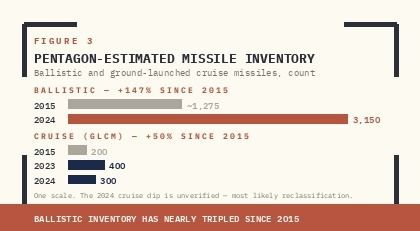
The Pentagon's most recent estimate puts China's arsenal at 3,150 ballistic missiles and 300 ground-launched cruise missiles — up 147% and 50% from 2015, respectively. The corporate filings now provide a coincident indicator that the production cadence behind those stockpile numbers is accelerating, not plateauing.
FIGURE 3 · PENTAGON-ESTIMATED CHINESE MISSILE INVENTORY
Supplied archive exhibit · original labels. Read alongside the editorial corrections.
“The number of disclosed suppliers has more than doubled since Xi took office, and 2025 saw the highest share of record-revenue years of the entire Xi era.”
FLOW
Figure 01 · Conceptual framework
From defence budget to supplier capability
WHERE THE CAPITAL IS MOVING
Orders flow from the PLA through CASIC and CASC into a tier-2 ecosystem that is increasingly civilian, publicly listed, and raising capital on mainland exchanges. Three archetypes:
- Sensors and seekers — Wuhan Guide Infrared (+73% YoY); defense ~70% of sales; one of the few civilians permitted full weapon assembly; subsidiary already on US/EU sanctions lists.
- Navigation and guidance — Yangtze Optical Electronic (+20% YoY); fiber-optic coils for ballistic and cruise missile gyroscopes; CASIC entities ~43% of 2019-21 revenue.
- Signature management — Chengdu JC Technology (+16% YoY); radar-absorbent stealth coatings for jets, ships and missiles; CASC is primary client.
Of the 81-firm universe, 22 serve both ballistic and cruise programmes — the highest-conviction names. Another 15 are cruise-specific, the deep-strike systems most relevant to a Taiwan contingency.
RISK
WHAT COULD BREAK THE TRAJECTORY
Budget deceleration — China's 2026 outlay grows 7%, the slowest since 2022. The purge — PLA Rocket Force leadership has been cleaned out; microwave-weapons expert Liu Guozhi removed; procurement tightening could re-introduce execution drag. Sanctions overhang — US Entity List expansion would compress optionality for USD-mandated capital; chip-access curbs cap the AI-targeting roadmap. The binary near-term catalyst is Thursday's Trump-Xi summit in Beijing — Taiwan and the Iran war framed as primary agenda items.
PRICE
WHAT THE MARKET IS DISCOUNTING
The cleanest mispricing is the stockpile gap. US large-cap defense trades on backlog visibility and book-to-bill. The Iran-driven replenishment narrative is partially priced; the simultaneous US drawdown and Chinese inventory build is not. The replenishment cycle is therefore likely to run longer and harder than current order-book multiples imply. Regionally, the Japanese and Korean defense primes are repricing on Indo-Pacific defense-spending mandates; European exposure benefits from the parallel NATO cycle and is a partial substitute hedge.
“US munitions backlogs reflect what the Pentagon has ordered. They do not yet reflect what the Pentagon will need to order once the post-Iran inventory audit is complete.”
INDIA LENS — COMPARABILITY AND IMPLICATIONS
India sits inside the DF-26 envelope alongside Guam. The asymmetry that has flipped against Washington is, in proportional terms, more acute for Delhi — a potentially substantial but unverified gap on comparable ballistic inventory and a qualitative gap on hypersonics that is roughly one operational generation. The comparison frame, however, runs both ways.
METRIC | CHINA | INDIA | READ |
|---|---|---|---|
Ballistic missile inventory | ~3,150 | ~150-200 est. | 15-20x gap |
Cruise missile inventory | ~300 GLCM | ~70-100 (BrahMos family) | 3-4x gap |
Defense budget FY26 | ~$245bn | ~$79bn | 3.1x absolute |
Defense budget growth | +7% | +13% | India faster |
Listed missile-relevant suppliers | 81 firms | ~30-40 names | Catching up |
Aggregate listed defense revenue | ¥189bn (~$28bn) | ~$8-10bn est. | ~3x gap |
Operational hypersonic systems | DF-17, YJ-21 deployed | BrahMos-II, HSTDV test | One generation |
Combat validation (recent) | Limited since 1979 | Operation Sindoor, May 2025 | India tested |
Sub-component indigenization | ~85% domestic | ~70% domestic | 30% import dep. |
Strategic procurement model | State primes top-down | Positive list + SP | Private opening |
Sources: US DoD estimates, MoD India, international arms-transfer databases, listed company filings, our estimates. India figures rounded to nearest reasonable band; precise stockpile counts are not publicly disclosed.
Where India trails: production cadence (tens to low hundreds annually versus Chinese hundreds-plus), sub-component depth (RF/microwave electronics, propellants, some semiconductors still imported), hypersonic systems at flight-test maturity (BrahMos-II, HSTDV) against operational Chinese deployment, and the absence of a CASIC- or CASC-scale prime — Bharat Dynamics, the closest comparable, is a single mid-cap. Where India is positioning: the FY26 defense budget at ~$79bn is growing 13% YoY — the fastest cycle in two decades. The Positive Indigenization List restricts ~509 line items to domestic-only; defense corridors in Uttar Pradesh and Tamil Nadu are absorbing capex; the $5bn export target for 2029 is already at a $2.5bn run-rate. Operation Sindoor in May 2025 was the first live-combat validation of BrahMos, the Akash air-defense system and indigenous loitering munitions — exposing both genuine capability and the gaps still serviced by import.
POSITION
TRADE ARCHITECTURE
A six-to-eighteen-month book built around the deterrence rerating, with India as the primary regional leg rather than a satellite trade:
- India indigenous defense — the structural overweight. Tier 1: the missile, aerospace, defense-electronics and explosives primes — direct beneficiaries of the indigenization mandate with sovereign order visibility. Tier 2: the forgings, RF/microwave, electronics and precision-engineering sub-component makers — sub-component depth where the indigenization push is repricing the supply chain. Tier 3: the drone, simulation and microelectronics makers — emerging at scale.
- US munitions primes — the replenishment thesis remains intact across both summit outcomes. Overweight names with disclosed precision-munitions, hypersonic and air-defense exposure.
- Indo-Pacific regional — the Japanese and Korean defense primes. Leveraged to multi-year regional defense-spending uplift; cleaner order-flow visibility than European primes.
- Tactical hedge — TWD volatility overlay into Thursday's summit; long-vol KOSPI tech and Taiwan semiconductor proxies if cross-strait language hardens. The Taiwan AI hardware complex carries an underpriced political-risk premium.
- Avoid — pure-play Chinese defense exposure for USD-mandated funds (sanctions optionality too asymmetric); pure-play Taiwan capex stories without explicit hedging structure.
The structural call: the 81-firm Chinese disclosure base is not a 2025 anomaly — it is a multi-year industrial mobilization that will continue absorbing capital, talent and policy attention through the PLA's 2027 centenary. For Indian capital, the same external pressure is the political tailwind behind the indigenization push. Position for the duration, in Delhi as much as in Washington.