Original Lens and publication context
The asymmetric-warfare buildout has moved from battlefield doctrine into formal budget proposals. Where the capital is being forced to go next.
- The drone thesis tracked across four prior Buy Side Lens reports has entered formal budget proposals: a ~$21B FY27 base unmanned request, a proposed ~$54B autonomous-warfare reconciliation add, and a dedicated drone combatant command.
- Eurosatory 2026 confirmed the structural shift — every European prime is re-cutting its portfolio around drones, counter-drones, seekers and sensors. The pure-offense story is now a sector-wide retooling.
- The investable frontier has rotated from cheap offense to the defensive layer: counter-UAS detection, low-cost effectors, and the AI compute and command backbone that runs them.
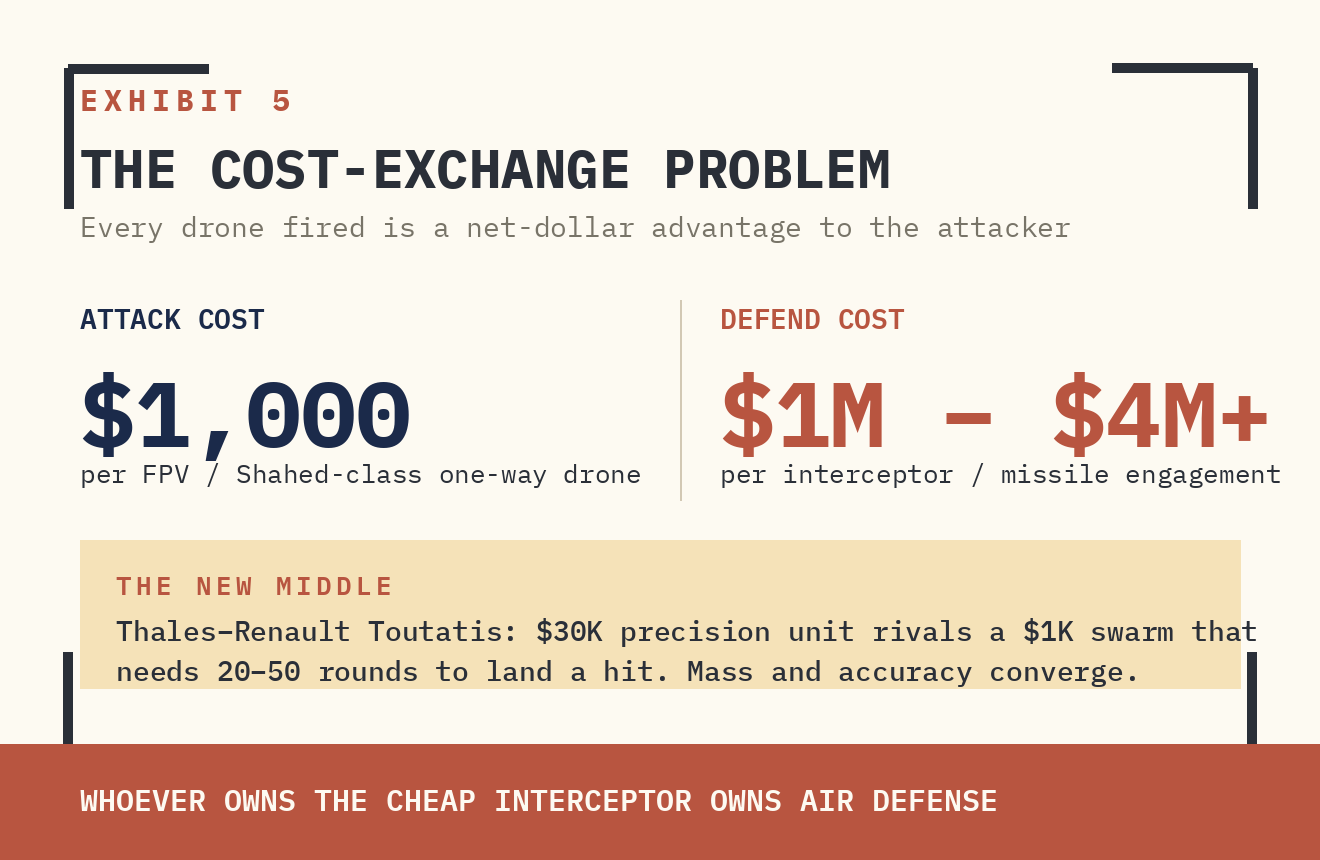
- Cost-exchange is the engine. A four-figure attack drone against a seven-figure interceptor forces a permanent structural bid under detection and cheap-kill defense.
- Positioning resolves into three sub-sectors: European sensor and effector primes, US drone and counter-UAS pure-plays, and the battlefield control plane of AI command software plus sovereign military compute.
TRIGGER
Doctrine Becomes a Budget Line
Across four prior reports — The Cheap Kill Chain, The Economic Inversion of Warfare, the Anduril and War Unicorns deep-dive, and the humanoid-robotics thesis — this desk argued a single doctrinal case: cheap, attritable, autonomous mass has inverted the economics of war. That argument no longer rests on battlefield anecdote. It has entered the authorisation and budget process.
The FY27 National Defense Authorization Act, cleared by both armed-services committees, authorizes roughly $1.15 trillion in defense spending. Inside it sits a base request near $21 billion for unmanned and autonomy programs spanning aerial, surface, undersea and ground systems, plus counter-UAS. Layered above is a proposed $350 billion reconciliation package carrying around $54 billion of incremental autonomous-systems funding through a dedicated Defense Autonomous Warfare Group line. Reporting points to the creation of a drone combatant command. The institutional reading is simple: the spending is now structural, multi-year and bipartisan.
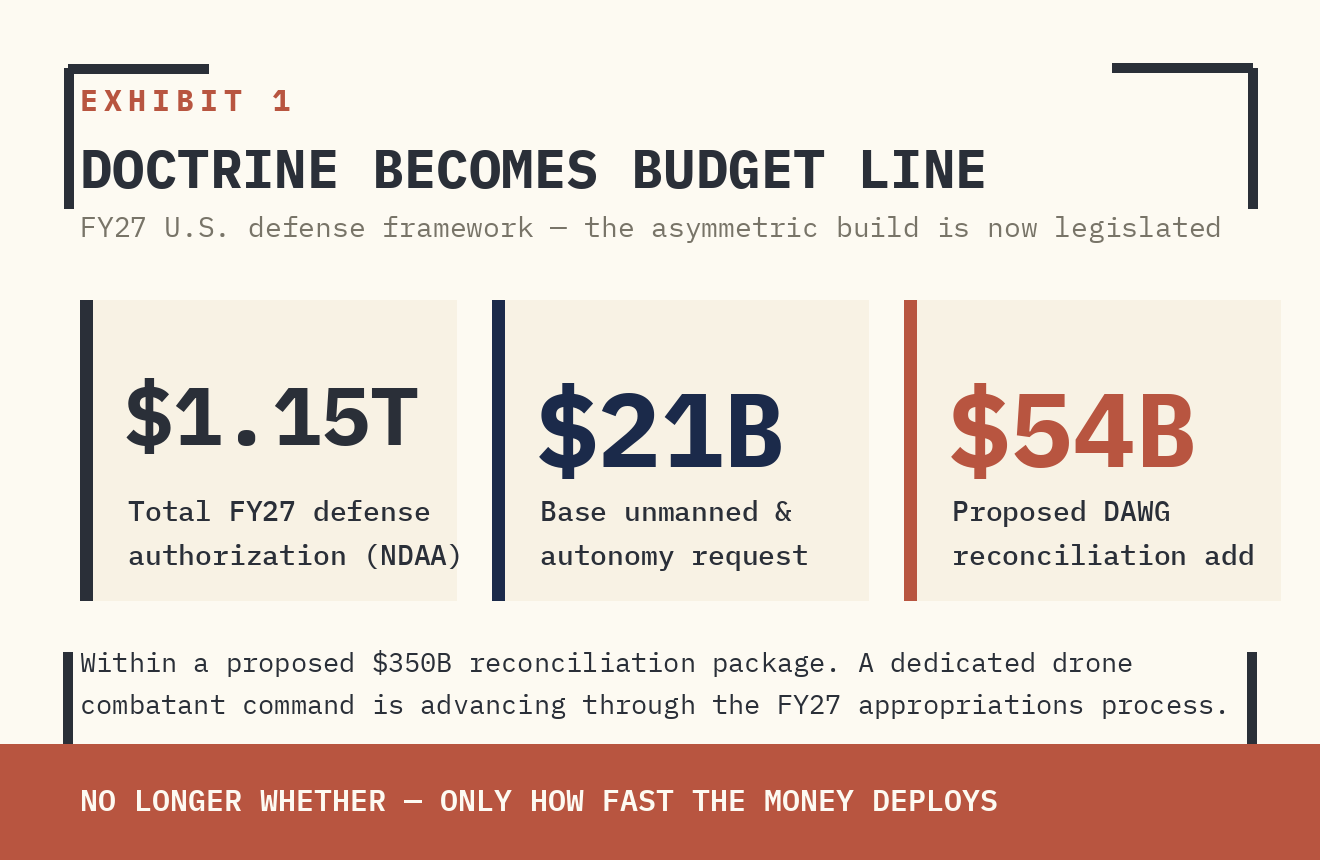
Supplied archive exhibit · original labels. Read alongside the editorial corrections.
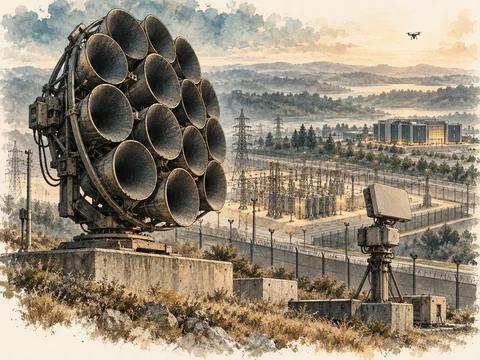
The catalyst was operational humiliation. In the Gulf, cheap Iranian Shahed-class drones erased multi-million-dollar communications, radar and command nodes, exposing a missing air-defense layer over high-value infrastructure. The institutional response is a procurement reset — source, order and stockpile low-cost one-way attack drones, interceptors and counter-UAS systems before the next conflict, not after it. The base $21 billion is intact; the $54 billion reconciliation line is the swing variable, pulled from an earlier package and still politically contested, but the direction of travel is unambiguously up.
FLOW
Where the Money Is Forced To Go
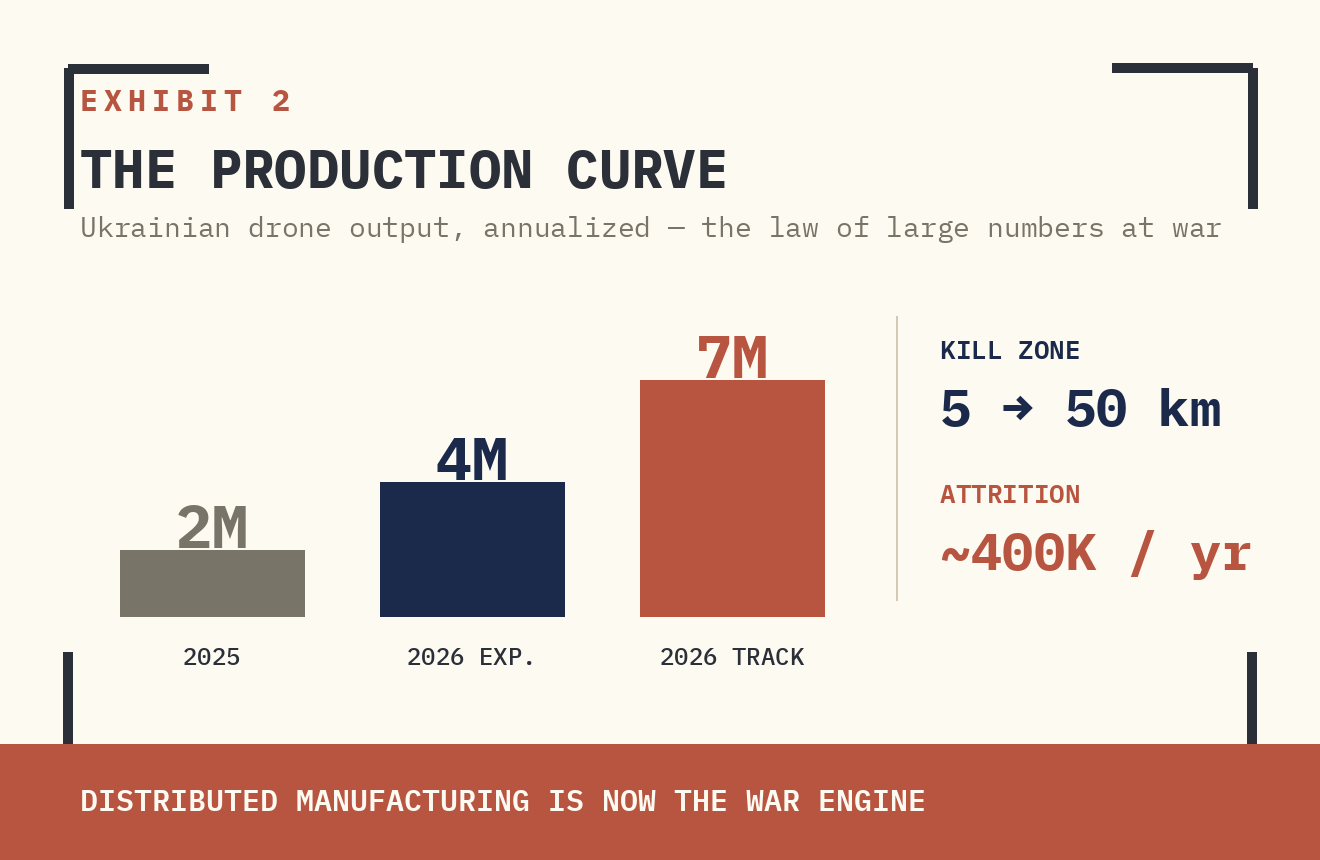
Eurosatory 2026 in Paris is the cleanest read-through on where the capital lands. A note penned from the floor by Kepler Cheuvreux took the pulse of the sector: European defense sentiment is firmly bullish, drones and counter-drones dominated the displays, and every incumbent is adapting its portfolio to the same shift. The production backdrop explains the urgency. Ukrainian drone output is annualizing from roughly two million units in 2025 toward seven million by year-end; the kill zone has widened from five kilometres to fifty; attrition is measured in the hundreds of thousands per year. Distributed workshops, not centralized assembly lines, are now the war engine.
Supplied archive exhibit · original labels. Read alongside the editorial corrections.
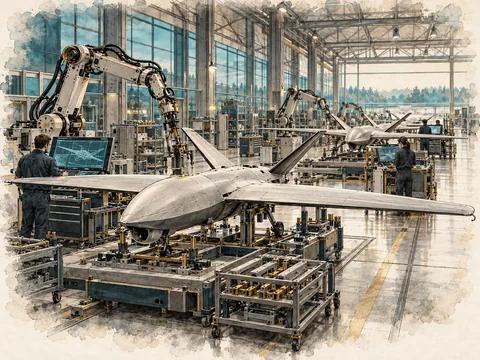
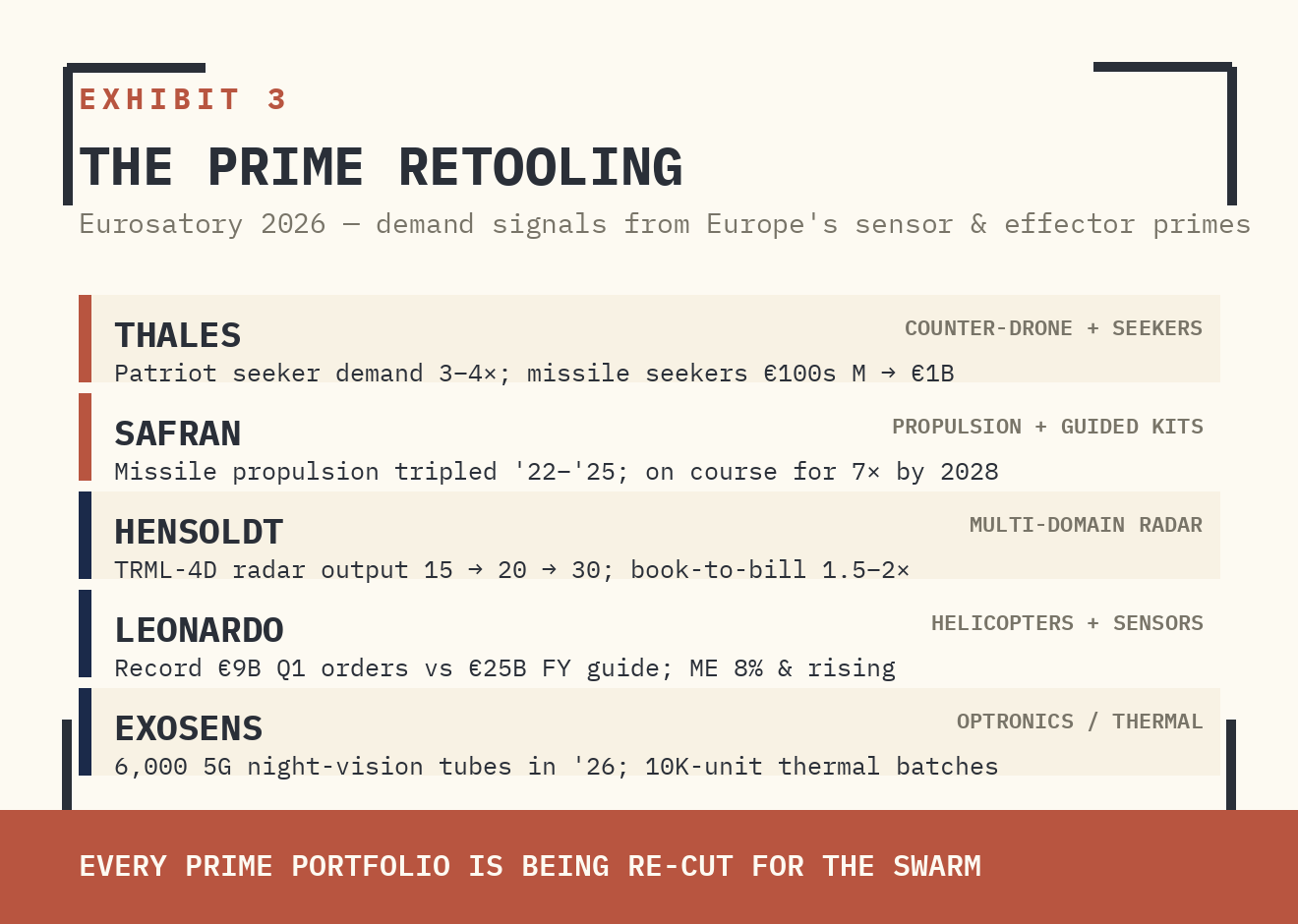
The retooling is portfolio-wide, and that is the point. Thales is scaling counter-drone effectors and its SAMP/T NG air-defense system, with Patriot seeker demand running three-to-four times higher and a missile-seeker franchise on a path from a few hundred million euros toward a billion; its venture with Renault targets a thousand low-cost Toutatis drones a month at roughly thirty thousand dollars apiece. Safran has tripled missile-propulsion revenue since 2022 and guides toward a seven-fold increase by 2028, with guided-kit demand up five-to-six times. Hensoldt is doubling radar output and running a book-to-bill between 1.5 and 2.0. Leonardo booked record first-quarter orders near nine billion euros. Exosens is supplying night-vision and thermal sensing directly into the drone industry.
Supplied archive exhibit · original labels. Read alongside the editorial corrections.
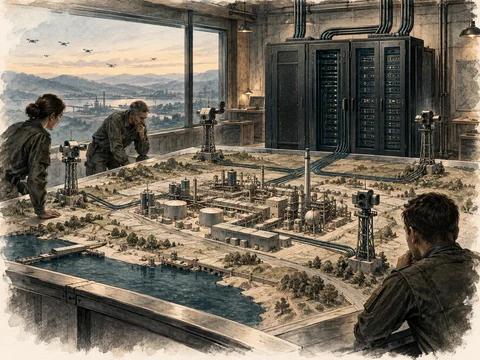
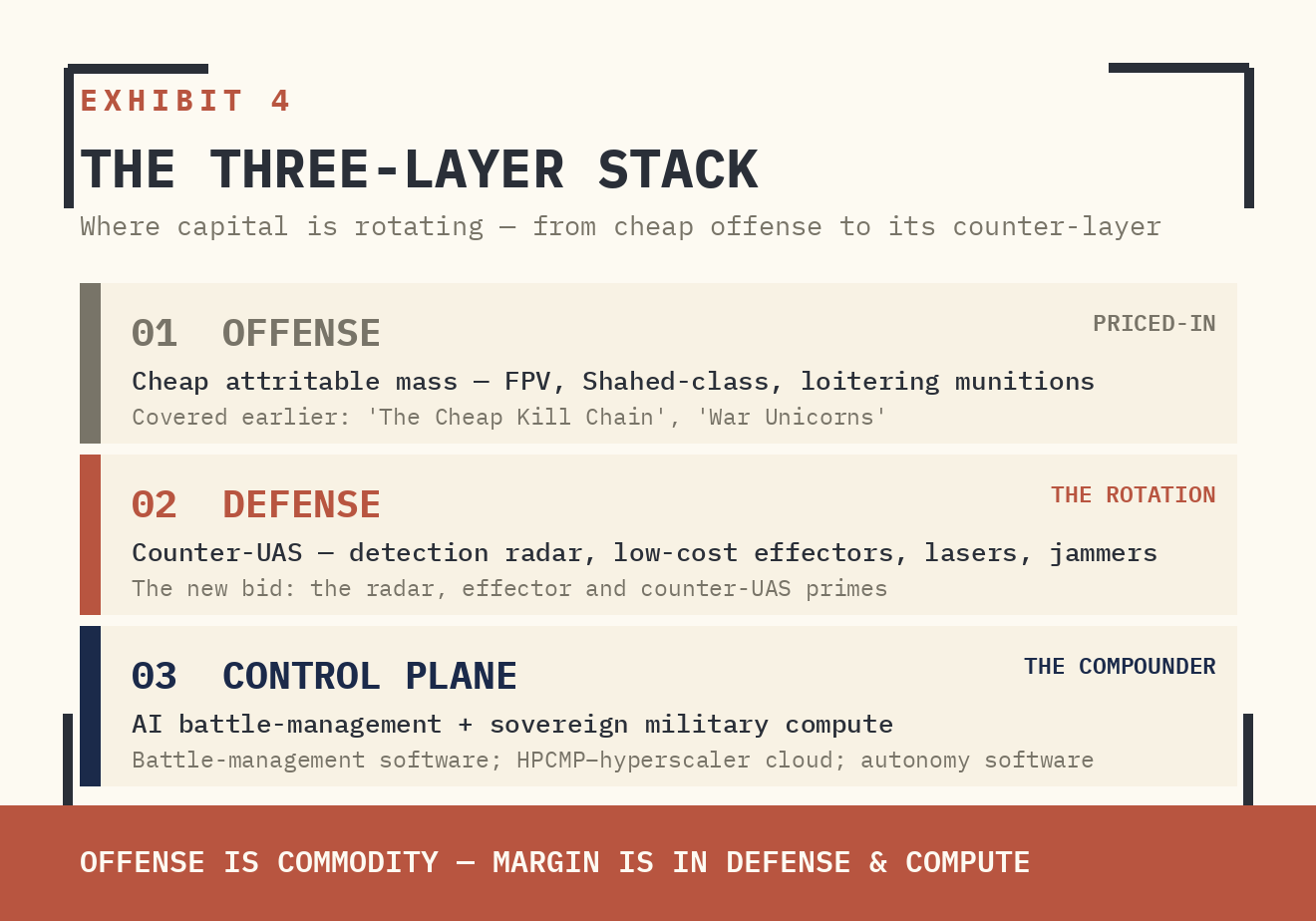
The defensive layer has become its own market. Counter-UAS has moved off the land base and onto the water: Robin Radar's maritime extension takes a combat-proven counter-drone radar to ports, shipping lanes and vessels, framed explicitly around Strait of Hormuz vulnerability. Detection paired with a cheap effector is the structural growth node. Underneath it all runs the backbone — AI warfare needs compute. The Pentagon's high-performance computing program has tapped an Argonne spinout to bridge military supercomputers with the major commercial clouds at high security, building a control plane for defense AI workloads. Software that turns raw drone sensor feeds into usable battlefield intelligence is now as decisive as the hardware.
Supplied archive exhibit · original labels. Read alongside the editorial corrections.
RISK
Figure 01 · Qualitative comparison
Three layers of the drone economy
| Layer | Economic driver | What can interrupt conversion |
|---|---|---|
| Offence | Low-cost, repeatable production | Commoditisation and supply constraints |
| Defence | Detection and affordable response | Integration and cost per engagement |
| Control and compute | Secure data movement and model execution | Procurement, interoperability and accreditation |
What Breaks the Thesis
The cost-exchange asymmetry cuts both ways. It guarantees a structural bid under detection and cheap-kill defense, but the same economics compress the margins of legacy exquisite-system platforms. The discipline is to separate the defensive and compute winners from the legacy-platform losers, rather than owning the sector indiscriminately.
Supplied archive exhibit · original labels. Read alongside the editorial corrections.
Crowding is the second risk. Defense has become a consensus long at a moment when positioning across the broader tape is already stretched — semiconductors are among the most crowded trades on the planet and AI now accounts for close to two-fifths of the S&P 500. Several primes have seen multiples expand ahead of earnings. The third and most acute risk is the ceasefire. Hensoldt has already de-rated on ceasefire concerns, and oil fell sharply on hopes of a Hormuz de-escalation; peace headlines are this sector's primary drawdown vector. The structural argument, however, survives any single ceasefire — the procurement reset is a lesson learned, not a war-duration spend. Layered on top is the specific political risk around the $54 billion reconciliation line, whose timing and passage remain uncertain.
Offense has become a commodity. The asymmetric return now sits one layer up — in the systems that defeat the swarm, and the software that commands them.
PRICE
What the Tape Already Shows
The bid is visible in the order books, not just the narrative. European backlogs are at records — Leonardo near nine billion euros in a single quarter, Hensoldt running a book-to-bill of 1.5 to 2.0, Thales absorbing jumbo air-defense and combat-aircraft orders. The demand multiples cited across the primes — Patriot seekers up three-to-four times, Safran missile propulsion on a seven-fold path — are order-book facts, not analyst forecasts. The cost curve does the rest: so long as a thousand-dollar drone forces a million-dollar interceptor, capital is pulled toward whoever closes that gap, which means cheap effectors, detection radar and directed energy.
Geography matters to the price. The majority of the European bid is European-sourced and European-funded, supported by national budget top-ups and lending facilities that favor European-made equipment; the United States adds the legislated base on top. Middle East demand is the recurring upside surprise across the radar and sensor primes. The read-through is that this is a broad, multi-region spending wave rather than a single-budget event.
POSITION
The Three Baskets
Consistent with this publication's framework, positioning is expressed at the sub-sector layer, not the individual security. The theme resolves into three baskets, each a different expression of the same structural build. Named companies are illustrations of where the spending concentrates, not recommendations.
One — European sensor and effector primes. The direct beneficiaries of the retooling: radar, seekers, optronics, guided kits and propulsion. This is the basket the Eurosatory read-through maps onto most cleanly.
Two — US drone and counter-UAS pure-plays. The procurement-supercycle basket. The public universe flagged by the sell side runs through the listed drone, counter-UAS and sensor pure-plays, with the private war-unicorn pipeline — Anduril, Shield AI, Skydio, Quantum Systems — feeding the next leg of public-market supply.
Three — the control plane. The compounder. AI battle-management software and sovereign military compute monetize regardless of which drone or which prime wins the hardware race. This is the layer where the Maven-style command software and the military-cloud backbone sit, and where the durable software margin lives.
The discipline follows from the stack. The offense layer is a commodity and largely priced. The asymmetric return sits in the defensive layer that fixes the cost-exchange problem and in the control plane that compounds across the whole build. Position the layer rather than the ticker, size for the de-rating risk that any ceasefire will deliver, and treat peace headlines as accumulation windows rather than exit signals. The war is changing shape. The budget has already followed. The capital is next.