Original Lens and publication context
Goldman Sachs just sat down with a nine-year-old private company. Here is why — for investors, for governments, and for India.
- Goldman met Anduril because the company is the leading indicator for the entire defense sector — every legacy multiple reprices off how fast this model scales.
- Affordable mass is the doctrine: cheap, simple, mass-producible weapons win wars of attrition that exquisite platforms lose.
- Lattice is the moat: the hardware deploys the software, and the software locks in the customer. This is a platform, not a products company.
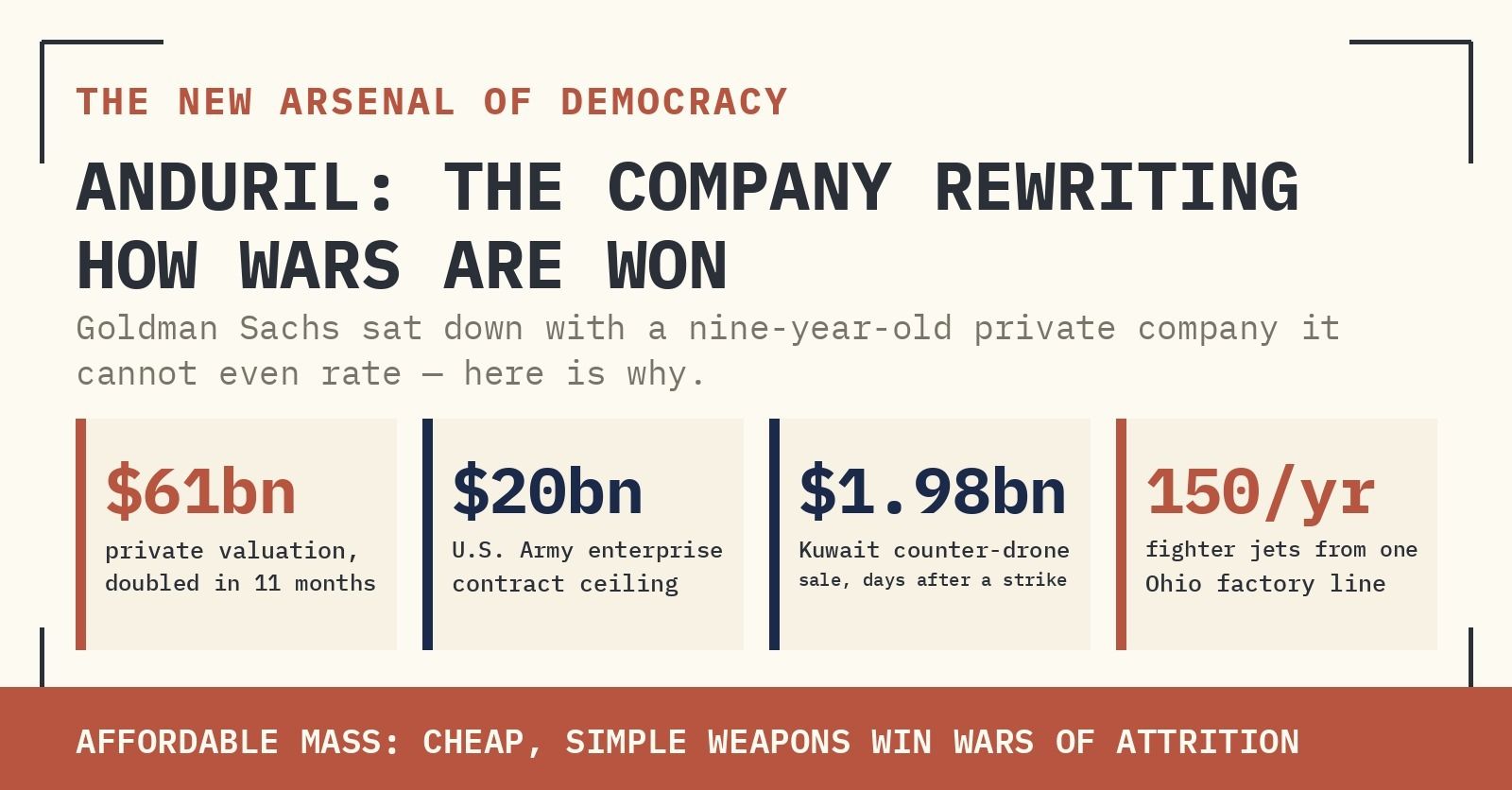
- The order book is real: a $20 billion Army ceiling, production across four services and three continents, a $2 billion export print in Kuwait — and a 5-million-square-foot factory to deliver it.
- For India, this is a syllabus: reform procurement, deepen private defense capital, build the software layer, size the magazine for attrition, and contest the Gulf counter-drone market.
Supplied archive exhibit · original labels. Read alongside the editorial corrections.
Why Goldman Sachs sat down with Anduril
In June, Goldman’s lead defense analyst hosted Anduril CEO Brian Schimpf in front of institutional investors. The stated purpose: understand how Anduril is solving the industry’s biggest bottleneck. Not technology. Not budgets. Speed. Ukraine and the Gulf proved that munitions are expended faster than factories can replace them, and that a $50,000 drone can kill a $200 million platform.
Goldman cannot even rate Anduril — it is private. It studied the company anyway, for three reasons. Every legacy defense stock Goldman covers reprices off how fast this model scales. A company that raised $11.3 billion and doubled to a $61 billion valuation in eleven months is the defense listing of a generation. And the Department of War is rebuilding procurement around the behaviors Anduril pioneered. Studying Anduril is studying the customer.
Supplied archive exhibit · original labels. Read alongside the editorial corrections.
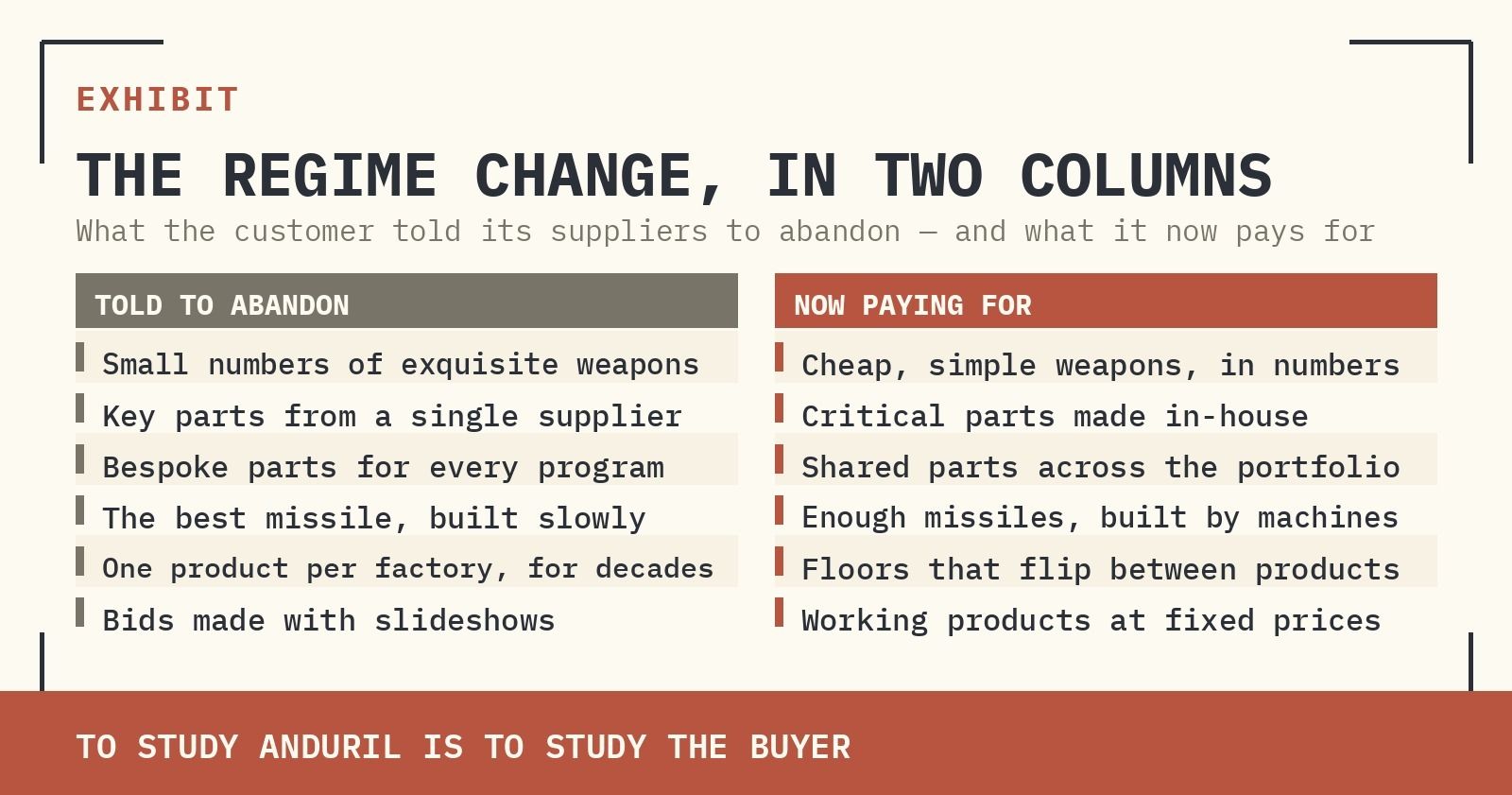
Read it this way. Two columns, one verdict. Everything in the left column is what the customer has publicly told its suppliers to abandon. Everything in the right column is what the customer is now paying for.
The doctrine: affordable mass
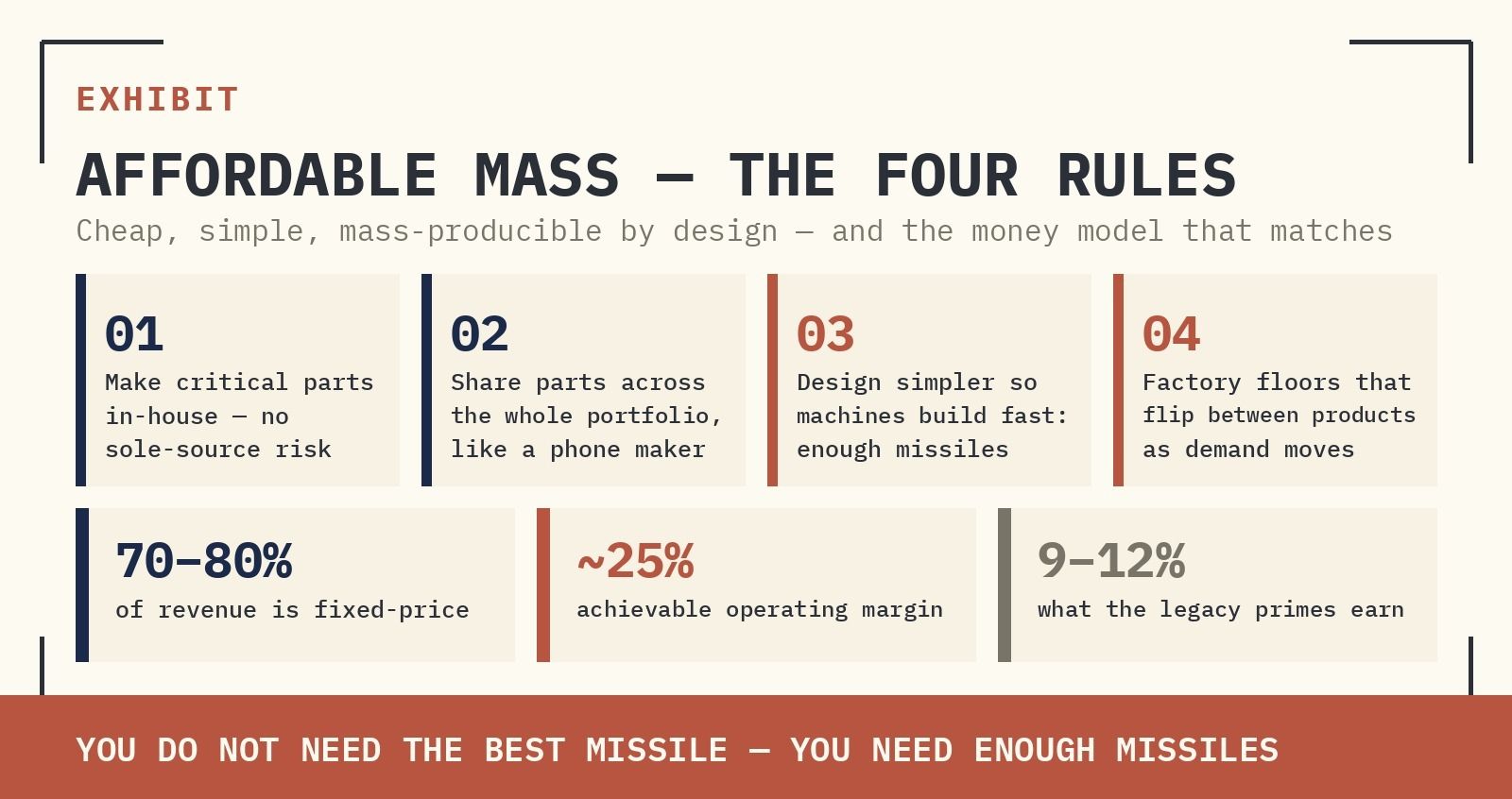
The U.S. builds small numbers of exquisite weapons. They are superb — and they run out. Anduril builds the opposite: weapons designed from day one to be cheap, simple, and mass-producible. Four rules make it work: bring critical components in-house to kill sole-source risk; share parts across the whole portfolio like a consumer-electronics company; design simpler so machines can build faster — you do not need the best missile, you need enough missiles; and build factory floors that flip between products as demand moves.
Supplied archive exhibit · original labels. Read alongside the editorial corrections.
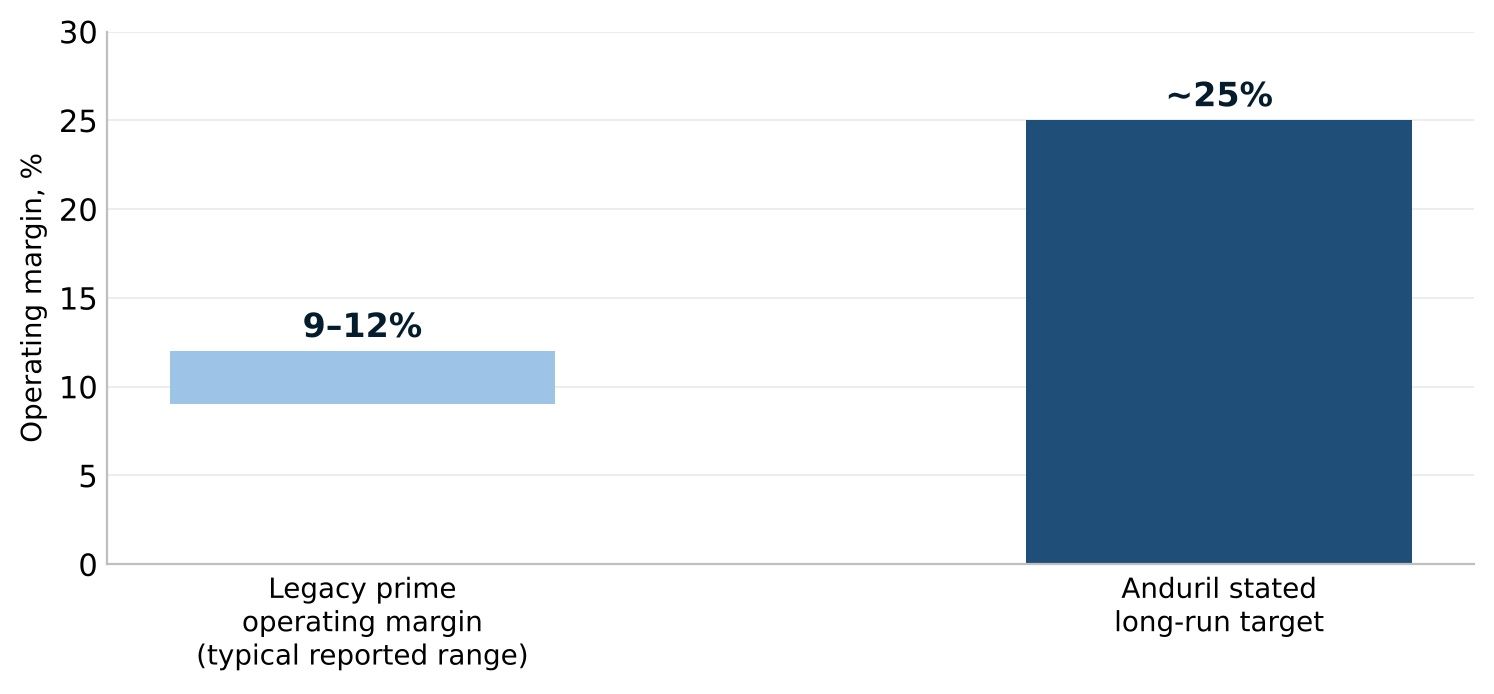
The money model matches the machine model. An estimated 70 to 80 percent of revenue is fixed-price, with Anduril spending its own capital on R&D before the customer asks — so it bids with working products while rivals bid with slideware. Management told Goldman’s audience a roughly 25 percent operating margin is achievable. Legacy primes earn 9 to 12 percent. That gap is the entire equity story.
Supplied archive exhibit · original labels. Read alongside the editorial corrections.
One operating system, dozens of weapons
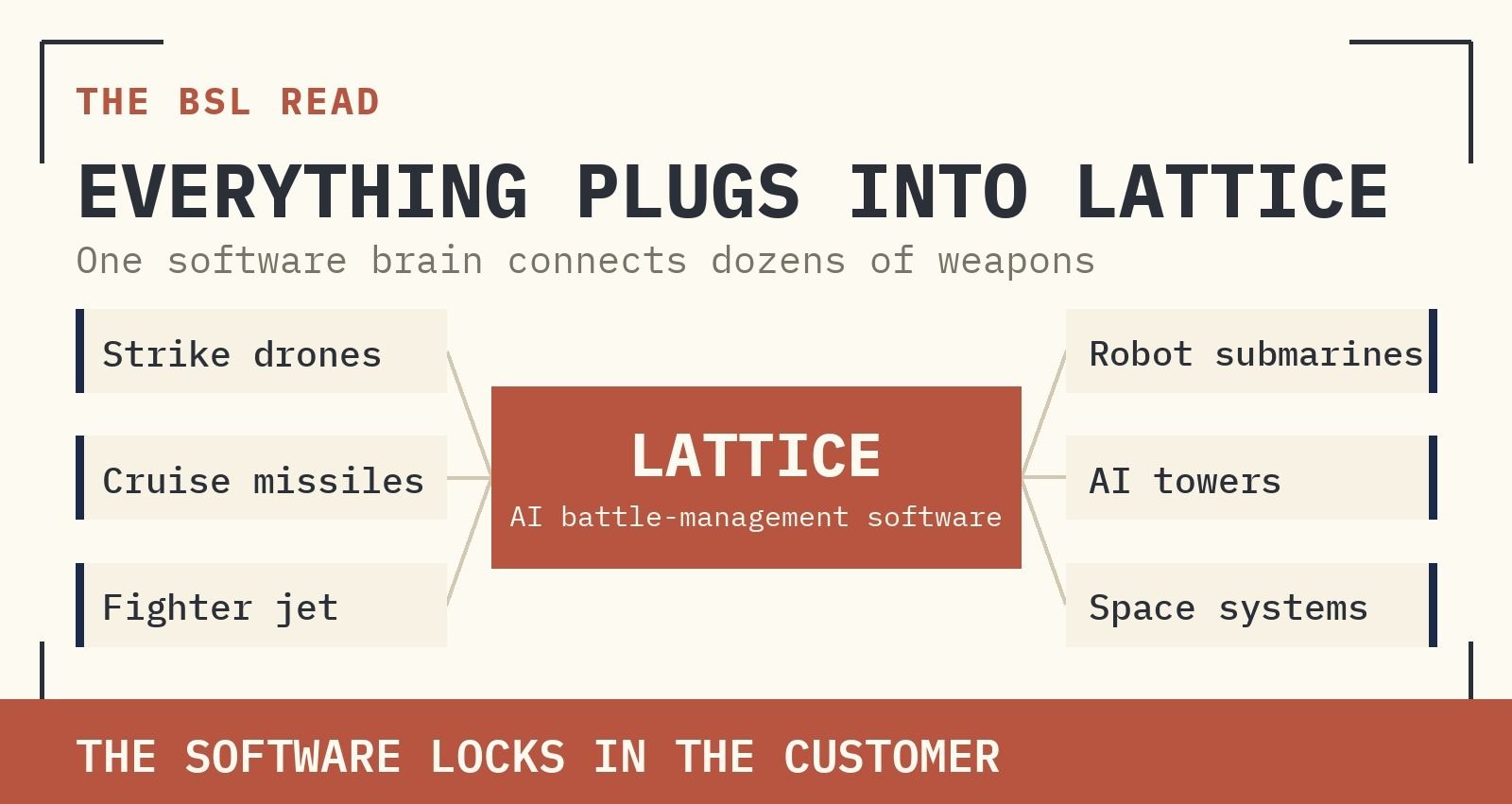
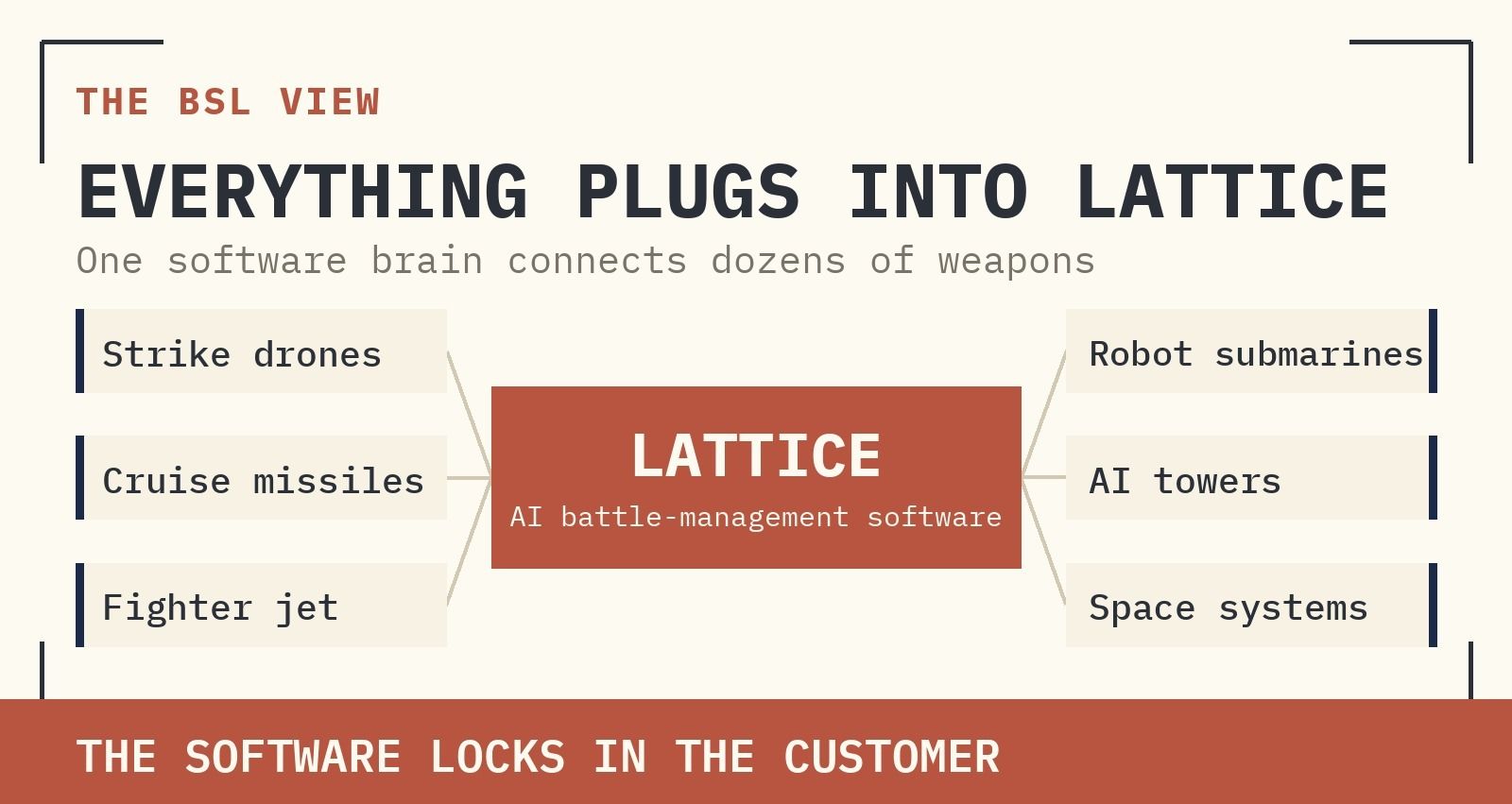
Strike drones, cruise missiles, an autonomous fighter, robot submarines, AI sentry towers, space payloads. The breadth is impressive. It is not the point. The point is Lattice — the AI battle-management software connecting every product, fusing thousands of sensors into decisions at machine speed. The Army and the U.S. Space Surveillance Network buy Lattice enterprise-wide, on its own. Every drone, tower, and submarine sold deploys another node of the software; every enterprise seat makes a rival’s hardware harder to choose. Hyperscaler economics, grafted onto a weapons company.
 Supplied archive exhibit · original labels. Read alongside the editorial corrections. | 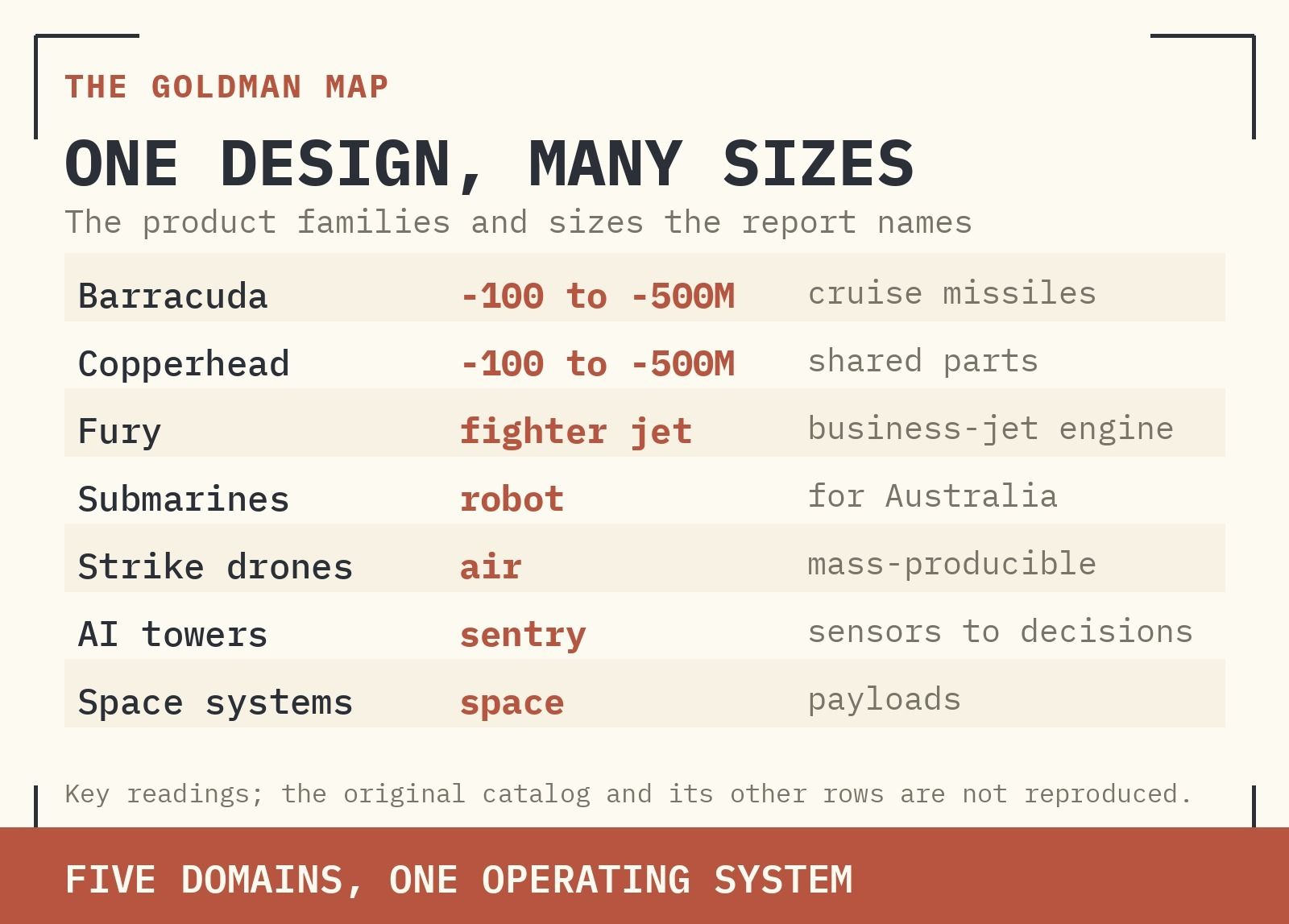 Supplied archive exhibit · original labels. Read alongside the editorial corrections. |
Read it this way. Left: the operating system and its Trojan-horse economics. Right: Goldman’s product map — note the naming discipline (Barracuda-100 to -500M, Copperhead-100 to -500M): one design, many sizes, shared parts. Affordable mass made visible.
The machines, by the numbers
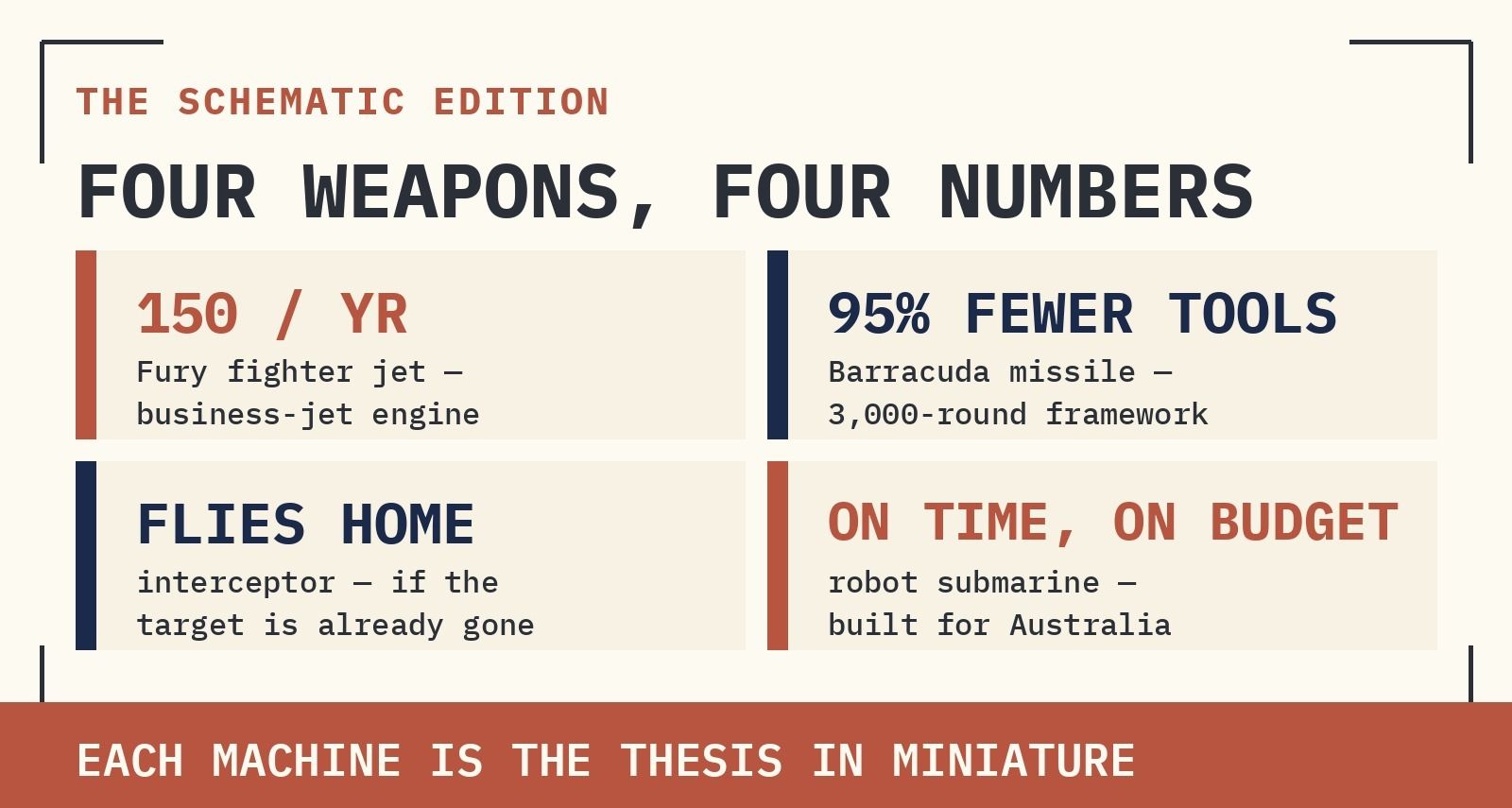
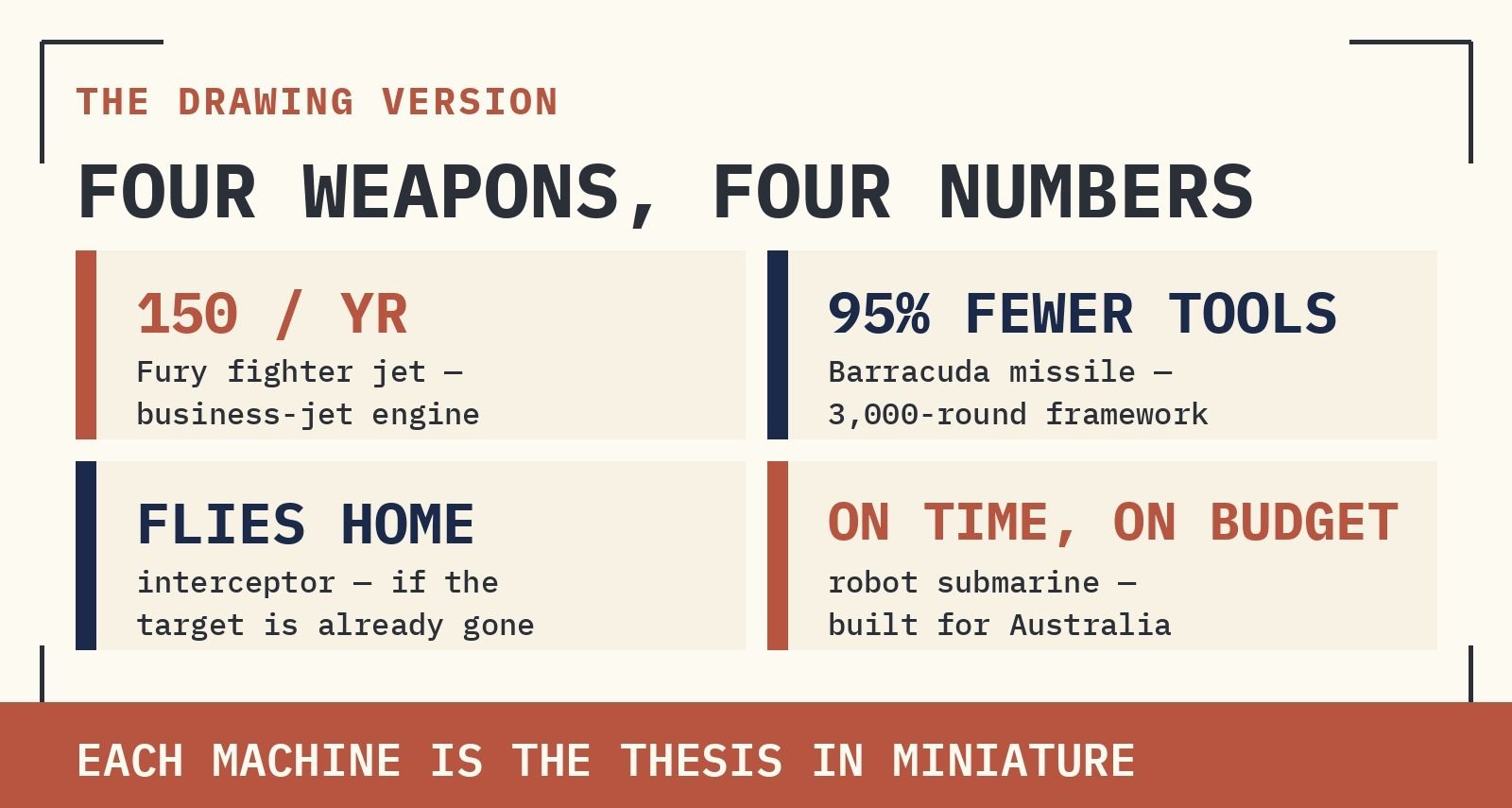
Each machine is the thesis in miniature: a fighter powered by a business-jet engine, a missile with 95 percent fewer tools, an interceptor that flies home if the target is already dead, a submarine program that ran on time and on budget.
 Supplied archive exhibit · original labels. Read alongside the editorial corrections. | 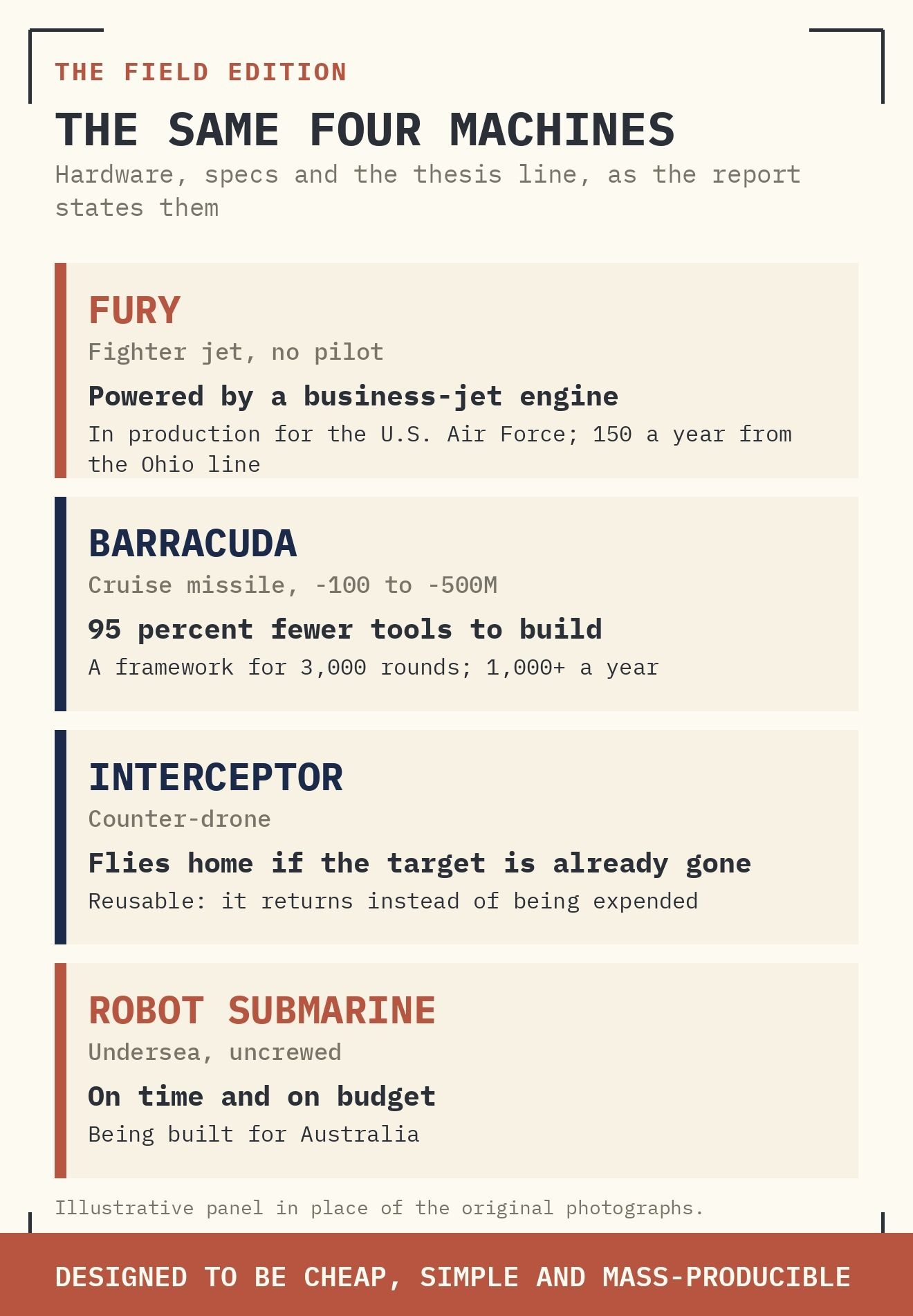 Supplied archive exhibit · original labels. Read alongside the editorial corrections. |
Figure 01 · Conceptual framework
How affordable mass becomes an industrial proposition
Narrative to reality: the order book
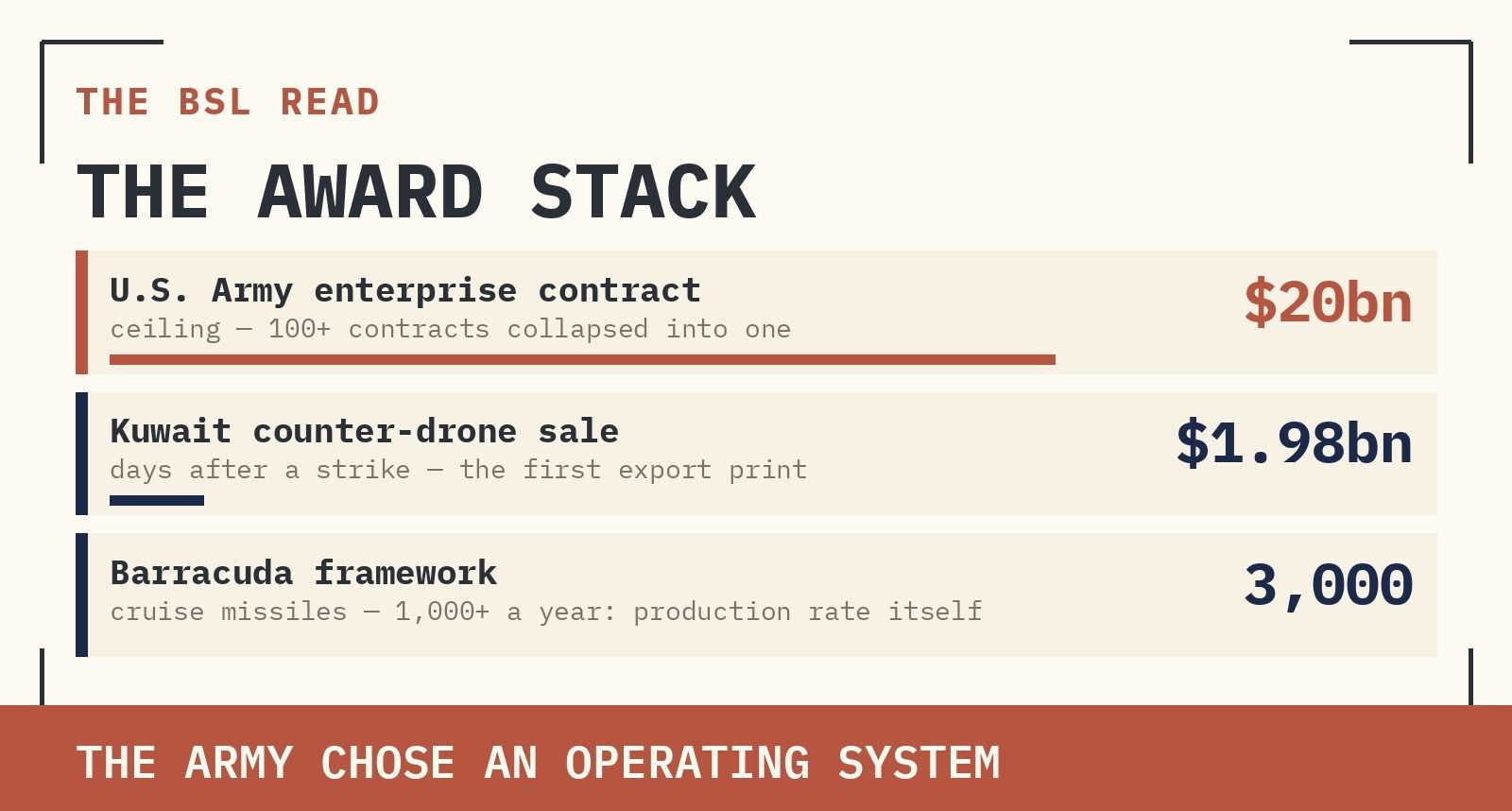
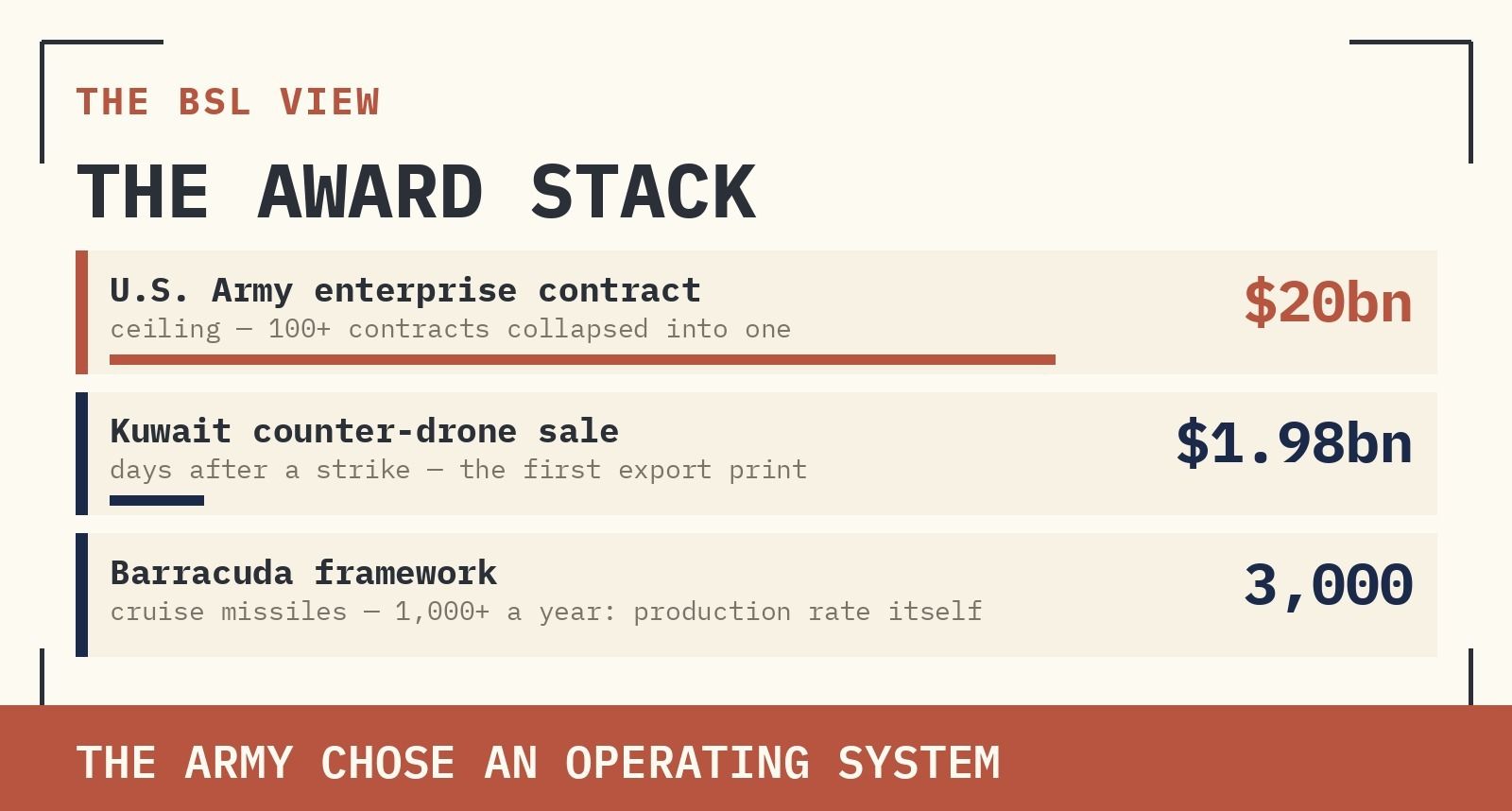
The standard objection to defense-tech valuations is narrative without revenue. The contract framework provides a route to future orders; its ceiling is not recognised revenue. March 2026: the Army signed a firm-fixed-price enterprise contract with a $20 billion ceiling — collapsing one hundred-plus separate contracts into one. The Army did not buy products; it standardized on an operating system. Around it: Ghost Shark in serial production for Australia, Fury in production for the Air Force’s CCA program, a Marine Corps counter-drone program of record, a framework for 3,000 Barracuda cruise missiles — and, days after an Iranian Shahed struck Kuwait International Airport, a proposed $1.98 billion counter-drone sale to Kuwait. Doctrine became contracts. Contracts are becoming production lines.
 Supplied archive exhibit · original labels. Read alongside the editorial corrections. | 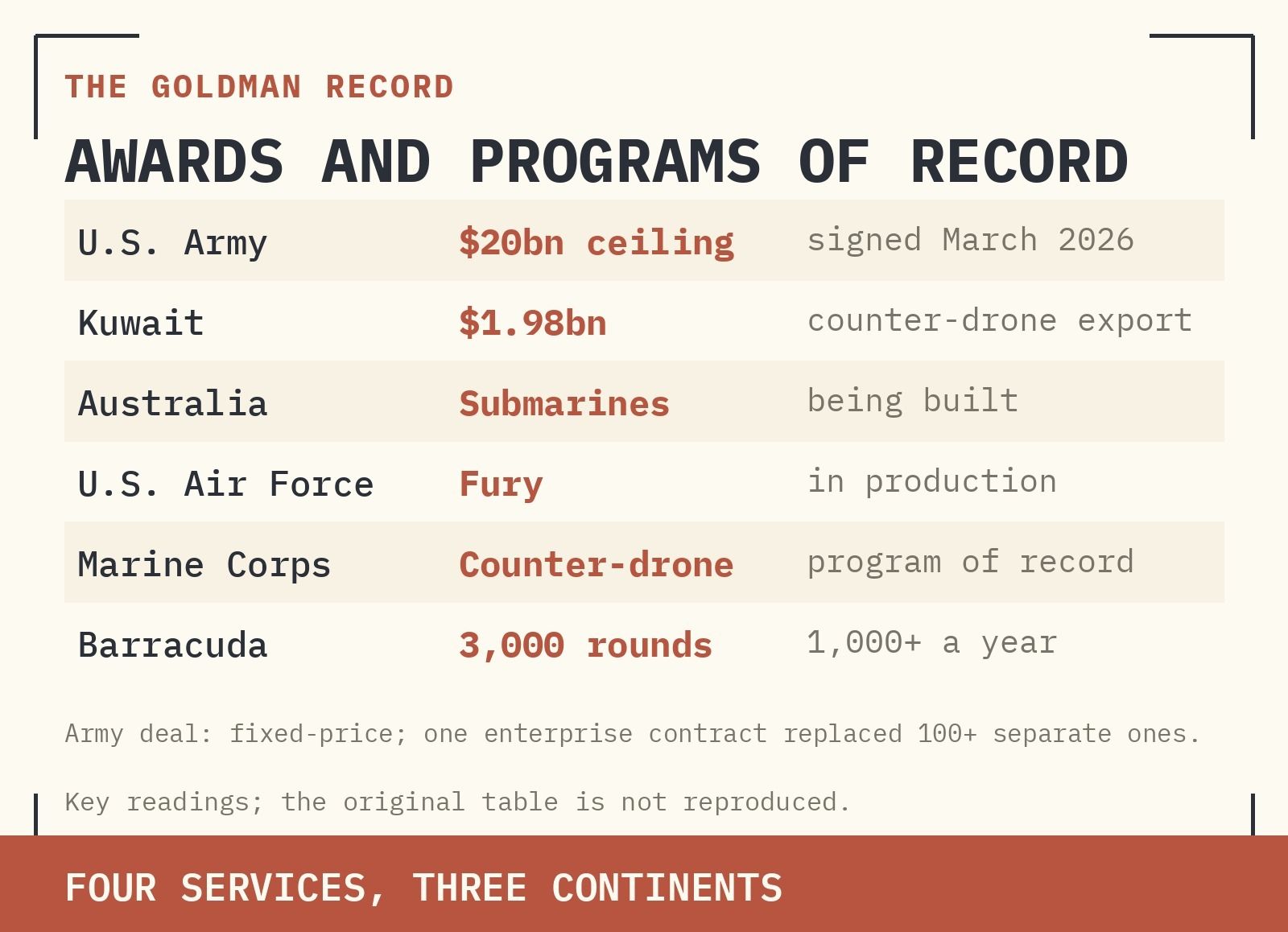 Supplied archive exhibit · original labels. Read alongside the editorial corrections. |
Read it this way. The Army bar is a maximum ten-year purchasing ceiling, not an obligated amount. The Kuwait bar is the first export print — every Gulf state faces the same drone threat. And the Barracuda framework buys production rate itself: 1,000+ rounds a year.
Arsenal-1: the factory is the product
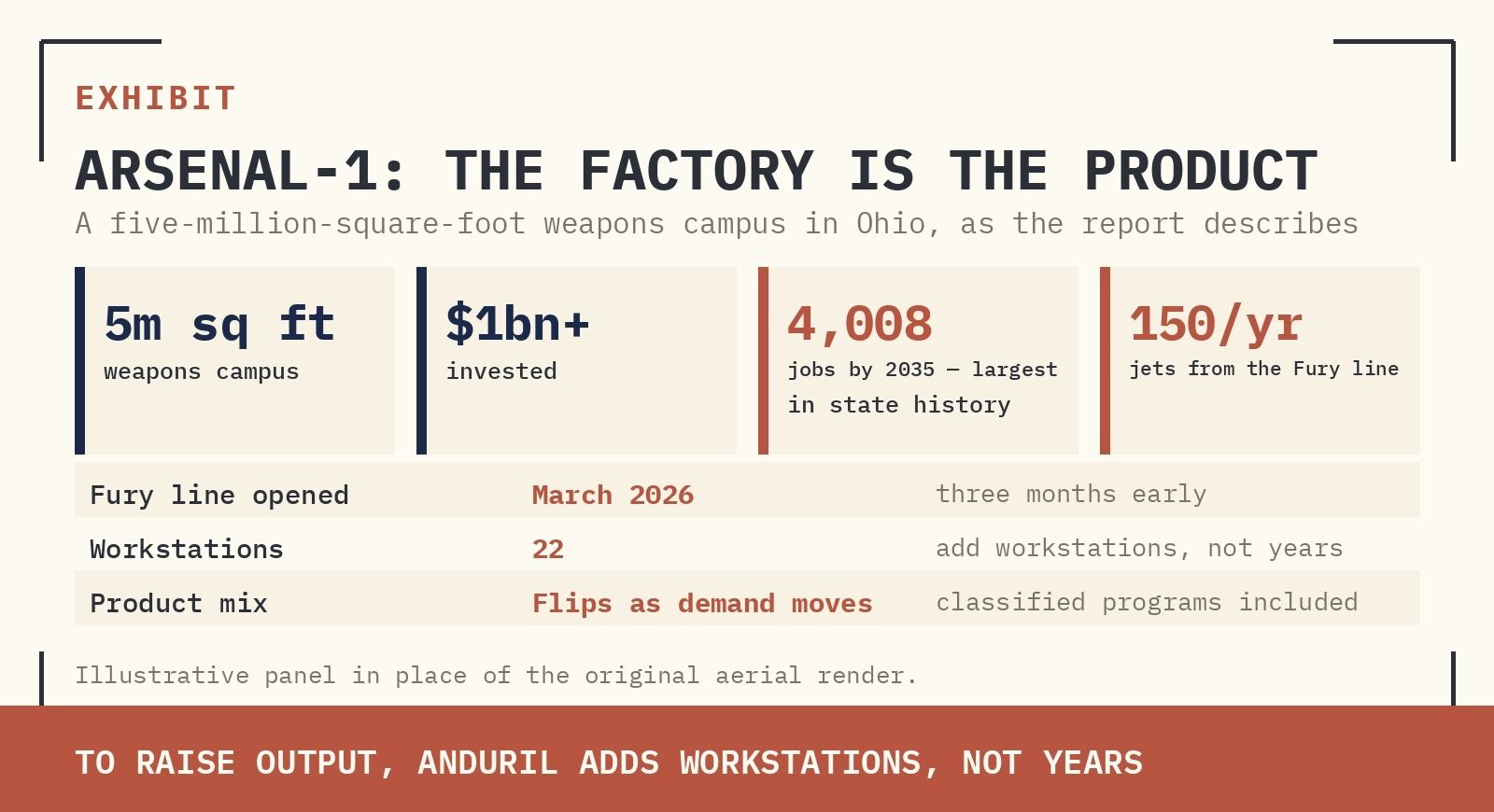
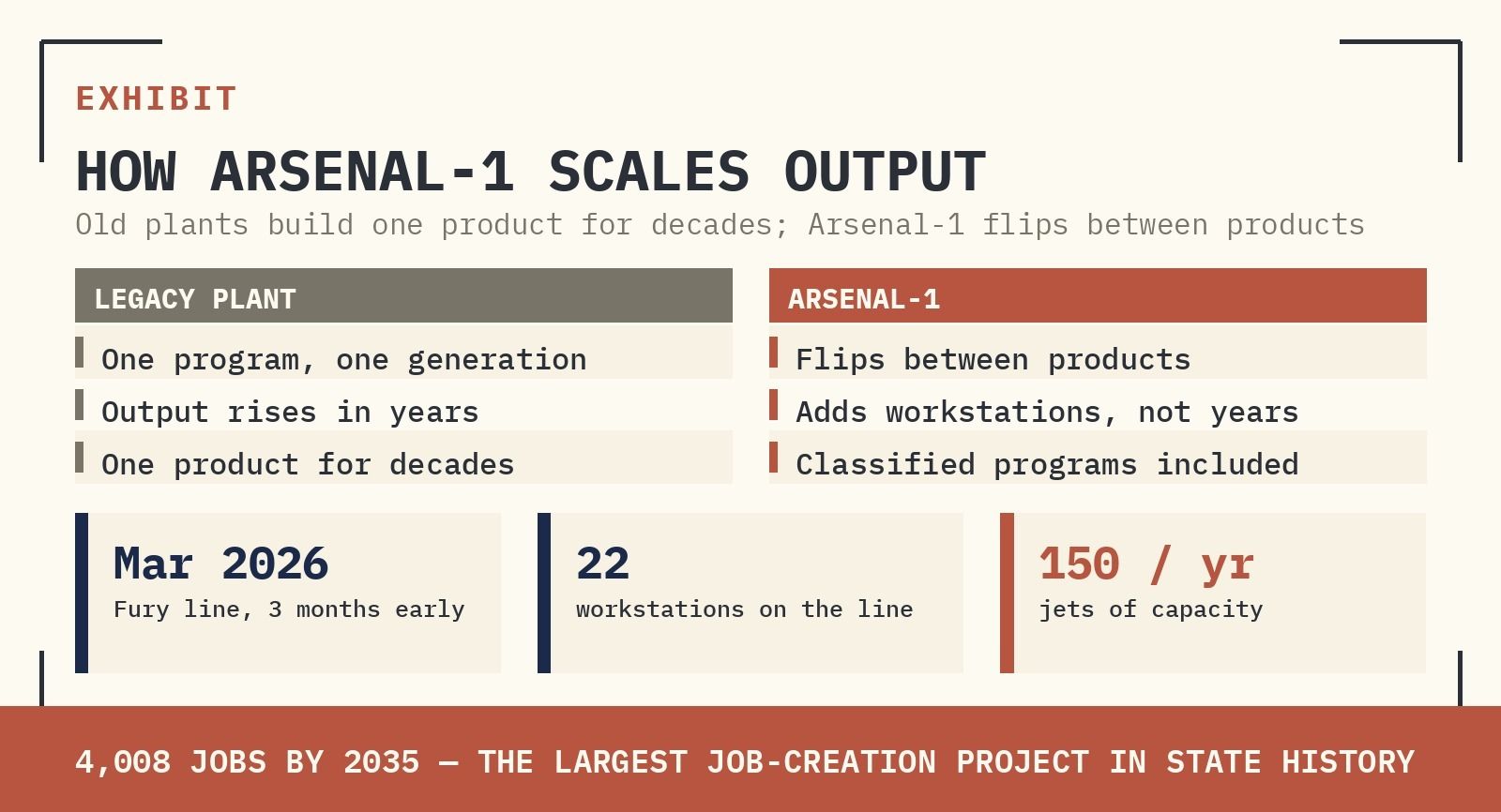
In Ohio: a five-million-square-foot weapons campus, over $1 billion invested, 4,008 jobs by 2035 — the largest job-creation project in state history. The Fury line opened in March 2026, three months early, with 22 workstations and capacity for 150 jets a year. To raise output, Anduril adds workstations, not years. Legacy plants serve one program for one generation; Arsenal-1 flips between products — classified programs included — as demand moves.
Supplied archive exhibit · original labels. Read alongside the editorial corrections.
Supplied archive exhibit · original labels. Read alongside the editorial corrections.
The money: from contrarian bet to institutional consensus
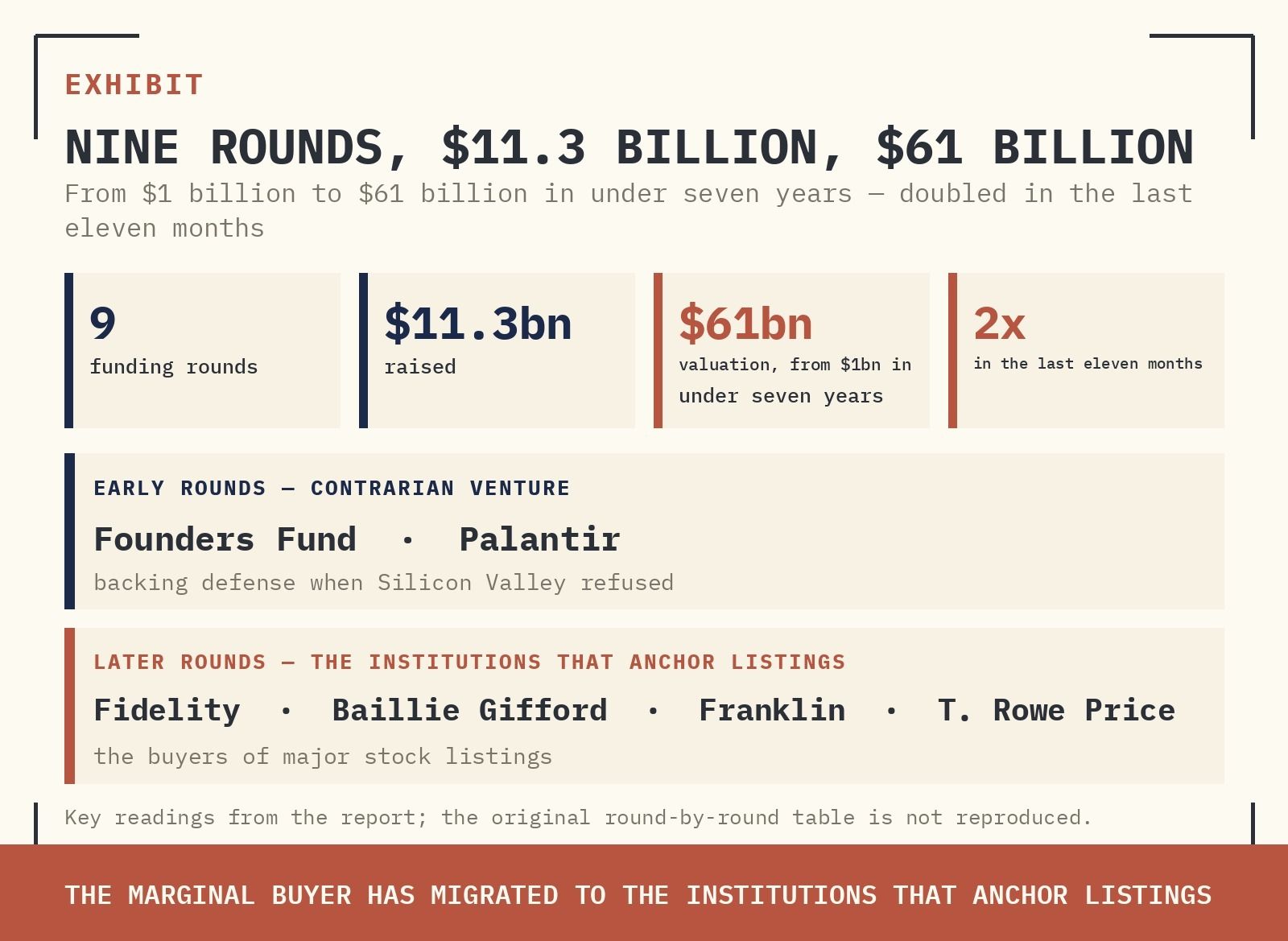
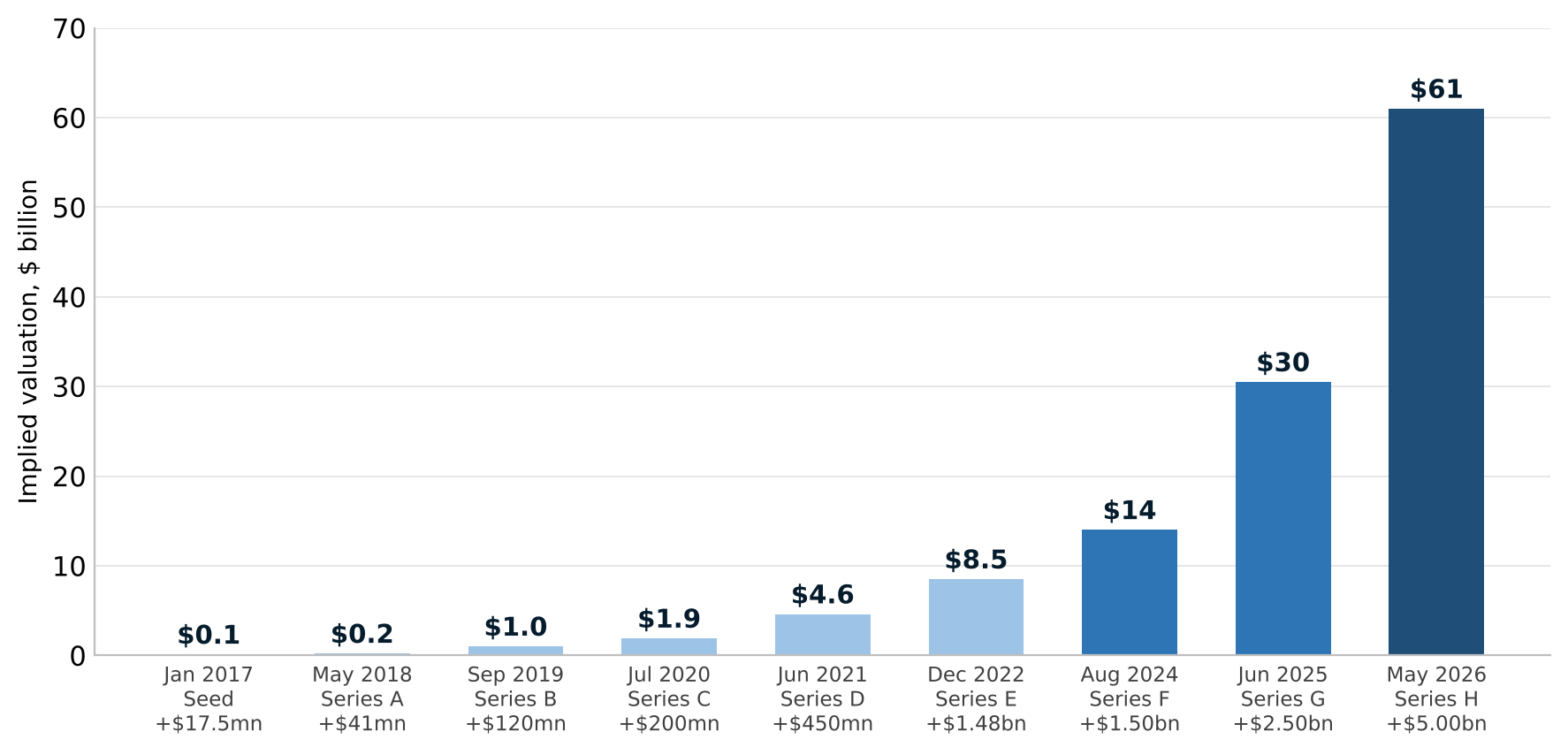
Nine rounds. $11.3 billion raised. $1 billion to $61 billion in under seven years — doubled in the last eleven months alone. The telling story is who is paying: early rounds were contrarian venture — Founders Fund and Palantir, backing defense when Silicon Valley refused. By Series F the buyers were Fidelity, Baillie Gifford, Franklin, T. Rowe Price — the institutions that anchor technology IPOs. The cap table now looks like a shareholder register waiting for a ticker. That migration of the marginal buyer is, historically, the most reliable precursor to a listing.
Supplied archive exhibit · original labels. Read alongside the editorial corrections.
The M&A strategy: infiltrating the bill of materials
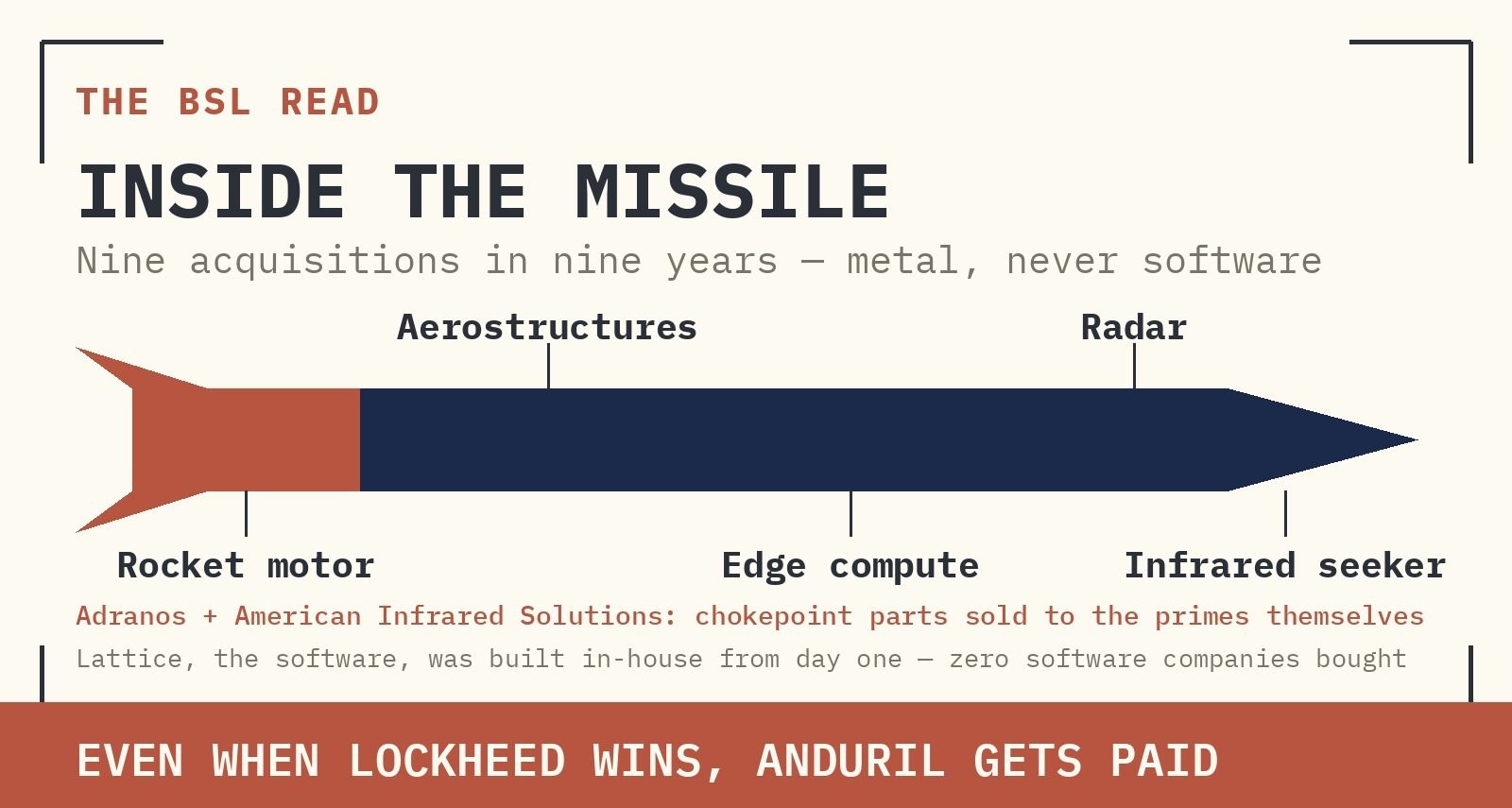
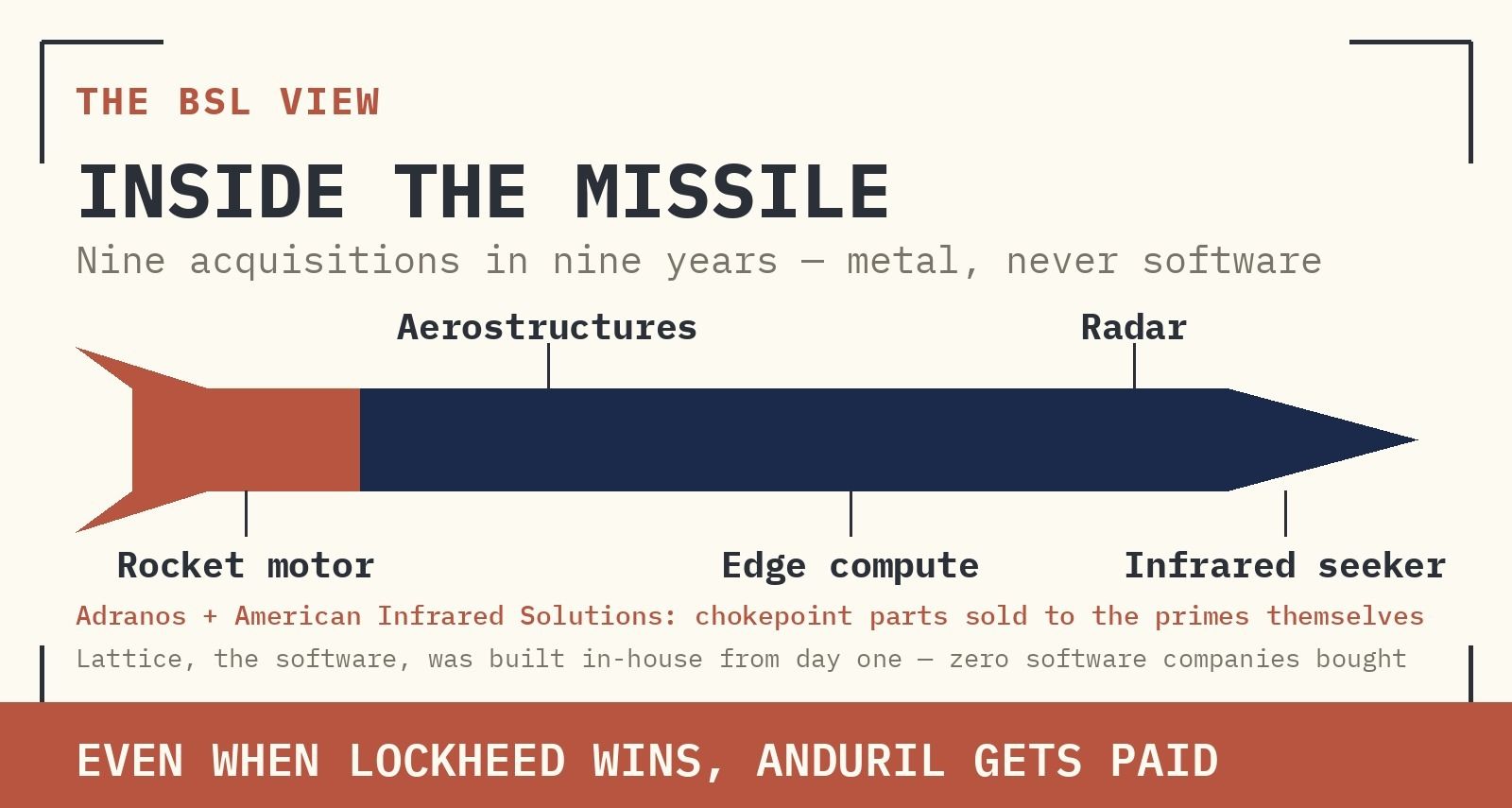
Nine acquisitions in nine years. Zero software companies bought — Lattice was built in-house from day one. Anduril acquires metal: rocket motors, aerostructures, radar, edge compute, infrared. Two purchases hide the most aggressive move: Adranos and American Infrared Solutions position Anduril as a merchant supplier of chokepoint components to the prime contractors themselves. Even when Lockheed wins, Anduril gets paid.
 Supplied archive exhibit · original labels. Read alongside the editorial corrections. | 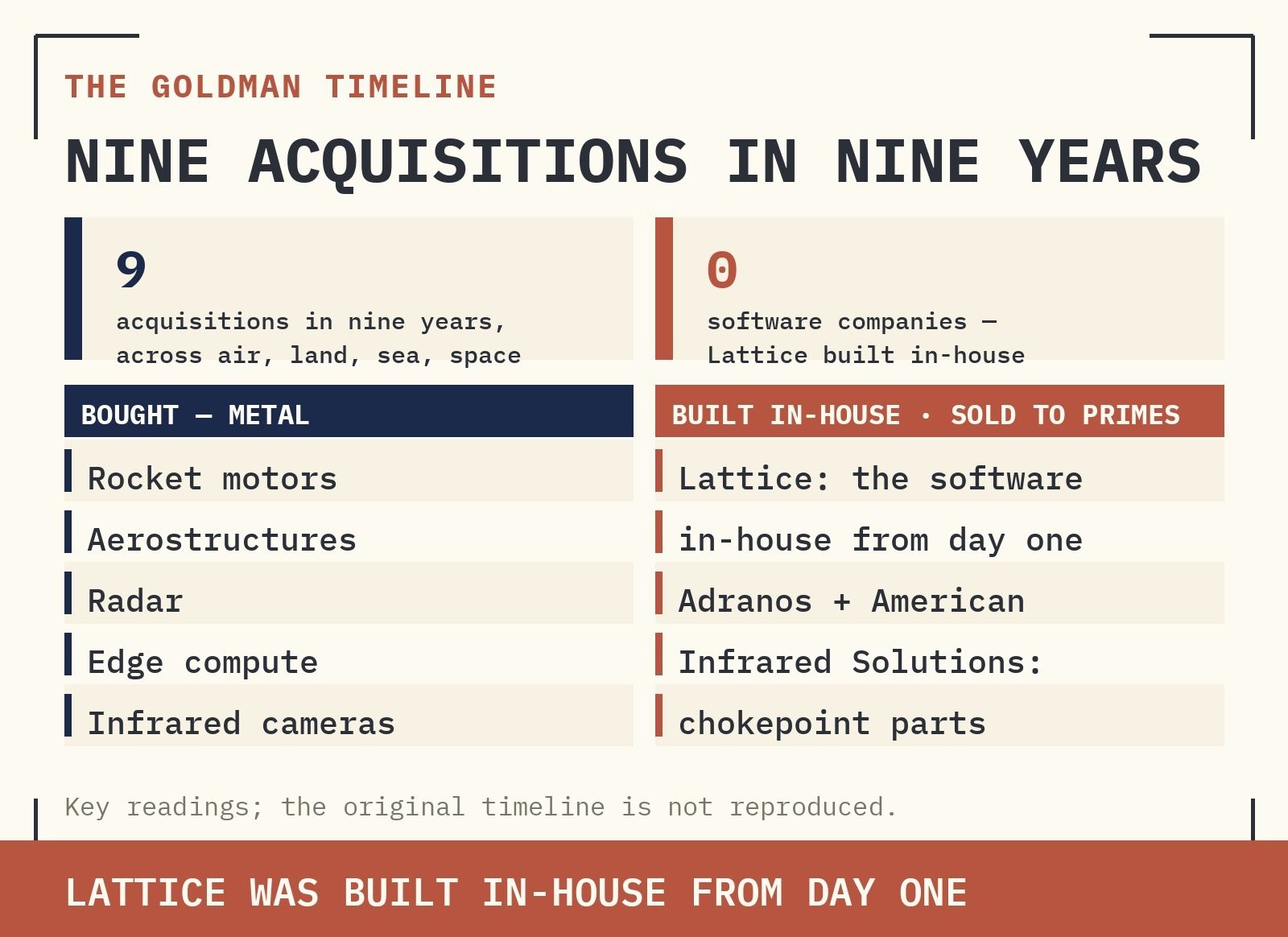 Supplied archive exhibit · original labels. Read alongside the editorial corrections. |
What it means — and why India must study it
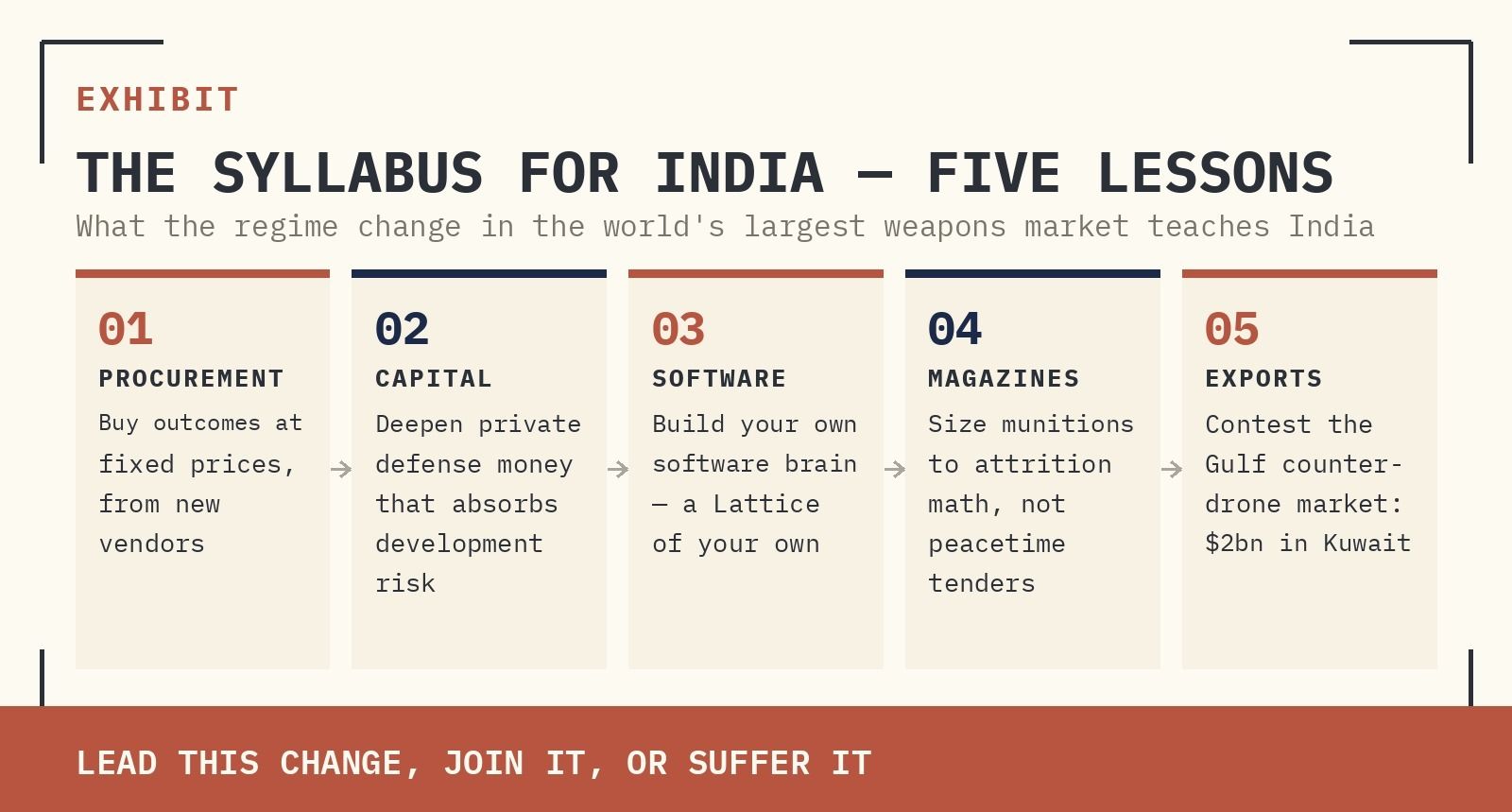
Anduril is the measurement instrument for a regime change in the world’s largest procurement market. The Army’s leadership has told its suppliers, publicly, to adapt and change or die. Value is migrating from the airframe to the autonomy layer — from metal to Lattice. For India, facing the world’s most demanding two-front geometry, this is not an investment opportunity. It is a syllabus: reform procurement to buy outcomes fixed-price from non-traditional vendors; deepen the private defense capital pool that absorbs development risk; build the indigenous software moat, because platforms without a Lattice-equivalent fight inside someone else’s operating system; size the munitions base to attrition mathematics, not peacetime tenders; and contest the Gulf counter-drone market that Kuwait just priced at $2 billion.
Supplied archive exhibit · original labels. Read alongside the editorial corrections.
Figure 02 · Qualitative comparison
Read the order book in stages
| Stage | What it establishes | What it does not establish |
|---|---|---|
| Contract ceiling | Maximum purchasing capacity | Committed revenue |
| Export notification | A proposed sale may proceed | Signed final sale or delivery |
| Funded order | Specific work is authorised | Completed performance |
| Delivery and acceptance | Contractual output reaches the customer | Cash collected in every case |
The bottom line
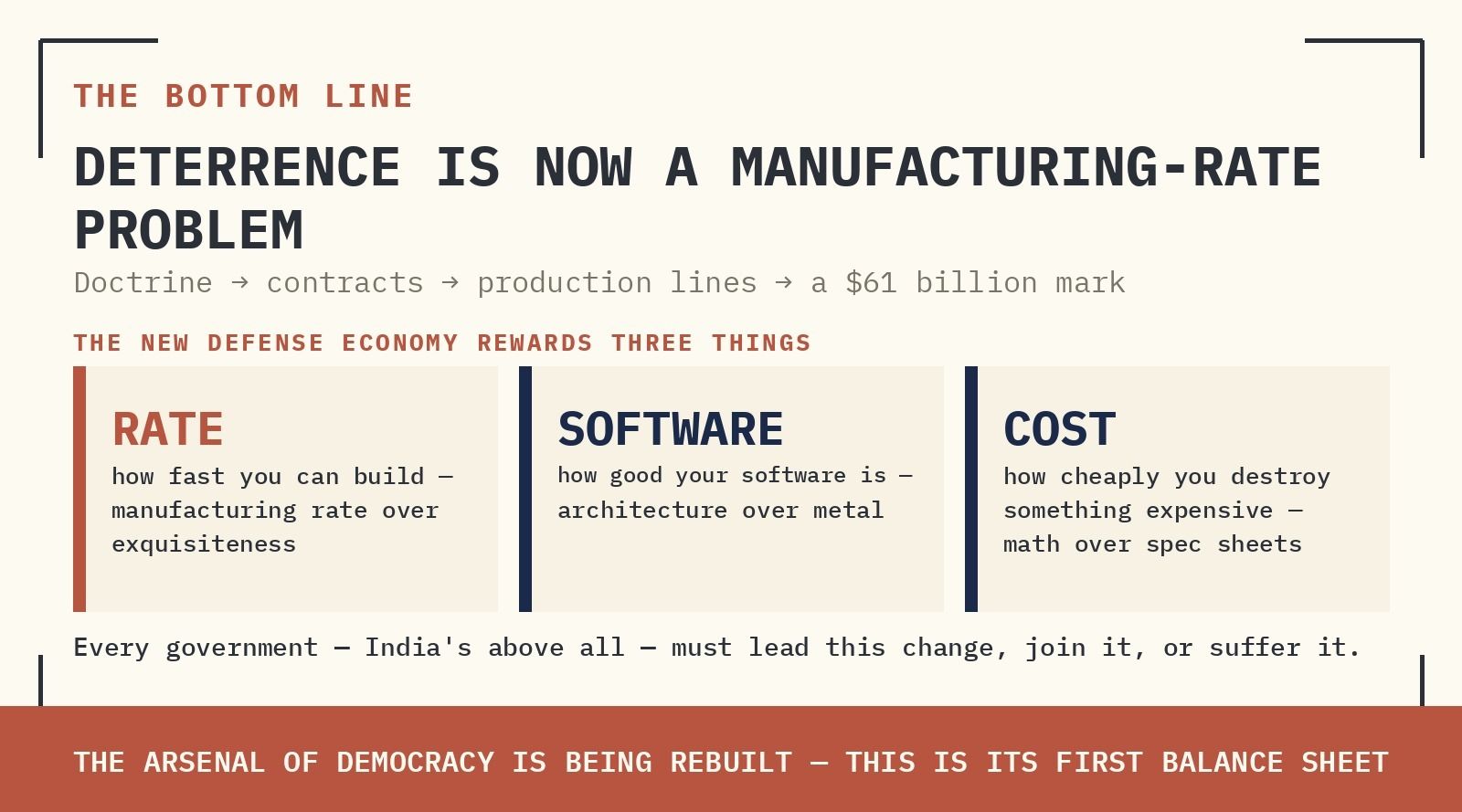
A nine-year-old company has converted doctrine into contracts, contracts into production lines, and production lines into a $61 billion mark funded by the institutions that anchor public listings. The defense economy it is reshaping rewards manufacturing rate over exquisiteness, software architecture over metal, and cost-exchange math over spec sheets. Every government — India’s emphatically included — must now lead this transition, buy into it, or suffer it. The arsenal of democracy is being refounded. This is its first balance sheet.
Supplied archive exhibit · original labels. Read alongside the editorial corrections.
Companion edition: Military perspective
Anduril: The Company Rewriting How Wars Are Won
Original Lens and publication context
A nine-year-old company is redefining how wars are won — and everyone, from armies to Goldman Sachs, is chasing it. Explained in plain language for military leaders, defence experts, strategists, and governments. Above all, India’s.
- Armies, governments, and capital are all chasing this one company, because it shows how the next war will be fought and won. Goldman Sachs studying a private firm it cannot even rate is just the proof.
- The big idea is “affordable mass”: many cheap, simple weapons beat a few expensive ones in a long war. The cost-exchange ratio wins, not the spec sheet.
- The real weapon is Lattice, the software brain. The platform is no longer the unit of combat power — the kill chain is. Whoever owns the software owns the tempo of the battle.
- The orders are real: a $20 billion Army deal, work for four military branches on three continents, a $2 billion anti-drone sale to Kuwait — and a factory that raises output in months, not years.
- For India — facing a two-and-a-half-front threat: Pakistan in the west, China in the north and east, and a half front on the Bangladesh side — this is a survival lesson book, not a stock tip.
Supplied archive exhibit · original labels. Read alongside the editorial corrections.
Why everyone is chasing this company
This is how a war unicorn is born. The wars in Ukraine and the Gulf rewrote the rules of fighting: ammunition runs out faster than factories can make it, and a $50,000 drone can destroy a $200 million machine. One nine-year-old company, Anduril, built itself entirely around those new rules — and now everyone is chasing it. Armies are signing decade-long deals with it. Governments are copying its methods. And in June, Goldman Sachs’ top defense analyst invited its CEO, Brian Schimpf, to speak to the world’s biggest investors.
Note what that means. Goldman cannot even give Anduril a stock rating — the company is private. It studied it anyway, because it had no choice. The U.S. military is rebuilding the way it buys weapons around the way Anduril works. Money is not leading this story. War is. The money is simply following. To study Anduril is to study the future battlefield — and the future buyer.
Supplied archive exhibit · original labels. Read alongside the editorial corrections.
How to read it. Two columns, one message. The left column is what the buyer has told its suppliers to stop doing. The right column is what the buyer now pays for.
The big idea: cheap weapons, in huge numbers
The U.S. builds a small number of superb, very expensive weapons. They are the best in the world — and they run out. Anduril builds the opposite: weapons that are cheap, simple, and easy to make in large numbers. Four rules make this work. Make key parts yourself, so you never depend on one supplier. Use the same parts across many weapons, like a phone maker does. Keep designs simple so machines can build them fast — you do not need the best missile, you need enough missiles. And build factory floors that can switch from one product to another as orders change.
Supplied archive exhibit · original labels. Read alongside the editorial corrections.
One software brain, dozens of weapons
Strike drones, cruise missiles, a pilotless fighter jet, robot submarines, AI watchtowers, space systems. The range is impressive. But it is not the point. The point is Lattice — the software brain that connects every product and turns data from thousands of sensors into decisions at machine speed. The Army and the U.S. space network buy Lattice on its own, for everything. Every drone, tower, or submarine sold installs the software in one more place. And once a customer runs the software, a rival’s hardware becomes harder to choose. It works like a big tech platform — built into a weapons company. For a commander, the meaning is simple: the platform is no longer the unit of combat power. The kill chain is. Whoever owns the software owns the tempo.
 Supplied archive exhibit · original labels. Read alongside the editorial corrections. | Supplied archive exhibit · original labels. Read alongside the editorial corrections. |
How to read it. Left: the software, and why it locks customers in. Right: Goldman’s product map — look at the names (Barracuda-100 to -500M, Copperhead-100 to -500M): one design, many sizes, same parts. Cheap mass production, made visible.
The machines, in numbers
Each machine tells the same story in a small way: a fighter jet that uses a business-jet engine, a missile that needs 95 percent fewer tools, an interceptor that flies home if the target is already gone, and a submarine project that finished on time and on budget. The lesson for any force: these weapons are designed to be lost — and replaced — at a rate the enemy cannot match.
 Supplied archive exhibit · original labels. Read alongside the editorial corrections. | 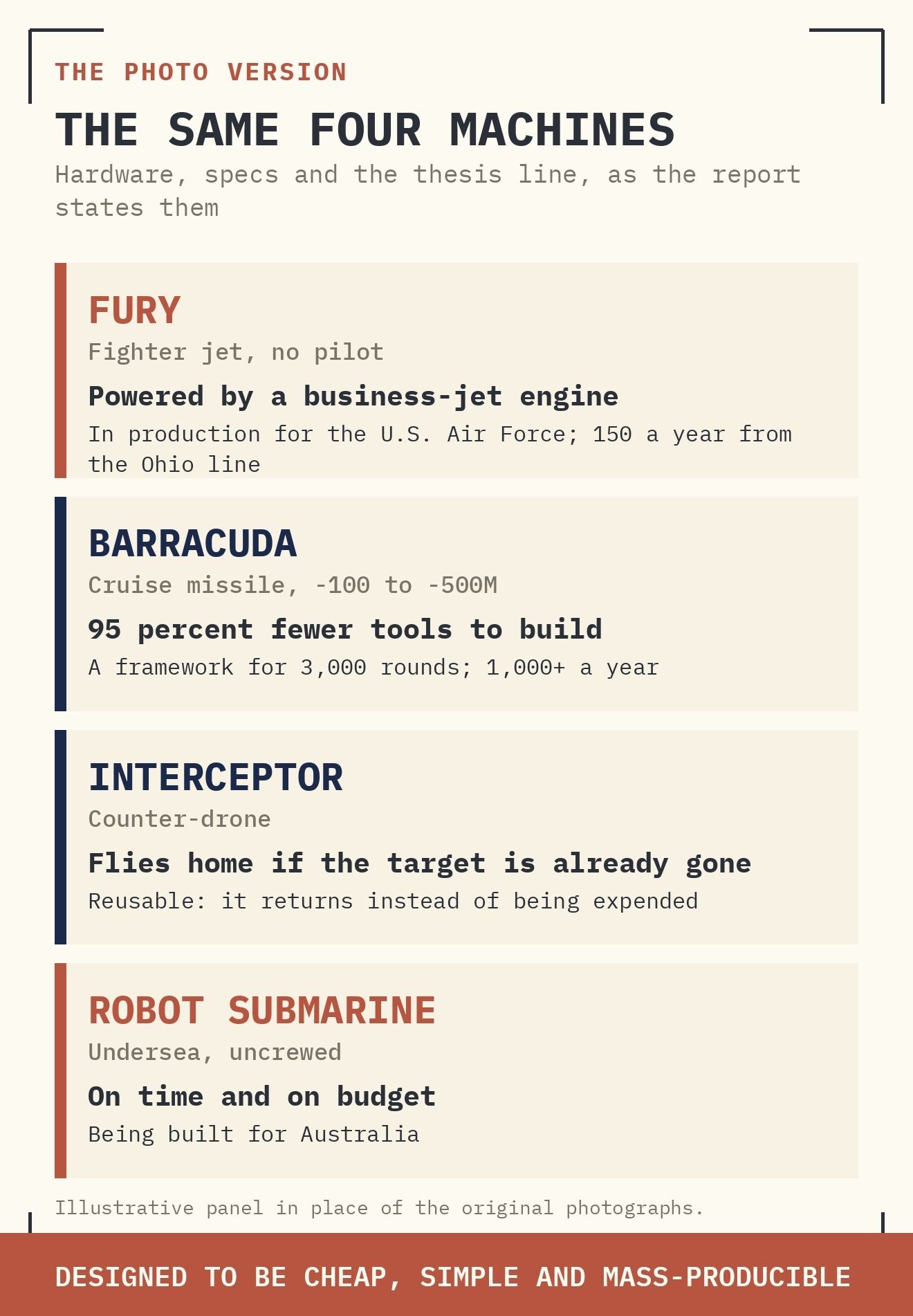 Supplied archive exhibit · original labels. Read alongside the editorial corrections. |
From story to sales: the order book
People often say defense startups have a story but no sales. The order list ends that argument. In March 2026, the Army signed one fixed-price deal worth up to $20 billion — replacing more than one hundred separate contracts. The Army did not just buy products. It chose an operating system. Around that deal: robot submarines being built for Australia, the Fury jet in production for the U.S. Air Force, an anti-drone program for the Marines, a plan for 3,000 Barracuda cruise missiles — and, days after an Iranian drone hit Kuwait’s main airport, a proposed $1.98 billion anti-drone sale to Kuwait. The idea became contracts. The contracts are becoming factory lines. For planners, the signal is the Barracuda deal: the customer is no longer buying missiles — it is buying the rate at which missiles can be made.
 Supplied archive exhibit · original labels. Read alongside the editorial corrections. | Supplied archive exhibit · original labels. Read alongside the editorial corrections. |
How to read it. The Army bar is a maximum ten-year purchasing ceiling, not an obligated amount. The Kuwait bar is the first export sale — every Gulf country faces the same drone threat. And the Barracuda deal buys production speed itself: more than 1,000 missiles a year.
Arsenal-1: the factory is the product
In Ohio: a factory campus of five million square feet, more than $1 billion invested, and 4,008 jobs by 2035 — the biggest job-creation project in the state’s history. The jet line opened in March 2026, three months early, with 22 workstations and room to build 150 jets a year. To build more, Anduril adds workstations, not years. Old factories build one product for decades. Arsenal-1 switches between products — including secret programs — as demand changes. For a force planner, the question this factory poses is direct: can your industrial base surge in months, or does it measure in decades?
Supplied archive exhibit · original labels. Read alongside the editorial corrections.
Supplied archive exhibit · original labels. Read alongside the editorial corrections.
The war chest: how a war unicorn is funded
The money side matches the machine side. About 70 to 80 percent of revenue comes from fixed-price deals, and Anduril spends its own money on research before the customer even asks. So it shows up with working products while rivals show up with slideshows. Management says a profit margin of about 25 percent is possible. Old defense companies earn 9 to 12 percent. For a planner, the margin matters for one reason: it funds the next weapon before any government asks for it.
Supplied archive exhibit · original labels. Read alongside the editorial corrections.
Nine funding rounds. $11.3 billion raised. From $1 billion to $61 billion in value in under seven years — doubling in the last eleven months alone. The real story is who is paying. The early money came from bold venture funds — Founders Fund and Palantir — backing defense when most of Silicon Valley refused to. By the later rounds, the buyers were Fidelity, Baillie Gifford, Franklin, and T. Rowe Price — the big institutions that buy into major stock listings. A reported $61 billion private valuation, reached without a stock-exchange listing — that is what a war unicorn looks like. Why should a military reader care? Because this private money is absorbing the development risk that taxpayers used to carry. New weapons now arrive ready, tested, and funded before any ministry signs a cheque.
Supplied archive exhibit · original labels. Read alongside the editorial corrections.
The buying spree: owning the critical parts
Nine companies bought in nine years. Not one of them a software company — Lattice was built at home from day one. Anduril buys the hard stuff: rocket motors, aircraft parts, radar, computers, infrared cameras. Two purchases hide the boldest move: Adranos and American Infrared Solutions let Anduril sell critical parts to the big old defense companies themselves. So even when Lockheed wins a contract, Anduril still gets paid. The military lesson: control of critical parts — rocket motors, sensors — is itself a weapon. Whoever owns the chokepoints controls everyone’s production rate.
 Supplied archive exhibit · original labels. Read alongside the editorial corrections. | Supplied archive exhibit · original labels. Read alongside the editorial corrections. |
What it means for India’s two-and-a-half-front war
Anduril is the measuring stick for a deep change in how wars will be fought and how weapons will be bought. Now place India on this map. India plans for a two-and-a-half-front threat: one full front against Pakistan in the west, one full front against China in the north and east, and a half front on the Bangladesh side — a long, porous eastern border that can turn hostile and tie down forces at any time. No other major power plans for this geometry — which is exactly why these lessons matter more for India than for anyone else. A two-front war is a war of attrition by definition, so size ammunition and drone stocks to attrition math, not peacetime paperwork. Two theatres mean thousands of sensors across the Himalayas, the western desert, and the ocean — so build the indigenous software brain that fuses them, because forces without one will fight inside someone else’s system. The half front in the east adds exactly the kind of threat this report describes — cheap drones and proxy action across a porous border — and it demands the same answer: low-cost, reusable interceptors, the $50,000 solution to the $500 problem. Demand an industrial base that can surge in months, with factory lines that switch between products. Change how you buy: pay fixed prices for results, from new companies, not only the old ones. And compete for the Gulf anti-drone market that Kuwait just valued at $2 billion — the same threat India trains against every day.
Supplied archive exhibit · original labels. Read alongside the editorial corrections.
The bottom line
In nine years, one company turned an idea into contracts, contracts into factory lines, and factory lines into a $61 billion value — funded by the same institutions that back the biggest stock listings. The new defense economy rewards three things: how fast you can build, how good your software is, and how cheaply you can destroy something expensive. Every defence ministry and every general staff must now lead this change, join it, or suffer it — India’s above all, because no one else prepares for a two-and-a-half-front war. Deterrence is now a manufacturing rate problem. The arsenal of democracy is being rebuilt. This is its first balance sheet.
Supplied archive exhibit · original labels. Read alongside the editorial corrections.
Companion edition: Plain-language edition
Anduril: The Company Rewriting How Wars Are Won
Original Lens and publication context
Goldman Sachs just met a nine-year-old private company. This report explains why, in plain language — for investors, for governments, and for India.
- Goldman Sachs studied Anduril because this one company shows where the whole defense industry is going — every old defense stock will rise or fall based on how fast this model grows.
- The big idea is “affordable mass”: many cheap, simple weapons beat a few expensive ones in a long war.
- The real product is Lattice, the software brain. Every weapon sold spreads the software, and the software keeps the customer. This is a platform, not just a weapons maker.
- The orders are real: a $20 billion Army deal, work for four military branches on three continents, a $2 billion sale to Kuwait — and a five-million-square-foot factory to build it all.
- For India, this is a lesson book: buy weapons differently, grow private defense money, build your own software, stock enough ammunition for a long war, and compete for Gulf anti-drone sales.
Supplied archive exhibit · original labels. Read alongside the editorial corrections.
Why Goldman Sachs sat down with Anduril
In June, Goldman Sachs’ top defense analyst invited Anduril’s CEO, Brian Schimpf, to speak to big investors. The reason was simple. The defense industry’s biggest problem is not technology or money. It is speed. The wars in Ukraine and the Gulf showed two things: ammunition runs out faster than factories can make it, and a $50,000 drone can destroy a $200 million machine.
Goldman cannot even give Anduril a stock rating — the company is private. It studied it anyway, for three reasons. First, every old defense stock Goldman covers will move based on how fast this model grows. Second, a company that raised $11.3 billion and doubled its value to $61 billion in eleven months will be the biggest defense stock listing in a generation. Third, the U.S. military is changing how it buys weapons to match how Anduril works. To study Anduril is to study the buyer.
Supplied archive exhibit · original labels. Read alongside the editorial corrections.
How to read it. Two columns, one message. The left column is what the buyer has told its suppliers to stop doing. The right column is what the buyer now pays for.
The big idea: cheap weapons, in huge numbers
The U.S. builds a small number of superb, very expensive weapons. They are the best in the world — and they run out. Anduril builds the opposite: weapons that are cheap, simple, and easy to make in large numbers. Four rules make this work. Make key parts yourself, so you never depend on one supplier. Use the same parts across many weapons, like a phone maker does. Keep designs simple so machines can build them fast — you do not need the best missile, you need enough missiles. And build factory floors that can switch from one product to another as orders change.
Supplied archive exhibit · original labels. Read alongside the editorial corrections.
The money side matches the machine side. About 70 to 80 percent of revenue comes from fixed-price deals, and Anduril spends its own money on research before the customer even asks. So it shows up with working products while rivals show up with slideshows. Management says a profit margin of about 25 percent is possible. Old defense companies earn 9 to 12 percent. That gap is the whole investment story.
Supplied archive exhibit · original labels. Read alongside the editorial corrections.
One software brain, dozens of weapons
Strike drones, cruise missiles, a pilotless fighter jet, robot submarines, AI watchtowers, space systems. The range is impressive. But it is not the point. The point is Lattice — the software brain that connects every product and turns data from thousands of sensors into decisions at machine speed. The Army and the U.S. space network buy Lattice on its own, for everything. Every drone, tower, or submarine sold installs the software in one more place. And once a customer runs the software, a rival’s hardware becomes harder to choose. It works like a big tech platform — built into a weapons company.
Supplied archive exhibit · original labels. Read alongside the editorial corrections. | Supplied archive exhibit · original labels. Read alongside the editorial corrections. |
How to read it. Left: the software, and why it locks customers in. Right: Goldman’s product map — look at the names (Barracuda-100 to -500M, Copperhead-100 to -500M): one design, many sizes, same parts. Cheap mass production, made visible.
The machines, in numbers
Each machine tells the same story in a small way: a fighter jet that uses a business-jet engine, a missile that needs 95 percent fewer tools, an interceptor that flies home if the target is already gone, and a submarine project that finished on time and on budget.
Supplied archive exhibit · original labels. Read alongside the editorial corrections. | Supplied archive exhibit · original labels. Read alongside the editorial corrections. |
From story to sales: the order book
People often say defense startups have a story but no sales. The order list ends that argument. In March 2026, the Army signed one fixed-price deal worth up to $20 billion — replacing more than one hundred separate contracts. The Army did not just buy products. It chose an operating system. Around that deal: robot submarines being built for Australia, the Fury jet in production for the U.S. Air Force, an anti-drone program for the Marines, a plan for 3,000 Barracuda cruise missiles — and, days after an Iranian drone hit Kuwait’s main airport, a proposed $1.98 billion anti-drone sale to Kuwait. The idea became contracts. The contracts are becoming factory lines.
Supplied archive exhibit · original labels. Read alongside the editorial corrections. | Supplied archive exhibit · original labels. Read alongside the editorial corrections. |
How to read it. The Army bar is a maximum ten-year purchasing ceiling, not an obligated amount. The Kuwait bar is the first export sale — every Gulf country faces the same drone threat. And the Barracuda deal buys production speed itself: more than 1,000 missiles a year.
Arsenal-1: the factory is the product
In Ohio: a factory campus of five million square feet, more than $1 billion invested, and 4,008 jobs by 2035 — the biggest job-creation project in the state’s history. The jet line opened in March 2026, three months early, with 22 workstations and room to build 150 jets a year. To build more, Anduril adds workstations, not years. Old factories build one product for decades. Arsenal-1 switches between products — including secret programs — as demand changes.
Supplied archive exhibit · original labels. Read alongside the editorial corrections.
Supplied archive exhibit · original labels. Read alongside the editorial corrections.
The money: from bold bet to mainstream
Nine funding rounds. $11.3 billion raised. From $1 billion to $61 billion in value in under seven years — doubling in the last eleven months alone. The real story is who is paying. The early money came from bold venture funds — Founders Fund and Palantir — backing defense when most of Silicon Valley refused to. By the later rounds, the buyers were Fidelity, Baillie Gifford, Franklin, and T. Rowe Price — the big institutions that buy into major stock listings. The owner list now looks like a company getting ready to go public. In market history, that shift in buyers is the most reliable sign that a listing is coming.
Supplied archive exhibit · original labels. Read alongside the editorial corrections.
The buying spree: owning the critical parts
Nine companies bought in nine years. Not one of them a software company — Lattice was built at home from day one. Anduril buys the hard stuff: rocket motors, aircraft parts, radar, computers, infrared cameras. Two purchases hide the boldest move: Adranos and American Infrared Solutions let Anduril sell critical parts to the big old defense companies themselves. So even when Lockheed wins a contract, Anduril still gets paid.
Supplied archive exhibit · original labels. Read alongside the editorial corrections. | Supplied archive exhibit · original labels. Read alongside the editorial corrections. |
What it means — and why India must study it
Anduril is the measuring stick for a deep change in the world’s largest weapons market. The U.S. Army has told its suppliers, in public, to change or die. Value is moving from the metal body of a weapon to the software brain. For India, which faces threats on two fronts at once, this is not a stock tip. It is a lesson book with five lessons. Change how you buy: pay fixed prices for results, from new companies, not only the old ones. Grow the pool of private money that takes on development risk. Build your own software brain, because weapons without one will fight inside someone else’s system. Stock ammunition for a long war, not for peacetime paperwork. And compete for the Gulf anti-drone market that Kuwait just valued at $2 billion.
Supplied archive exhibit · original labels. Read alongside the editorial corrections.
The bottom line
In nine years, one company turned an idea into contracts, contracts into factory lines, and factory lines into a $61 billion value — funded by the same institutions that back the biggest stock listings. The new defense economy rewards three things: how fast you can build, how good your software is, and how cheaply you can destroy something expensive. Every government — India’s above all — must now lead this change, join it, or suffer it. The arsenal of democracy is being rebuilt. This is its first balance sheet.
Supplied archive exhibit · original labels. Read alongside the editorial corrections.
Companion edition: Supplementary analysis
War Unicorns: Affordable Mass and the Repricing of the American Arsenal
Original Lens and publication context
The defense-industrial base has reached its evolve-or-die moment. With the fog of the procurement reset burning off, the terrain ahead looks structurally tougher for the legacy primes — and structurally bid for the companies built to manufacture attrition.
- Three triggers have fired: the Department of War has put acquisition on a wartime footing, the Army has told its primes to adapt or die, and the Kuwait airport strike turned Gulf counter-drone demand into a $1.98 billion foreign military sale within days.
- Capital has heard it: defense-tech venture investment rose roughly 200 percent in the first year of the current administration, and Anduril’s implied valuation doubled from $30.5 billion to $61.0 billion in the eleven months to May 2026 on a $5.0 billion Series H.
- The legacy primes face tougher terrain: the decide-to-field cycle now runs 7.5 years at best and 26 years at worst, and book-to-bill ratios of roughly 2.3x–3.0x signal capacity saturation, not pricing power — backlog without throughput.
- The order book is doing the converting: a $20 billion Army enterprise ceiling over ten years, $1.1 billion-plus for Ghost Shark, a $642 million Marine Corps counter-UAS program and a Barracuda framework of 1,000-plus cruise missiles a year, on 70–80 percent fixed-price revenue.
- Position: long the picks-and-shovels of affordable mass — Tier 2 chokepoint suppliers with pricing power, counter-UAS and sensor merchants, and pre-IPO exposure where mandates permit; underweight legacy prime equity still priced for the old procurement regime. The catalyst to track into 2027 is a war-unicorn listing.
The weather over defense procurement has cleared, revealing more demanding, technical ground. Here is what the flow of capital, contracts, and combat data indicates for allocators positioning across the new arsenal.
After three years of describing the reordering of the American military-industrial complex as an emerging possibility, the fog has finally burned off. The twin conflicts raging across Eurasia and the Middle East — the Russia-Ukraine war and the U.S.-Iran confrontation — have forever altered the grammar of modern warfare. Drones, seaborne drones, ground robots, electronic warfare, and AI-enabled kill chains now define the battlefield. The Department of War has responded by putting its acquisition system on what its leadership explicitly calls a wartime footing, and the Army's message to its suppliers has been delivered without diplomatic varnish: adapt and change, or die — with public accountability for those who do not.
Capital has heard the message. Venture investment in defense-technology startups surged roughly 200 percent in the first year of the current administration and is expected to go further parabolic this year. The clearest single price signal sits in Anduril Industries, the archetype of what we term the war unicorn: an American company with a significant share of defense business and a valuation above $1 billion. Anduril's implied valuation doubled from $30.5 billion to $61.0 billion in the eleven months to May 2026, on a $5.0 billion Series H. Both major bulge-bracket research houses have now formally engaged the thesis — one hosting Anduril's chief executive for investors, the other framing the entire U.S. defense-industrial base as standing at a decisive inflection point defined by three interlocking imperatives: integrating the defense and commercial industrial bases, unlocking genuine mass-scale production, and unleashing innovation across the ecosystem.
Now, with improved visibility, we can more clearly observe how much the terrain has changed. Shifts in procurement doctrine, contract structure, capital formation, and export demand — previously considered episodic — are more likely structural features of a re-industrializing defense economy. The landscape is therefore both more technical and more demanding, even for experienced allocators. Success on the road ahead will depend less on exposure to the defense theme than on holding the right vehicle: fit for the changed terrain, properly equipped, and driven with discipline. This report maps that terrain through the Buy Side Lens framework — Trigger, Flow, Risk, Price, Position — and closes with the questions each class of investor should be asking now.
Heat map
The signals dashboard shows key readings across the defense-industrial complex.
SIGNAL | READING, JUNE 2026 | DIRECTION | WINNER |
|---|---|---|---|
Acquisition posture | Wartime-footing reform package; multi-year frameworks; fixed-price priority; DoW equity stakes in industry | Structural | Unicorns |
Prime book-to-bill | Roughly 2.3x–3.0x across major primes — decade highs; capacity saturated | Tightening | Challengers |
Procurement cycle | 7.5–26 years measured end-to-end; electronics obsolete before fielding | Stalled | Unicorns |
Defense-tech capital | Venture investment up roughly 200% in the first year of the current administration; still accelerating | Parabolic | Unicorns |
Anduril valuation | $30.5bn (June 2025) to $61.0bn (May 2026) — doubled in eleven months on a $5.0bn Series H | Re-rating | Privates |
Revenue conversion | $20bn Army ceiling; $1.1bn+ RAN Ghost Shark; $642mn USMC I-CsUAS; Barracuda framework at 1,000+ rounds per year | Scaling | Unicorns |
Export demand | $1.98bn Kuwait counter-UAS FMS approved within days of the airport strike | New vector | Unicorns |
Margin structure | 70–80% fixed-price revenue mix; stated path to ~25% operating margin | Optionality | Anduril |
Direction shading: darker cells indicate stronger structural support for the war-unicorn cohort relative to the legacy primes.
More technical, demanding terrain for the legacy primes
The post-Cold War model — centered on exquisitely capable systems such as fifth-generation stealth fighters, carrier strike groups, and advanced missile platforms — has been rendered obsolete in a world defined by anti-access strategies, attritional drone warfare, cyber and electronic warfare, and low-cost precision weapons. Modern conflict is increasingly defined by the ability to sense, make sense, and act: processing vast amounts of battlefield data and translating it into timely decisions through AI kill chains. The industrial base that must supply this fight carries four major vulnerabilities: shallow supplier depth, slow acquisition timelines, prime-contractor concentration, and fragile global supply chains with exposure to China-linked inputs.
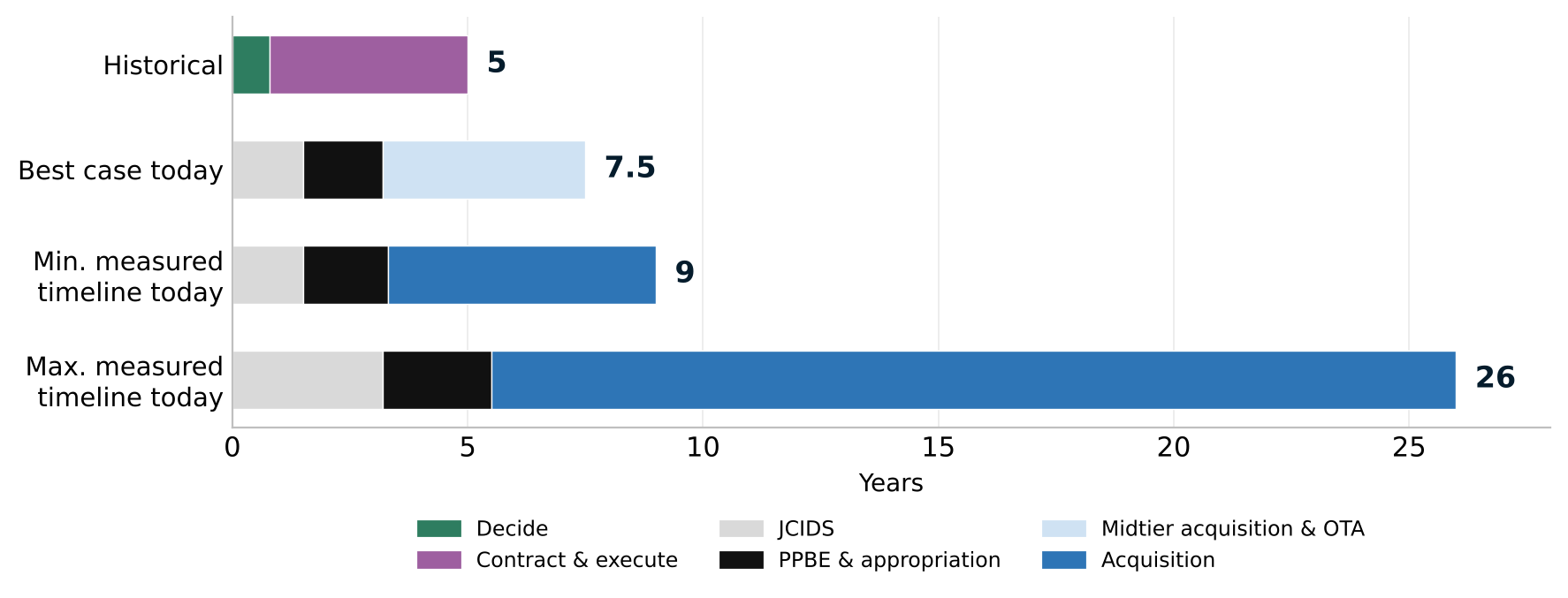
The first vulnerability is temporal. Major defense programs can take years — in measured cases, decades — to field, while critical electronics may be obsolete before they ever reach the battlefield. The historical decide-to-field cycle of roughly five years has degenerated into a best case of 7.5 years today and a measured maximum of 26 years (Exhibit 1). Against an adversary fusion model that iterates weapons on commercial production cadence, this is not a procurement inefficiency; it is a deterrence failure in slow motion.
Exhibit 1
The procurement cycle has lengthened even as the battlefield has accelerated.
Supplied archive exhibit · original labels. Read alongside the editorial corrections.
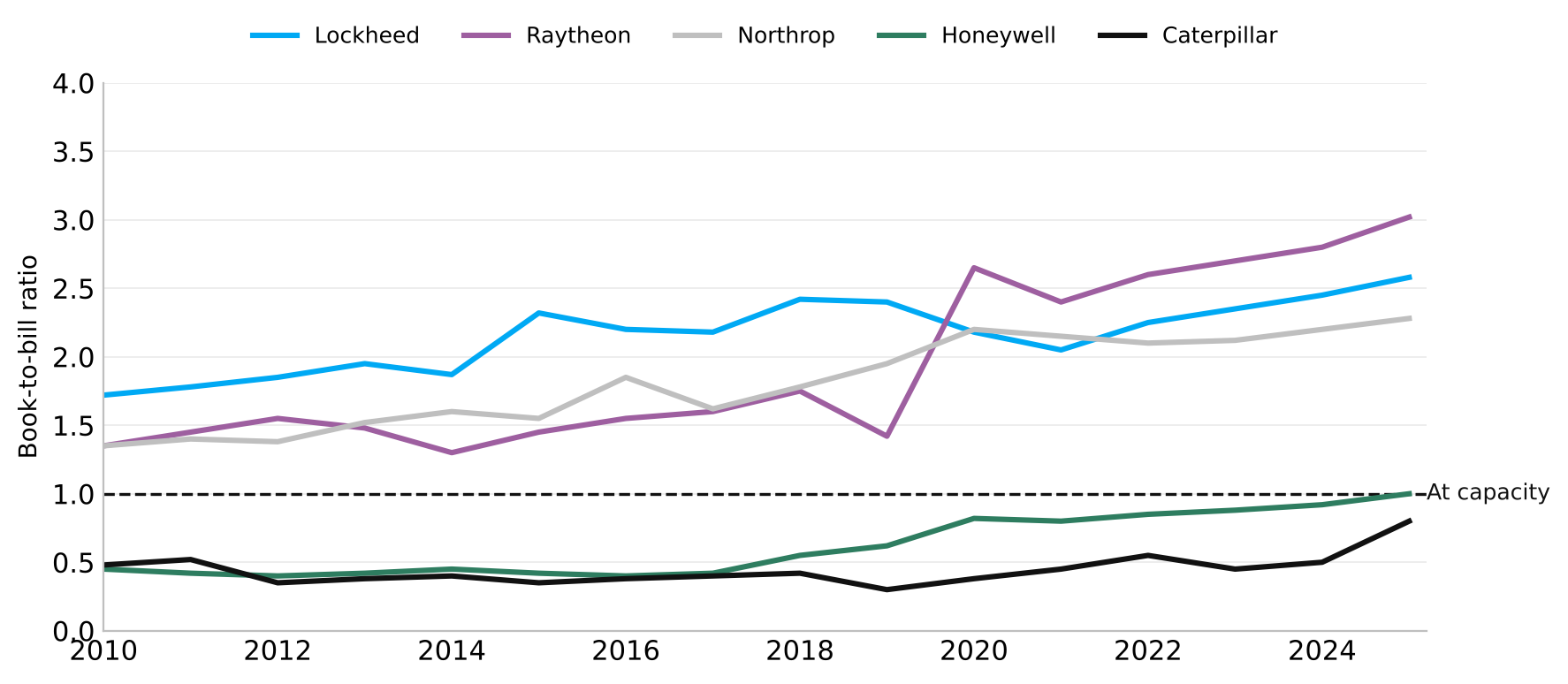
The second vulnerability is capacity. The book-to-bill ratios of the major primes have climbed to decade highs of roughly 2.3 to 3.0 times (Exhibit 2). In most industries, that profile signals pricing power; here it signals saturation. Orders are accumulating faster than factories can convert them — backlog without throughput. The rate at which precision munitions and interceptors have been expended in modern conflicts, relative to manufacturing footprints and stockpile levels, has proven punishingly high. The United States has been forced to pursue two tracks simultaneously: raising production rates of exquisite assets, and developing lower-cost alternatives that can be mass-manufactured.
Exhibit 2
Capacity constraints are notable among the primes.
Supplied archive exhibit · original labels. Read alongside the editorial corrections.
The third and fourth vulnerabilities are structural and sit below the waterline (Exhibit 3). The tiered architecture of the defense-industrial base concentrates final integration in four primes, routes major subsystems through a narrow band of sub-primes — the critical chokepoints in propulsion, seekers, fuzes, and data links — and rests the entire pyramid on thousands of small suppliers whose raw materials are often foreign-sourced. Policy reforms such as the NDAA provisions and Modular Open Systems Architecture are promising, but they must overcome entrenched acquisition processes, budgeting constraints, and persistent friction over intellectual property and data rights — barriers that can either enable competition and modularity or reinforce vendor lock-in.
Exhibit 3
The supply chain pyramid concentrates risk at the tiers investors see least.
TIER | ACTORS | STRUCTURAL READ |
|---|---|---|
End customer | DoW, Department of Energy, DHS, NASA | Monopsony buyer now actively re-architecting its own demand signal toward speed, scale, and attritable mass. |
Tier 1 primes | Northrop, Raytheon, Lockheed, Boeing | System integrators of record; book-to-bill at decade highs signals saturation, not strength — backlog without throughput. |
Tier 2 sub-primes | L3Harris, Leidos, Kratos, Teledyne, Acutronic, DLS | The critical chokepoints: propulsion, seekers, fuzes, data links. Scarce capacity here gates every prime ramp. |
Tier 3+ SMEs | Hundreds to thousands of small and mid-sized suppliers | Castings, bearings, precision electronics — with raw-material exposure that is often foreign-sourced, including China-linked inputs. |
Flow of products and services runs from raw-material suppliers at the base to the end customer at the apex.
Adapting to persistent competition, rapid technological change, and mass-scale attrition warfare is not optional. Failure to act risks eroding deterrence — and, for investors, eroding the franchise value embedded in legacy prime multiples.
The war-unicorn archetype: engineering affordable mass
Anduril is the cleanest expression of the new model and therefore the cleanest read-through for the cohort. The U.S. defense-industrial base is currently geared toward producing low numbers of expensive, bespoke assets — highly capable, but built in limited quantities, dependent on sole-source specialty materials, and burdened by complex manufacturing processes that make scaled ramps difficult. Anduril designs in the opposite direction: products conceived from the outset for affordability and scalability — what the company calls affordable mass. In the long run it believes its capability set will differentiate; right now it is prioritizing scalability and speed through four operating principles.
1. Vertical integration, selectively applied. Where it makes sense, component and module production is brought in-house, decreasing reliance on external vendors to hit production targets. Where external sourcing remains, the company seeks strategic relationships with commoditized component manufacturers, deliberately avoiding the supply-chain risk of sole-source suppliers. Commodity items with deep supplier bases — small turbojets, fasteners — stay outside. This is supply-chain design as a weapons capability.
2. Component and process commonality across product lines. Common bearings, bushings, electronic components, and materials across products simplify the supply chain and allow a shared inventory pool to flex across the portfolio. Similar production processes permit rapid manufacturing switches between products — the industrial logic of a consumer-electronics company applied to munitions.
3. Product simplification and production automation. Simpler designs create more automation opportunity, lower cost, and higher output. A simpler product often carries a lower capability ceiling, but the use cases for such products are expanding, because best-in-class assets are not always required to achieve mission outcomes. This is the heart of the attritable-mass thesis: the cost-exchange ratio, not the spec sheet, wins the war of magazines.
4. Flexible manufacturing facilities. Production lines designed to switch rapidly between products allow demand to be met when and where it occurs, and reduce the risk of idle, dedicated floor space tied to programs outside a procurement cycle.
The financial architecture compounds the industrial one. An estimated 70 to 80 percent of revenue is fixed-price, and the company invests substantially in internal R&D ahead of customer demand — accepting development risk in exchange for competing with in-production assets rather than hypothetical designs when requests for proposals are released. Management has stated that a total company operating margin approaching 25 percent is achievable over time — a structurally different profile from cost-plus primes. Critically, the customer is reinforcing the model: the DoW is increasingly requesting that industry participants invest their own capital into R&D and production, negotiating multi-year framework agreements, prioritizing fixed-price terms, taking equity stakes in companies, and opening test and procurement pathways such as the Drone Dominance Program.
Exhibit 4
Nine rounds, two wars, one repricing: implied valuation has compounded at venture velocity.
Supplied archive exhibit · original labels. Read alongside the editorial corrections.
The contract framework supports potential future orders; ceiling values alone do not establish revenue conversion (Exhibit 5). The March 2026 U.S. Army enterprise contract — a firm-fixed-price award with a $20 billion ceiling over ten years — consolidates more than one hundred existing contract vehicles into a single Lattice-anchored capability and is best understood as the Army standardizing on an operating system, not buying a product. Around it sit the Ghost Shark serial production line in Australia, Fury entering production at Arsenal-1 for the Collaborative Combat Aircraft program, the Marine Corps counter-UAS program of record, and a Barracuda framework that contemplates cruise-missile output measured in the thousands. Lattice, the AI battle-management layer, is critically integrated into the hardware but is also sold enterprise-wide — to the Army and to the U.S. Space Surveillance Network — giving the company a software annuity inside a hardware ramp.
Exhibit 5
Programs of record have moved the thesis from promise to backlog.
PROGRAM | VALUE | DETAIL |
|---|---|---|
U.S. Army Enterprise Contract | $20bn ceiling | Firm-fixed-price award (March 2026), 10-year period of performance. Consolidates 100+ existing contract vehicles into a single Lattice-anchored capability, with fixed commercial pricing and volume efficiencies. |
RAN Ghost Shark XL-AUV | $1.1bn+ | September 2025 award to deliver, maintain, and develop Ghost Shark over five years, after three prototypes were delivered on time and on budget; serial units rolling off the Australian line since November 2025. |
Collaborative Combat Aircraft (Fury / YFQ-44A) | est. $1bn+ | Selected with General Atomics for Increment 1 production-representative test articles; first flight October 2025; production began March 2026 at Arsenal-1. USAF intends to acquire more than 100 CCA over five years. |
USMC I-CsUAS PoR | $642mn | 10-year IDIQ program of record (March 2025) to deliver, install, and sustain installation-counter small UAS, following a $200mn MADIS engagement-system award. |
Barracuda framework | TBD (volume) | May 2026 DoW framework: minimum 3,000 all-up SLB-500M low-cost cruise missiles across three years; scale to at least 1,000 all-up rounds per year, first deliveries 1H27. |
Kuwait counter-UAS FMS | $1.98bn | State-approved foreign military sale (June 2026): Roadrunner-M, Anvil-Kinetic, Lattice C2, Sentry tower family, Pulsar EW, Menace TOCs, plus training and sustainment. |
Space-Based Interceptor | Prototype | May 2026 prototype contract to compete for the U.S. Space Force SBI program, teaming with Impulse Space, Inversion Space, K2 Space, Voyager Technologies, and Sandia National Labs. |
The portfolio breadth behind these programs was not organically grown alone; it was assembled with M&A discipline that mirrors the platform playbook of software consolidators (Exhibit 6). Roughly nine acquisitions since the 2017 founding have systematically filled capability gaps — propulsion, aerostructures, radar and C2, edge compute, infrared sensing — and in two cases (solid rocket motors and cooled IR components) positioned the company as a merchant supplier to the very primes it competes against. That is a subtle but important structural read: the challenger is inserting itself into the incumbents' bill of materials.
Exhibit 6
Acquisitions have assembled an arsenal across air, land, sea, and space.
DATE | ACQUISITION | CAPABILITY ACQUIRED |
|---|---|---|
Apr 2021 | Area-1 | Air-launched effects; expands the ALTIUS UxS portfolio. |
Sep 2021 | Copious Imaging | Passive sensing; adds WISP infrared detection. |
Feb 2022 | Dive Technologies | Autonomous underwater vehicles; adds Dive-LD. |
Mar 2026 | ExoAnalytic Solutions | Space domain awareness and missile defense. |
Jun 2023 | Adranos | Solid rocket motors; merchant supply of propulsion to primes. |
Sep 2023 | Blue Force Technologies | Autonomous aircraft with integrated aerostructures; adds Fury, the Group 5 CCA in development since 2019. |
Jan 2025 | Numerica (radar/C2) | Signal processing, tracking algorithms, radar systems. |
May 2025 | Klas | Edge computing and tactical communications; adds the Voyager line. |
Oct 2025 | American Infrared Solutions | Cooled infrared cameras; merchant supply of IR components to the broader defense-industrial base. |
The demand signal: the Gulf becomes the proving ground
Doctrine and capital describe the supply side; the demand side announced itself over Kuwait. The Iranian Shahed-136 strike on Kuwait International Airport last week — one dead, dozens injured — crystallized a reality that Gulf air-defense planners had been circling for two years: legacy, high-end air-defense systems are mismatched against the proliferating low-cost drone threat. Within days, the State Department approved a potential $1.98 billion foreign military sale to Kuwait for a layered counter-UAS architecture: Roadrunner-Munition and Anvil-Kinetic interceptors, launch boxes, Lattice command and control, the full Sentry tower family including maritime variants, Pulsar electromagnetic warfare, and Menace tactical operations centers, with training and sustainment.
The economics are the story. Expending a multi-million-dollar Patriot interceptor against a Shahed-class one-way attack drone is a losing cost-exchange trade repeated at scale; the Kuwait package exists to plug the lower-altitude defense layer against small drones, one-way attack munitions, and swarms with electronic and kinetic defeat options priced for attrition. Every Gulf state operating critical energy and aviation infrastructure under the same threat envelope is now running the same calculation, and the counter-UAS franchise is already gaining momentum domestically with the Marine Corps and internationally around critical infrastructure. We read Kuwait not as a one-off but as the first print in an export demand curve.
Nor is the cohort a single company. The unveiling of BLITZ — a low-cost, fully autonomous, hand- or rail- or container-launched Group I UAS designed as an expendable swarm platform, assembled by operators in under two minutes — illustrates that the affordable-mass design language is propagating across a second tier of venture-backed manufacturers. The investable universe is widening from one flagship name into an ecosystem: interceptor specialists, swarm platforms, autonomy stacks, sensor merchants, and the component suppliers feeding all of them.
The battlefield of the 2030s will be defined less by slow-cycle platforms and more by high-speed, low-cost, increasingly automated weapons. The order flow of 2026 is the first derivative of that future.
Trigger → Flow → Risk → Price → Position
Trigger. Three triggers have fired in sequence: the November acquisition-reform package placing the DoW on a wartime footing; the Army leadership's public adapt-or-die ultimatum to the primes; and the Kuwait airport strike converting Gulf counter-drone demand from deliberation to procurement inside a single week. Each is independently bullish for the unicorn cohort; together they are regime-defining.
Flow. Capital is moving on three rails at once. Private capital: defense-tech venture up roughly 200 percent year on year, with Anduril's $5.0 billion Series H doubling its valuation in eleven months. Government flow: fixed-price framework agreements, $20 billion contract ceilings, direct equity stakes in industry. Export flow: a $1.98 billion FMS approved at crisis speed. The flows reinforce — programs of record de-risk the venture capital, and the venture capital funds the capacity that wins the next program.
Risk. The bull case is consensus among the fast money; the risks are not. Fixed-price economics cut both ways — investing ahead of demand entails real balance-sheet risk if RFPs slip or specifications drift. Acquisition reform is showing early progress, but PPBE constraints and intellectual-property friction can still reinforce vendor lock-in for incumbents. Module-level sole-source dependencies remain hard to avoid even for vertical integrators. A $61 billion private mark embeds flawless execution; private marks correct without printing a tape. And the primes are not passive — saturated book-to-bill is also a war chest, and the incumbents will buy what they cannot build.
Price. Public-market expression of the theme remains inefficient: the purest assets are private, so the listed complex trades the theme through proxies — Tier 2 chokepoint suppliers (propulsion, seekers, data links, IR sensing), counter-UAS adjacencies, and the primes themselves, whose multiples still embed franchise durability the procurement reset is actively eroding. The widest mispricing, in our assessment, sits in the gap between what prime backlogs imply (strength) and what prime book-to-bill reveals (saturation), and in Tier 2 names whose capacity gates every ramp on both sides of the incumbent-challenger divide.
Position. The analytical construct: long the picks-and-shovels of affordable mass — Tier 2 chokepoint suppliers with pricing power, counter-UAS and sensor merchants, and pre-IPO exposure to the unicorn cohort where mandates permit; underweight legacy prime equity where valuation still capitalizes the old procurement regime; and monitor the secondary market for unicorn paper as the discipline check on private marks. The single highest-value catalyst to track into 2027: any signal of an Anduril public listing, which would force the entire complex to re-mark against a printed comp.
Key questions for the road ahead
As in any regime change, the terrain rewards those who interrogate their own books before the market does it for them. Three sets of questions, by seat.
The road ahead
The defense-industrial base of 2026 is an industry in forced maturation — a dramatic shift from a decade in which the primes' franchise was treated as a perpetuity. The conditions that once underwrote that perpetuity — captive procurement, cost-plus economics, generational program cycles — have passed. Over the next decade, outcomes will increasingly be shaped by deliberate choices: how the customer rewires its own acquisition machinery; how challengers convert venture capital into production lines and production lines into programs of record; how incumbents deploy saturated backlogs and acquisition currency in self-defense; and how allocators distinguish the vehicles built for this terrain from those still driving with maps designed for smoother roads.
Future military power will not be defined by the legacy primes alone, but by the war unicorns — and by the suppliers, sensors, and software layers that feed them. The repricing is under way in the private market; the public market has barely begun to mark its books. The road ahead, while steeper and more demanding, remains very much open. Especially for the right vehicles.
Companion edition: Original teaser
Anduril Won an Army Contract With a $20 Billion Ceiling. What Does That Mean?
Original Lens and publication context
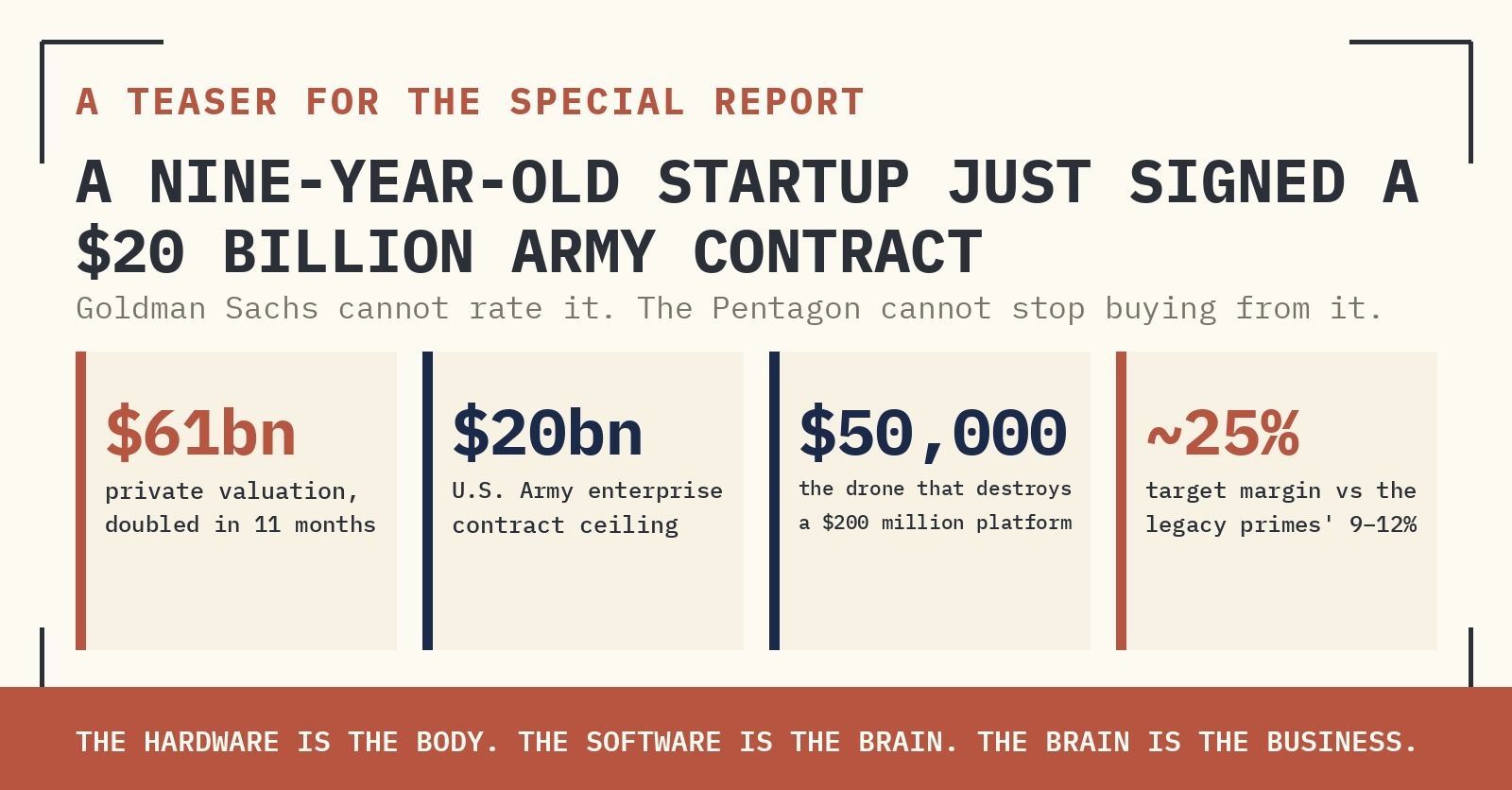
Goldman Sachs cannot rate it. The Pentagon cannot stop buying from it. A teaser for the Special Report.
- A nine-year-old private company signed a U.S. Army enterprise contract with a $20 billion ceiling in March 2026; its private valuation of $61bn doubled in eleven months, and a proposed $1.98 bn Kuwait counter-drone sale was notified days after a strike.
- The model is affordable mass: one design, many sizes, shared parts, made by machines by the thousand, all running on one piece of software, Lattice — the hardware is the body, the software is the brain, and the brain is the business.
- Why it matters: Ukraine and the Gulf showed that arsenals run out and a $50,000 drone destroys a $200 million platform. Roughly 25 percent target margins against the legacy primes’ 9–12 percent mean every defense multiple reprices off how fast this model scales.
Here is the company in one breath. Anduril builds weapons the way Apple builds phones: one design, many sizes, shared parts, made by machines, by the thousand. Strike drones, cruise missiles, an autonomous fighter, robot submarines — all cheap enough to lose, smart enough to win, all running on one piece of software called Lattice, which fuses thousands of sensors into decisions at machine speed. The hardware is the body. The software is the brain. And the brain is the business.
Why does that matter now? Because Ukraine and the Gulf exposed the West’s most dangerous secret: its arsenals run out. A $50,000 drone routinely destroys a $200 million platform, and munitions are expended faster than factories can replace them. Anduril builds affordable mass at consumer-electronics speed while the legacy industry builds exquisite weapons over decades. In March 2026 the U.S. Army answered with a single enterprise contract carrying a $20 billion ceiling. It did not buy products. It standardized on an operating system.
$61bn PRIVATE VALUATION — DOUBLED IN ELEVEN MONTHS | $20bn U.S. ARMY ENTERPRISE CONTRACT CEILING | $2bn KUWAIT COUNTER-DRONE EXPORT, DAYS AFTER A STRIKE | 150/yr FIGHTER JETS FROM ONE OHIO FACTORY LINE |
|---|
Supplied archive exhibit · original labels. Read alongside the editorial corrections.
Who must read this — and why
Inside the full report
01 Why Goldman’s lead defense analyst put a private company in front of institutional investors — and why studying Anduril is studying the customer.
02 The doctrine of affordable mass: the four manufacturing rules that let one factory flip between fighter jets, missiles, and classified programs as demand moves.
03 Lattice, the Trojan horse: how every drone, tower, and submarine sold deploys another node of the software — and locks the customer in.
04 The order book that retires the “narrative without revenue” objection: four services, three continents, and a $2 billion export print in Kuwait.
05 The five-point syllabus for governments that intend to lead this transition rather than suffer it — procurement, capital, software, magazines, exports.
The full Special Report runs to seven pages in this edition: the regime-change matrix, the machines by the numbers, the order book, the factory, the cap table, the M&A map — and the syllabus. Read it before your next procurement review, policy briefing, or portfolio meeting. The arsenal of democracy is being refounded. This is its first balance sheet.