Original Lens and publication context
Washington has placed the asymmetric-warfare thesis in formal budget proposals. The budget, the supercycle, and the names it is built on.
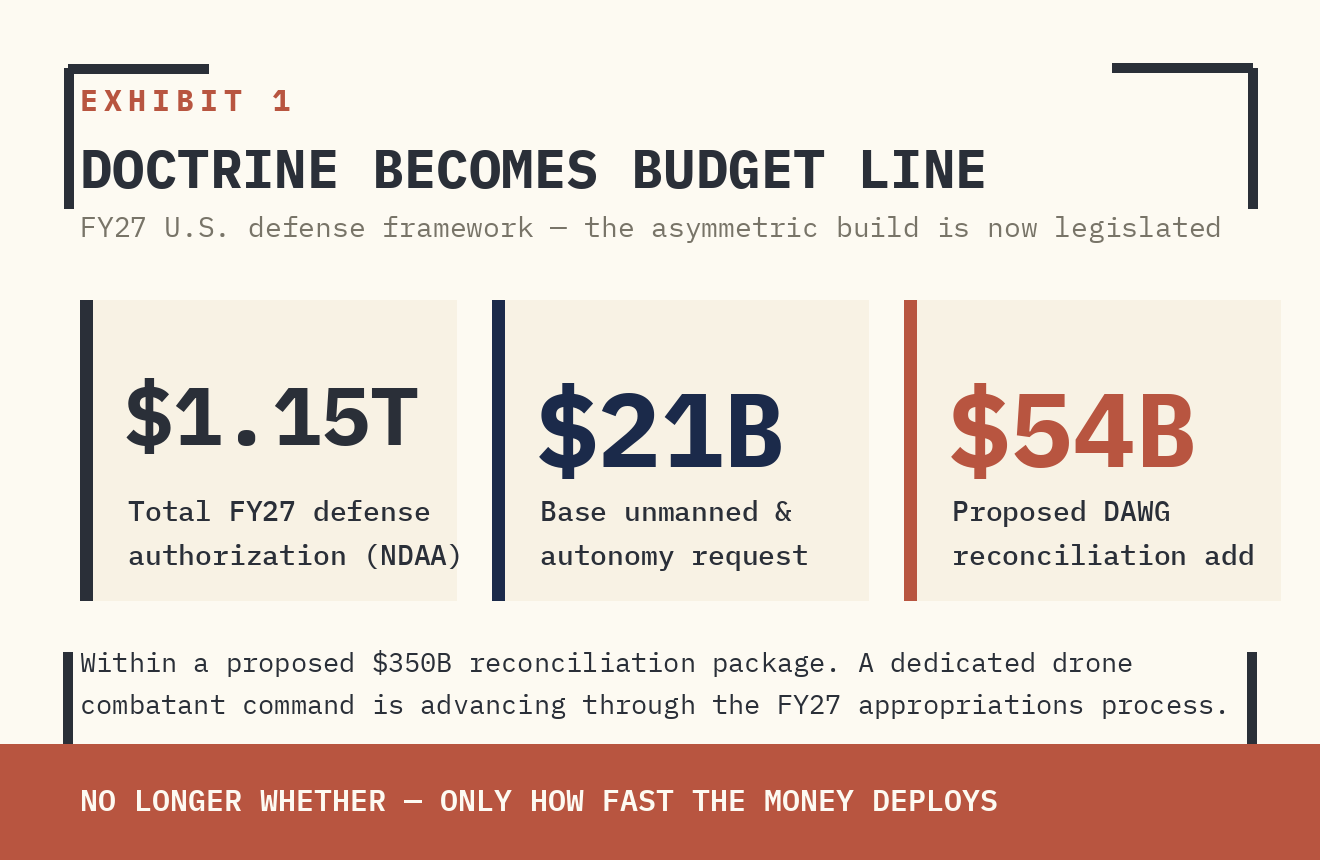
- FY27 authorizes roughly $1.15T of defense spending, with about $21B base for unmanned and autonomy and a proposed ~$54B Defense Autonomous Warfare Group line on top.
- The base $21B is intact with bipartisan support; the $54B reconciliation add is the swing variable — contested, but with multiple legislative paths to passage.
- A dedicated drone combatant command is advancing, confirming unmanned warfare as a service-level priority rather than a line item.
- The sell side frames this as a procurement supercycle set to reshape the roughly $3T of annual global military spend around cheap, attritable systems.
- Positioning resolves into a public drone-and-enabling basket and a private war-unicorn pipeline feeding the next leg of listed supply.
TRIGGER
The Budget Became Real
The asymmetric-warfare argument no longer rests on battlefield anecdote. The FY27 National Defense Authorization Act, cleared by both armed-services committees, authorizes roughly $1.15 trillion in defense spending. Inside it sits a base request near $21 billion for unmanned and autonomy programs spanning aerial, surface, undersea and ground systems, plus counter-UAS. Above the base sits a proposed $350 billion reconciliation package carrying around $54 billion of incremental autonomous-systems funding through a dedicated Defense Autonomous Warfare Group line.
Supplied archive exhibit · original labels. Read alongside the editorial corrections.
Reporting points to the creation of a drone combatant command — institutional confirmation that the shift toward robotic warfare is structural. The catalyst was operational: in the Gulf, cheap Iranian Shahed-class drones eliminated multi-million-dollar communications, radar and command nodes, exposing a missing air-defense layer over high-value infrastructure. The response is a procurement reset — source, order and stockpile low-cost one-way attack drones, interceptors and counter-UAS before the next conflict. Congressional testimony points toward expanding these investments, not scaling them back.
FLOW
Anatomy Of A Supercycle
The sell-side framing is unusually direct: one of the defining lessons of the decade is how affordable drone technology has reshaped the modern battlefield and forced a re-evaluation of the procurement, organization and strategy behind roughly three trillion dollars of annual global military spend. The Ukraine war supplied the proof; the budget supplies the follow-through. The first wave of the market centers on inexpensive unmanned production, domestic supply chains and rapid procurement. The second wave is driven by autonomy, swarming, mothership configurations and deeper integration into command-and-control networks — with battle-management software as decisive as the hardware.
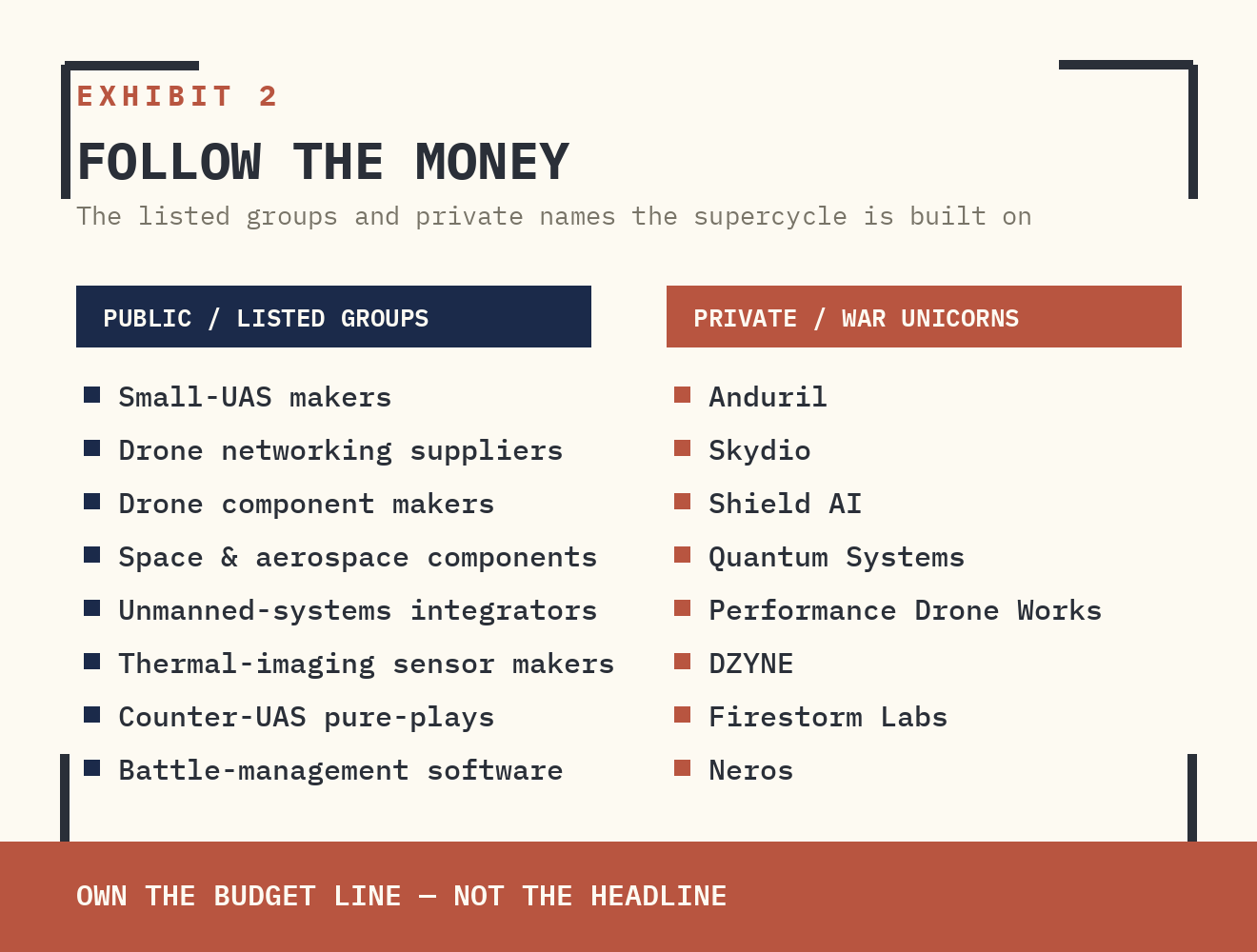
The universe is wide and maturing. The sell side maps roughly nine public and nineteen private companies powering the domestic drone industry, spanning production, supply chain, sensing and software. Most militaries remain in the earliest innings — building defensible supply chains, refining designs and aligning budgets to field these systems — which is precisely why the procurement runway is long.
Supplied archive exhibit · original labels. Read alongside the editorial corrections.
RISK
Figure 01 · Conceptual framework
From a budget headline to delivered capability
What Breaks The Thesis
The $54 billion reconciliation line is the principal swing variable. It has become politicized, was left out of an earlier reconciliation package, and its timing is uncertain — a genuine source of sector-wide volatility. Two further risks compound it. First, procurement cycles are slow and execution-heavy; early-innings programs carry delivery and integration risk that the equity market tends to underprice. Second, defense has become a consensus long at a moment when broader positioning is stretched, leaving the names exposed to multiple compression on any ceasefire headline. The structural budget, however, persists across ceasefires — the reset is a lesson learned, not a war-duration spend.
This is a multi-year procurement thesis, but its funding depends on legislation, appropriations and execution.
PRICE
What The Tape Already Shows
The defense budget framework remains intact, with the base unmanned allocation reinforced rather than trimmed as the FY27 process advances. Independent budget trackers carry a high degree of confidence that funding for unmanned and autonomous systems will at least meet proposed levels, with upside as the legislative process unfolds. The market has already begun rewarding the war-unicorn complex; the question for allocators is sizing and timing, not direction.
POSITION
Two Baskets
Consistent with this publication's framework, positioning is expressed at the sub-sector layer rather than the individual security. The theme resolves into two baskets, each a different expression of the same legislated build. Named companies are illustrations of where the spending concentrates, not recommendations.
One — public drone and enabling. The listed beneficiaries of cheap-mass production, domestic supply chains and the software layer: a universe spanning the listed drone makers, their networking and component suppliers, and the sensor primes, with the command-and-control software layer as the expression through Maven-style battle management.
Two — the private war-unicorn pipeline. Anduril, Skydio, Shield AI, Quantum Systems, Performance Drone Works, DZYNE, Firestorm Labs and Neros are the forward supply of public listings and acquisition targets. They are not investable today, but they define where the next leg of listed exposure will come from.
The discipline is to own the budget line rather than the headline, treat the $54 billion reconciliation add as optionality on top of an intact base, and use ceasefire-driven drawdowns as accumulation windows. The proposed spending wave still has to pass its funding and delivery gates.