Original Lens and publication context
Trump Strikes Iran’s Oil Crown Jewel — and Holds His Hand
- Trump struck every military installation on Kharg Island at about 9:30 PM EDT on March 13 and spared its oil terminals, with a conditional threat tied to Hormuz. Roughly 90 percent of Iran's crude exports load there, about seven million barrels a day of capacity.
- The market was already in crisis: Brent is up more than 40 percent since the war began, closing at $103.14 on Friday despite a record 400-million-barrel IEA release, with prompt barrels $14.20 over next month; Hormuz, about 20 mb/d, is at near-total standstill.
- Every president since Carter avoided Kharg; Trump struck it and handed Tehran the detonator. If Iran relents, Brent has a path back to $85–92; if it escalates, bank scenarios run to $135 and beyond, with half of Iran's 3.3 mb/d output at risk within days.
- The asymmetry is stark: relief takes oil down 10–15 percent, escalation takes it up 25–40 percent, so the only honest position into Sunday's open is long volatility. A third, unpriced path, partial passage settled in yuan, would be the petrodollar's biggest structural hit since 1973.
- Indian upstream producers and complex refiners outperform in the $100–120 range, but the rupee stays under pressure in both scenarios, with every $10 a barrel costing the current account $14–15 billion annually. Watch the Brent spot–three-month spread, the Indian 10-year, and gold-dollar haven flows.
With US equity and energy futures opening in under 45 hours, Washington has handed Tehran a binary ultimatum: stand down on the Strait of Hormuz, or watch the oil infrastructure that sustains the regime turn to ash. This is not strategy. It is a poker hand played with global energy markets — and the table stakes are $20 per barrel in either direction.
I. TRIGGER
THE STRIKE
At approximately 9:30 PM EDT on March 13, 2026, President Donald Trump announced via Truth Social that CENTCOM had executed what he called “one of the most powerful bombing raids in the History of the Middle East,” destroying every military installation on Iran’s Kharg Island. The announcement was followed immediately by a conditional threat that has defined the market calculus for the 45 hours that follow: oil infrastructure on the island was spared — but only for now.
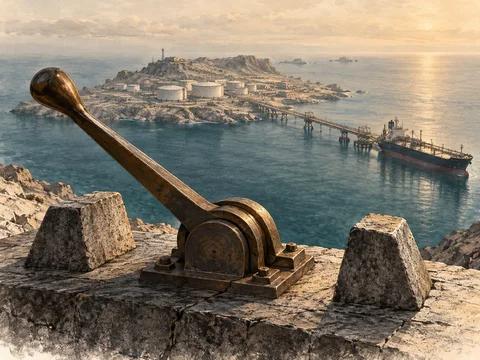
Kharg Island is not merely a military outpost. It is the economic spinal cord of the Iranian state. Roughly 90 percent of Iran’s crude exports flow through its terminals, loading onto supertankers bound for Asia. Its loading capacity stands at approximately seven million barrels per day. Without it, Iran cannot fund its military, its proxies, or its population. Trump knows this. Tehran knows this. The futures market will price this starting Sunday.
“For reasons of decency, I have chosen NOT to wipe out the Oil Infrastructure on the Island. However, should Iran — or anyone else — do anything to interfere with the Free and Safe Passage of Ships through the Strait of Hormuz, I will immediately reconsider this decision.” — President Trump, Truth Social, March 13 2026
The context in which this strike lands matters. Operation Epic Fury began February 28, when joint US-Israeli strikes killed Supreme Leader Ayatollah Khamenei on Day 1. His son Mojtaba Khamenei was installed as replacement and has struck a hardline posture from the outset, declaring the Strait of Hormuz must remain closed as a tool of pressure against the enemy. Iran has since attacked ships in the Arabian Gulf, struck targets across Gulf states including Qatar and Saudi Arabia, and launched missile salvos at Israel. Turkey’s NATO air defenses have now intercepted three Iranian ballistic missiles. The war is in Week 3 and is escalating, not winding down.
II. FLOW
WHAT HAS ACTUALLY MOVED
The global oil market was already under extreme stress before the Kharg strike. Brent crude has surged more than 40 percent since the war began, peaking at nearly $120 per barrel before settling at $103.14 at Friday’s close — the second consecutive close above $100. WTI settled at $98.71. The IEA has authorized the largest strategic reserve release in history — 400 million barrels — and Brent is still above $100. That is the scale of the disruption.
The Strait of Hormuz handles approximately 20 million barrels per day of crude and petroleum products — roughly one-fifth of global supply. It is currently at near-total standstill. Tanker operators have ceased transit. The physical crude market has entered extreme backwardation, with prompt barrels trading at a $14.20 premium over next-month futures. This signals genuine physical scarcity, not speculative positioning. Buyers are desperate for any available cargo.
J.P. Morgan calculates that if Kharg goes offline, upstream shut-ins could threaten half of Iran’s 3.3 million-barrel-per-day production within days. The 20-day buffer the market assumed would vanish from Day 1.
The US military has deployed AI-powered Merops drones across the region, a Marine Expeditionary Unit of 2,500 Marines and sailors is en route, and Defense Secretary Hegseth confirmed Friday that US strike volume is “ramping up and only up.” Iran, simultaneously, has struck targets in Qatar (Doha evacuations), Oman (Port of Sohar suspended), Saudi Arabia (over a dozen drones intercepted), and Israel (missiles over Tel Aviv). This is not a localized confrontation. The entire Persian Gulf energy corridor is in active disruption.
III. RISK
THE ANATOMY OF TRUMP’S GAMBLE
The Kharg strike is deliberately calibrated. Trump destroyed military targets and left the oil infrastructure standing. This is coercive leverage, not destruction. The message to Tehran is precisely structured: I can end your economy in a single sortie, and I have chosen not to. Stop closing the Strait. The question that markets must answer Sunday night is whether Tehran reads this as strength to be conceded to, or provocation to be escalated against.
Even by Trump’s standards, this is an extreme gamble. Former top advisers note that Kharg has been untouched in every modern Middle East conflict — through the Iran-Iraq Tanker War of the 1980s, the 1979 hostage crisis, and multiple cycles of maximum pressure sanctions. Reagan, Carter, and every president since avoided it precisely because of the asymmetric energy market risk. Trump has now entered the island’s airspace and struck it — while leaving the taps open. No precedent exists for this exact move.
Every president since Carter has avoided Kharg. Trump struck it — and then handed Tehran the detonator, telling them when he will use it himself. That is not strategy. That is a bet.
The risk calculus bifurcates cleanly. If Iran relents — signals willingness to let ships through, even partially — the Hormuz premium drains from oil prices, the IEA’s 400-million-barrel release does its work, and Brent has a credible path back toward the $85–92 range. White House officials have telegraphed this expectation explicitly. If Iran escalates — attacks more Gulf infrastructure, strikes the island’s oil terminals in retaliation, or formally closes Hormuz to all traffic — analysts from Barclays, UBS, and JPMorgan have flagged Brent scenarios at $135 and beyond. Iran’s own militia spokesperson invoked $200 per barrel. Robert Kimmitt, former Deputy Treasury Secretary, stated plainly: if the oil infrastructure goes, “prices will just go out of control.”
There is a third scenario that markets have not fully priced: Iran offers partial passage but only in Chinese yuan. A senior Iranian official floated this to US television on Friday. This is not de-escalation — it is weaponized re-engagement. It introduces a dollar-yuan energy wedge directly into the Hormuz calculus, with profound implications for petrodollar architecture. If adopted even partially, the geopolitical consequences extend far beyond the oil price.
IV. PRICE
TWO SCENARIOS, ONE MARKET OPEN
US crude futures open Sunday evening. What happens in the first 30 minutes will be the most consequential single price signal in global energy markets since the 2020 COVID crash. The Kharg strike is less than 48 hours old at that point. Any Iranian communication — or absence of one — will be the input the market is pricing.
Scenario A — Iran Relents (Hormuz Partially Reopens)
Brent corrects from $103 toward $85–92. The IEA release provides the liquidity buffer. White House narrative of “victory” takes hold. Energy equities rally, then fade as the crude price premium collapses. Indian rupee gets modest relief on LPG and fertilizer import cost. Brent backwardation narrows. WTI retraces below $85. The relief is real but fragile — Mojtaba Khamenei remains in power, and no structural resolution has occurred.
Scenario B — Iran Escalates (Kharg Oil Infrastructure Struck)
Brent gaps above $110 at the open, with scenarios to $130–140 depending on the scale of Iranian retaliation. JPMorgan’s upstream shut-in model activates: half of Iran’s production is at risk within days of Kharg’s terminals going offline. The IEA’s 400 million barrels buys weeks, not months, of buffer. US airline stocks crash on jet fuel exposure — most US carriers removed fuel hedges. Indian monetary policy faces its most acute imported inflation shock since 2022. RBI credibility comes under direct pressure.
The asymmetry is stark. Relief upside: oil falls 10–15 percent. Escalation downside: oil rises 25–40 percent. The market is not priced for a symmetric outcome. Long volatility is the only honest position.
V. POSITION
HOW THE BUY SIDE IS THINKING ABOUT THIS
The rational institutional position entering Sunday’s open is not directional — it is volatility-long. Brent options are pricing extreme uncertainty. The prompt backwardation of $14.20 means the physical market is already in crisis mode regardless of which scenario unfolds. What changes is the magnitude and duration, not the direction of disruption.
Energy equities present a more nuanced picture. Indian upstream producers and complex refiners have asymmetric exposure: high crude means high upstream margins for producers, while complex refining generates superior margin in a high-spread environment. Both outperform in the $100–120 range. The rupee, however, remains under sustained pressure in both scenarios — India imports roughly 85 percent of its crude, with every $10 per barrel move costing the current account approximately $14–15 billion annually. Fertilizer and LPG subsidy pressures mount in tandem.
Three positions warrant monitoring as the 45-hour clock expires. First: Brent spot versus three-month forward spread — the backwardation will either steepen sharply (escalation) or compress rapidly (de-escalation), and the move will be violent. Second: Indian government bond yields — an oil shock of this magnitude forces RBI into an impossible position between inflation control and growth support; the 10-year is the tell. Third: safe-haven flows into gold and the dollar — if Hormuz remains closed, the dollar’s role as petrocurrency anchor gets tested precisely as Iran floats yuan-denominated passage.
The yuan scenario deserves a standalone note. If even a portion of Hormuz passage is routed through yuan settlement, it represents the single most significant structural challenge to petrodollar dominance since the 1970s — achieved not through decades of diplomacy but through a war that the US initiated. The irony is not lost on Beijing. China’s position — as Iran’s primary oil buyer and a primary beneficiary of yuan internationalisation — places it at the center of the post-conflict energy architecture regardless of who wins the shooting war.
If Iran routes Hormuz passage through yuan settlement, the petrodollar takes its most significant structural hit since 1973 — engineered inadvertently by the same administration that launched the strike.
BUY SIDE VERDICT
The Kharg strike is the single most consequential energy market event since Russia’s 2022 invasion of Ukraine — and it has been executed with a 45-hour fuse attached. Trump struck the island that every president since Carter avoided, spared the infrastructure that every analyst said would send oil to $140 if hit, and handed Tehran an ultimatum timed precisely to the US futures open. This is pressure maximization at its most theatrical. Whether it is also effective depends entirely on what Tehran’s new Supreme Leader chooses to do with the next 48 hours.
Markets are not priced for a clean resolution. The backwardation, the IEA emergency release, the marine deployments, and the Qatari evacuations tell a singular story: the system is under maximum stress, and the relief valve has not opened yet. The bet Trump has made is that a man who just watched his father’s regime get obliterated will blink before the oil terminals burn. That may be right. But it is, by any measure — even by Trump’s own standards — one of the biggest geopolitical gambles ever played with global energy markets as the table.