Original Lens and publication context
Why the collapse of industrial military doctrine triggers permanent global macroeconomic risk — and what institutional capital must price in.
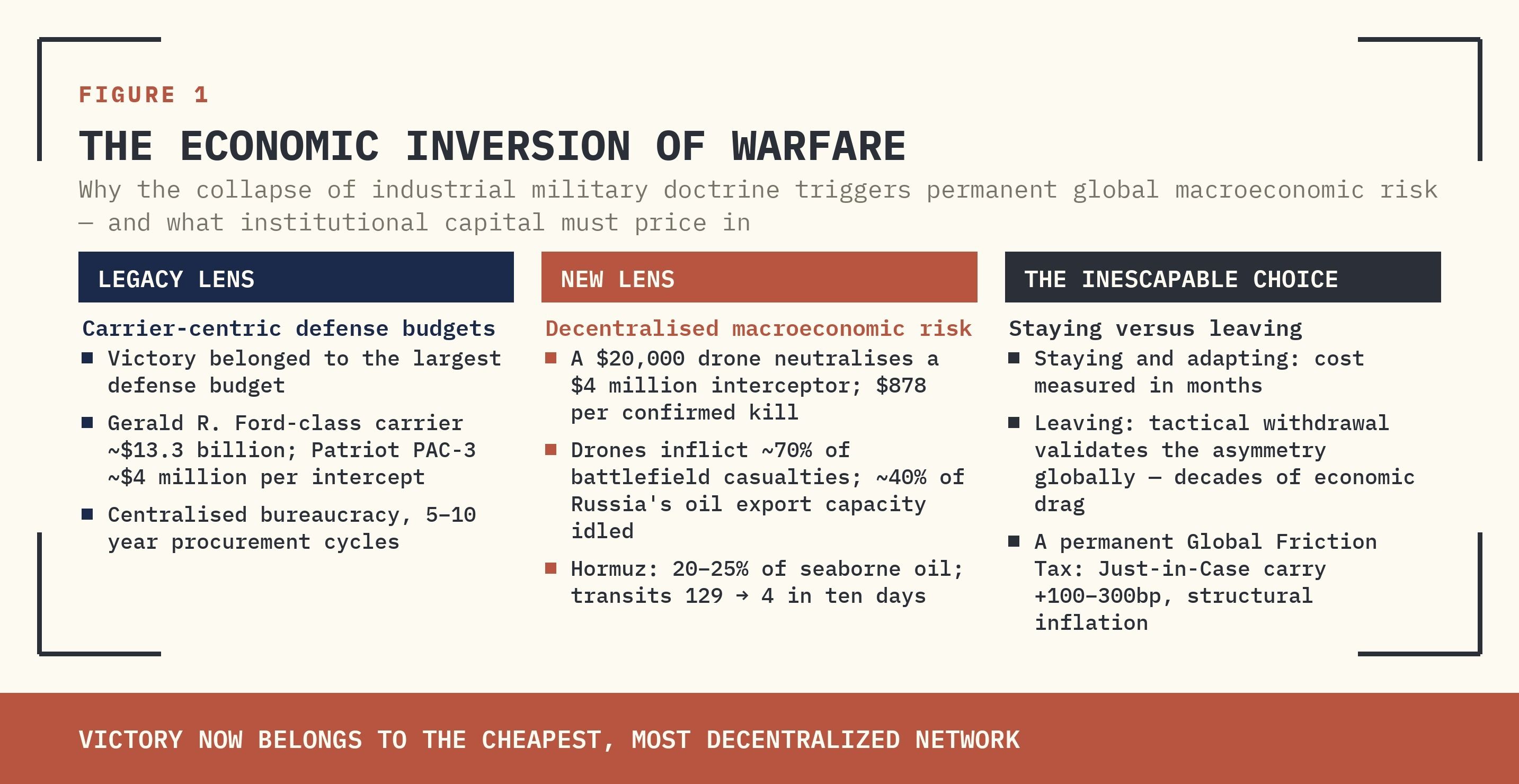
- The cost asymmetry between attack and defense has flipped structurally: a $20,000 drone neutralises a $4 million interceptor, the cost per confirmed kill in Ukraine is $878, and drones inflict roughly 70% of battlefield casualties. Cheap networks have idled ~40% of Russia's oil export capacity.
- The doctrine has crossed the Atlantic: over 9–20 March 2026, waves of 12–15 drones loitered up to four hours a day over Barksdale AFB, home of US Global Strike Command and its B-52 fleet; countermeasures failed, nothing was intercepted. Not an attack, an announcement.
- Hormuz is the inescapable chokepoint: 20–25% of seaborne oil. After the 28 February US strikes on Iran, daily tanker transits fell from 129 to 4 in ten days; crude spiked 27%, LNG 74%. The US Navy cannot economically defend transits at $4 million an intercept.
- The result is a permanent Global Friction Tax: tactical withdrawal validates the asymmetry, Just-in-Time gives way to Just-in-Case with a 100–300 basis-point inventory carry uplift, and structural inflation lifts the equilibrium real rate above the 2010–2019 regime.
- Position across five books: long chokepoint-risk energy structures and crude upside calls; long counter-UAS, software-defined defense and small-batch drone makers against legacy primes weighted to manned platforms; long disciplined London reinsurers; long nearshore warehousing; 2s10s flatteners, long 5y5y breakevens, petrocurrencies over Asian importer FX.
EXECUTIVE SUMMARY
A century-old industrial military equilibrium has broken. The cost asymmetry between attack and defense has flipped — and the flip is not tactical, it is structural. A $20,000 drone now neutralises a $4 million Patriot interceptor. Battlefield casualties in Ukraine are 70% drone-inflicted. Ukrainian "housewives with 3D printers" — derisively dismissed by the Rheinmetall CEO — have pushed Russia to its smallest territorial control footprint since 2022 and have idled roughly 40% of Russia's oil export capacity from Baltic and Black Sea ports.
The same doctrine has now reached US soil. Between 9–20 March 2026, multiple waves of 12–15 sophisticated drones loitered for up to four hours daily over Barksdale Air Force Base — headquarters of US Air Force Global Strike Command, home of the B-52 fleet and W80-armed AGM-86B cruise missiles. Base electronic countermeasures failed. No interception occurred. This was not an attack. It was an announcement.
For markets, the consequence is a permanent re-pricing of three things: (i) the credibility of US-led freedom-of-navigation guarantees over chokepoints carrying 20–25% of global seaborne oil, (ii) the working-capital intensity of global supply chains as logic shifts from Just-in-Time to Just-in-Case, and (iii) the geographic risk premium embedded in defense, insurance, and energy equities. We frame the institutional response below using the Buy Side Lens proprietary framework: Trigger → Flow → Risk → Price → Position.
Victory used to belong to the largest defense budget. It now belongs to the cheapest, most decentralized network. That single sentence is the entire macro thesis.
Supplied archive exhibit · original labels. Read alongside the editorial corrections.
TRIGGER
THE DOCTRINE HAS CROSSED THE ATLANTIC
Three datable events in March 2026 collapsed any remaining ambiguity about whether the Ukraine drone doctrine is a regional anomaly or a global standard.
9 March 2026 — Barksdale AFB, Louisiana
An unidentified drone triggered a shelter-in-place order and elevation of Force Protection Condition to FPCON Charlie. The 2nd Bomb Wing, which operates approximately 44 B-52H Stratofortress bombers, was briefly grounded. Subsequent reporting confirmed multiple waves of 12–15 drones over the following ten days, loitering up to four hours per day. The drones exhibited non-commercial signal characteristics, long-range control links, and active resistance to jamming. The US Air Force's own electronic countermeasures — designed to disable GPS and the operator-drone datalink — failed to function. This is the first publicly reported instance of a US air base being temporarily taken out of operation in wartime — a scenario that did not occur even during World War II.
28 February 2026 — Onset of US–Iran Conflict
US strikes on Iran began on 28 February 2026. Within ten days, Strait of Hormuz tanker transits collapsed from approximately 129 per day to four — a 97% reduction. Iranian Shahed drones attacked US naval and Gulf installations. The report argues that relying on expensive interceptors against cheap drones can strain defence economics. Patriot is a land-based system; naval and site defence use different layered combinations of sensors, electronic warfare, guns and interceptors. Insurance markets responded immediately: London marine war risk premia spiked, and 90–97% of tanker traffic diverted or suspended.
March 2026 — Ukraine's Strategic Strike Campaign
Across the month of March, Ukrainian deep-strike drones systematically hit Russian energy infrastructure — Primorsk and Ust-Luga (Baltic), Novorossiysk (Black Sea), Volgograd, Ryazan, Syzran, Saratov, and the Gazprom Ust-Luga gas processing complex. Published tallies put approximately 40% of Russia's oil export capacity — around 2 million barrels per day — offline by 25 March. Industry surveys put refinery throughput declines at 300,000–400,000 b/d. The campaign was conducted by drones costing low-thousands of dollars per unit, against infrastructure worth tens of billions of dollars and defended by legacy air defense systems costing millions per intercept.
The doctrine is no longer Ukrainian, no longer experimental, and no longer optional. It is global, validated, and exportable.
FLOW
THE MATH OF ASYMMETRY
The economic inversion can be expressed in three quantitative collapses. Each is independently severe. Together, they describe a doctrine that cannot be unlearned.
Collapse 1 — Cost Per Kill
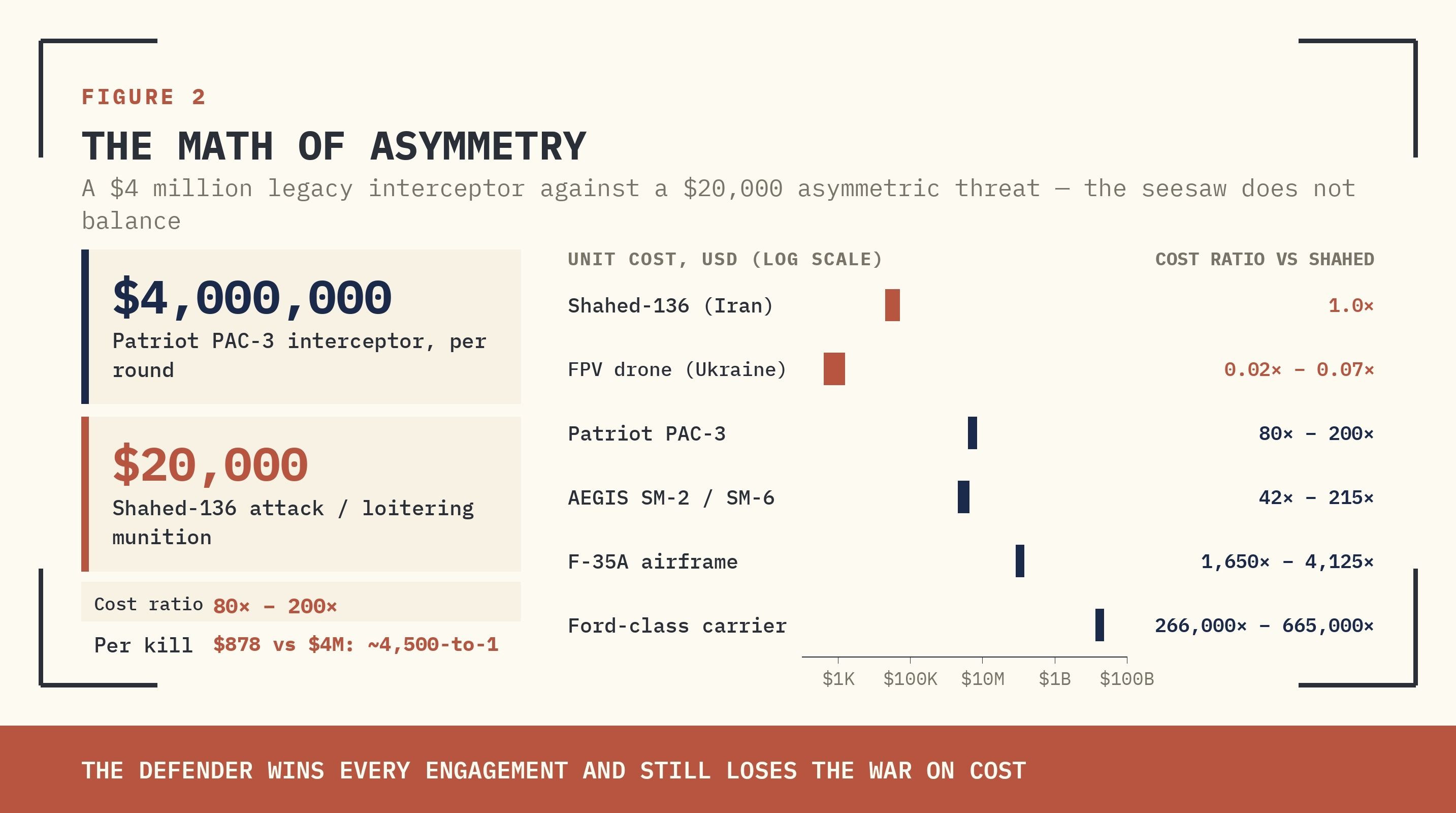
The marginal cost of inflicting a battlefield casualty has fallen from the hundreds of thousands of dollars typical of guided-munition warfare to under $1,000 in the Ukrainian theatre. Operational reporting from Madyar Brovdi's Unmanned Systems Forces puts the figure at $878 per confirmed kill. Against a Patriot interceptor at approximately $4 million per round, the asymmetry is roughly 4,500-to-1 in favour of the attacker. This is not an efficiency improvement. It is a different economic regime.
SYSTEM | APPROX. UNIT COST (USD) | ROLE | COST RATIO VS SHAHED |
|---|---|---|---|
Shahed-136 (Iran) | $20,000 – $50,000 | Attack / loitering munition | 1.0× |
FPV drone (Ukraine) | $400 – $1,500 | Tactical strike | 0.02× – 0.07× |
Patriot PAC-3 interceptor | $4,000,000 | SAM intercept | 80× – 200× |
AEGIS SM-2/SM-6 | $2.1M – $4.3M | Naval SAM intercept | 42× – 215× |
F-35A airframe (unit fly-away) | ~$82,500,000 | Air dominance platform | 1,650× – 4,125× |
Gerald R. Ford-class carrier | ~$13,300,000,000 | Power projection | 266,000× – 665,000× |
Read the bottom row carefully. Comparing a carrier’s acquisition cost with a drone’s unit cost does not establish whether defence is economical; protection costs and the consequences of loss must also be assessed. The defender wins every individual engagement and still loses the war on cost.
Supplied archive exhibit · original labels. Read alongside the editorial corrections.
Collapse 2 — Casualty Composition
Drone-inflicted casualties now account for approximately 70% of battlefield losses in the Ukraine theatre — a higher share than artillery delivered in the First World War. For the first time since 1914, industrial-scale killing is being conducted with non-industrial weaponry. The implication for legacy defense procurement is severe: every dollar already committed to manned platforms, large-calibre artillery, and traditional armour is depreciating against a doctrine that did not exist five years ago.
Collapse 3 — Strategic Effect Per Dollar
Ukrainian drone operations recaptured approximately 470 sq km of territory in early 2026 and idled 40% of Russian seaborne oil export capacity. Russia's territorial control is now at its lowest since the start of the full-scale invasion in 2022. The cost of mounting this campaign is measured in low billions of dollars of distributed manufacturing. The economic damage inflicted — destroyed refining capacity, lost export revenue, repair capex, capacity de-rating — runs into the tens of billions. Strategic effect per dollar has improved by orders of magnitude.
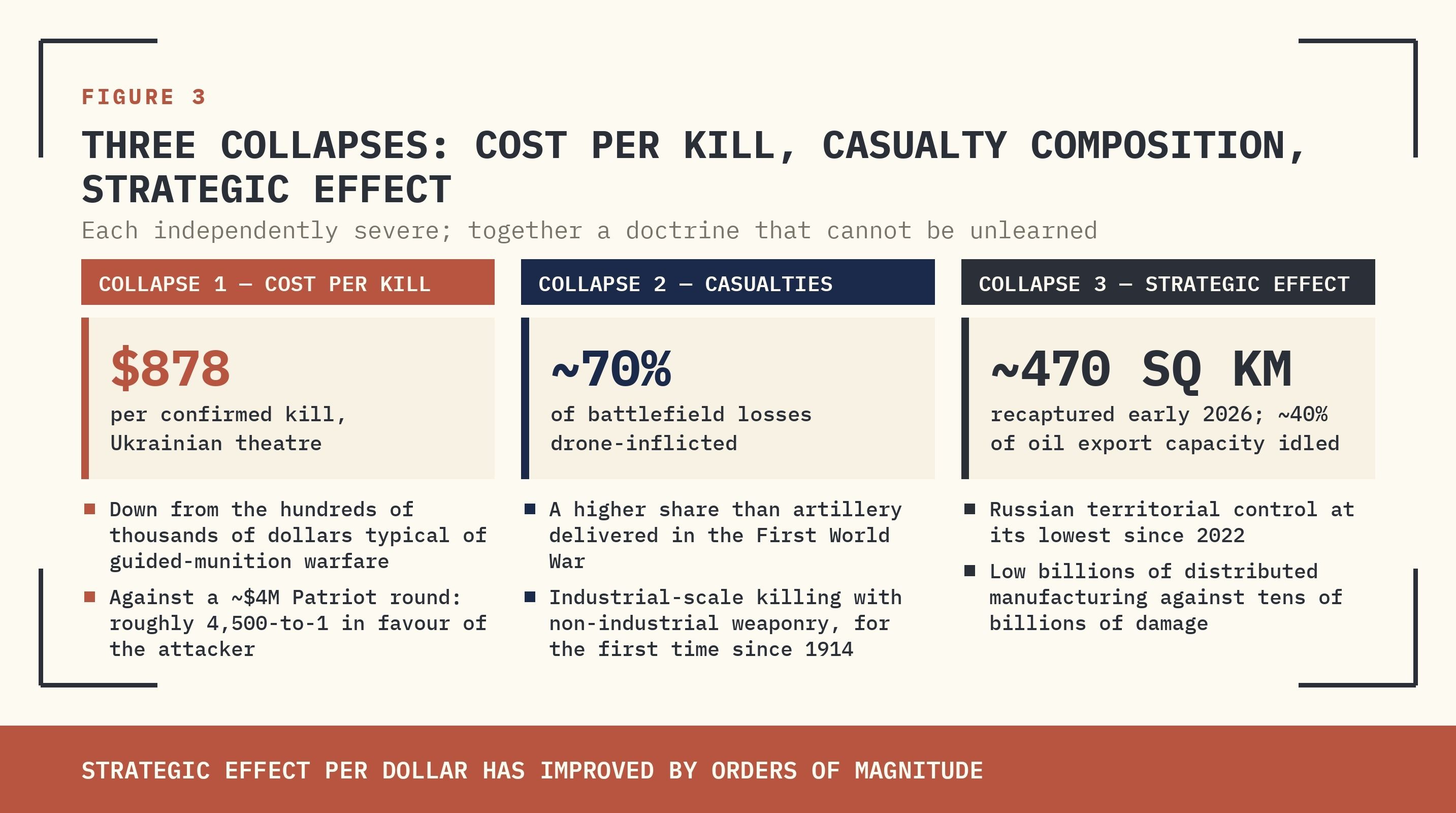
Supplied archive exhibit · original labels. Read alongside the editorial corrections.
DIAGNOSIS — WHY THE INDUSTRIAL EQUATION BROKE
Industrial warfare, as practised from 1914 to roughly 2022, rested on five mutually reinforcing structural conditions. All five have inverted simultaneously. The table below sets out the regime change.
DIMENSION | 20TH CENTURY — INDUSTRIAL WARFARE | 21ST CENTURY — DECENTRALISED WARFARE |
|---|---|---|
Primary weaponry | Stealth bombers, carriers, MBTs, manned aviation | Commercial drones, FPV platforms, software |
Procurement model | Centralised bureaucracy, 5–10 year cycles | App-based market, 5–10 day delivery |
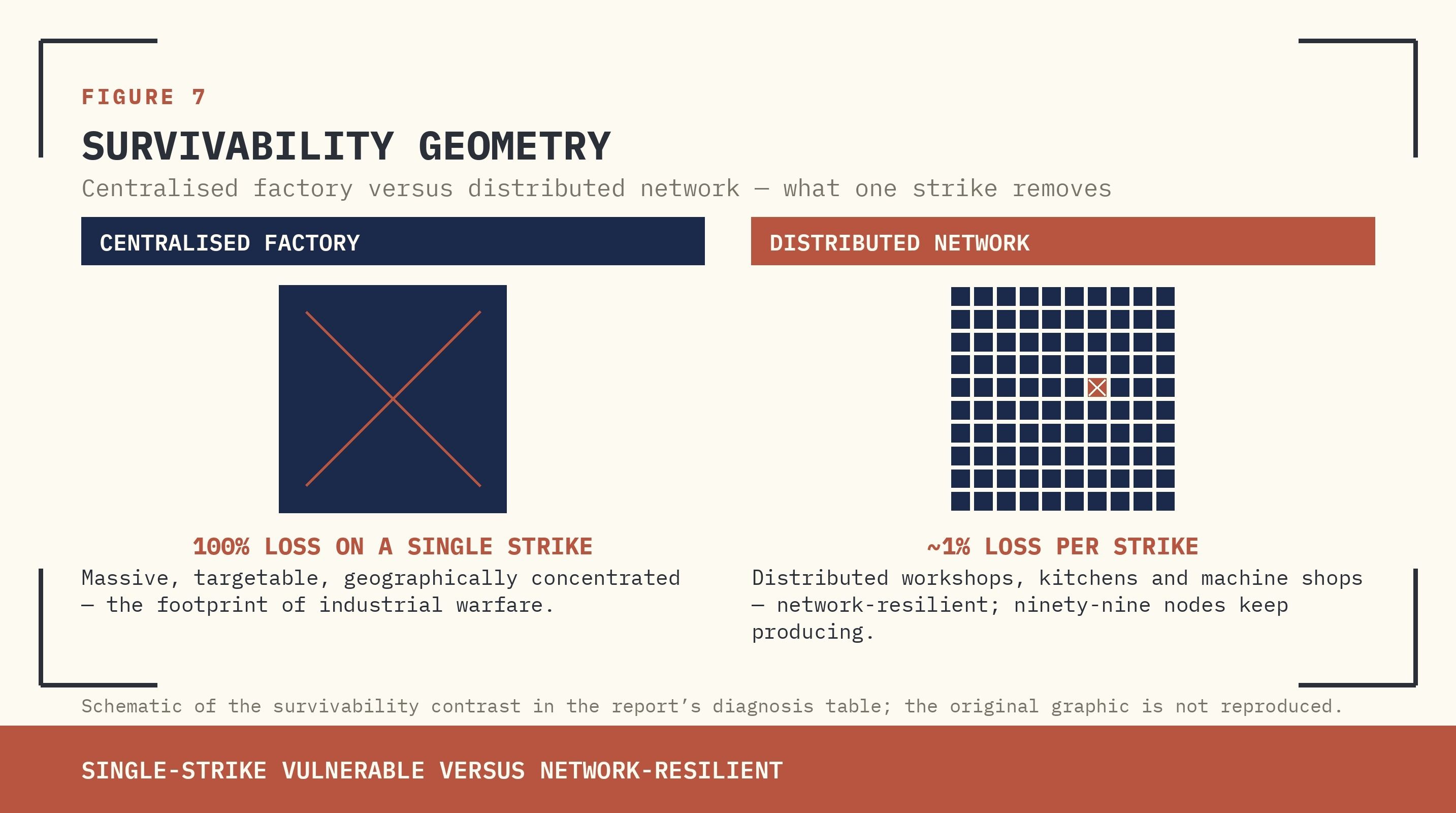
Manufacturing footprint | Massive, targetable, geographically concentrated | Distributed workshops, kitchens, machine shops |
Command structure | Top-down, rigid hierarchy | Empowered frontline edges with budget authority |
Economic profile | Millions of dollars per strike | Under $1,000 per kill |
Innovation cycle | Months to years | Days; field-to-factory iteration loops |
Survivability of supply chain | Single-strike vulnerable (100% loss potential) | Network-resilient (~1% loss per strike) |
Each row, taken alone, would constitute a significant doctrinal shift. Taken together, they describe a regime change of the same magnitude as the transition from cavalry to mechanised warfare in the 1930s. The legacy primes — Lockheed, Raytheon, BAE, Rheinmetall — are not wrong to keep building exquisite systems. They are wrong to assume those systems will dominate the cost curves of future conflicts.
Rheinmetall's CEO called Ukrainian drone manufacturers "housewives with 3D printers" playing with "Legos". Those housewives are pushing back the largest land army in Europe.
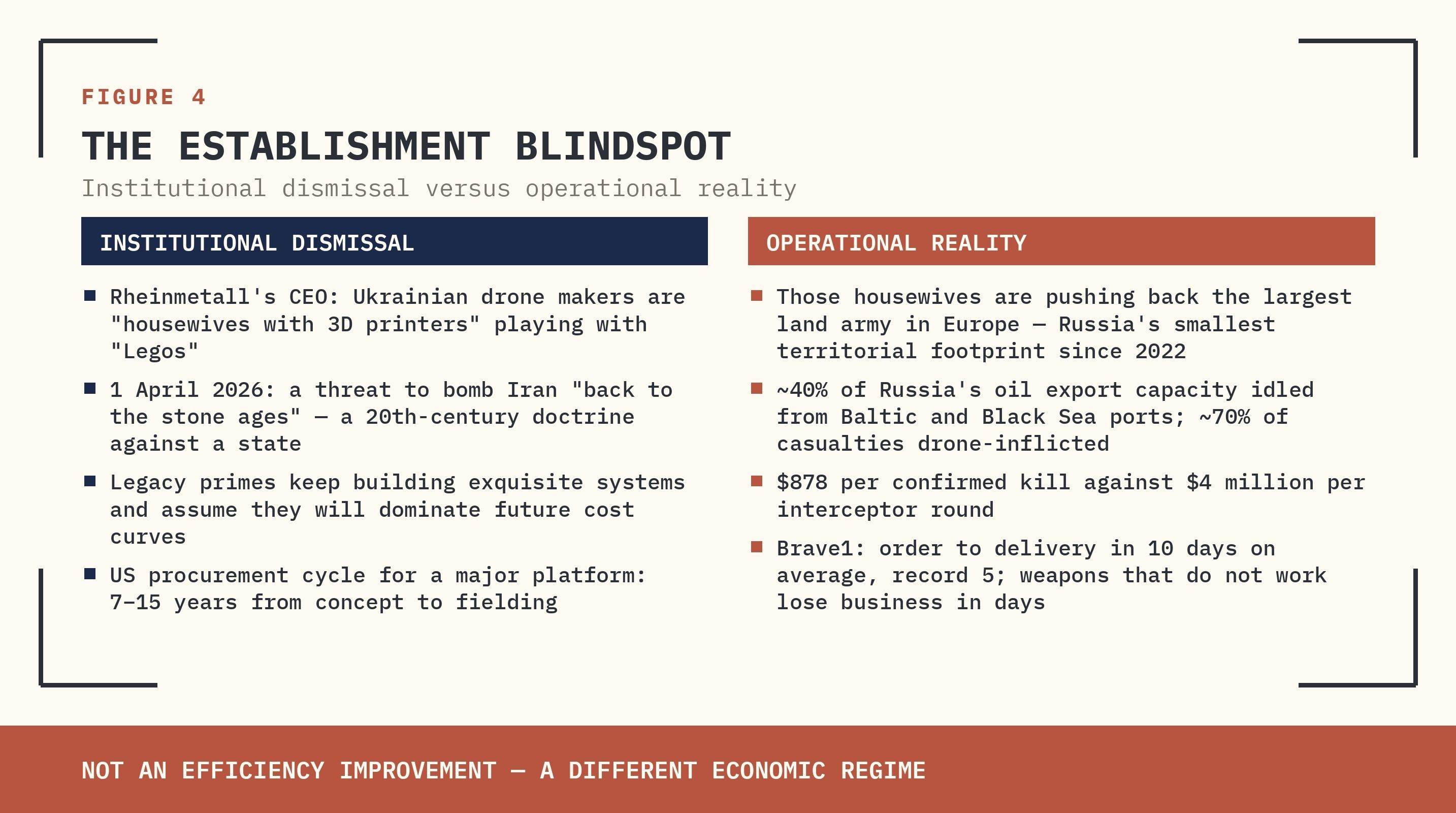
Supplied archive exhibit · original labels. Read alongside the editorial corrections.
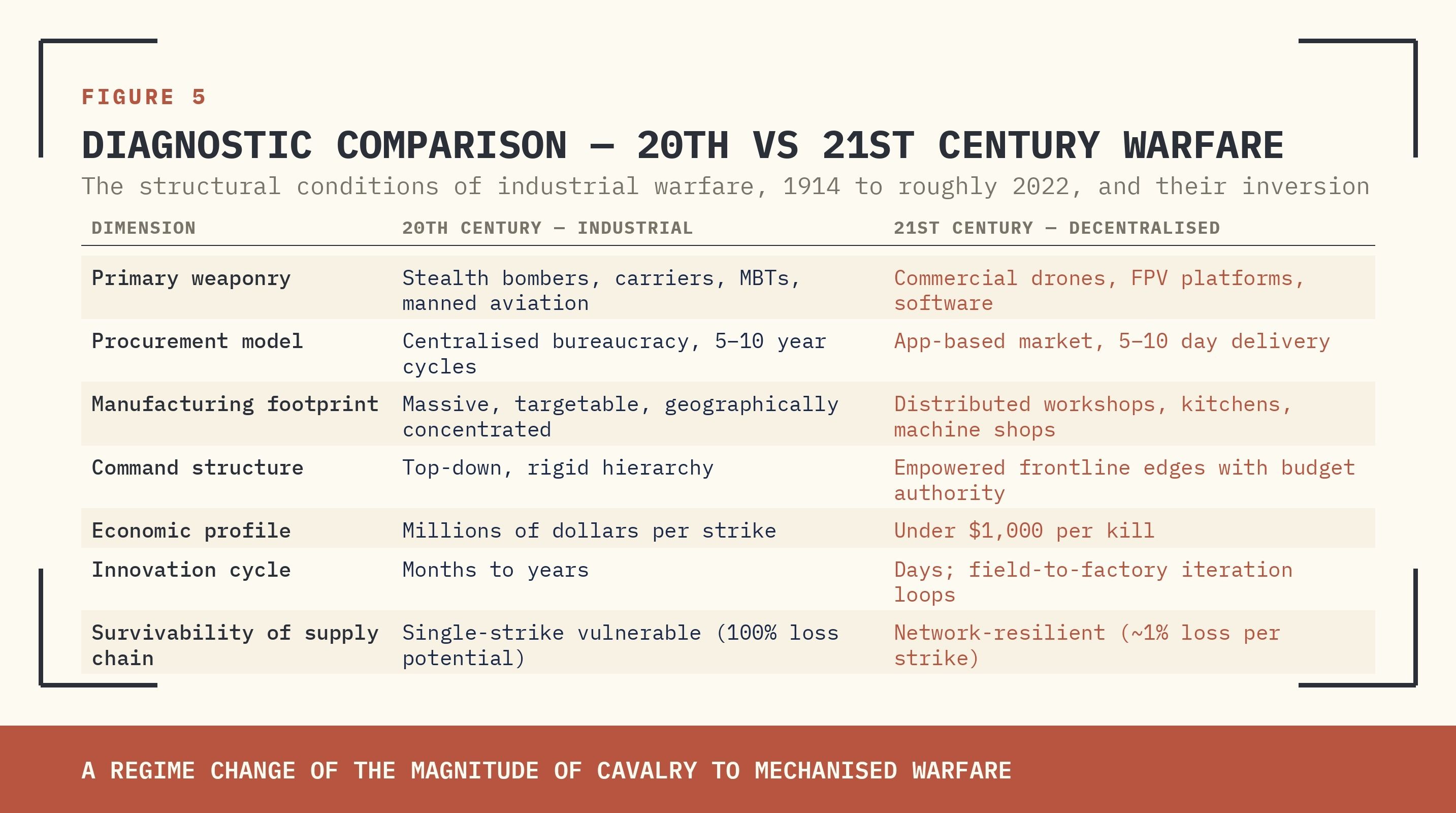
Supplied archive exhibit · original labels. Read alongside the editorial corrections.
BRAVE1 — FROM PROCUREMENT TO MARKET
The most important institutional innovation of the war is not a weapon. It is a marketplace. Ukraine's Brave1 platform, operated by the Ministry of Digital Transformation in tandem with the Defence Procurement Agency's DOT-Chain Defence system, has functionally rewritten the procurement equation that has defined defense spending since the Second World War.
Operational Mechanics
Frontline commanders log into the Delta authentication system, view their unit's accumulated e-points ("ye-baly") balance, browse a catalogue of approximately 150–300 combat-tested drone models from 30+ verified manufacturers, place an order, and receive delivery in an average of 10 days — with a record of 5 days. Points are earned by uploading video confirmation of destroyed enemy equipment or personnel; an additional point is credited for kills using autonomously-targeting drones. Ninety-five percent of Ukrainian drone units are now signed onto the system.
Validated Throughput
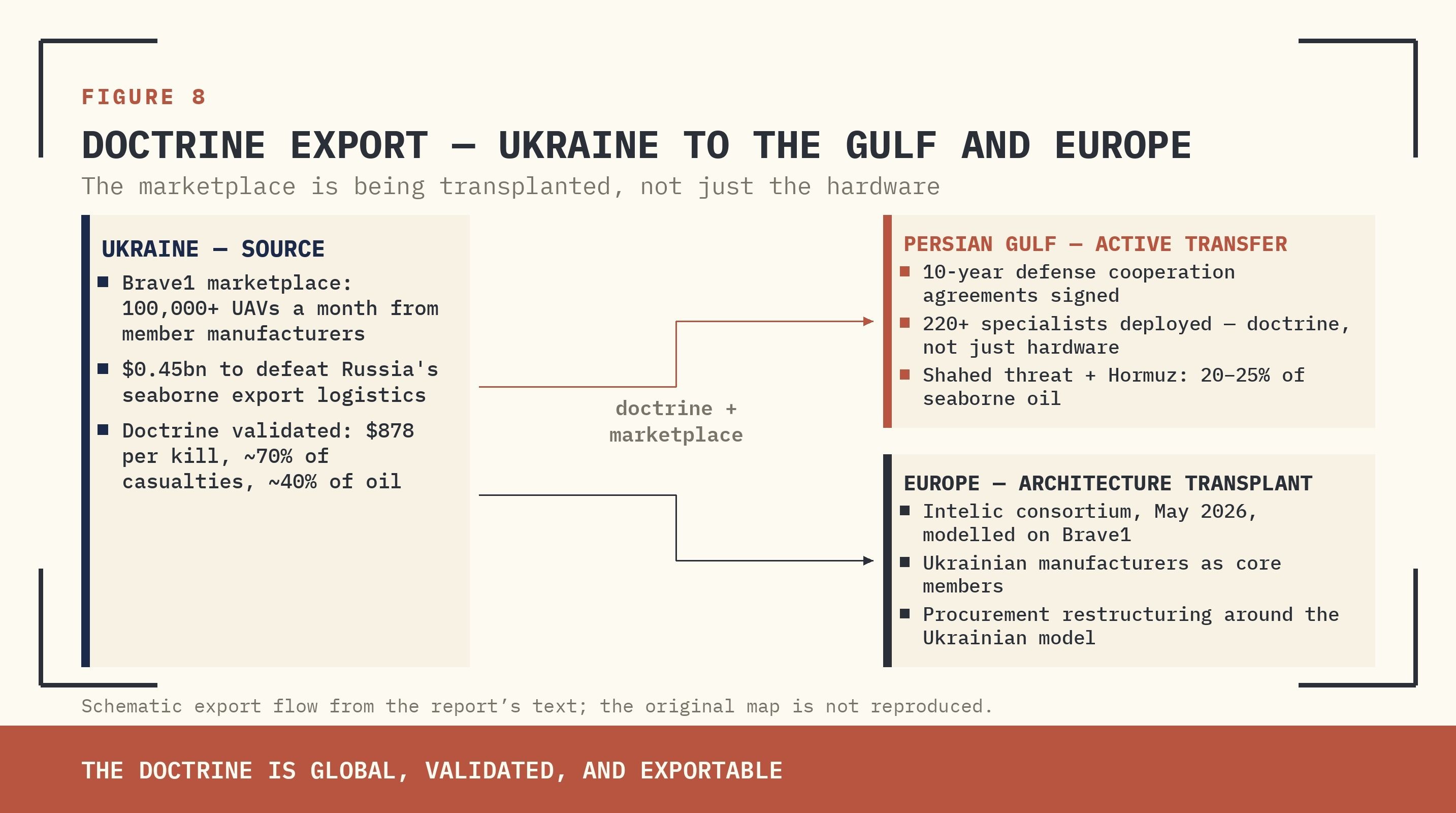
By April 2026, Brave1 Market had processed orders exceeding 20 billion hryvnia (approximately $450 million), with 181,000 systems delivered to frontline units in 2026 alone. By December 2025, the platform had passed 10 billion UAH ($235 million) in cumulative sales and 100,000 pieces of equipment. Member manufacturers collectively now produce more than 100,000 unmanned aerial vehicles per month, generating over $1.5 billion in sales according to consortium reporting on a new European procurement platform that draws explicitly on the Brave1 architecture.
Why This Matters For Markets
Brave1 is a Darwinian market. Manufacturers that build weapons that do not work lose business in days, not years. Brave1 now provides live battlefield-effectiveness data back to manufacturers — so the design loop closes within the operational tempo of the war. Compare this to the average US defense procurement cycle for a major platform: 7–15 years from concept to fielding. The cost-of-capital implications for legacy primes are severe and underpriced.
Brave1 is not a procurement system. It is a fiercely competitive market that drives weapons evolution at the operational tempo of the war itself.
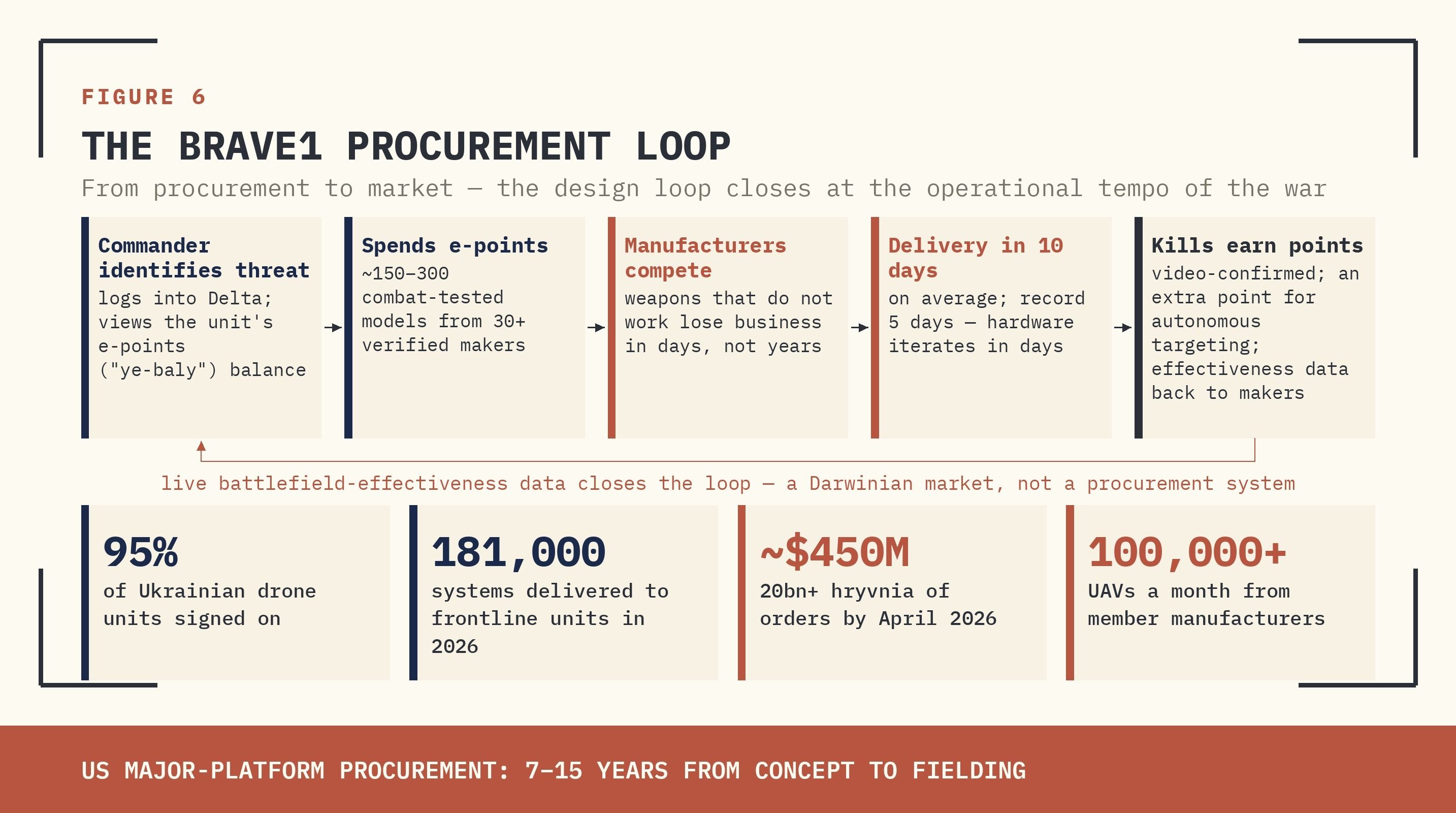
Supplied archive exhibit · original labels. Read alongside the editorial corrections.
Supplied archive exhibit · original labels. Read alongside the editorial corrections.
RISK
THE DOCTRINE IS EXPORTABLE
A doctrine confined to one theatre is a curiosity. A doctrine being actively exported is a structural risk. The evidence on export is unambiguous.
Persian Gulf — Active Technology Transfer
Ukraine has signed 10-year defense cooperation agreements with Gulf partners. More than 220 Ukrainian specialists are now deployed across the Persian Gulf, embedding doctrine in addition to hardware. The combination of (i) Gulf wealth, (ii) acute Iranian Shahed threat, and (iii) the Strait of Hormuz chokepoint creates the highest-yield possible market for Ukrainian counter-drone and offensive-drone capabilities. The technology is moving from a theatre where it cost $0.45bn to defeat Russia's seaborne export logistics to a theatre where the same technology can hold 20–25% of global seaborne oil hostage.
Iran — The Mosaic Doctrine
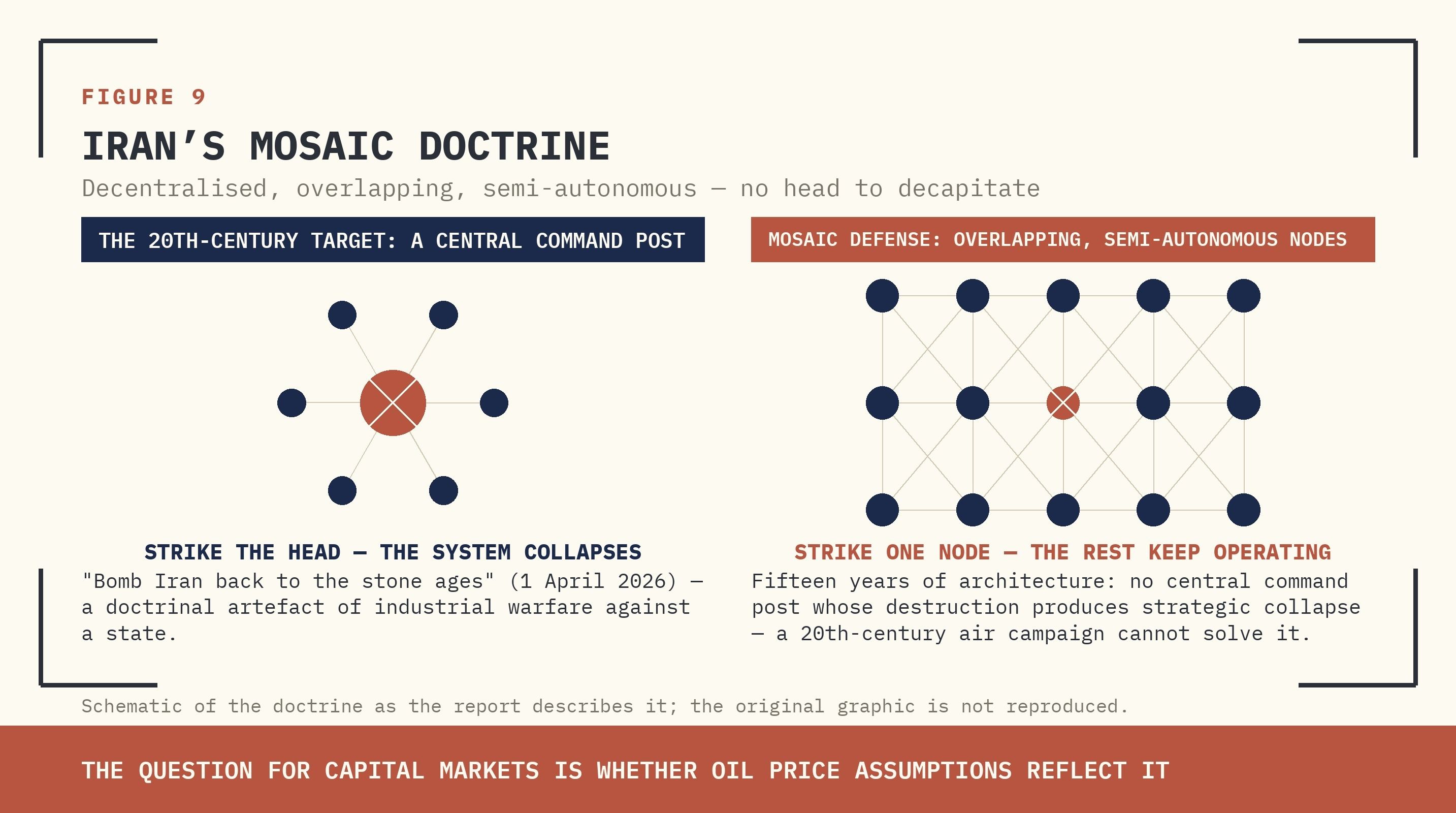
On 1 April 2026, the US President threatened to bomb Iran "back to the stone ages" — a doctrinal artefact of 20th-century industrial warfare against a state. Iran has spent fifteen years architecting precisely the opposite system. Mosaic Defense is a decentralised command structure with overlapping, semi-autonomous nodes. There is no head to decapitate. There is no central command post the destruction of which produces strategic collapse. A 20th-century air campaign cannot solve a 21st-century distributed system. The Iranian regime understands this; the US Defense Department understands this; the question for capital markets is whether oil price assumptions reflect it.
Europe — Procurement Architecture Transplant
A European procurement consortium announced in May 2026 — Intelic and partners — is explicitly modelled on Brave1, with unnamed Ukrainian manufacturers as core members. The architectural transfer of the marketplace itself, not just the hardware, is the second-order risk. Defense procurement worldwide is on the cusp of restructuring around the Ukrainian model. Legacy primes will find themselves competing against fast-iterating, software-defined, frontline-feedback-loop manufacturers on price, speed, and adaptability.
Supplied archive exhibit · original labels. Read alongside the editorial corrections.
Supplied archive exhibit · original labels. Read alongside the editorial corrections.
RISK
THE THREAT IS NOW LOCAL
The Barksdale incursions of 9–20 March 2026 are not a footnote. They are the institutional moment at which US homeland sanctuary — a concept underlying eight decades of defense posture and roughly four decades of equity market pricing of US assets — was visibly punctured.
What Actually Happened
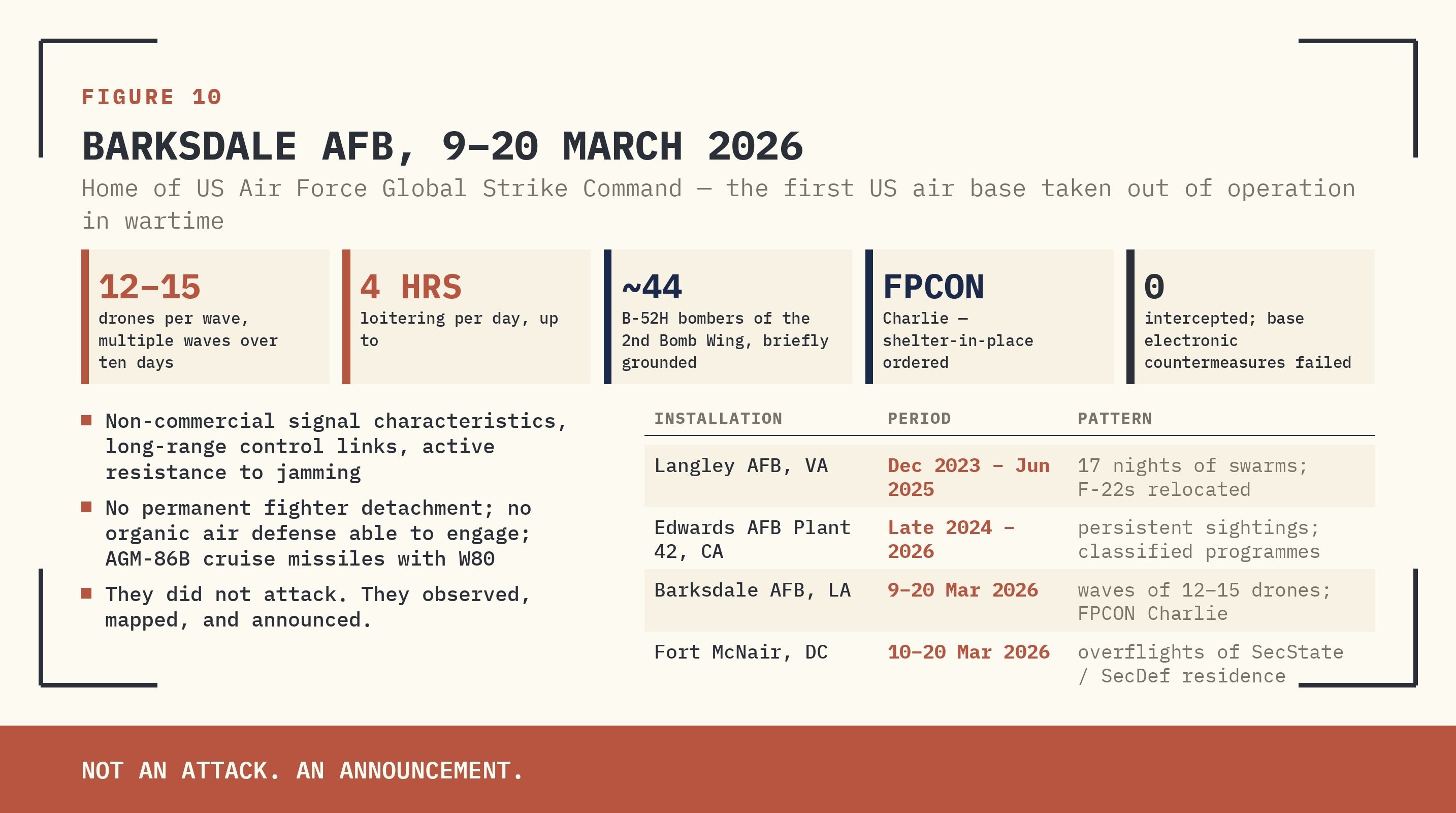
Multiple waves of 12–15 sophisticated drones, with non-commercial signal characteristics and long-range control links, loitered over the home of US Air Force Global Strike Command for up to four hours daily over a ten-day period. Force Protection Condition was elevated to Charlie. The Air Force base houses approximately 44 B-52H bombers and AGM-86B Air-Launched Cruise Missiles armed with W80 thermonuclear warheads. Barksdale has no permanent fighter detachment, no organic air defense capable of engaging the threat, and electronic countermeasures that demonstrably failed against the platforms used. The drones did not attack. They observed, mapped, and announced.
Pattern, Not Anomaly
Barksdale is not an isolated event. Between December 2023 and June 2025, Langley AFB experienced seventeen separate nights of drone swarms, forcing the relocation of F-22 Raptor aircraft. Edwards AFB Plant 42 in Palmdale — home of Skunk Works and classified Lockheed, Northrop Grumman, and Boeing programmes — saw persistent sightings into 2026. Fort Leslie J. McNair in Washington DC, residence of the Secretaries of State and Defense, experienced overflights between 10–20 March 2026. The pattern is geographic, temporal, and targeted at the highest-value US strategic assets.
They did not attack. They announced their presence. Every adversary watching learned that cheap drone networks reach directly into the US homeland.
Figure 01 · Conceptual framework
From security risk to working-capital pressure
Capital Markets Implication
The penetration of Global Strike Command airspace by a doctrine that defenders cannot economically interdict has two immediate equity-market implications. First, the security premium on US infrastructure assets — pipelines, refineries, transmission, data centres — is structurally underpriced. Second, the counter-UAS and short-range air defense segment is the most under-supplied capability in the entire Western defense stack. The capital allocation gap will close, but slowly and chaotically.
Supplied archive exhibit · original labels. Read alongside the editorial corrections.
RISK
THE INESCAPABLE CHOKEPOINT
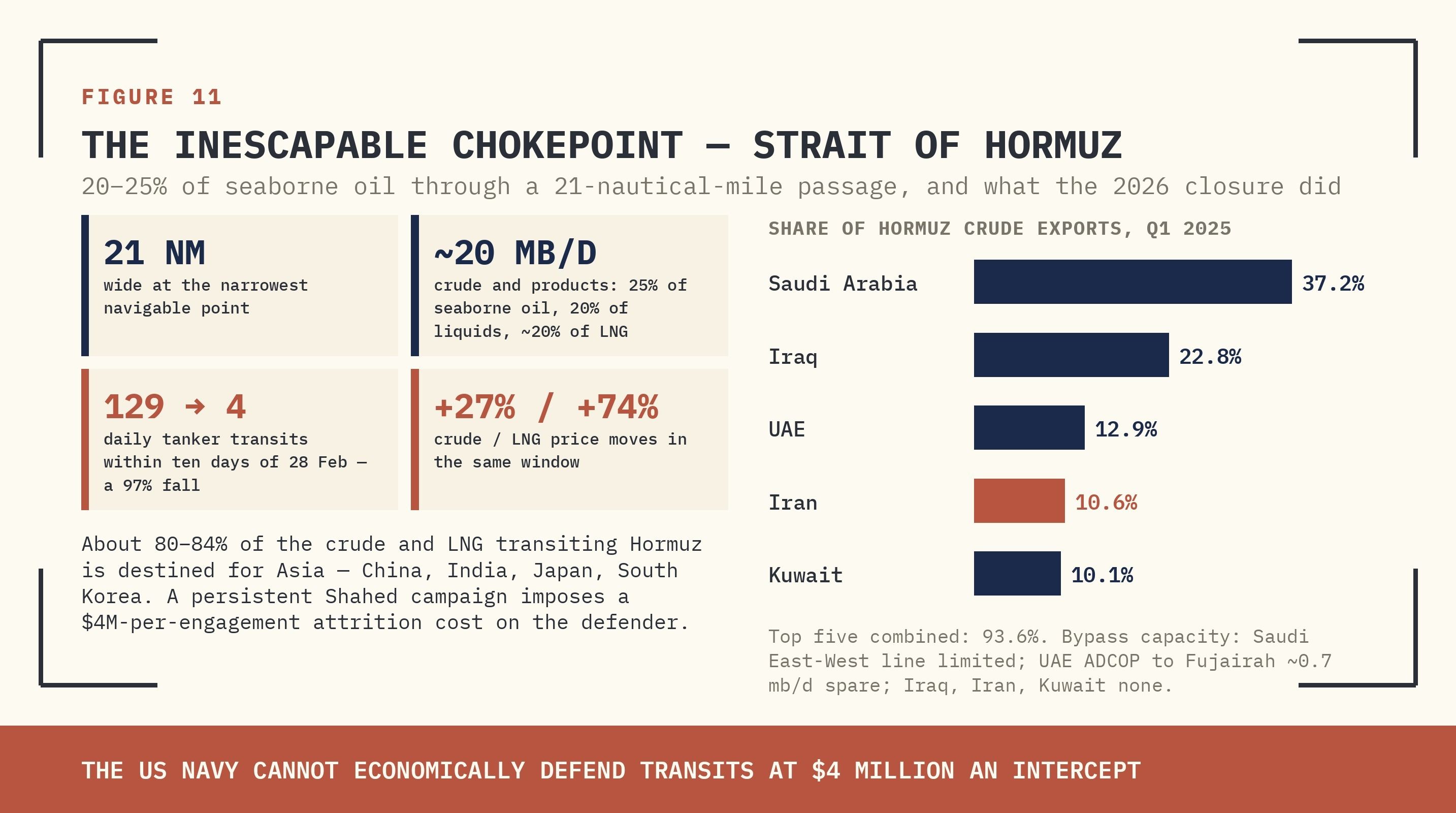
The Strait of Hormuz is 21 nautical miles wide at its narrowest navigable point. Through it transits approximately 20–20.3 million barrels per day of crude and refined products — 20% of global petroleum liquids consumption, 25% of seaborne oil trade, and approximately 20% of global LNG trade. The IEA reports nearly 15 million b/d of crude transited the strait in 2025, equivalent to 34% of global crude oil trade.
February–March 2026 Closure Mechanics
Following US strikes on Iran on 28 February 2026, the closure mechanics were rapid and instructive. Within ten days, daily transits collapsed from 129 to 4 — a 97% reduction. Crude prices spiked 27% and LNG 74% in the same window. Insurance markets withdrew or repriced war-risk cover before military action made physical transit impossible. Iraq and Kuwait began shutting in production in early March as local storage filled. The Dallas Fed model estimates that removing close to 20% of global oil supplies from Q2 2026 markets generates first-order price effects in the high tens of dollars per barrel.
Exporter Concentration
COUNTRY | SHARE OF HORMUZ CRUDE EXPORTS (Q1 2025) | BYPASS PIPELINE CAPACITY |
|---|---|---|
Saudi Arabia | 37.2% | Limited (East-West / Petroline) |
Iraq | 22.8% | None operational |
UAE | 12.9% | ADCOP pipeline to Fujairah (~0.7 mb/d spare) |
Iran | 10.6% | None |
Kuwait | 10.1% | None |
Top 5 combined | 93.6% |
Approximately 80–84% of crude and LNG transiting Hormuz is destined for Asian markets — China, India, Japan, South Korea. A sustained or repeating closure does not just spike crude. It restructures Asian energy import diversification, accelerates LNG long-term contracting, and shifts strategic petroleum reserve composition globally.
Why The US Cannot Reopen It Cheaply
The affordability of protecting shipping depends on the defensive mix, engagement rate and value of assets protected; it cannot be inferred from one interceptor price alone. A persistent Shahed campaign — even with low hit rates — imposes either a $4M-per-engagement attrition cost on the defender or an insurance premium on every transit that makes commercial shipping uneconomic. The choice the US faces is between (i) sustaining a presence that loses money per engagement, (ii) tactical withdrawal that validates the asymmetry globally, or (iii) negotiating de-escalation terms set partly by Tehran. None of these outcomes is bullish for US naval-power-projection credibility.
Supplied archive exhibit · original labels. Read alongside the editorial corrections.
PRICE
THE FRICTION TAX BECOMES PERMANENT
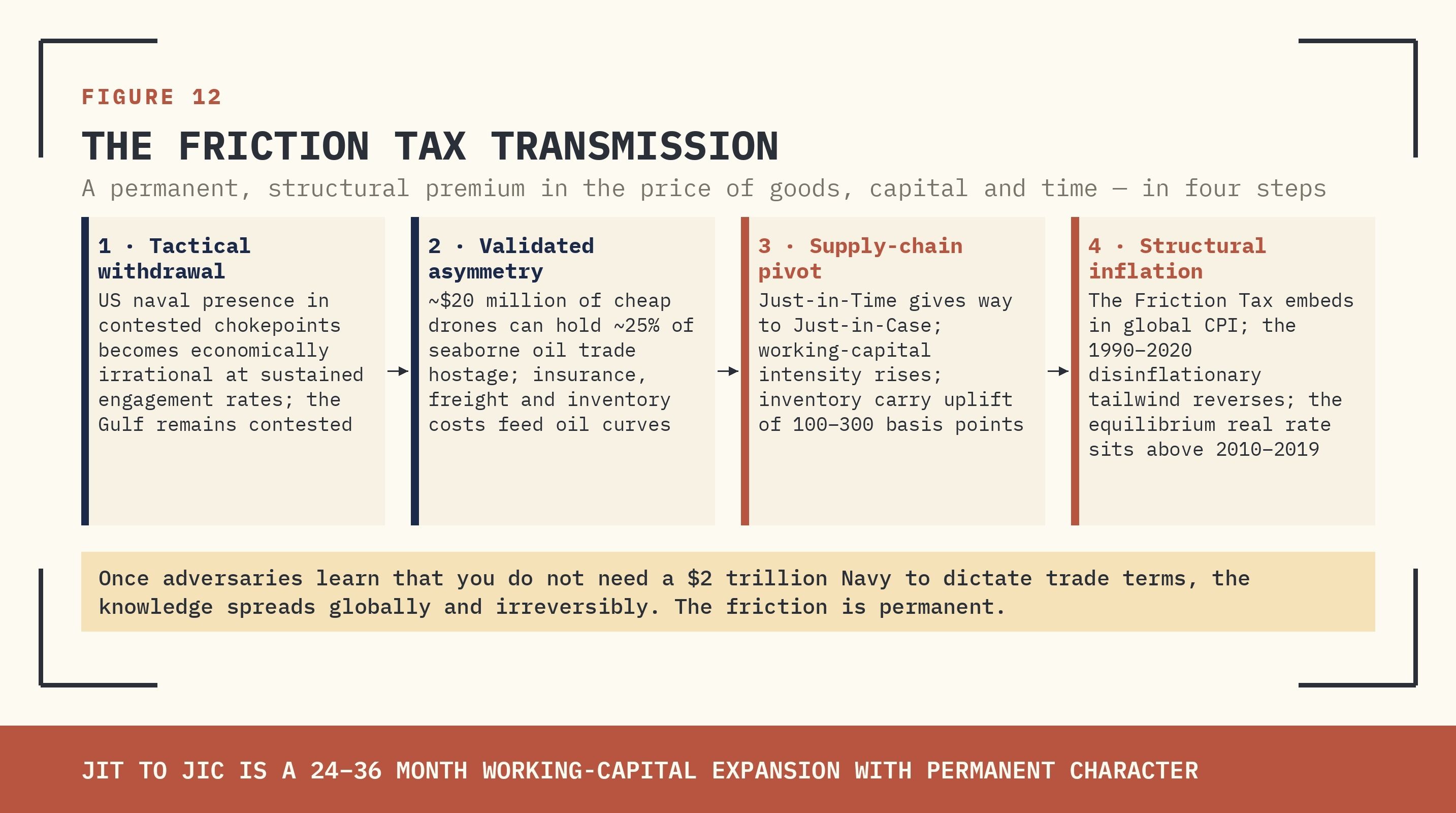
The macro consequence of validated asymmetry is what we term the Global Friction Tax: a permanent, structural premium embedded in the price of goods, capital, and time. The transmission mechanism runs in four steps.
Step 1 — Tactical Withdrawal
US naval presence in contested chokepoints becomes economically irrational at sustained engagement rates. The Gulf remains contested. IEA and shipping data on Hormuz transit volumes through Q2 2026 will tell whether normalisation is possible without a political settlement that itself validates the threat.
Step 2 — Validated Asymmetry
Capital markets price in the new equation: that approximately $20 million in cheap drones can hold approximately 25% of seaborne global oil trade hostage. The implied insurance, freight, and inventory costs feed directly into oil curves, shipping spreads, and producer-region risk premia.
Step 3 — Supply Chain Pivot
Just-in-Time inventory logic — which depended on assured navigation and stable transit — gives way to Just-in-Case redundancy. Working capital intensity rises across global manufacturing. War-risk insurance premia, container rates, and tanker day-rates incorporate a permanent risk floor. Goldman estimates put the inventory carry uplift at 100–300 basis points across affected supply chains.
Step 4 — Structural Inflation
The Global Friction Tax becomes embedded in global CPI. The disinflationary tailwind of efficient global trade that dominated 1990–2020 reverses. Central bank reaction functions shift: the new equilibrium real rate is higher because the underlying productivity of global trade is lower. This is the macro thesis in its starkest form.
Once adversaries learn that you do not need a $2 trillion Navy to dictate trade terms, the knowledge spreads globally and irreversibly. The friction is permanent.
Supplied archive exhibit · original labels. Read alongside the editorial corrections.
POSITION
INSTITUTIONAL ALLOCATION FRAMEWORK
We structure positioning across five thematic books. Sizing, instrument selection, and hedge structure are determined by individual mandate constraints, but the directional bias is clear in each.
Book 1 — Energy & Chokepoint Risk
Long-bias structures: Brent prompt vs deferred steepeners; long Asian refiner crack spreads selectively; long Qatari/UAE LNG long-duration contract beneficiaries; long Indian and Korean strategic petroleum reserve build-out vendors. Short-bias: Asian energy importers without diversified supply (specific names depend on individual book hedging capacity). Optionality: 25-delta upside crude calls on three-month tenor as cheap insurance against repeating chokepoint events.
Book 2 — Defense Capital Reallocation
Long-bias: pure-play counter-UAS vendors (electronic warfare, radar, directed energy), software-defined defense (Anduril, Helsing and the listed battle-management software layer), and small-batch drone manufacturers with NATO certification. Short-bias / underweight: legacy primes whose programme backlogs are heavily weighted to manned platforms, large-calibre artillery without precision payload upgrade paths, and exquisite low-volume platforms whose unit cost cannot survive a contested theatre.
Book 3 — Marine & Aviation Insurance
Lloyd's syndicates and reinsurers with disciplined chokepoint exposure underwriting stand to reprice the entire war-risk book. Long-bias: well-capitalised London market reinsurers; short-bias: marine cargo underwriters with concentrated Hormuz exposure absent commensurate premium repricing. Critical metric: war-risk additional premium (AP) as a percentage of hull value through the Strait — this is the cleanest single instrument-of-pricing for the doctrine itself.
Book 4 — Supply Chain Working Capital
Long-bias: warehousing REITs in nearshore destinations (Mexico, Vietnam, India, Turkey, Morocco); inventory management software vendors; bulk shipping with long-duration coverage. Short-bias: pure JIT manufacturers without inventory pivot capacity (specific exposure varies). The pivot from JIT to JIC is a 24–36 month working capital expansion across affected sectors with permanent rather than cyclical character.
Book 5 — Sovereign & Curve Positioning
The structural inflation thesis implies higher equilibrium real rates than the 2010–2019 regime. Curve flatteners on 2s10s in the deferred forward space; long 5y5y inflation breakevens in USD and EUR; underweight long-duration sovereign credit in current-account-deficit Asian importers. Currency: structural support for petrocurrencies (NOK, CAD), structural pressure on net-energy-importer Asian FX during chokepoint events.
The cost of staying and adapting is measured in months. The cost of leaving is measured in decades of economic drag. Capital must price the doctrine, not just the headlines.
DATA APPENDIX — VALIDATED REFERENCE SET
All figures below are drawn from primary sources, government data, and major-wire reporting between February and May 2026. Citations are summarised; full source URLs are available on request.
A1. Brave1 Marketplace Throughput
METRIC | VALUE | SOURCE / DATE |
|---|---|---|
Active drone unit participation | 95% of Ukrainian drone units | Ukr. Ministry of Digital Transformation, Apr 2026 |
Equipment delivered (2026 YTD) | 181,000 systems | Defense Minister Fedorov, Apr 2026 |
Total order value (cumulative) | 20+ billion UAH (~$450M) | Brave1 reporting, Apr 2026 |
Average delivery time | 10 days (record: 5 days) | DOT-Chain Defence data |
Manufacturer catalogue | 150+ models, 30+ manufacturers (DOT-Chain) | Press reporting, Apr 2026 |
Reported cost per kill | ~$878 / confirmed kill | Madyar Brovdi USF data |
Member monthly UAV production | 100,000+ units / month | Intelic consortium, May 2026 |
A2. Strait of Hormuz — Q1 2026 Closure
METRIC | PRE-CLOSURE | POST-CLOSURE (10 MARCH 2026) |
|---|---|---|
Daily tanker transits | 129 / day (Feb avg) | 4 / day (–97%) |
Crude oil throughput | ~20 mb/d | Negligible |
Share of global seaborne oil | 25–27% | — |
Crude price move | — | +27% in 10 days |
LNG price move | — | +74% in 10 days |
Asian destination share (crude) | 84% | Diverted / rerouted |
A3. Russian Energy Infrastructure Impact
METRIC | VALUE | SOURCE |
|---|---|---|
Oil export capacity offline (peak, Mar 2026) | ~40% (~2 mb/d) | Published tallies, 25 Mar 2026 |
Refining capacity disabled (peak) | ~17% (~1.1 mb/d) | Published tallies |
Primary refining throughput decline | 300,000–400,000 b/d | Industry survey |
Refineries targeted (cumulative) | 10+ major facilities | Open-source tracking, May 2026 |
Russian territorial control | Lowest since 2022 | Operational mapping data |
Territory recaptured (UA, early 2026) | ~470 sq km | Source briefing |
A4. US Homeland Drone Incursions
INSTALLATION | PERIOD | PATTERN |
|---|---|---|
Langley AFB, VA | Dec 2023 – Jun 2025 | 17 nights of swarms; F-22s relocated |
Edwards AFB Plant 42, CA | Late 2024 – 2026 | Persistent sightings; classified programmes |
Barksdale AFB, LA | 9–20 Mar 2026 | Multiple waves of 12–15 drones; FPCON Charlie |
Fort McNair, DC | 10–20 Mar 2026 | Overflights of SecState/SecDef residence |
The pattern of these incursions — strategic targets, long durations, non-commercial signal characteristics, resistance to jamming — indicates a doctrine-level capability already resident inside or proximate to the US homeland. The institutional response and capability gap will shape US defense capital allocation for the next decade.
CONCLUSION — WHAT INSTITUTIONAL CAPITAL MUST PRICE
The Economic Inversion of Warfare is the report’s structural thesis, validated in three independent theatres — Ukraine, the Persian Gulf, and the continental United States — within a six-month window. The implication for global capital is not a single trade. It is a regime-level repricing of geographic risk, supply chain architecture, defense procurement, and the structural rate of inflation.
The instinct of legacy institutions — defense primes, central planners, and conventional asset allocators — is to treat each of the events above as an anomaly. They are not. They are the same event, viewed from different angles. The Buy Side Lens framework — Trigger, Flow, Risk, Price, Position — exists precisely to compress a regime change into actionable institutional intelligence before consensus catches up.
Three operational priorities for institutional readers over the next 90 days. First, audit existing equity exposure to legacy defense primes for procurement-cycle and platform-vintage risk. Second, structure non-zero exposure to counter-UAS, software-defined defense, and distributed-manufacturing supply chains. Third, embed a permanent chokepoint-risk premium into Asian energy importer and JIT supply chain modelling. None of these is heroic. All of them are urgent.
Markets move before the noise does. The noise on this doctrine has not yet started. The repricing has.