Original Lens and publication context
The build-out's next frontier is not the drone. It is the radar that sees it and the compute that runs the AI.
- As cheap offense commoditizes, the asymmetric return moves up a layer — to detection, counter-UAS, and the compute backbone that runs the AI.
- Counter-UAS has gone maritime: a combat-proven mobile radar now tracks drones from vessels at up to 54 knots, shaped explicitly by Strait of Hormuz vulnerability.
- The drone threat is no longer confined to the battlefield — ports, shipping lanes and offshore assets are now exposed, repricing maritime-infrastructure risk.
- AI warfare needs compute: the Pentagon is bridging military supercomputers to the major commercial clouds at high security to run defense AI workloads.
- Positioning is a counter-UAS detection-and-effector basket plus the sovereign-compute control plane — the enabling layer that monetizes whichever drone wins.
TRIGGER
Offense Is Solved; Defense Is The Gap
The offense layer of drone warfare — cheap, attritable mass — is largely understood and increasingly commoditized. The unsolved problem, and therefore the next investable frontier, is everything required to defeat it: detection, counter-UAS effectors, and the compute backbone that turns sensor feeds into decisions. The Gulf made the gap concrete, exposing a missing air-defense layer over high-value infrastructure that cheap drones walked straight through.
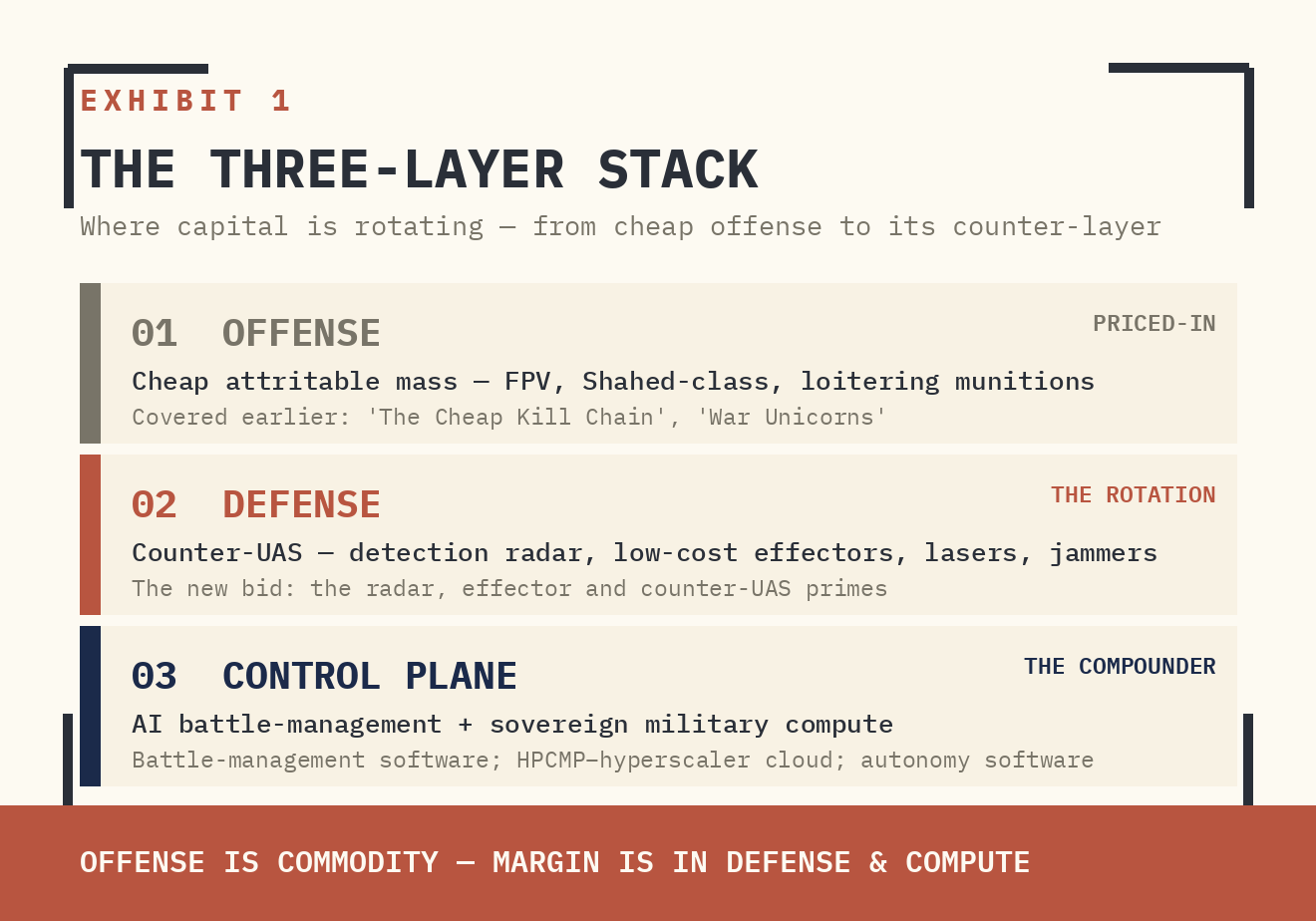
Supplied archive exhibit · original labels. Read alongside the editorial corrections.
The cost-exchange asymmetry is what forces the rotation. As long as a thousand-dollar drone can be met only by a million-dollar interceptor, capital is pulled toward whoever closes that gap — detection radar, low-cost effectors and the software that coordinates them. The two enabling nodes are the sensor that sees the threat and the compute that runs the model.
FLOW
Two Enabling Nodes
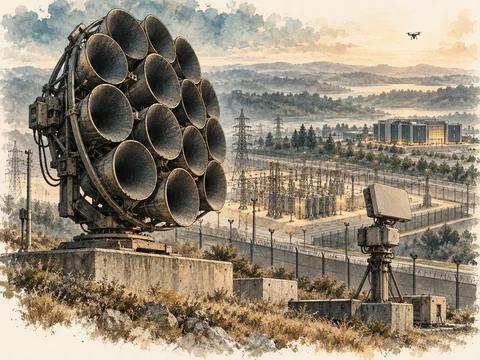
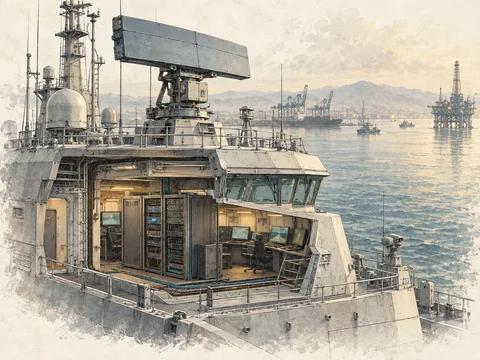
The first node is detection, and it is going mobile and maritime. A combat-proven counter-drone radar has been extended from land vehicles to vessels: a software-defined, salt- and corrosion-resistant upgrade designed to detect, track and classify drones from vessels moving at up to fifty-four knots, filtering heavy sea clutter to isolate low-flying threats. The framing is explicit — the Strait of Hormuz has shown how vulnerable critical maritime corridors become during instability, and ports, shipping lanes and offshore assets are now exposed to low-cost aerial threats. The static-radar era is ending; the future of counter-UAS is agile, mobile sensing that moves with the threat.
The second node is compute. AI-driven warfare demands far more model-sharing than legacy infrastructure can provide, and the Pentagon has moved to bridge its supercomputing centers with commercial cloud. An Argonne-spun control plane now links Defense Supercomputing Resource Centers to the major clouds at Impact Level 5 for sensitive unclassified workloads, cleared for export-controlled and controlled-unclassified workloads, giving researchers on-demand compute without traditional queue delays. The Naval Research Laboratory is already running live forecasting workloads across the bridge. Software and compute have become as decisive as the airframe.
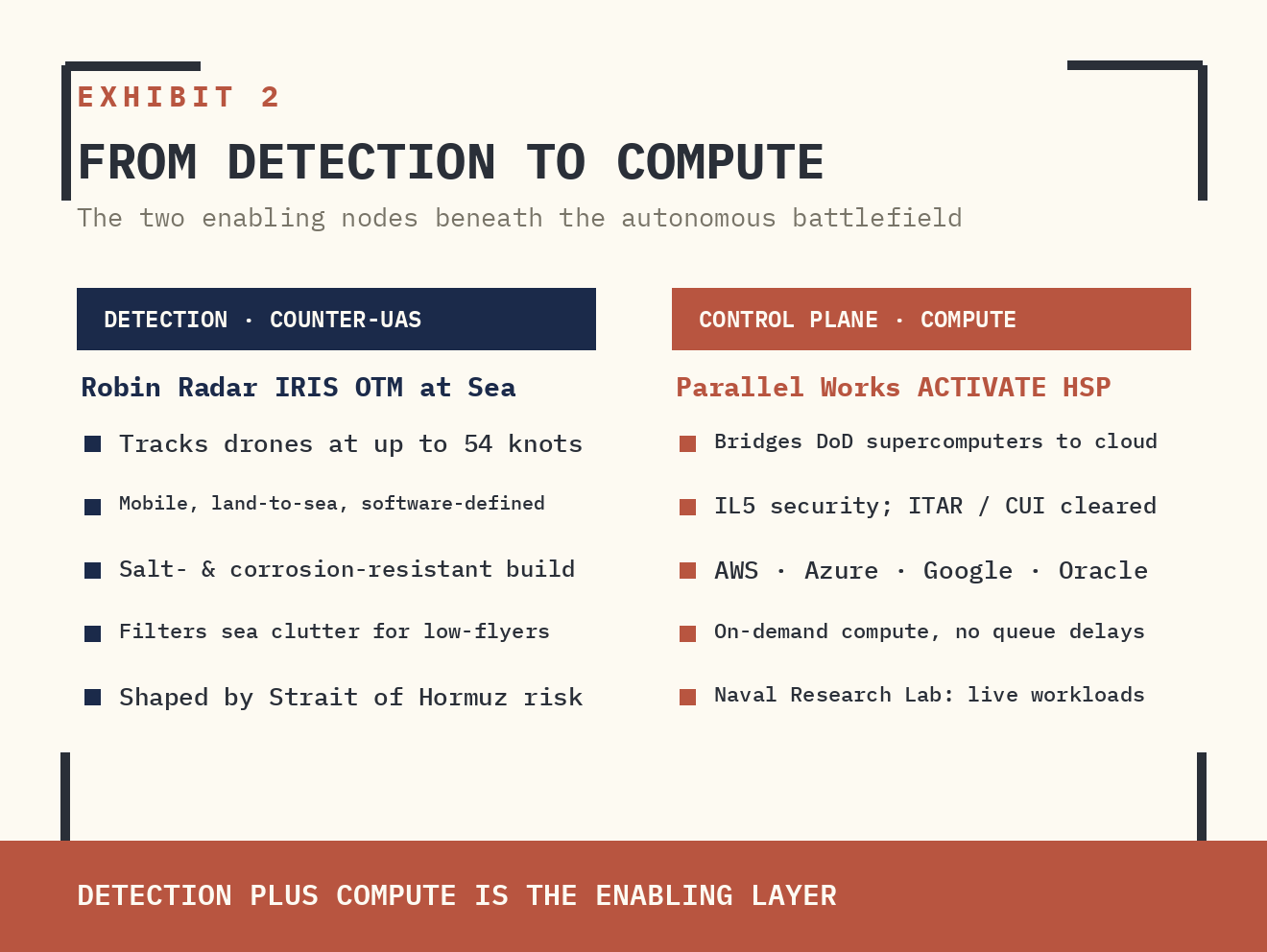
Supplied archive exhibit · original labels. Read alongside the editorial corrections.
RISK
Figure 01 · Conceptual framework
The economic chain behind counter-drone defence
What Breaks The Thesis
Counter-UAS is early and fragmented, and detection is not defeat — the effector economics that actually neutralize a swarm remain unsolved at scale, so detection vendors can lead the revenue curve while the kill problem lags. The compute layer is enabling infrastructure rather than a pure-play: much of its value accrues to incumbents — the hyperscalers, the battle-management software leaders and the integrating primes — rather than to a single listed counter-drone name. Procurement timing and the usual ceasefire de-rating apply here as across the sector.
Offense has become a commodity. The asymmetric return now sits one layer up — in the systems that see the swarm, and the compute that decides what to do about it.
PRICE
What The Tape Already Shows
Strait of Hormuz vulnerability keeps a persistent bid under maritime counter-UAS, and the cost-exchange arithmetic pushes capital toward detection and cheap effectors wherever a four-figure drone forces a seven-figure interceptor. On the compute side, the defense-cloud opportunity is expanding as AI workloads scale, with the major providers and the command-software layer the visible beneficiaries. The bid is structural because the threat surface — land, sea and infrastructure — is still widening.
POSITION
Two Sub-Baskets
Positioning is held at the layer rather than the security. Named companies illustrate where spending concentrates and are not recommendations.
One — counter-UAS detection and effectors. Radar, optronics and directed-energy content — the universe spanning the radar and effector primes, the sensing specialists and the laser and detection specialists, alongside the private counter-drone vendors building mobile, software-defined systems.
Two — the control plane. Battle-management software and sovereign military compute — the Maven-style command layer and the military-cloud backbone bridging supercomputers to commercial providers. This is the layer that monetizes regardless of which drone or which prime wins, and where the durable software margin sits.
The discipline is to own the enabling layer rather than the airframe: detection and the control plane compound across the entire build, while the offense layer commoditizes beneath them. Size for the ceasefire de-rating, and treat the widening threat surface — now maritime as well as terrestrial — as the structural tailwind. The drone is the commodity. Seeing it, and deciding, is the franchise.