Original Lens and publication context
Al Arabiya retracts the deal as "fabricated." Pezeshkian refuses to bow. Khamenei locks the uranium inside Iran. Open-source trackers confirm Iran's counter-proposal misses US demands. Riyadh asks Washington to delay strikes until after Hajj — which begins May 24. The ceasefire is a refit window. The clock is now days, not months.
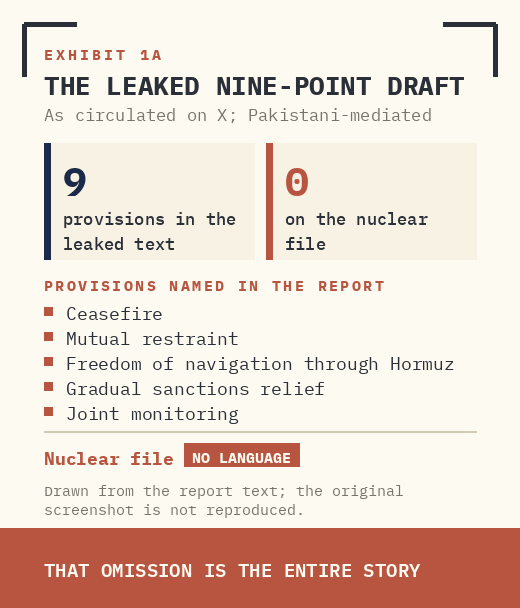
- A leaked nine-point Pakistani-mediated ceasefire draft hit the tape overnight and was retracted within hours — the broadcaster called the reporting fabricated and the Iranian recirculation a "professional error". The nine points contained no language on the nuclear file; that omission is the entire story.
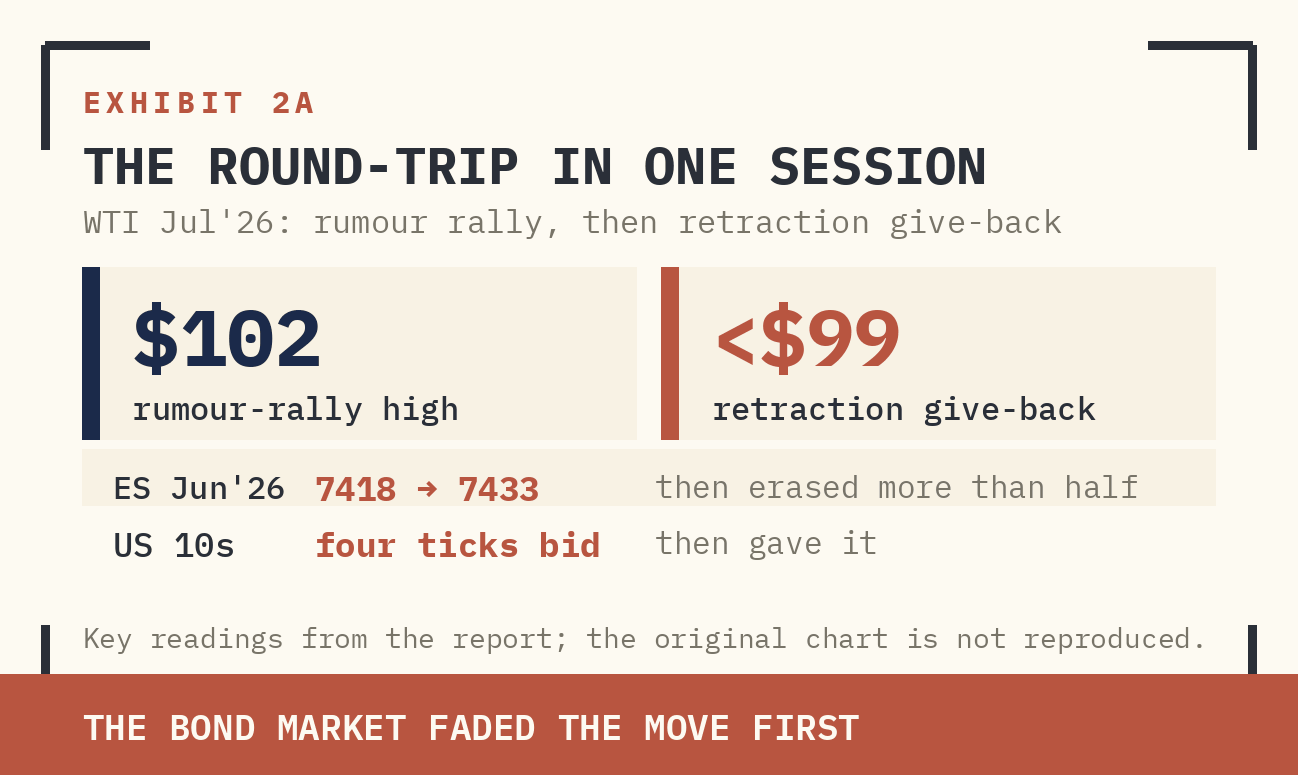
- The tape whipsawed: WTI Jul'26 round-tripped from $102 to under $99 in one session and ES Jun'26 ran 7418 to 7433 then erased more than half the move as Khamenei's reported uranium order surfaced. The bond market faded the move first.
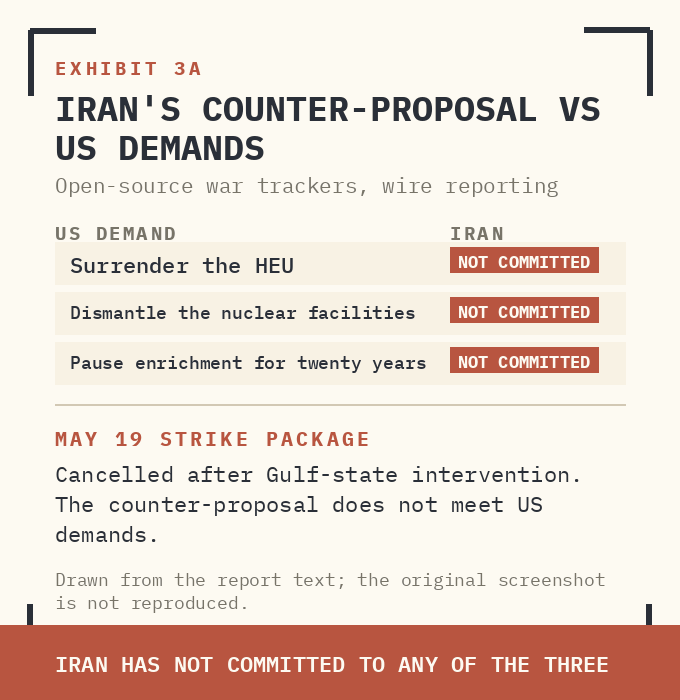
- Corroboration points one way: Iran's counter-proposal does not meet US demands (surrender the HEU, dismantle facilities, pause enrichment twenty years), a May 19 strike package was cancelled after Gulf intervention, and Riyadh has asked Washington to wait until after Hajj, which begins around May 24.
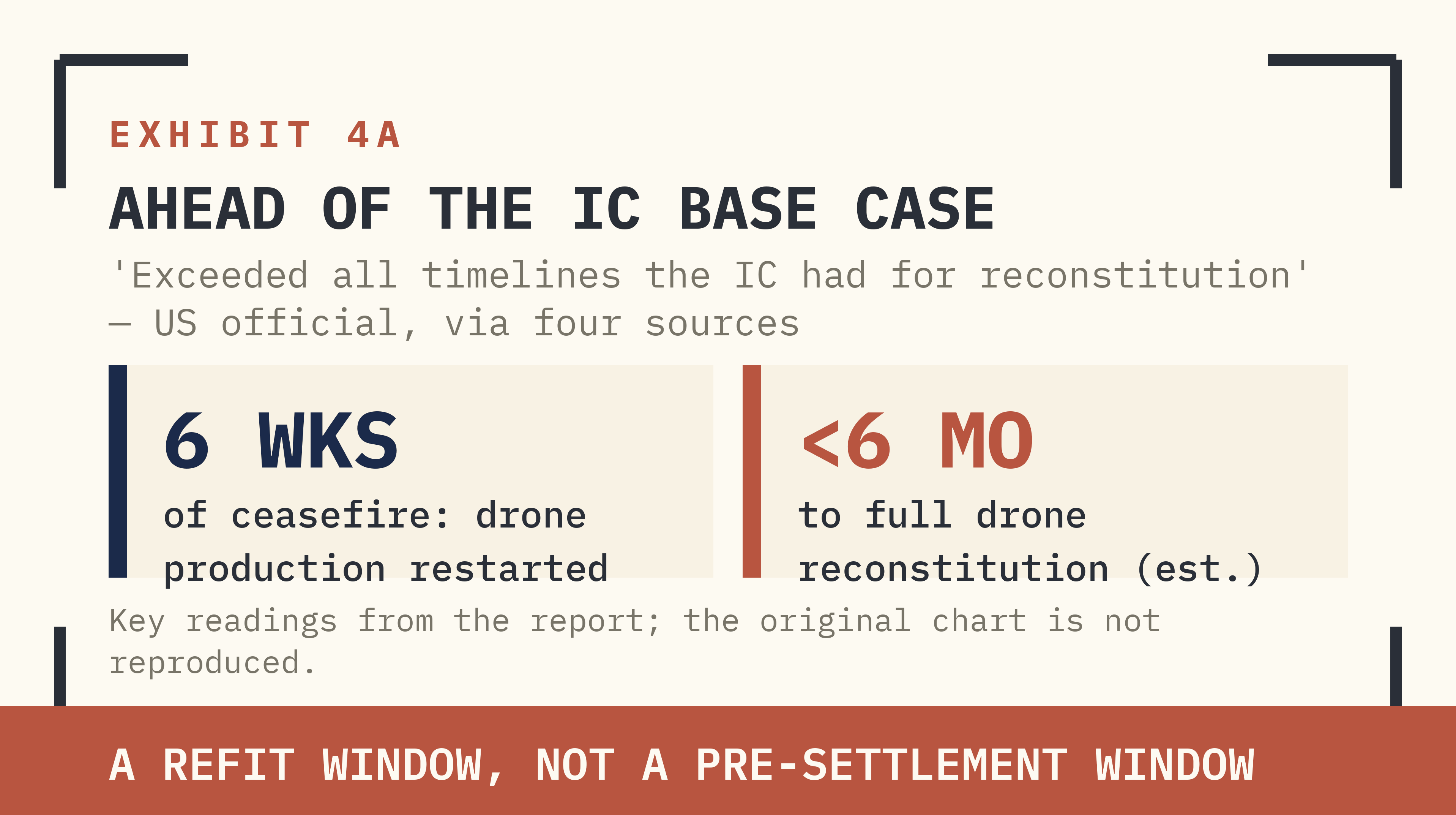
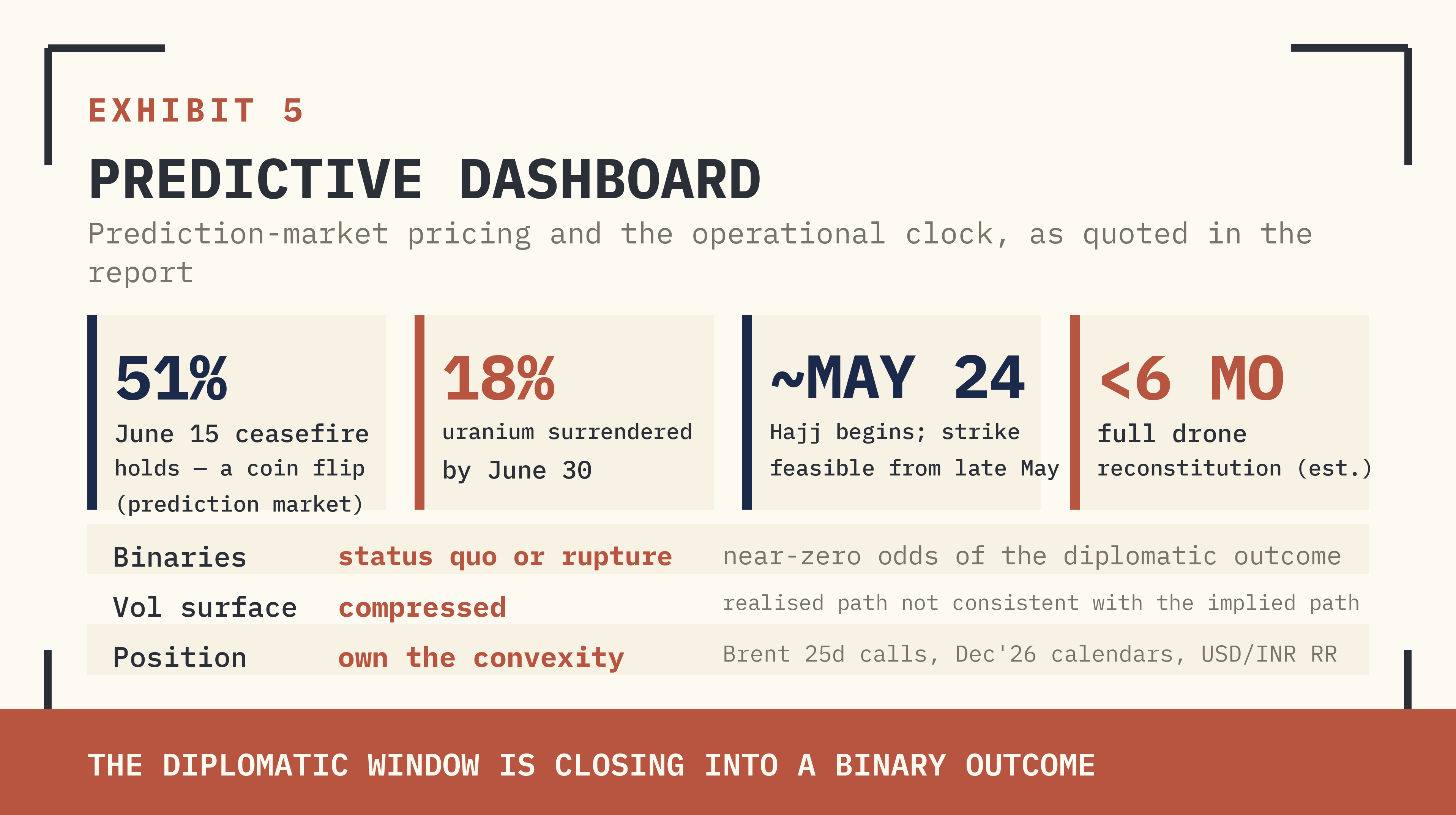
- The ceasefire is a refit window: US intelligence indicates Iran has "exceeded all timelines the IC had for reconstitution", with drone production restarted and full reconstitution inside six months. The report judged escalation a serious risk, but the cited claims do not rule out continued negotiations or a prolonged status quo.
- Position: prediction markets price the June 15 ceasefire at 51% and uranium surrender by June 30 at 18%; the mispricing is in the compressed vol surface. Long Brent Aug–Oct 25-delta calls and Dec'26 calendars, long USD/INR risk reversals, long aerospace and defense, long tankers.
1. TRIGGER · THE RUMOUR, THEN THE RETRACTION
In a single overnight session the market was offered a complete US-Iran ceasefire framework — and then handed back a formal retraction. A leak surfaced of what Al Arabiya was about to call the final draft of a Pakistani-mediated agreement: a nine-point text covering ceasefire, mutual restraint, freedom of navigation through Hormuz, gradual sanctions relief, and joint monitoring. We flagged it on publication: it did not align with what we were hearing. Hours later Al Arabiya called the Iranian recirculation of its own story a "professional error" and declared the agreement reporting fabricated. The nine points contained no language on the nuclear file. That omission is the entire story.
 Supplied archive exhibit · original labels. Read alongside the editorial corrections. | 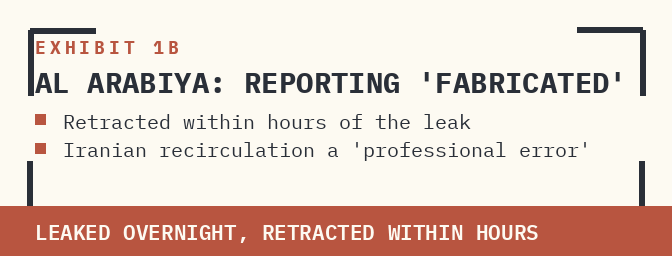 Supplied archive exhibit · original labels. Read alongside the editorial corrections. |
"We will not bow our heads. We are willing to sacrifice as much as possible for the honor and pride of Iran." — President Pezeshkian, state television.
2. FLOW · WHIPLASH ON THE TAPE
The headline cycle produced a three-phase volatility wave: rumour rally, presidential pushback, uranium denial. The crude print captured the asymmetry cleanly. Green box: the spike into the deal headline. Red box: the give-back as Khamenei's reported uranium order surfaced and the Pakistani Army Chief's Tehran trip was cancelled. WTI Jul'26 round-tripped from $102 to under $99 in one session. US 10s ticked four bid then gave it. ES Jun'26 ran 7418 to 7433 then erased more than half the move. The bond market faded the move first. That is the order of conviction.
Al Arabiya then framed the entire episode as an Iranian information operation — Iranian outlets had been re-attributing news to the network without verification. The translation: the network that was supposedly carrying the deal is now publicly disowning the chain of custody on it.
 Supplied archive exhibit · original labels. Read alongside the editorial corrections. | 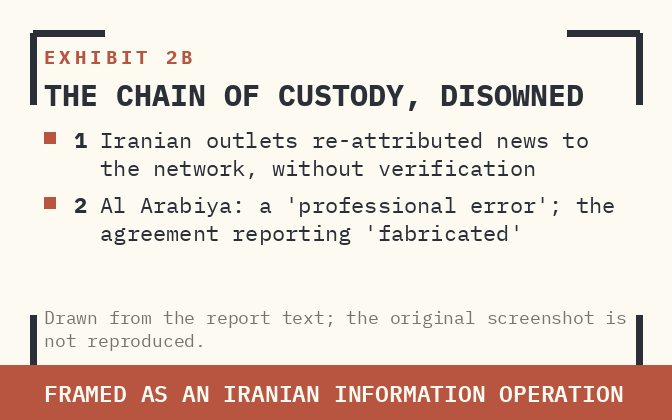 Supplied archive exhibit · original labels. Read alongside the editorial corrections. |
3. RISK · INDEPENDENT CORROBORATION
Strip the headlines and the analytical baseline is consistent across independent sources. Open-source war trackers, working from wire reporting, assess that Iran's latest counter-proposal does not meet US demands and that Trump cancelled a strike package originally planned for May 19 after Gulf state intervention. US demands remain: surrender the HEU, dismantle the nuclear facilities, pause enrichment for twenty years. Iran has not committed to any of these.
On the Saudi axis: two senior regional diplomats are reported to have said that Riyadh has asked the Trump administration to postpone any major military action against Iran until after the conclusion of Hajj. Hajj 2026 begins around May 24. Two reads on this. First, Riyadh believes a strike is actively on the table — otherwise the ask is meaningless. Second, the delay window is measured in days, not weeks. The optionality on a post-Hajj strike package is short-dated.
 Supplied archive exhibit · original labels. Read alongside the editorial corrections. | 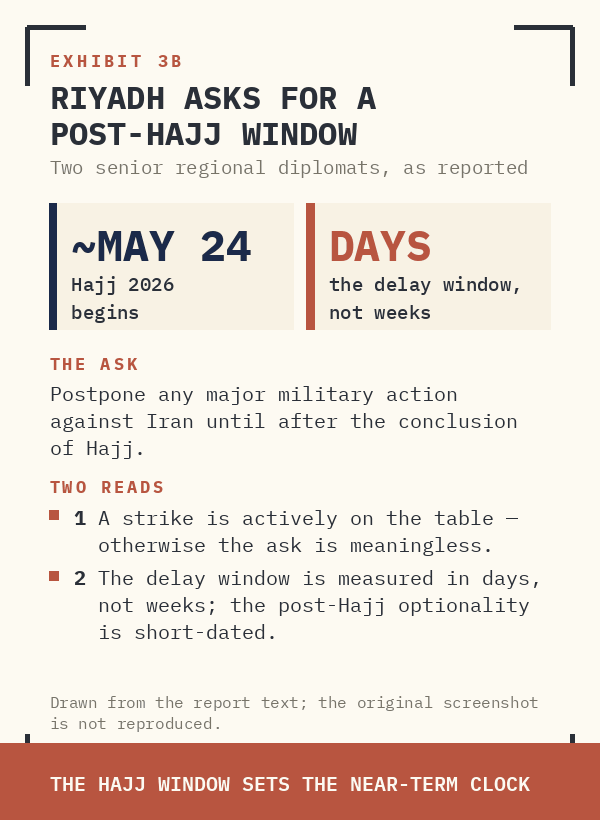 Supplied archive exhibit · original labels. Read alongside the editorial corrections. |
4. RISK · RECONSTITUTION WINDOW
US intelligence, as reported through four sources, indicates Iran is rebuilding faster than the IC modelled. Drone production has restarted during the six-week ceasefire. One official: Iran has "exceeded all timelines the IC had for reconstitution." Internal estimates put full drone reconstitution within six months. This is a refit window, not a pre-settlement window.
The report assigns greater weight to the escalation branch, without establishing that other outcomes are impossible. Diplomatic capitulation is blocked by Khamenei's standing order. Covert extraction is dismissed as a suicide mission by the national security consensus. Military escalation is one possible path consistent with the stated Trump position — and Stephen Miller has put it on the record from the podium.
 Supplied archive exhibit · original labels. Read alongside the editorial corrections. | 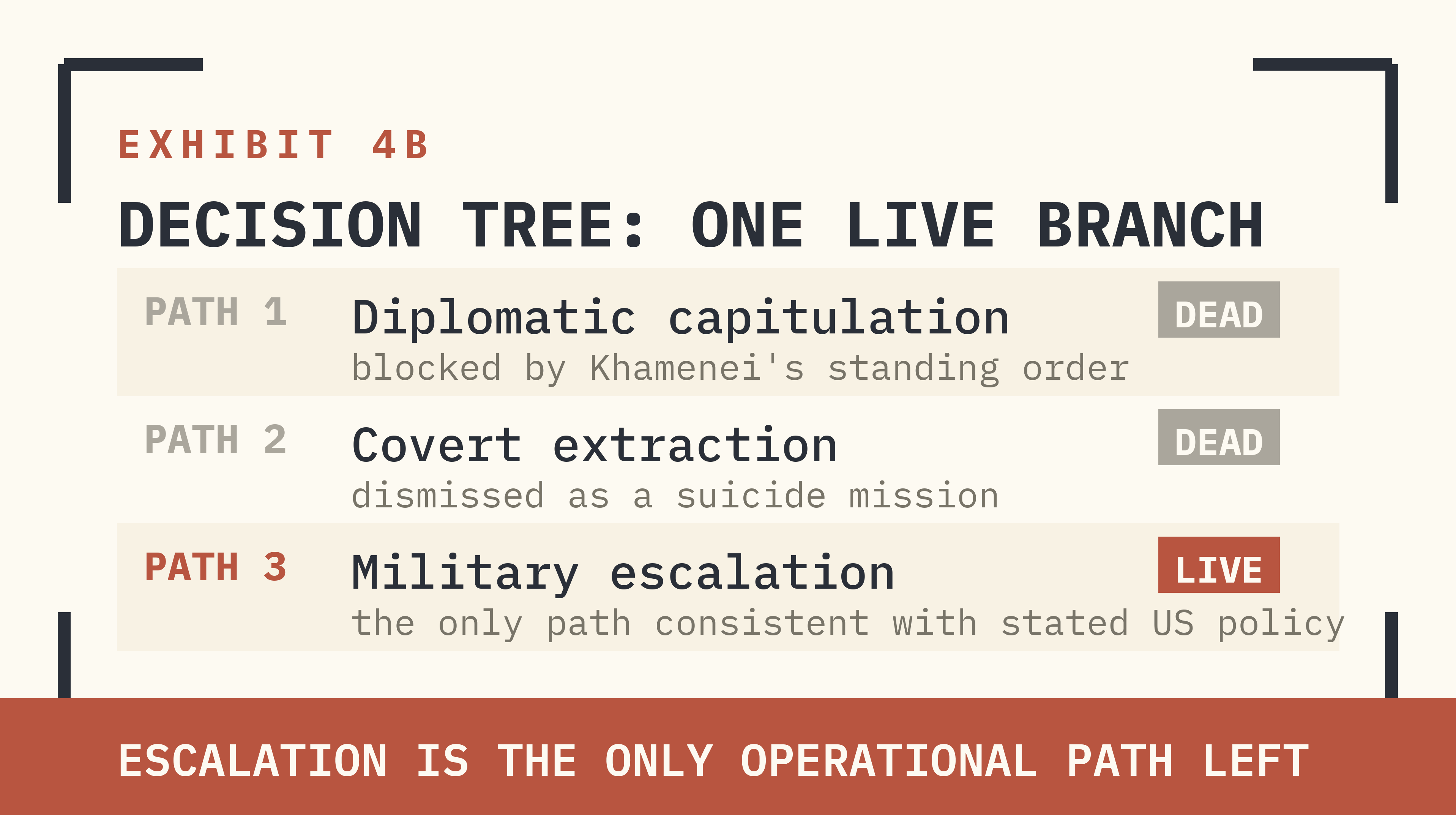 Supplied archive exhibit · original labels. Read alongside the editorial corrections. |
5. PRICE & POSITION · STRATEGIC CONCLUSION
Polymarket has the June 15 ceasefire at 51% — a coin flip. The uranium-surrender market by June 30 sits at 18%. Read together: the market prices a fragile status quo or active rupture with near-zero probability of the diplomatic outcome Washington keeps describing as imminent. The mispricing is not in the binaries. It is in the vol surface. Brent vol has compressed materially through the ceasefire as the headline cycle generated more two-way fades than directional moves. The realised path of the last 24 hours is not consistent with the implied path embedded in front-month options.
Position for the reconstitution window. Do not pay for the headline. Own the convexity into the strike the market keeps refusing to price.
Supplied archive exhibit · original labels. Read alongside the editorial corrections.
Trade construction: long Brent Aug-Oct 25-delta calls and Dec'26 calendar spreads (long front); long USD/INR 1M-3M risk reversal for India transmission risk; long aerospace and defense; underweight EM high-beta sovereign credit; long tanker equities and VLCC rates on structural ton-mile premium. The Hajj window sets the near-term clock: any strike package is operationally feasible from late May. The downside on long convexity is theta. The upside is a step-function repricing on a strike headline the market is not positioned for.