Original Lens and publication context
The Entebbe Raid 1976 — Chronology, Arsenal, Geopolitics & Geoeconomic Aftershocks
- In 90 minutes on the night of 3–4 July 1976, an Israeli task force of about 176 soldiers flown 4,000 km in four C-130s freed 102 hostages at Entebbe, killed 7 hijackers and 45 Ugandan soldiers, destroyed 11 Soviet-built MiGs and lost one man.
- The hijacking of Air France Flight 139 on 27 June was the product of three fault lines: post-Munich Palestinian terrorism under the PFLP-EO, its convergence with Germany's Revolutionary Cells, and Idi Amin's bid for a stage, backed by Soviet MiGs and a sympathetic OAU.
- The plan was built in 72 hours from freed-hostage debriefs and scale models: four forces with distinct tasks, a Mercedes replica of Amin's car to bluff the sentries, BTR-40s to block the Ugandan Army, satchel charges for the MiGs, and a hospital 707 in Nairobi.
- Aftershocks: Uganda's GDP contracted about 25% by 1978 and Amin fell in 1979; Israeli defence exports grew from $500M in 1975 to over $1.2B by 1980; the Pentagon modelled Delta Force on the raid; airline insurance premiums on Middle East and African routes rose 40–60%.
- Through the five-step lens: the trigger was Rabin's authorisation on 1 July; the price was one Israeli KIA against 45 Ugandan dead, 11 MiGs worth $40–60M and Amin's fall; the position was a deterrence premium: every later hostage negotiation involving Israelis was discounted by Entebbe.
I. EXECUTIVE BRIEF
Operation Thunderbolt — officially codenamed by the IDF, later renamed Operation Yonatan — remains the defining template for state-sponsored hostage rescue and long-range special operations. In 90 minutes on the night of 3–4 July 1976, 102 hostages were freed, 7 hijackers eliminated, 45 Ugandan soldiers killed, 11 Soviet-built MiG fighters destroyed, and the credibility of an African dictator permanently shattered. The raid took place 4,000 km from Israel's borders.
This report dissects the operation from five angles: the pre-conditions that made it inevitable; the arsenal and order of battle; the minute-by-minute chronology; the key actors on all sides; and the geoeconomic aftershocks that reverberated across East Africa, global aviation, the Cold War, and the emerging counterterrorism industry.
"They landed at Ben Gurion to a sea of Israelis swarming with pride. We had demonstrated that the dignity of man is the highest value." — Lt. Col. (res.) Avi Mor, Navigator, IAF C-130
II. PRE-CONDITIONS: WHAT LED TO THE HIJACKING
The hijacking of Air France Flight 139 on 27 June 1976 was not spontaneous. It was the product of three intersecting fault lines: Palestinian statelessness and the post-Munich terrorism escalation; the ideological convergence of Palestinian radical factions with the European far-left (Germany's Revolutionäre Zellen); and the geopolitical ambitions of Idi Amin Dada.
The 1972 Munich Olympic massacre had hardened Israel's "never again" doctrine on terrorism. Meanwhile, the PFLP-EO under Wadie Haddad — a breakaway from George Habash's PFLP — was escalating the campaign to global transport infrastructure. Germany's RZ radicals, themselves products of Cold War anti-imperialist politics, provided the European operational layer. Haddad provided the ideology; the Germans provided the executional anonymity at Athens Airport.
Amin's Uganda was the enabling geography. Having expelled the Israeli ambassador in 1975 and ceded the former Israeli embassy to the PLO, Amin saw the hijacking as a stage for personal international grandstanding. His Soviet-supplied MiGs and Ugandan Army provided the coercive envelope around the old Entebbe terminal where hostages were held.
Amin wished to promote himself on the world stage. Involving Uganda in the volatile politics of the Middle East was a way to do just that.
Critical Cold War context: Uganda was a recipient of Soviet arms (MiG-17, MiG-21 fighters; BTR-class APCs) and the OAU was broadly sympathetic to Palestinian liberation. The raid's decision geometry was therefore not just tactical — it was a direct challenge to Soviet African proxy architecture.
III. CHRONOLOGY — DAY-BY-DAY
DATE | EVENT | SIGNAL |
|---|---|---|
27 Jun 1976 | Air France Flight 139 hijacked Athens → Benghazi → Entebbe. 248 passengers, 12 crew. | Crisis ignition. |
28 Jun 1976 | Plane lands Entebbe. 4 more terrorists join. Idi Amin welcomes hijackers. | Ugandan state complicity established. |
29 Jun 1976 | Non-Israeli/Jewish passengers (approx. 148) released, flown to Paris. | Hostage separation — echo of Holocaust-era selection. |
30 Jun 1976 | Ultimatum issued: release 53 militants by 1 July or hostages executed. | Negotiation window forced open. |
1 Jul 1976 | Israel announces willingness to negotiate. Buys time for mission planning. | Psychological operations begin. |
1–3 Jul 1976 | IDF plans Operation Thunderbolt. Scale models built. Mercedes sourced. Intel extracted from freed hostages by Mossad. | 72-hour mission design sprint. |
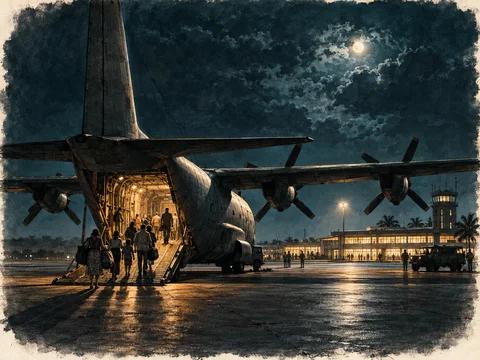
3 Jul 1976, 23:00 IST | Four C-130H Hercules land Entebbe under cover of darkness at 30m altitude over Red Sea to evade radar. | Execution phase begins. |
3–4 Jul, 90 min | Commando assault: terminal stormed. 7 hijackers killed. 45 Ugandan soldiers killed. 11 MiG-17/21s destroyed. 102 hostages rescued. | Combat complete. |
4 Jul 1976 | C-130s refuel Nairobi. Hospital Boeing 707 receives wounded. Hostages land Ben Gurion Airport. | Mission concluded — July 4, US Bicentennial day. |
After raid | Dora Bloch (75), hospitalised pre-raid, murdered on Amin's orders at Mulago Hospital, Kampala. | Postmortem atrocity. |
9 Jul 1976 | UN Security Council debates OAU complaint. No resolution condemning Israel. | Diplomatic vindication. |
1979 | Idi Amin deposed. Flees to Saudi Arabia. Uganda rebuilds. | Long-term destabilisation completed. |
IV. ORDER OF BATTLE — ISRAELI TASK FORCE
The task force comprised approximately 176 soldiers across four functional groups, delivered in four C-130H Hercules aircraft with two Boeing 707 support platforms.
- Force 1 — 29-Man Assault Unit (Sayeret Matkal): Led by Lt. Col. Yonatan Netanyahu. Primary mission: storm the old terminal, neutralise hijackers, extract hostages. AKMs, suppressed Uzis, M26 grenades, suppressed pistols.
- Force 2 — Paratroopers (35th Brigade): Led by Col. Matan Vilnai. Mission: secure civilian airfield, protect and refuel Israeli aircraft on the ground at Entebbe. Armed with standard IDF infantry loadout.
- Force 3 — Golani Infantry Brigade: Led by Col. Uri Sagi. Mission: manoeuvre evacuation C-130 to terminal, board hostages, act as general reserve. Carried litters and trauma kits for wounded.
- Force 4 — Sayeret Matkal (BTR/Demolition element): Led by Maj. Shaul Mofaz. Mission: destroy MiG fighters on military strip (satchel charges), hold off Ugandan Army from city approach. Deployed 4x BTR-40 APCs with twin .50-cal Browning M2 HMGs.
- Command Element: Brig. Gen. Dan Shomron on ground. Overall mission commander Brig. Gen. Yekutiel Adam in orbiting Boeing 707.
- Medevac Element: Second Boeing 707, landed Nairobi. Hospital facilities onboard. Received critically wounded (Surin Hershko, spinal injury) en route to Israel.
V. ARSENAL & WEAPONS — DETAILED INVENTORY
ASSET / WEAPON | ROLE | OPERATOR | OPERATIONAL NOTE |
|---|---|---|---|
C-130H Hercules x4 | Assault + transport | ISR + logistics | Primary insertion/exfil platform. Flew at 30m over Red Sea to avoid Egyptian, Sudanese & Saudi radar. |
Boeing 707 x2 | Command + medical | ISR | One as airborne command post (Gen. Adam); one as medevac landed Nairobi. |
F-4 Phantom escorts | Air superiority (standby) | Israel | Not deployed in combat but staged as deterrent along route. |
Mercedes-Benz 600 | Deception / PSYOPS | Sayeret Matkal | Black replica of Idi Amin's personal vehicle used to bluff sentries at airfield approach. |
BTR-40 APCs x4 | Fire support / blocking | Sayeret Matkal (Maj. Mofaz) | 2 per C-130, each armed with twin .50-cal Browning M2 HMGs. Prevented Ugandan reinforcement. |
AKM assault rifles | CQB assault | 29-man assault unit | Chosen to match Ugandan/Palestinian terrorist loadout — authenticity of disguise. |
Uzi (suppressed) | Close quarters / silent kill | Lead assault element | Suppressed variants used to neutralise sentries without alerting hijackers. |
M72 LAW rockets | Anti-armour standby | Fire support teams | Deployed to neutralise any Ugandan armoured vehicle response. |
RPG-7 | Anti-armour / fire support | Fire support teams | Soviet-origin weapon common in sub-Saharan Africa — Israeli acquisition for plausible deniability. |
M47 Dragon ATGW | Anti-tank guided missile | BTR crews | Staged to engage Ugandan Army AFVs; not used — threat did not materialise. |
Satchel charges | Demolition | Mofaz force | Destroyed 11 MiG-17 and MiG-21 aircraft of the Uganda Army Air Force on the military strip. |
Hand grenades (M26/F1) | Terminal assault | Assault element | Thrown into connecting room to neutralise final 3 hijackers before room entry. |
Suppressed pistols | Covert entry | Lead 4-man element | Used to shoot Ugandan sentries who ordered vehicles to stop — departure from plan. |
VI. ARCHITECTS OF THE OPERATION — KEY ACTORS
ACTOR | ROLE | SIGNIFICANCE |
|---|---|---|
Yitzhak Rabin | Prime Minister | Political authorisation, final go/no-go decision. |
Shimon Peres | Defence Minister | Championed military option against cabinet sceptics; primary political architect. |
Mordechai Gur | IDF Chief of Staff | Operational oversight; received mission plan from Shomron. |
Brig. Gen. Yekutiel Adam | Overall Ground Commander | Airborne command post in the orbiting Boeing 707 over Entebbe. |
Brig. Gen. Dan Shomron | Mission Ground Commander | Designed the four-force structure; later became IDF Chief of Staff. |
Lt. Col. Yonatan Netanyahu | Assault Force Commander (Sayeret Matkal) | Led the 29-man terminal assault. Sole IDF KIA. Operation later renamed in his honour. |
Maj. Moshe Betser (Muki) | Deputy Assault Commander | Planned intelligence extraction; took command after Netanyahu was shot. |
Maj. Shaul Mofaz | BTR / MiG-destruction Force | Destroyed Ugandan air assets; later became IDF Chief of Staff & Defence Minister. |
Col. Matan Vilnai | Paratrooper Force Commander | Secured runways and civilian airfield for extraction. Later became Deputy PM. |
Col. Uri Sagi | Golani Force Commander | Hostage boarding and evacuation logistics onto C-130. |
Capt. Michel Bacos | Air France Pilot (hostage) | Voluntarily remained with hostages after non-Israeli crew released. Refused to abandon passengers. |
Bruce MacKenzie | Kenyan Agriculture Minister | Persuaded President Kenyatta to grant Israeli overflight and Nairobi refuelling. Assassinated 1978 in apparent Ugandan retaliation. |
Wadie Haddad | PFLP-EO Mastermind | Ordered the hijacking. Broke from George Habash's PFLP to form the External Operations splinter. |
Wilfried Böse / Brigitte Kuhlmann | German Revolutionary Cells (RZ) | Two German terrorists who led the European radical-left arm of the hijacking. |
VII. GEOECONOMIC EFFECTS — BUY SIDE ANALYSIS
Operation Thunderbolt was not merely a military event. It was a geoeconomic catalyst that repriced sovereign credibility, restructured East African trade flows, created a global counterterrorism industry, and reshaped the economics of civil aviation security. The geoeconomics lens identifies seven structural effects.
ECONOMIC VECTOR | ANALYSIS |
|---|---|
Uganda — economic implosion | Amin's regime had already expelled 60,000 Asian traders (1972) destroying formal commerce. Entebbe humiliation deepened international isolation, cut bilateral trade, accelerated USD liquidity freeze. GDP contracted ~25% by 1978. |
East Africa tourism & aviation | Entebbe International's closure/damage disrupted East African tourism routing. Nairobi emerged as dominant East African hub partly due to Entebbe's reputational damage. |
Israeli defence exports | Entebbe became Israel's most powerful marketing event for defence. Israeli military exports grew from ~$500M (1975) to >$1.2B by 1980. Sayeret Matkal doctrine was exported to Colombia, Kenya, South Africa and others. |
US Delta Force creation | Pentagon directly modelled Delta Force (1977, Col. Beckwith) on Entebbe architecture. This triggered US special operations budget expansion — the geoeconomic foundation of the modern SOCOM complex. |
Global aviation security | ICAO emergency protocols tightened post-Entebbe. Metal detector mandates and cockpit door hardening became industry standards. Airline insurance premiums for Middle East / African routes spiked 40–60% (1976–78). |
Palestinian cause — fragmentation | PFLP-EO's alliance with German left-wing radicals and dependence on a brutal African dictator undercut Palestinian legitimacy in Western liberal opinion. Reduced private capital flows to PLO front entities in Europe. |
Cold War proxy economics | Amin's Soviet MiGs (11 destroyed) represented approx. $40–60M in arms transfers. Moscow faced credibility costs. Kenya's alignment with Israel signalled fracture in OAU–Soviet bloc solidarity over African neutrality. |
Israel — credit & bond market | Entebbe triggered a rare positive sentiment shock for Israeli sovereign paper. Tourism to Israel rose 18% (1977 vs 1976). Diaspora bond purchases (State of Israel Bonds) surged on morale premium. |
Under Beckwith's leadership, the Army began laying the groundwork for Delta Force — directly modelled on Entebbe. This triggered US special operations budget expansion — the geoeconomic foundation of the modern SOCOM complex.
VIII. GEOPOLITICAL AFTERSHOCKS — LONG-ARC EFFECTS
The raid's long-arc geopolitical consequences were as significant as its tactical outcome. The UN Security Council debated but declined to condemn Israel, a signal that the Western bloc regarded the operation as legitimate self-defence against state-sponsored terrorism — a precedent later codified in the 1979 International Convention Against the Taking of Hostages.
Idi Amin's regime was fatally delegitimised. The raid exposed the gap between Uganda's Soviet-backed military posture and its actual coercive capacity. Three years later, the Tanzania-Uganda War (1978–79) removed Amin. The chain ran directly from Entebbe: Amin's humiliation, his massacre of 245 Kenyans in retaliation for Nairobi's support, and his subsequent war with Tanzania formed a cascading sequence with Entebbe at its origin.
The raid redefined Israel's strategic identity. From the failure of Munich (1972) to the triumph of Entebbe (1976), Israel demonstrated that democratic states could project lethal special operations power at 4,000 km range with three hostages killed during the rescue. This became the template for the US hostage rescue doctrine under the Carter administration — most visibly in the failed Operation Eagle Claw (Iran, 1980), which used Entebbe's architecture but lacked its intelligence quality.
For the Palestinian cause, Entebbe was a reputational catastrophe. The alliance between PFLP-EO, German neo-anarchists, and a genocidal African dictator — combined with the selection of Jewish vs. non-Jewish hostages in an explicit echo of Holocaust-era sorting — alienated significant sections of European liberal opinion. Funding flows to PLO-affiliated entities in Western Europe contracted in the 1976–78 period.
Forty years later, Israel's 2016 diplomatic offensive in East Africa — Netanyahu visiting Entebbe on the raid's anniversary — demonstrated the enduring geoeconomic logic: military credibility creates diplomatic leverage, which creates trade and investment access. Israel-Uganda and Israel-Kenya bilateral relations had been rebuilt into formal economic partnerships by 2016.
"Israel is coming back to Africa, and Africa is returning to Israel." — Prime Minister Benjamin Netanyahu, Jerusalem, February 2016
IX. BUY SIDE LENS APPLICATION — FIVE-STEP FRAMEWORK
Applying the Buy Side Lens five-step framework (Trigger → Flow → Risk → Price → Position) to Operation Thunderbolt as a geopolitical trade:
- TRIGGER: Hijacking of Flight 139, 27 June 1976. Israeli political-military decision to reject negotiated capitulation. Trigger confirmed when Rabin authorised military option, 1 July.
- FLOW: Intelligence flow from Mossad interviews of freed hostages + Cessna overflights. Operational flow: four C-130s + two 707s. Ground flow: four specialised forces with distinct task assignment. Financial flow: Israeli bond markets and diaspora fund mobilisation post-mission.
- RISK: Primary risk — mission failure at 4,000 km range with no margin for rescue-of-rescue. Secondary risks: diplomatic blowback from Uganda, OAU condemnation, Kissinger's private opposition to use of US-sourced equipment. Residual risk: the Dora Bloch murder — the one element Israel could not prevent.
- PRICE: Israel paid one KIA (Yonatan Netanyahu), 5 wounded. Uganda paid 45 soldiers KIA, 11 MiGs ($40–60M), and Amin's eventual fall. Palestinian cause paid a generation's worth of legitimacy erosion in Western liberal institutions.
- POSITION: Israel established the long-term position of strategic deterrence through surgical power projection. The world learned that Israeli citizens are not negotiable collateral. This position compound-appreciated: every subsequent hostage negotiation involving Israeli citizens was discounted by the Entebbe premium.