Original Lens and publication context
MACRO STRATEGIC ANALYSIS OF U.S.–ISRAEL STRIKE OPERATIONS AGAINST IRAN
- Operation Epic Fury is the most ambitious combined-arms campaign since Desert Storm: two carrier strike groups, 50,000+ troops, 250+ fighter-attack aircraft and 5,000+ aim points, built to degrade Iran's ballistic missiles, IRGC command, nuclear sites and Hormuz denial capability.
- Hormuz is the center of gravity: 18–21 mb/d of petroleum liquids and about 20% of LNG trade transit it, the Saudi Petroline carries at most 5 mb/d and the UAE bypass about 1.5 mb/d, so even partial closure removes 10–15 mb/d with no near-term substitute.
- The base case is a contested victory at 45% probability lasting 21–45 days: oil peaks $35–50 higher and stays elevated for months, Iran's nuclear program is set back 3–5 years, Hezbollah fully activates, and markets trace a U-shaped 6–12 month recovery. Escalation spiral is 10%.
- Price map: oil $120–140 (base-case peak), gold $3,200–3,500, DXY 108–114, Nifty 50 down 12–18%, defense ETFs up 25–35%. Position: long front-month crude, gold, defense and dollar against EM FX; short Asian equity indices and oil-importer EM currencies; hedge with VIX calls and S&P put spreads.
- Iran's campaign is built to survive, not win: 3,000+ missiles with pre-delegated launch authority, underground missile cities, 5,000+ mines and 150,000+ Hezbollah rockets. The most dangerous moment is Day 6–10, with BMD magazines depleted, Hormuz mined and oil past $100; the decisive variable is political.
TABLE OF CONTENTS
I. Order of Battle — Complete U.S.-Israeli Asset Inventory
II. Day-by-Day Operational Timeline & Phase Analysis
III. Strike Architecture — Axes, Arrows, and Target Package
IV. Military Analysis — Doctrinal & Tactical Assessment
V. Geopolitical Analysis — Regional & Global Realignment
VI. Economic & Market Impact Analysis
VII. Energy & Commodity Shock Transmission
VIII. Scenario Matrix — War Outcomes & Probability Weighted Consequences
IX. Strategic Conclusions — The Buy Side Lens
X. Iranian Campaign — Order of Battle & Force Structure
XI. Iranian Air Defense Architecture — Layered IADS
XII. Iranian Missile Arsenal — Ballistic, Cruise & Hypersonic
XIII. Iranian Naval Strategy — Hormuz A2/AD & Swarm Doctrine
XIV. Iranian Drone Warfare — UAS Arsenal & Tactics
XV. Iranian Proxy Network — Coordinated Multi-Front Response
XVI. Iranian Cyber & Electronic Warfare Capabilities
XVII. Iranian Counter-Campaign — Navigation, Doctrine & Endgame
I-A. Gerald R. Ford Carrier Strike Group (GRFCSG)
The Ford CSG anchors the Northern Axis. USS Gerald R. Ford (CVN-78), the Navy's newest nuclear supercarrier, embarked Carrier Air Wing 8 (CVW-8) with nine squadrons delivering unmatched sortie generation — up to 160 sorties/day under surge — enabled by its Electromagnetic Aircraft Launch System (EALS) and Advanced Arresting Gear (AAG).
SQN | CALLSIGN | AIRCRAFT | PRIMARY MISSION |
|---|---|---|---|
VFA-31 | Tomcatters | F/A-18E Super Hornet | Strike / Air Superiority |
VFA-37 | Raging Bulls | F/A-18E Super Hornet | Strike / Anti-surface |
VFA-87 | Golden Warriors | F/A-18E Super Hornet | Strike / SEAD |
VFA-103 | Jolly Rogers | F/A-18F Super Hornet | Strike / Electronic Attack escort |
VFA-143 | Tridents | F/A-18E Super Hornet | Strike / Close Air Support |
VAW-124 | Bear Aces | E-2D Advanced Hawkeye | AEW&C / Battle Management |
HSM-70 | Spartans | MH-60R Seahawk | ASW / SAR / Surface targeting |
VTOL Det | Roadrunners | Autonomous VTOL Drones | ISR / Forward target designation |
EFX Det | Coyotes | Raytheon Coyote UAS | Counter-UAS effector |
Escort & Support — GRFCSG
- USS Roosevelt (DDG-80) — Arleigh Burke Flt I; primary SAM screen (SM-2/SM-6); TLAM strike platform
- USS Winston Churchill (DDG-81) — Arleigh Burke; TBMD / SM-3 Block IIA intercept; ASW screen
- USS Paul Hamilton (DDG-60) — Arleigh Burke; forward picket; TLAM deep-strike reserve
- USS Thomas Hudner (DDG-116) — Arleigh Burke Flt III; SPY-6 radar; integrated IAMD node
- USS William Molean (T-AGS 47) — Oceanographic survey / hydrographic support
- USS Marie Thayer (T-AGS 96) — Survey / C2 relay node
- USS Mount Whitney (LCC 20) — Amphibious command ship
- USS Lewis B. Puller (ESB-3) — Expeditionary sea base; VBSS / Special Operations support
- USS Georgia (SSGN-729) — Ohio-class SSGN; up to 154 TLAMs; forward-deployed stealth strike asset
I-B. Abraham Lincoln Carrier Strike Group (ABECSG)
The Lincoln CSG (CVW-9) anchors the Southern Axis, operating from the Arabian Sea and Persian Gulf approaches. CVW-9 embeds two fifth-generation F-35C squadrons (VFA-147 and VMFA-314), providing stealth-enabled deep penetration against Iran's layered IADS — specifically the Bavar-373 and HQ-9 batteries defending Tehran and nuclear sites.
SQN | CALLSIGN | AIRCRAFT | PRIMARY MISSION |
|---|---|---|---|
VFA-147 | Argonauts | F-35C Lightning II | Stealth Strike / SEAD-DEAD |
VMFA-314 | Black Knights | F-35C Lightning II | Stealth Strike / ISR relay |
VFA-14 | Tophatters | F/A-18E Super Hornet | Strike / Air Superiority |
VFA-97 | Titans | F/A-18E Super Hornet | Strike / Anti-surface |
VFA-25 | Fist of the Fleet | F/A-18E Super Hornet | Strike / CAS |
VFA-41 | Black Aces | F/A-18F Super Hornet | Strike / Radar Jamming (ALQ-218) |
VFA-113 | Stingers | F/A-18E Super Hornet | Strike / Precision Ground Attack |
VAW-117 | Wallbangers | E-2D Advanced Hawkeye | AEW&C / NIFC-CA airborne node |
HSM-71 | Raptors | MH-60S Seahawk | ASW / Mine Countermeasures / CASEVAC |
Escort & Support — ABECSG / Fifth Fleet
- USS Michael Murphy (DDG-112) — Deployed; AAW / TLAM; 5th Fleet AOR screen
- USS Momsen (DDG-92) — ASW specialist; towed array sonar against IRIN Kilo submarines
- USS Charlotte (SSN-766) — Los Angeles-class SSN; torpedo / TLAM / intelligence collection
- USS John Finn (DDG-113) — Arleigh Burke; BMD-capable; SM-3 IIA terminal defense
- DESRON 21 + Task Force 59 — Unmanned Surface Vessel (USV) swarm; maritime domain awareness
- DESRON 15 (IndoPACOM nearby) — 7th Fleet forward presence; deterrence against Chinese opportunism
I-C. Air Assets — EUCOM (Forward-Deployed & Rotational ISR)
- F-15E Strike Eagles — Al Udeid AB (Qatar) & Incirlik AB (Turkey); dual-role strike / SEAD
- F-16C/D Fighting Falcons — Multiple EUCOM bases; close air support and suppression
- EA-18G Growlers — Electronic attack; jamming corridor suppression of IADS
- RC-135 Rivet Joint — SIGINT collection; intercept of IRGC communications
- U-2S / RQ-4 Global Hawk — High-altitude ISR; persistent Battle Damage Assessment
- MQ-9 Reaper — Armed ISR; time-sensitive targeting of mobile missile launchers (TELs)
- B-52H Stratofortress (CONUS) — Standoff ALCM / JASSM-ER delivery; "Bomber Pulse" sorties
- B-1B Lancer (CONUS) — Hypersonic integration; LRASM anti-ship; penetrating bomber
I-D. Air Assets — CENTCOM (Deployed & Forward-Deployed)
- F-35A Lightning II — Al Dhafra AB (UAE); 5th-gen penetration of southern IADS
- F-22 Raptor — Air superiority; counter IRIAF F-14A / MiG-29 intercept attempts
- KC-46A / KC-135 Stratotanker — Aerial refueling; extended combat radius for all packages
- E-3 Sentry AWACS — Airspace management; IFF; battle management overlay
- P-8 Poseidon — ASW patrol; IRIN submarine detection; maritime ISR
- Israeli AF F-35I Adir + F-15I Ra'am — Joint Force strike assets from Israeli bases
I-E. Joint Force Composition
COMPONENT | ROLE IN OPERATION |
|---|---|
U.S. Navy + USMC | Maritime strike, amphibious threat-in-being, TLAM deep strike, SSGN fires |
U.S. Air Force | Strategic bombing, SEAD/DEAD, ISR, tanker support, space-based targeting |
U.S. Space Force | GPS constellation integrity, satellite comms (AEHF/MUOS), missile warning (SBIRS) |
U.S. Cyber Command | IRGC network disruption, radar spoofing, C2 node degradation, financial-system interference |
U.S. Coast Guard | Port security, MSO in Persian Gulf; VBSS detachments |
Israel Defense Forces | Ground-based fires; Arrow-3 / David's Sling BMD screen for U.S. assets |
Israeli Air Force | Northern Axis strike packages; F-35I deep penetration; Jericho missile fires |
OPERATION EPIC FURY — STRIKE MAP & JOINT FORCE OVERVIEW
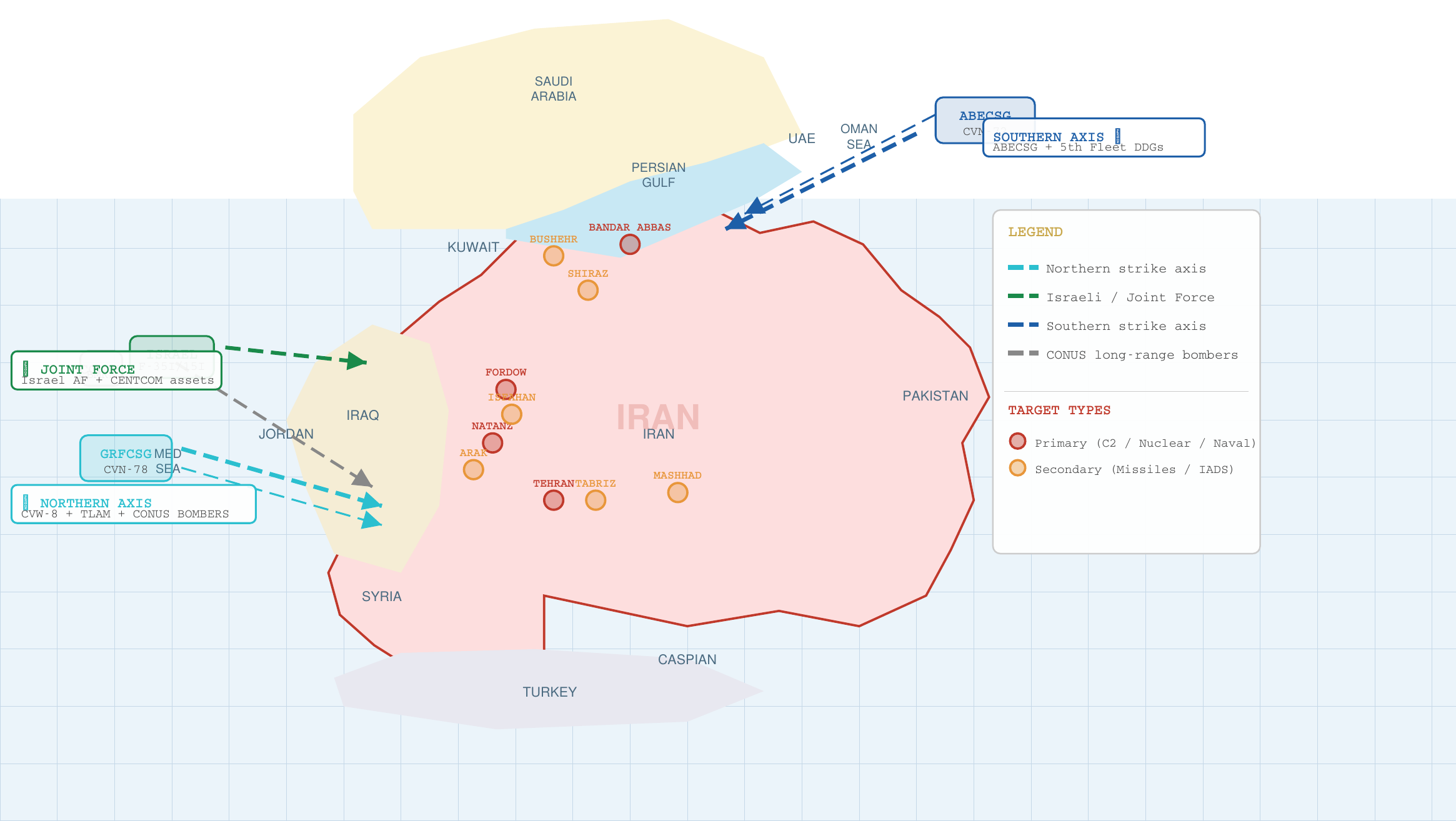
Supplied archive exhibit · original labels. Read alongside the editorial corrections.
DAY 1 H+0 TO H+24 | SHAPING & INITIAL SUPPRESSION |
|---|---|
EVENTS | GRFCSG positioned Mediterranean (Day 1 posture). SSGN Georgia fires first TLAM salvo targeting IRGC C2 nodes, radar sites, and IADS command posts. EUCOM B-52s launch ALCM packages. CYBERCOM executes network intrusion against IRGC Aerospace Force targeting systems. Israeli AF conducts F-35I penetrating strikes against Tabriz radar corridors. EA-18G Growlers open jamming corridors. Space Force activates GPS denial countermeasures over contested airspace. IRIN forced to surface to assess damage — P-8s vector attack submarines. |
WHY | Blind the opponent. Degrade integrated air defense (IADS) before manned aircraft enter threat envelope. Iran loses C2 coherence within 3 hours of H-hour. |
DAY 2-3 H+48 TO H+72 | PHASE 1: SEAD/DEAD & OPENING STRIKES |
|---|---|
EVENTS | F/A-18F Jolly Rogers (ALQ-99 jamming pods) execute SEAD runs against surviving SA-15/SA-20 sites. ABECSG F-35Cs penetrate southern IADS under electronic cover — first aim points are Bushehr ballistic missile storage and Bandar Abbas naval infrastructure. B-1B Lancers conduct "Bomber Pulse" dropping JASSM-ER against Fordow and Natanz. TLAMs from DDGs saturate air defense reload sites. Joint Force Strike Assets (Israel + USAF) transit Jordan corridor toward Isfahan. MQ-9s hunt IRGC mobile TEL launchers in real time. |
WHY | Systematic destruction of Iran's ability to shoot back. Each SEAD wave opens airspace for the next strike layer. TEL hunting is the decisive tactical effort — mobile launchers are Iran's most dangerous retaliatory capability. |
DAY 4 H+96 | PHASE 2: SYSTEMATIC DEEP STRIKE |
|---|---|
EVENTS | With IADS degraded, strike packages transition to deep-penetration profiles. F-35Cs attack Tehran-area IRGC HQ buildings, intelligence compounds, and hardened C2 bunkers. CVW-8 executes coordinated Alpha Strikes against Tabriz ballistic missile production. DDGs fire second TLAM salvo against surviving IADS nodes revealed by SIGINT collection. Iranian retaliatory drones and missiles launched — ABECSG SM-6 and Israeli Arrow-3 execute intercepts via NIFC-CA. CYBERCOM disrupts IRGC retaliation command net. IRIN fast-attack craft attempt Hormuz harassment — repelled by DESRON 21 USV swarm and P-8-directed torpedo fires. |
WHY | Decapitation of command networks. Attrition of Iranian retaliation capability must outpace reconstitution. NIFC-CA architecture enables over-the-horizon engagement of retaliatory salvos. |
DAY 5 H+120 | PHASE 3: SUSTAINED PRESSURE & ISR EXPLOITATION |
|---|---|
EVENTS | RC-135 and U-2S ISR products drive real-time retargeting of IRGC dispersal sites. Iranian leadership relocates to hardened mountain facilities — targeted by GBU-57 Massive Ordnance Penetrator (MOP) delivered by B-2A Spirit (CONUS sortie). MH-60S helicopters conduct VBSS on IRIN vessels suspected of minelaying in Hormuz approaches. SOF elements forward-positioned via USS Lewis B. Puller execute direct action against maritime mining infrastructure. Iranian proxy response activates in Iraq and Syria — F-15Es and A-10s conduct counter-fire. |
WHY | Convert ISR advantage into kinetic dominance. MOP delivery signals political decision to destroy underground hardened facilities — a message to Iran and China simultaneously. |
DAY 6 H+150 | PHASE 4: HORMUZ CLEARANCE & MARITIME CONTROL |
|---|---|
EVENTS | TF-59 USV swarm + MH-60S helicopters conduct systematic mine clearance of Hormuz approaches. Charlotte (SSN-766) hunts surviving IRIN Kilo-class submarines. F/A-18E strikes on Bandar Abbas destroy remaining IRIN fast-attack craft and C-802 batteries on Qeshm Island and Abu Musa. CVW-9 strikes Kharg Island loading infrastructure — chokepoint leverage without full blockade. INDOPACOM DESRON 15 repositioned toward Taiwan Strait as deterrence signal to Beijing. |
WHY | Hormuz is the center of gravity for global energy markets. Every day Hormuz is contested, crude spikes $5-8/bbl. Clearing it is both a military and economic imperative. |
DAY 10+ H+240+ | PHASE 5: CONSOLIDATION, BDA & DETERRENCE POSTURE |
|---|---|
EVENTS | ISR-driven mopping up of residual IRGC capabilities. BDA satellites and U-2S confirm destruction status of 5,000+ aim points. GRFCSG and ABECSG maintain deterrence posture — ready to re-strike reconstitution attempts. Political phase begins: ceasefire conditions conveyed through Oman and Swiss back-channels. Two DDGs + USS Charlotte remain on 180-day deterrence patrol. CYBERCOM maintains persistent network access for early warning of nuclear restart. |
WHY | The campaign ends when Iran's decision calculus is permanently altered. Military victory without a political settlement produces insurgency, proxy escalation, and eventual nuclear reconstitution. Deterrence posture + intelligence access is the real strategic objective. |
III-A. Northern Axis (GRFCSG — Mediterranean to Northern Iran)
The Northern Axis arrow originates from GRFCSG's Mediterranean position (anchored near Cyprus, EUCOM AOR / Sixth Fleet) and projects eastward through Turkey/Syria or Jordan/Iraq airspace corridors to strike targets across northern and central Iran — Tabriz, Tehran, Mashhad, Isfahan. This is the primary axis for targeting IRGC ballistic missile capabilities and nuclear enrichment infrastructure.
- GRFCSG Day 1 position: Eastern Mediterranean, south of Cyprus (EUCOM AOR, Sixth Fleet)
- DESRON 2 + DESRON 3: Escort screen + forward pickets for the Northern Axis
- CVW-8 + TLAMs: Over-the-horizon TLAM fires from DDGs precede manned aircraft; terrain-hugging profiles exploit radar coverage gaps
- Israel IAF F-35I Adir: Depart Nevatim AB; refuel over Jordan; penetrate via Iraq corridor; strike Fordow and Isfahan NRC
- B-52H "Bomber Pulse": Launch CONUS (Barksdale/Minot); ALCM standoff delivery against hardened IRGC HQ Tehran and Tabriz missile complex
- CYBERCOM: Disable IRGC Aerospace Force command network before first aircraft enter Iranian airspace
III-B. Southern Axis (ABECSG — Arabian Sea / Persian Gulf to Southern Iran)
The Southern Axis arrow originates from ABECSG's position in the Northern Arabian Sea / Persian Gulf approaches and projects northward into Iran's southern littoral — Bandar Abbas, Bushehr, Zahedan, Shiraz. This axis targets Iran's naval A2/AD capability, Persian Gulf C-802 batteries, and southern ballistic missile storage. DESRON 21 + TF-59 USVs provide Hormuz maritime control overlay.
- ABECSG Day 7 position: Directly east of Strait of Hormuz, Arabian Sea (5th Fleet AOR)
- CVW-9 + TLAMs: F-35Cs (stealth) penetrate weaker southern IADS; destroy Bandar Abbas naval base and IRIN fast-attack fleet
- DESRON 21 + TF-59: Autonomous USV swarm creates layered mine-detection / counter-IRGC maritime screen; denies Iran's swarm-boat tactic
- INDOPACOM DESRON 15 (nearby): Deterrence posture — signals to China that INDOPACOM readiness is undiminished
III-C. Joint Force Strike Assets (Central Corridor — Israel/Jordan to Tehran)
The "Joint Force Strike Assets" arrow on the battle map originates from Israeli-Jordanian territory and projects northeast toward Tehran and Isfahan. Israeli aircraft transit Arab airspace — enabled by Abraham Accords architecture and covert Saudi acquiescence for overflight. F-35Is provide stealth penetration; F-15Is carry 5,000-lb GBU-28 bunker-busters for hardened targets. Primary objective: Fordow Fuel Enrichment Plant (FFEP), buried 80m underground, requiring B-2A + GBU-57 Massive Ordnance Penetrator for guaranteed destruction.
III-D. Complete Target Package (5,000+ Aim Points)
TARGET CATEGORY | SPECIFIC TARGETS | WEAPON SYSTEM | STRATEGIC PURPOSE |
|---|---|---|---|
C2 Centers | IRGC HQ Tehran; Aerospace Force HQ; MOIS facilities | TLAM Block IV / JASSM-ER | Blind Iranian decision-making loop |
IRGC Intelligence | Quds Force compounds; VEVAK sites; proxy coordination hubs | TLAM / F-35C SDB | Sever Hezbollah/Hamas retaliation command |
Ballistic Missiles | Shahab-3/6 TELs; Emad/Ghadr-110 storage; Fateh-110; Zolfaghar | MQ-9 / F/A-18E / ATACMS | Eliminate Iran's primary coercive leverage |
Integrated IADS | Bavar-373; HQ-9B; SA-20 Gargoyle; TOR-M1/M2 | HARM / AARGM-ER / JASSM | Open airspace for sustained campaign |
Navy / Submarines | Kilo-class subs; fast-attack craft; C-802 batteries | Mk-48 torpedo / LRASM / F/A-18F | Hormuz clearance; eliminate A2/AD |
Nuclear Facilities | Natanz; Fordow; Arak; Isfahan NRC; Parchin | GBU-57 MOP (B-2A); GBU-28 (F-15I) | Set back nuclear program 3-5 years minimum |
Anti-Ship Missiles | Noor/Ghader sites — Qeshm; Abu Musa; Hormuz Island; Jask | TLAM / F-35C | Protect CSGs and Gulf tanker lanes |
Drone Manufacturing | Shahed-136 production; Arash-2; HESA complex | JASSM-ER / TLAM | Atrophy global proxy warfare capability |
Missile Manufacturing | DIO complex; Parchin missile; Bakeri Industrial Group | B-1B / JASSM-ER | Prevent reconstitution within 12-24 months |
IV-A. Doctrinal Framework: Multi-Domain Operations (MDO)
Operation Epic Fury is the first live execution of Joint All-Domain Command and Control (JADC2) doctrine at operational scale. The campaign integrates five simultaneous domains: (1) Maritime — two CSGs, SSGN, DDG TLAM fires; (2) Air — stealth + non-stealth layered strikes; (3) Space — GPS, SATCOM, missile warning; (4) Cyber — IRGC network disruption; (5) Information — deception operations and EW corridors. The NIFC-CA architecture links all five domains in a single kill chain, enabling any sensor to cue any shooter.
IV-B. Key Tactical Innovations
- F-35C + EA-18G Growler pairing: The F-35C operates in passive sensor-fusion mode, feeding targeting data to Growlers via Link-16. This achieves stealth penetration + brute-force jamming simultaneously — the lethality combination that defeats layered SAM systems.
- SSGN Georgia as first-mover: Ohio-class SSGNs carry up to 154 TLAMs across 22 converted Trident tubes. TLAM Block IV has 1,500-km range with GPS + TERCOM + DSMAC terminal guidance. Georgia fires before any Iranian radar operator knows the war has started.
- Task Force 59 USV overlay: Experimental unmanned surface vessels create an autonomous maritime patrol layer in Hormuz, removing manned-hull risk from IRIN fast-attack swarming while maintaining persistent mine-detection and domain awareness capability.
- Autonomous VTOL + Raytheon Coyote: CVW-8 carries VTOL drones for forward target designation and Coyote UAVs as counter-UAS interceptors — reflecting the Ukraine lesson that cheap drone swarms can threaten billion-dollar platforms.
- E-2D NIFC-CA node: Advanced Hawkeye acts as airborne battle management node, extending the kill chain beyond radar horizon. SM-6 missiles can be guided by E-2D targeting data — enabling over-the-horizon engagement of Iranian ballistic missiles in boost phase.
IV-C. Iranian Countermeasure Threat Assessment
IRANIAN CAPABILITY | THREAT | U.S. COUNTER | RESIDUAL RISK |
|---|---|---|---|
Bavar-373 SAM (S-300 derivative) | HIGH | F-35C stealth; HARM/AARGM-ER; Growler jamming | MODERATE — some sites survive Day 1-2 |
Shahab-3 / Emad MRBM (2,000 km range) | VERY HIGH | SM-3 IIA from DDGs; Arrow-3; THAAD (UAE) | HIGH — salvo attacks may overwhelm BMD |
IRIN Kilo-class submarines (3 boats) | HIGH | P-8 Poseidon + SSN Charlotte; towed array DDGs | MODERATE — diesel-electric are quiet; shallow Hormuz |
Hezbollah rockets / PGMs (150,000+) | EXTREME | Iron Dome / David's Sling; Patriot PAC-3 | HIGH — saturation could overwhelm screens |
IRGC Shahed-136 drone swarms | VERY HIGH | Coyote counter-UAS; CIWS Phalanx; SM-6 | HIGH — cheap; proven in Ukraine and Red Sea |
Cyberattack on U.S. financial system | MODERATE | CYBERCOM defensive posture; NSA monitoring | MODERATE — less likely to achieve kinetic-scale effect |
V-A. The Abraham Accords as Strategic Infrastructure
Operation Epic Fury would be operationally impossible without the Abraham Accords. Normalization agreements between Israel and UAE, Bahrain, Sudan, and Morocco — plus covert Saudi overflight acquiescence — created the diplomatic architecture enabling the "Joint Force Strike Assets" arrow to traverse Arab airspace. This is the Accords' most consequential strategic payoff: not trade or tourism, but a shared security architecture against a common Iranian threat. The Saudi position is decisive — without Riyadh's quiet support, the central corridor collapses and the operation loses its most direct strike vector.
V-B. China's Dilemma and INDOPACOM Signaling
The repositioning of DESRON 15 toward the Taiwan Strait while Epic Fury proceeds in the Gulf is a deliberate two-theater signaling architecture. Beijing faces a decision: exploit U.S. Gulf preoccupation to move on Taiwan or the South China Sea? DESRON 15's visible redeployment answers before the question is asked. Iran's degradation simultaneously removes China's most significant energy diversification partner and arms customer. PRC policy will shift toward: (1) diplomatic protest; (2) accelerated arms supply to remaining non-Western partners; (3) deepened economic relationship with Russia to hedge against Iranian supply loss.
V-C. Russian Strategic Position
Russia supplied Iran's S-300/S-400 variant systems (basis for Bavar-373). Operation Epic Fury's success demonstrates that even Russian-origin SAM systems are penetrable by 5th-generation + SEAD combinations — Moscow's most feared demonstration since F-117 strikes in Serbia. Expect Russia to: (1) accelerate S-500 development and export marketing; (2) deepen nuclear deterrence posture; (3) probe NATO's eastern flank (Baltic, Finnish border) while EUCOM assets are committed to the Iran campaign.
V-D. Regional Proxy Cascade
ACTOR | ASSESSMENT |
|---|---|
Hezbollah | Most dangerous immediate proxy. 150,000+ rockets and Fateh-110 / Zelzal-2 PGMs pointed at Israeli cities and U.S. bases. Full activation opens Lebanon as simultaneous second front requiring IDF ground response. |
Hamas / PIJ | Gaza-based rockets already degraded by prior operations. Residual capability launched in solidarity waves — primarily a threat to Israeli civilian morale, not military operations. |
Houthis | Anti-ship ballistic missiles (ASBMs) and Shahed-136 drones targeting Red Sea shipping and potentially GRFCSG in transit. Already demonstrated in 2024 — a Red Sea second front divides NAVCENT attention. |
Iraqi PMF | Kataib Hezbollah drone and rocket attacks on U.S. bases in Iraq (Ain al-Asad, Erbil). Escalation forces CENTCOM to divert F-15E / A-10C assets from Iran strike packages to force protection. |
Syria | Passive; Hezbollah logistics and IRGC Quds Force elements transiting Syria become targets — expanding battlefield geometry northward without requiring Syrian state action. |
V-E. Pakistan and the Nuclear Proliferation Risk
Iran's nuclear degradation creates a vacuum in Islamic nuclear deterrence that Pakistan — the only Muslim-majority nuclear state — may be pressed to fill. Saudi Arabia's reported understanding with Islamabad (access to Pakistani nuclear warheads in case of existential threat) becomes relevant in the post-strike environment. A destabilized Iran pushes both nuclear and refugee pressures toward Pakistan and Afghanistan, risking a regional proliferation cascade and Taliban opportunism on Iran's eastern border.
VI-A. Immediate Market Reaction (Day 1–7)
ASSET CLASS | DIRECTION | MAGNITUDE (EST.) | MECHANISM |
|---|---|---|---|
Crude Oil (WTI/Brent) | SPIKE UP | +$25 to +$45/bbl | Hormuz disruption fear; 20% of global supply at risk |
Natural Gas (TTF/Henry Hub) | SPIKE UP | +40% to +80% | LNG re-routing; European winter supply anxiety |
Gold | SPIKE UP | +$150 to +$300/oz | Safe haven flight; dollar hedge; geopolitical risk premium |
U.S. Dollar (DXY) | UP / MIXED | +2 to +4 pts initially | Safety bid then inflation/deficit pressure erodes gains |
U.S. Treasuries (10yr) | COMPLEX | Yield drop then rise | Safety bid (yields down) vs. inflation premium (yields up) |
EM Equities | CRASH | -8% to -20% | Currency depreciation, inflation pass-through, capital flight |
Global Shipping | DISRUPTION | +200–400% rates | War risk insurance premia explode; Red Sea re-routing |
Defense / Aero ETFs | SPIKE UP | +15% to +30% | US defense primes; TLAM, SM-6, F-35 demand signal |
Indian Rupee (INR) | WEAKNESS | -3% to -6% | India imports 85% of oil; acute current account shock |
S&P 500 | FALLS/RECOVERS | -5% to -12% initially | Risk-off; recovery contingent on Hormuz clearance speed |
VI-B. Macro Transmission Channels
- Channel 1 — Oil Supply Shock: Iran produces ~3.2 mb/d (sold via China grey market). Hormuz disruption threatens 18-21 mb/d of global supply. A 2-week closure produces the largest oil shock since the 1973 Arab embargo, potentially exceeding it in absolute volume terms.
- Channel 2 — Insurance & Shipping: Lloyd's of London war risk premia in the Gulf trigger "war exclusion" clauses — grounding commercial shipping voluntarily before any Iranian naval action. Suez-to-Cape re-routing adds 10-14 days and $1-2M per voyage.
- Channel 3 — Central Bank Dilemma: Oil spike produces cost-push inflation globally. The Fed faces stagflation — raise rates (kill demand, preserve credibility) vs. pause (support activity, risk inflation expectations). ECB, BoE, and BoJ face the identical dilemma with less policy space.
- Channel 4 — EM Sovereign Stress: Oil-importing EMs (India, Pakistan, Egypt, Turkey, Sri Lanka, Bangladesh) face simultaneous current account deterioration, currency pressure, and imported inflation. Countries with thin FX reserves face IMF programme risk.
- Channel 5 — U.S. Fiscal: A sustained 30-90 day campaign costs $5-15B in munitions and logistics. TLAM replenishment ($1.9M each), SM-6 ($4.3M), JASSM-ER ($1.3M) orders drive defense supplemental spending. Deficit widens; debt ceiling becomes acute political crisis.
VII-A. Strait of Hormuz — The Singular Chokepoint
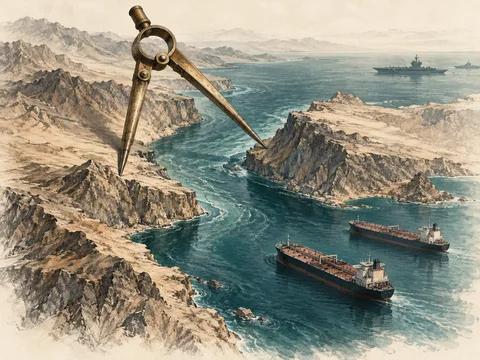
The Strait of Hormuz is 33 nautical miles wide at its narrowest, with two 2-mile-wide shipping lanes. Approximately 18-21 mb/d of petroleum liquids transit it — nearly 20% of global consumption. ~20% of global LNG trade also transits Hormuz (Qatar exports). No alternative route exists at scale: Saudi Petroline carries max 5 mb/d; UAE's Habshan-Fujairah pipeline carries ~1.5 mb/d. Net: even partial closure removes 10-15 mb/d with no near-term substitute.
COUNTRY / ENTITY | HORMUZ DEPENDENCE | DAILY VOLUME | CONSEQUENCE |
|---|---|---|---|
Saudi Arabia | All crude except Petroline cap | 7-9 mb/d | Revenue catastrophe even for Riyadh; supports fast U.S. clearance |
Qatar | All LNG exports (77 MT/year) | Critical | European/Asian LNG market collapses; spot prices explode |
Kuwait | 100% of oil exports | 2.5 mb/d | No bypass; total export shutdown if blocked |
Iraq | 95% of oil exports | 3.5 mb/d | Baghdad fiscal crisis; government collapse risk |
UAE | All LNG + most crude | 2-3 mb/d | Fujairah pipeline partial bypass; still major disruption |
China | ~7 mb/d routed via Hormuz | 7 mb/d | SPR drawdown; economic slowdown; intense PRC diplomatic pressure |
Japan | ~3 mb/d via Hormuz | 3 mb/d | Emergency BoJ response; nuclear restart political pressure |
South Korea | ~2.5 mb/d via Hormuz | 2.5 mb/d | Chaebol manufacturing disruption; KRW depreciation |
India | 85% of oil via Indian Ocean routes | 4.5 mb/d | INR crisis; inflation spike; RBI emergency measures required |
Europe | TTF gas spike; oil re-routing | Complex | Energy security crisis; Nordstream 2 re-opening political pressure |
VII-B. OPEC+ Response and Energy Market Dynamics
- Saudi Arabia faces a paradox: high oil prices are revenue-positive, but prolonged Hormuz blockade destroys Saudi export capacity. Riyadh's interest is rapid U.S. success and Hormuz clearance — not prolonged conflict.
- IEA SPR coordinated release: U.S. SPR (372M bbl remaining) + IEA members deploy emergency releases within 72 hours. But at 1-2 mb/d maximum release rate, SPR cannot compensate for 10+ mb/d Hormuz closure.
- Russia windfall: Russia exports via Baltic and Black Sea — not Hormuz. Russia becomes the swing supplier. European leverage held by Moscow increases dramatically. This is the most perverse geopolitical outcome of the campaign.
- U.S. shale response: WTI above $120/bbl unlocks full Permian Basin surge. U.S. shale can add 1-2 mb/d within 6-12 months — but the acute crisis is measured in days and weeks, not quarters.
SCENARIO | PROB. | DURATION | KEY CONSEQUENCES |
|---|---|---|---|
S1: Clean Victory Full IADS suppression; Hormuz cleared Day 6; no proxy escalation | 20% | 7-10 days | Oil: +$25 peak then -$10 in 30 days. Nuclear: set back 5+ years. Proxies: minimal/suppressed. Markets: V-shaped recovery in 3-6 months. |
S2: Contested Victory (Base Case) Partial IADS suppression; Houthi + Hezbollah activate; Hormuz partially open | 45% | 21-45 days | Oil: +$35-$50 peak; elevated for months. Nuclear: set back 3-5 years. Proxies: Hezbollah full activation. Markets: U-shaped, 6-12 month recovery. |
S3: Strategic Stalemate Iran reconstitutes partially; Hormuz closed 30+ days; China/Russia diplomatic intervention | 25% | 60-90+ days | Oil: +$60-$80 peak; structural shift. Nuclear: partially degraded; rebuilds. Proxies: all actors fully active. Markets: L-shaped, 12-24 months. |
S4: Escalation Spiral Iranian missile hits carrier or Aramco; CBRN escalation threat; China enters | 10% | Open-ended | Oil: $100+/bbl; market circuit breakers triggered. Nuclear: ambiguous; reconstitution risk. Proxies: global warfare. Markets: structural regime change. |
Base case is Scenario 2 (45% probability): The most likely outcome involves partial military success — Iran's nuclear and ballistic missile programs significantly degraded but not eliminated — combined with sustained proxy activation from Hezbollah and Houthis that extends the operational theater beyond Iran's borders. Hormuz is eventually cleared (Day 10-20) but the political and economic disruption runs for 6-12 months. Markets price in a "new normal" for Gulf risk premium across energy, shipping, and regional EM credits.
Applying the Buy Side Lens framework — Trigger → Flow → Risk → Price → Position — to Operation Epic Fury produces the following synthesis:
BUY SIDE LENS APPLIED TO OPERATION EPIC FURY | |
|---|---|
TRIGGER | Iran crosses nuclear red line (90% enrichment / weaponization breakout) OR attacks U.S./Israeli asset. Political decision made. SSGN Georgia fires. 90-second market repricing begins. |
FLOW | Capital flees EM oil-importers. Flows to: USD, Gold, U.S. Treasuries (initially), Defense stocks, Oil majors (short-term), Canadian/U.S. shale producers. Flows from: Asian equities, INR, TRY, EGP, PKR, Global shipping stocks. |
RISK | Tail risk = Scenario 4 (carrier struck / CBRN escalation). Fat-tail distribution on energy prices — right tail extends to $150+/bbl. Hezbollah activation = second independent market dislocation within the first event. |
PRICE | Oil: $120-140 (S2 base case peak). Gold: $3,200-3,500/oz. DXY: 108-114. 10yr UST: 3.5-4.0% initial, then 4.5-5.0% (inflation). Nifty 50: -12 to -18%. Defense ETF: +25-35%. |
POSITION | Long: WTI/Brent front-month; Gold; Defense; USD vs. EM FX basket. Short: Asian equity indices (Nikkei, Hang Seng); Oil-importer EM FX (INR, TRY, KRW). Hedge: Long VIX calls; Long put spreads on the S&P 500. |
Final Assessment
Operation Epic Fury — if executed as designed — would represent the single largest simultaneous deployment of American and Israeli military power since World War II. The target package of 5,000+ aim points exceeds the entire Desert Storm campaign. Integration of two CSGs, SSGN fires, fifth-generation stealth, JADC2 architecture, and autonomous systems represents a generational leap in joint warfighting. But the decisive variable is not military — it is political. A campaign that achieves tactical air dominance and kinetic degradation of Iran's capabilities still fails strategically if Iran reconstitutes within 5 years, if proxies open new fronts, or if the economic cascade fractures the coalition. The military campaign is the easy part. The strategic endgame — a permanently deterred, non-nuclear Iran integrated into a stable Gulf security architecture — is the hard part. History rhymes with Iraq 2003: kinetic victory achieved; strategic objective unresolved.
Iran's military is bifurcated into two parallel structures that operate with overlapping but distinct command chains: the Islamic Republic of Iran Army (IRIA / Artesh) and the Islamic Revolutionary Guard Corps (IRGC / Sepah). The IRGC is the decisive warfighting instrument — it controls ballistic missiles, strategic naval forces, drone programs, proxy networks, and the nuclear weapons program. The IRIA provides conventional combined-arms depth. Both report to Supreme Leader Khamenei via the Supreme National Security Council (SNSC), bypassing the civilian government.
X-A. IRGC Aerospace Force (IRGC-ASF) — Strategic Strike Arm
The IRGC Aerospace Force is Iran's strategic deterrence arm — equivalent to a combined SAC + STRATCOM. It controls all ballistic and cruise missiles, space launch vehicles (dual-use with ICBM relevance), and the national air defense integration function for IRGC-controlled assets. Commander: Brigadier General Amir Ali Hajizadeh — publicly visible, frequently quoted, directly threatens U.S. carriers by name.
SYSTEM / UNIT | CAPABILITY & ROLE |
|---|---|
Shahab-3 / Ghadr-110 | Medium-range ballistic missile (MRBM); 1,300-2,000 km; 750-1,000 kg warhead; liquid-fueled; targets Israel, U.S. Gulf bases, Saudi Aramco infrastructure |
Emad-1 (Ghadr variant) | Guided re-entry vehicle; CEP ~500m; first Iranian MRBM with terminal guidance — significantly raises strike accuracy against hardened targets |
Kheibar Shekan | Two-stage solid-fuel MRBM; 2,000 km range; mobile TEL; 30-min launch readiness vs. hours for liquid-fueled systems — critical survivability upgrade |
Zolfaghar / Dezful | Short-range BM (SRBM); 700-1,000 km; solid fuel; rapid salvo capability; used operationally against ISIS in Syria 2017 and U.S. bases in Iraq 2020 |
Fateh-110 / Fateh-313 | Precision SRBM; 300-500 km; solid fuel; 3-5m CEP; primary weapon for hardened command post and airfield attack; produced in large numbers |
Haj Qasem / Khaibar | New-generation MRBM announced 2022; 1,450 km range; improved accuracy; hypersonic glide vehicle (HGV) variant reportedly in testing |
Fattah HGV | Claimed first Iranian hypersonic missile; Mach 13-15; maneuvering re-entry vehicle — if operational, defeats current SM-3 / THAAD engagement envelopes |
Paveh / Ya Ali | Land-attack cruise missile; 1,650-2,500 km range; low-observable profile; terrain-hugging flight — complements ballistic missiles in saturation attacks |
IRGC Space Command | Qased SLV (Safir/Qadr family); LEO imaging satellites; GPS-independent targeting; dual-use with ICBM propulsion technology base |
X-B. Islamic Republic of Iran Air Force (IRIAF) — Aging but Present
IRIAF is a hollowed-out force built on 1970s-era U.S. platforms (F-14A Tomcat, F-4E Phantom, F-5E/F Tiger II) plus Soviet/Russian imports (MiG-29, Su-24MK, Su-25) and domestically assembled derivatives. Decades of sanctions have devastated maintenance. Assessed operational readiness: F-14A ~25-30 airframes (of 79 delivered); MiG-29A ~20 airframes; Su-24MK ~24 airframes. Total combat-capable fixed-wing: est. 100-130 sorties/day maximum, degrading rapidly under attrition. IRIAF's primary role in this conflict is not air superiority but martyrdom sorties — absorbing U.S. air assets and providing radar return signatures to complicate the battlespace picture.
PLATFORM | QTY (EST.) | ORIGIN | ROLE & THREAT LEVEL |
|---|---|---|---|
F-14A Tomcat | 25-30 operable | U.S. (1970s) | THREAT: AIM-54 Phoenix (long-range AAM if serviceable); radar-equipped intercept. LIMIT: Parts scarcity; spares fabricated locally. |
F-4E Phantom II | 30-40 operable | U.S. (1970s) | THREAT: Strike / recce; aging but large. LIMIT: No modern avionics; subsonic strike role only. |
MiG-29A Fulcrum | 18-22 operable | Russia (1990s) | THREAT: BVR capable (R-77); point defense intercept. LIMIT: Single-seat; dated radar. |
Su-24MK Fencer | 20-24 operable | Russia (1990s) | THREAT: Deep strike / interdiction; terrain-following radar; carries AS-14 Kedge. LIMIT: High maintenance demand. |
F-5E/F Tiger II | 35-45 operable | U.S. (1970s) | THREAT: Close air support; point defense. LIMIT: Subsonic; no BVR; attrition absorber role. |
Kowsar (F-5 clone) | 10-15 delivered | Domestic | THREAT: Minimal combat value; propaganda / deterrence signaling platform. |
HESA Saeqeh | 8-12 delivered | Domestic (F-5 der.) | THREAT: Negligible; demonstrated in parade roles. Useful for decoy emissions. |
X-C. IRGC Ground Forces & Artesh Army
UNIT / SYSTEM | CAPABILITY |
|---|---|
IRGC Ground Forces | 120,000+ personnel; 12 provincial corps; primary internal security and proxy coordination function; conventional combined-arms secondary |
Artesh Army | 350,000 personnel; tank-heavy (T-72S, T-55, Zulfiqar domestic); primarily territorial defense; not primary warfighting instrument in this campaign |
Zelzal / Fateh Artillery | Long-range artillery rockets (200-300 km); assigned to IRGC brigade-level; saturation of airfields and logistics nodes in Iraq/Gulf states |
Tor-M1 / ZSU-23-4 | IRGC ground-based short-range air defense; theater force protection for missile TEL launchers and field HQs |
IRGC Quds Force | Extraterritorial operations arm; commands all proxy forces (Hezbollah, Houthi, PMF, PIJ); Maj. Gen. Esmail Qaani commanding; mission: activate all proxies simultaneously on H+6 |
Iran has constructed the most sophisticated Integrated Air Defense System (IADS) in the Middle East outside of Israel. It is modeled on Russian layered doctrine: outer ring long-range SAMs, intermediate layer medium-range systems, inner ring point defense, supplemented by SHORADS and man-portable systems at the tactical level. All layers are networked through a national C2 architecture — the Khatam ol-Anbia Air Defense Headquarters — which integrates IRIAF, IRGC-ASF, and Army air defense assets under unified command. This is the primary obstacle the U.S. strike package must defeat.
SYSTEM | ORIGIN | RANGE/ALT | QUANTITY (EST.) | DEPLOYMENT & ASSESSMENT |
|---|---|---|---|---|
Bavar-373 | Domestic (S-300 equiv.) | 200 km / 27 km alt | 6-8 batteries | Long-range backbone. Phased array radar; simultaneous 6-target engagement. Deployed Tehran, Isfahan, Natanz, Fordow. WEAKNESS: Fixed radar sites mapped by U.S. ISR; vulnerable to HARM/AARGM-ER. |
HQ-9B | China (PRC) | 200 km / 30 km alt | 4-6 batteries | Chinese export S-300 variant; integrated into national IADS. Deployed southern Iran. WEAKNESS: Fire-control radar emits predictably; susceptible to AARGM-ER and F-35C passive tracking. |
S-300PMU-2 | Russia (pre-sanction) | 200 km / 27 km alt | 4 batteries | Russian-origin; delivered 2016 after JCPOA. Most capable platform in inventory. WEAKNESS: Spare parts cut by Russia under pressure; maintenance-degraded. |
SA-6 / SA-15 Tor | Russia | 35 km / 10 km alt | 15-20 batteries | Medium-range defense of key nodes. TOR-M1/M2 is highly mobile — difficult to pre-locate. THREAT: Autonomous engagement authority; can engage without central C2. |
Raad (Hawk upgrade) | Domestic | 80 km / 18 km alt | 10-12 batteries | Iranian Hawk derivative; engages medium-altitude threats. Widely deployed to cover field forces and secondary targets. WEAKNESS: Older seeker; susceptible to Growler jamming. |
Mersad (Hawk) | Domestic/U.S. origin | 40 km / 12 km alt | 8-10 batteries | Upgraded I-HAWK; point defense of airbases and industrial sites. WEAKNESS: 1970s seeker technology; limited ECCM capability. |
Talash (SA-5) | Russia/Domestic | 250 km / 40 km alt | 3-4 batteries | Long-range area defense; older system; primary value against non-stealthy aircraft. WEAKNESS: Large radar cross-section emitter; first-day SEAD target. |
Khordad-15 / 3rd of Khordad | Domestic | 150 km / 27 km alt | 6-8 units | Medium-range; shot down U.S. RQ-4 Global Hawk in 2019. Semi-mobile. Phased-array. Credible threat to ISR aircraft. WEAKNESS: Fixed engagement geometry. |
Azarakhsh / Herz-9 | Domestic (SHORADS) | 20 km / 8 km alt | Multiple | Point defense VSHORAD; man-portable + vehicle-mounted; layered around missile sites and C2 nodes. Near-impossible to suppress entirely — residual threat throughout campaign. |
XI-A. IADS Navigation Strategy — How Iran Fights the Air Battle
- Emission Control (EMCON): Iranian radar operators are trained to minimize emission signatures during peacetime and activate only when engagement is imminent. Multiple radar types (acquisition, tracking, fire-control) are kept geographically separated — forcing the attacker to prosecute them as independent targets rather than a network. This complicates SEAD targeting geometry significantly.
- Passive Cueing: Iran operates an extensive network of passive detection systems — optical trackers, acoustic sensors, human observer networks (Basij volunteers), and commercially acquired SIGINT receivers. These feed targeting data without emitting radar signatures, denying HARM-type anti-radiation missiles a homing signal to follow.
- Shoot-and-Scoot Tactics: Mobile systems (TOR-M2, Khordad-15, SA-6) are programmed for rapid displacement after every 2-3 missile firings. TEL vehicles have pre-surveyed alternate firing positions within 15-30 km. This cycle time (fire, displace, re-acquire) is 8-12 minutes for TOR-M2 — inside U.S. response loop for precision re-strike.
- SAM Netting: National IADS network links all batteries to a central air picture via fiber-optic backbone (hardened against EMP) supplemented by encrypted UHF data links. A battery can engage targets cued by a distant radar — denying attacker the ability to suppress radars one at a time before aircraft arrive.
- Decoy Emitters: Iran operates numerous known decoy radar emitters — purpose-built platforms that broadcast signatures identical to operational SAM radars. Multiple SEAD missions have reportedly expended HARMs against decoy emitters in prior exercises. Ratio of decoys to real sites: estimated 2:1.
Iran's ballistic missile force is the largest and most diverse in the Middle East. With 3,000+ missiles of all ranges, it represents Iran's strategic insurance policy — the capability that survived every sanction, every sabotage operation, and every diplomatic pressure campaign. It is the reason Iran does not need a nuclear warhead to threaten existential damage to its adversaries' economies. The missile force is structured in three layers: strategic deterrence (MRBMs targeting Israel and Europe), operational strike (SRBMs targeting Gulf bases, Saudi oil infrastructure), and tactical precision (Fateh family targeting specific hardened facilities).
MISSILE | CLASS | RANGE | CEP | FUEL | KEY TARGETS | THREAT ASSESSMENT |
|---|---|---|---|---|---|---|
Shahab-3 | MRBM | 1,300 km | ~2,000 m | Liquid | Israel, U.S. bases | MODERATE — large CEP limits military value; useful against area targets (cities, ports) |
Ghadr-110 | MRBM | 1,950 km | ~800 m | Liquid | Israel, SE Europe | HIGH — improved accuracy; post-boost guidance; reaches all Israeli population centers |
Emad-1 | MRBM | 1,700 km | ~500 m | Liquid | Israel, Gulf bases | HIGH — guided RV; can strike specific buildings; threatens Dimona nuclear facility |
Kheibar Shekan | MRBM | 2,000 km | ~300 m | Solid | Israel, U.S. carriers (threat) | VERY HIGH — solid fuel = 30-min readiness; improved RV; hardest to pre-empt on TEL |
Haj Qasem | MRBM | 1,400 km | ~300 m | Solid | Gulf bases, Saudi Arabia | VERY HIGH — new generation; precision strike against hardened airfields and ports |
Fattah HGV | HGV | 1,400 km | ~20 m | Solid | Carrier groups (claimed) | UNKNOWN — if operational defeats all current BMD envelopes; program status unconfirmed |
Zolfaghar | SRBM | 700 km | ~50 m | Solid | U.S. bases in Iraq/Gulf | VERY HIGH — used operationally Jan 2020 vs. Ain al-Asad; proven accuracy; large inventory |
Dezful | SRBM | 1,000 km | ~50 m | Solid | Gulf states, CVN approach | VERY HIGH — extended Zolfaghar; threatens all Gulf states from hardened Iranian launch sites |
Fateh-313 | SRBM | 500 km | ~3-8 m | Solid | Airfields, command posts | EXTREME — near-precision; large stockpile; primary anti-airfield weapon; simple TEL logistics |
Raad / Nasr | ASCM | 200 km | ~5 m | Turbojet | Surface ships, carriers | VERY HIGH — anti-ship cruise missile; sea-skimming; attacks ABECSG from shore-based launchers |
Noor / Ghader | ASCM | 200-300km | ~5 m | Turbojet | CVN, DDGs | VERY HIGH — C-802 derivative; coastal batteries on Qeshm, Abu Musa, Hormuz Island; saturates DDG Aegis |
Paveh | LACM | 1,650 km | ~5 m | Turbojet | Deep strike; CONUS threat (future) | HIGH — terrain-hugging; low radar cross-section; demonstrated in Aramco 2019 attack |
Ya Ali | ALCM | 700 km | ~3 m | Turbojet | Air-launched deep strike | HIGH — air-launched from Su-24MK and F-4E; extends IRIAF strike radius; 30+ delivered |
XII-A. Iranian Missile Navigation & Strike Doctrine
- Salvo architecture: Iran does not plan single-missile strikes. Every target is assigned a salvo of 3-6 missiles using different trajectories, launch azimuths, and time-on-target sequencing. This is designed to exhaust the BMD magazine of the defending Patriot/SM-3 battery before the last missile in the salvo arrives. Iran studied the 2019 Aramco attack — 18 drones/cruise missiles defeated Saudi Patriot systems through salvo saturation.
- Trajectory shaping: Solid-fuel MRBMs (Kheibar Shekan, Haj Qasem) use depressed trajectories to reduce time-of-flight and radar detection window. A standard Kheibar Shekan on maximum range has ~12-14 min. flight time — a depressed trajectory can cut this to 8-9 min., compressing the SM-3 engagement window by 40%. Boosted trajectories are also used to defeat THAAD's engagement envelope from below.
- GPS-independent guidance: Iranian MRBMs use inertial navigation (INS) as primary guidance, supplemented by domestic satellite navigation (Nahid constellation, partial), star-tracker systems, and terminal electro-optical/scene matching. This makes GPS jamming — a primary U.S. tool — insufficient to neutralize the missile force.
- TEL concealment and dispersal: Iran operates the world's most extensive network of underground ballistic missile storage and launch tunnels — "missile cities" (Shahre-Moushak). IRGC-ASF has 15+ known underground complexes, some with elevator-assisted launch capability. TELs emerge, fire, and return underground within 45 minutes. Pre-launch signature is near-zero.
- Pre-delegation of launch authority: IRGC-ASF doctrine includes pre-delegated launch authority at brigade level in the event that national C2 links are severed. This means even if IRGC HQ and the Supreme Leader's communication nodes are destroyed on Day 1, dispersed IRGC missile brigades retain independent authority to execute pre-assigned strike packages. This is Iran's most important deterrence credibility investment.
Iran's naval doctrine is asymmetric by design and necessity. The Islamic Republic of Iran Navy (IRIN) and IRGC Navy operate separately — IRIN handles blue-water and conventional naval operations; the IRGC Navy owns Hormuz and the Persian Gulf and is the primary operational force in this campaign. Iranian naval strategy is built on one objective: making the cost of operating in the Persian Gulf and Hormuz prohibitive for U.S. carrier groups through layered A2/AD (Anti-Access/Area Denial) that combines submarines, fast attack craft swarms, shore-based anti-ship missiles, mines, and coordinated drone strikes. Iran does not expect to sink a carrier — it expects to deter entry into Hormuz through the threat of doing so.
XIII-A. IRIN Submarine Force
PLATFORM | CLASS | QTY | WEAPON LOAD | THREAT ASSESSMENT |
|---|---|---|---|---|
Tareq / Noor | Kilo-class (Project 877EKM) | 3 boats | 18 × TYPE-53 torpedoes; TEST-71 wire-guided; mines | CRITICAL THREAT. Diesel-electric; extremely quiet on battery; Hormuz shallow water = ideal patrol environment. Noise signature drops below P-8 detection threshold in cluttered acoustic environment. Each boat capable of mining Hormuz shipping lane unsupported. |
Fateh | Domestically built SSK | 1-2 boats | Torpedoes; Jask-2 ASCM; mines | HIGH. Domestic submarine; air-independent propulsion (AIP) reported; stealthy; armed with Jask-2 (200km ASCM). Marks Iran's entry into AIP submarine technology — increases submerged endurance 3-4x. |
Ghadir / Nahang | Midget submarine (SSI) | 15-20 boats | 2 × torpedoes; diver delivery; mine-laying | HIGH. Miniature submarines optimized for Hormuz and Gulf shallow-water operations. Can operate at 15-20m depth — below sonar cone of many surface ships. Primary mission: covert mining and torpedo attack on anchored or slow-moving vessels. |
Nahang II | Domestic coastal submarine | 2-3 boats | Torpedoes; mines | MODERATE. Limited endurance; coastal patrol. Reserve ambush positions near Strait narrows. |
XIII-B. IRGC Navy Fast Attack Fleet — The Swarm
The IRGC Navy operates 100+ fast-attack craft (FAC) and fast inshore attack craft (FIAC) in the Persian Gulf and Hormuz. These are not conventional warships — they are armed speedboats operating in coordinated wolf packs. The doctrine is derived from the 1980s Tanker War experience: overwhelm with numbers, accept losses, close to gun/torpedo range before the defender can service all targets. Modern IRGC FACs carry C-704 anti-ship missiles, 107mm rocket pods, heavy machine guns, RPGs, and recoilless rifles. Some carry torpedoes. The primary targets in a Hormuz crisis are not warships — they are tankers, LNG carriers, and commercial vessels transiting the shipping lane.
PLATFORM | QTY | ARMAMENT | TACTIC |
|---|---|---|---|
Thondor (Kaman-class) | 10 | C-802 / Noor ASCM × 4; 76mm gun | Stand-off ASCM attack on large surface targets; primary ship-killer |
Peykan / Joshan | 8 | C-802 × 2; 40mm / 20mm cannon | Mid-range surface attack; escort missions for submarine insertions |
IPS-16 FIAC | 40+ | 12.7mm HMG; RPG-29; 107mm rockets | Swarm approach under radar horizon; simultaneous multi-vector attack from 360 degrees |
Zolfaghar FAC | 6 | C-704 × 2; 40mm cannon | Fast, stealthy; designed for carrier approach under electronic jamming conditions |
Al-Zafar FIAC | 10+ | Suicide drone launcher; HMG | Kamikaze variant with modified Shahed-136 drones launched from deck while moving |
Supply/C2 Vessels | 5 | Command, fuel, munitions resupply | Field logistics nodes dispersed across Gulf islands; enables 72-hour sustained swarm operations |
XIII-C. Mine Warfare — Iran's Cheapest Weapon of Mass Disruption
Iran has the largest mine stockpile in the Middle East — est. 5,000+ mines of multiple types. Mining the Strait of Hormuz is Iran's single most economically devastating action short of nuclear use. A credible mining threat alone — without a single mine actually detonating — causes global tanker insurance rates to spike 400-600% and triggers voluntary re-routing. Iran demonstrated this calculus during the Tanker War (1987-88) when USS Samuel B. Roberts nearly sank from a single contact mine. Modern Iranian mines are significantly more sophisticated.
MINE TYPE | FUZING | DEPTH | PRIMARY TARGET |
|---|---|---|---|
SADAF bottom mine | Acoustic / magnetic | Up to 100m | VLCC tankers, LNG carriers (large magnetic signature) |
M-08 / EM-52 rocket | Pressure + acoustic combo | 50-80m | Surface warships; rises vertically on activation — no paravane countermeasure |
Manta influence mine | Magnetic / pressure | Shallow | USV countermeasure; requires dedicated MH-60S sweep |
Contact moored mines | Physical contact | Any | Conventional shipping lane denial; low cost, high disruption |
Limpet mines (diver) | Timed / remote | Surface | Covert sabotage of anchored tankers; demonstrated in 2019 Gulf of Oman attacks |
XIII-D. Shore-Based Anti-Ship Missile Batteries
- Qeshm Island complex: Dense concentration of Noor (C-802) and Ghader (C-802 extended) anti-ship missile batteries with pre-surveyed fire-control solutions against Hormuz transit lanes. Range covers 100% of the 33nm strait. Multiple redundant fire-control radars with passive optical backup.
- Abu Musa and Greater/Lesser Tunb islands: Disputed islands (claimed by UAE) seized by Iran in 1971. Pre-positioned with anti-ship missiles, artillery, IRGC garrison, and SAM point defense. Geographic position allows enfilading fire across both Hormuz shipping lanes simultaneously.
- Jask naval base (Makran coast): Newly expanded deep-water naval base on Indian Ocean — outside U.S. strike reach from Gulf. Provides IRIN blue-water surface assets (Moudge-class frigates) access to open ocean without transiting Hormuz. Strategic significance: Iranian warships can interdict Red Sea and Indian Ocean shipping from Jask even if Hormuz is contested.
- Bandar Abbas: Primary IRIN naval base; home of Kilo-class submarines; covered dry docks; hardened tunnel storage for fast boats. Primary target for CVW-9 strike packages.
Iran has emerged as the world's most consequential state actor in offensive drone warfare — not through technological sophistication but through industrial scale, cost asymmetry, and the willingness to transfer capability to proxy forces globally. The Shahed-136 "Geranium" one-way attack drone, sold to Russia in 2022 and used extensively in Ukraine, demonstrated that a $20,000 drone can saturate a $1.2 billion air defense system. Iran has transferred this same logic to its own strategic deterrence: thousands of drones can overwhelm any finite missile defense magazine, regardless of per-intercept technology advantage. Production capacity: est. 3,000+ Shahed-136 per month across dispersed domestic facilities.
SYSTEM | TYPE | RANGE | PAYLOAD | SPEED | KEY ROLE |
|---|---|---|---|---|---|
Shahed-136 | One-way attack (OWA) | 2,000 km | 50 kg HE | 185 km/h | Primary saturation weapon. Cheap, GPS-guided, low RCS. Swarms of 50-100 launched simultaneously. Defeats limited magazine Patriot batteries through numbers alone. |
Shahed-131 | OWA (smaller) | 900 km | 15 kg HE | 170 km/h | Shorter range; used in dense swarms against hardened facilities and chokepoints. Lower cost per unit than -136. |
Arash-2 | OWA (large) | 2,000 km | 200-500 kg | 500 km/h | Jet-propelled; subsonic but much faster than piston-engine Shahed. Designed to defeat Coyote counter-UAS systems that were optimized for slower targets. |
Mohajer-6 | ISR / attack | 200 km | 13 kg guided munition | 200 km/h | Tactical reconnaissance and precision strike. Provides real-time BDA for missile brigades. Equivalent to MQ-9 at 1/100th the cost. |
Mohajer-10 | MALE ISR/attack | 2,000 km | 300 kg | 210 km/h | Strategic ISR; long dwell over carrier groups; targeting data transmission to shore-based ASCM batteries. |
Fotros | MALE ISR/SEAD | 2,000 km | Anti-radiation missile | 220 km/h | Drone designed to hunt radar emitters; complements ground-launched HARM equivalent. Stretches SEAD capability beyond ground-launched range. |
Karrar | Combat drone | 1,000 km | 4 × Kowsar AAM or bombs | 900 km/h | Jet-propelled; can prosecute air targets at low altitude. Anti-ship variant carries Kowsar missile. Not a peer fighter but saturates CIWS engagement capacity. |
Ababil-3 | ISR / light attack | 150 km | Light warhead or bomblets | 200 km/h | Distributed to all IRGC provincial corps and proxy forces. Tactical battlefield drone; primary proxy transfer platform (Hezbollah, Houthi, PMF). |
Shahed-149 Gaza | MALE (new) | 3,000 km | 500 kg | 300 km/h | Newest reported platform; if operational significantly extends Iran's strike envelope. Intelligence gaps remain on production status. |
XIV-A. Iranian Drone Tactics Against the Carrier Strike Group
- Magazine exhaustion strategy: The U.S. DDG Arleigh Burke carries 96 Mk-41 VLS cells. Each SM-6 (for air/missile defense) occupies one cell; an SM-2 occupies one cell. Against a swarm of 50 Shahed-136s at $20,000 each (total $1M salvo cost), the defending DDG may expend 30-50 SM-2/SM-6 missiles ($120-215M cost). Iran buys the exchange ratio. The goal is not to penetrate the first salvo — it is to exhaust the magazine by the fifth salvo.
- Multi-axis simultaneous attack: Iranian doctrine calls for coordinating drone swarms from multiple azimuths — IRGC-Navy FAC-launched drones from the south, shore-based drones from Qeshm/Abu Musa from the west, and IRGC-ASF air-launched drones from Iran's Bushehr region from the north. CIWS (Phalanx) and point defense systems physically cannot cover 360 degrees simultaneously at high engagement rates.
- Noise injection for missiles: Drone swarms are used tactically as screening layers ahead of anti-ship cruise missile salvos. AEGIS and SM-2/SM-6 fire control must engage both simultaneously — drones force allocation of limited engagement channels that would otherwise be used against the higher-value cruise missiles following 90 seconds behind.
- Electronic warfare integration: New Shahed variants observed in Ukraine carry Kometa-M GPS spoofing emitters — broadcasting false GPS signals to downstream adversary systems. Iran is reportedly testing this integration on domestic variants, targeting ship navigation and weapon guidance systems rather than airframes.
Iran's most consequential asymmetric investment over 40 years is the "Axis of Resistance" — a distributed proxy network across Lebanon, Palestine, Iraq, Syria, and Yemen that functions as a strategic force multiplier, deterrence instrument, and forward deployed retaliation capability simultaneously. The Quds Force (IRGC-QF) has spent $15-20 billion over two decades arming, training, and integrating these forces. In the context of Operation Epic Fury, the proxy network activates automatically upon the opening of hostilities — not by telephone order from Tehran, but by pre-positioned standing orders and pre-delegated commanders. Iran's objective: transform a bilateral U.S.-Iran conflict into a regional multi-front war that exhausts U.S. attention and coalition cohesion.
PROXY / THEATER | ARSENAL | QUANTITY | ACTIVATION TRIGGER | PRIMARY TARGETS | U.S./ISRAELI COUNTER |
|---|---|---|---|---|---|
Hezbollah (Lebanon) | Katyusha/Grad rockets; Fateh-110 PGMs; M-600; Zelzal-2; ATGM (Kornet); Radwan special forces; Almas ATGM; C-802 ASCM (shore-based) | 150,000+ rockets; 2,000+ PGMs; 65,000 fighters | Automatic on Iran strike; Nasrallah retains final authority but pre-positioned strikes pre-planned | Northern Israel (Haifa, Tel Aviv); U.S. bases Lebanon/Cyprus; IDF HQs; Ben Gurion Airport | IDF multi-division ground operation in south Lebanon; Iron Dome saturation with David's Sling backup; USAF F-15E counter-fires |
Houthi (Yemen) | Burkan-3 MRBM (1,200 km); Quds cruise missile (2,000 km); Shahed-136/131 (transferred); C-802 shore ASCM; USV boat bombs | 100+ MRBMs; 500+ drones; 50+ cruise missiles; 100+ ASCMs | Active since 2024 Red Sea campaign; standing orders to escalate on U.S.-Iran conflict | Saudi Aramco; UAE infrastructure; Red Sea shipping; potentially GRFCSG in transit | MQ-9 / F/A-18E counter-battery; USS destroyer CIWS; THAAD (Saudi); limited — no ground option |
Iraqi PMF (Iraq) | Shahed-136 (transferred); 107mm / 122mm rockets; Fateh-110 (limited); ATGM teams; IED networks | 50,000+ PMF fighters; 2,000+ drones; rocket artillery brigades | Kataib Hezbollah, Asaib Ahl al-Haq pre-positioned; orders via Quds Force; 2-4 hr lag | Ain al-Asad AB; Erbil air base; Baghdad embassy; U.S. logistics convoys; Kurdish forces | F-15E / A-10C counter-fire from Al Udeid; Iraqi Security Forces nominally; limited political will |
Hamas / PIJ (Gaza) | Qassam / M-75 / J-80 rockets; RPG-29; ATGMs; tunnel networks; paraglider attack capacity | Degraded by 2023-24 operations; ~5,000-8,000 rockets remaining; 15,000-20,000 fighters | Solidarity salvo on H+24; command degraded but rocket capability persists | Southern Israel; Israeli civilian morale; IDF redeployment pressure from north | Iron Dome; IDF ground forces; C-17 resupply for Israeli stockpiles |
Syrian Regime (Syria) | IRGC-QF forward logistics nodes; Hezbollah weapons transfer routes; S-200 SAM (aging); ground forces | Logistics and staging role primarily; not a primary fire platform | Passive — provides territory for IRGC operations; unlikely to directly strike U.S. | Transit routes for weapons; IRGC staging facilities | Israeli air strikes on Syrian territory continue unabated; U.S. SOF presence in northeast Syria |
XV-A. Proxy Coordination Architecture
- Quds Force communication network: Pre-conflict, Quds Force liaison officers are embedded with every major proxy formation at battalion level and above. These officers carry encrypted communication devices (reportedly adapted Motorola TETRA systems with Iranian encryption overlays) and have standing execution orders for specific contingency plans. Destroying IRGC HQ does not sever these links — the orders pre-exist.
- Hezbollah's "precision project": Over the past decade, Iran has transferred 10,000+ unguided rockets to guided precision munitions — converting Zelzal-2 rockets to GPS/INS guidance with CEP ~10m. These Fateh-110/M-600 precision missiles are Hezbollah's most consequential capability — capable of striking specific buildings in Tel Aviv or destroying the USS Gerald R. Ford's flight deck equipment while it transits the Mediterranean.
- Houthi naval threat evolution: Since 2023, Houthis have demonstrated Burkan-3 BM delivery, Quds-2 cruise missile accuracy, and USV (unmanned surface vehicle) boat-bomb capability. They sank or damaged 4 commercial vessels in the Red Sea campaign. The capability to credibly threaten GRFCSG while it operates in the Mediterranean is the most significant proxy capability escalation of the decade.
- Strategic timing coordination: Iran's playbook calls for proxy forces to activate not simultaneously (which is detectable in preparation phase) but in 6-hour waves. Wave 1 (H+6): Houthi Red Sea escalation forces NAVCENT to divide attention. Wave 2 (H+12): Iraqi PMF attacks U.S. bases, forcing CENTCOM to defend. Wave 3 (H+24): Hezbollah full salvo, forcing IDF to go on war footing. Each wave requires U.S./Israeli response that further disperses finite air defense magazine capacity.
Iran's cyber program is the fourth most capable state-actor program globally after U.S., Russia, and China. Built from scratch after the Stuxnet attack on Natanz in 2010 demonstrated the catastrophic potential of cyber operations against industrial control systems, Iran invested heavily in both offensive and defensive cyber capabilities. The IRGC Cyber Command (Cyber Defence Command / Gerdab) and the affiliated APT groups (APT33 "Elfin", APT34 "OilRig", APT35 "Charming Kitten", APT39) represent a mature, persistent, and growing offensive cyber capability.
CAPABILITY DOMAIN | ASSETS / TOOLS | DEMONSTRATED OPERATIONS | THREAT TO EPIC FURY |
|---|---|---|---|
Industrial Control (ICS) | Triton/TRISIS malware; custom SCADA exploits; USB-delivered payloads | Triton deployed against Saudi Aramco safety systems (2017); almost triggered physical explosion | CRITICAL — Saudi/UAE oil infrastructure; U.S. base HVAC/power systems; port fuel systems in Gulf |
Maritime Cyber | GPS spoofing (Kometa-M platform); AIS manipulation; chart manipulation | Documented GPS spoofing events in Gulf 2019-2023; vessels reporting false positions near Iranian waters | HIGH — USV navigation systems; ship autopilot on commercial tankers; carrier approach guidance |
Financial System | Wiper malware (Shamoon, ZeroCleare variants); SWIFT-adjacent intrusion tools | Shamoon destroyed 35,000 Saudi Aramco hard drives in 2012; ZeroCleare hit Middle Eastern energy sector 2019 | HIGH — Gulf state central banks; SWIFT messaging disruption; U.S. financial market volatility injection |
C2 Network Intrusion | APT34 OilRig; spear-phishing; supply chain compromise; VPN exploitation | Penetrated UAE government networks, ISPs, and oil sector for persistent access 2017-2021 | MODERATE — U.S. classified networks hardened; but Gulf state C2 nodes potentially already compromised |
Air Defense Disruption | GPS jamming vehicles; radar spoofing; IFF signal injection | Demonstrated GPS spoofing around Iranian nuclear sites; documented IFF frequency analysis | HIGH — GPS-guided TLAM CEP degradation; E-2D track management false targets; SM-6 engagement cue corruption |
Social Media / PSYOP | IRGC information operations; fake news injection; satellite TV hijacking | Hijacked BBC Arabic satellite feed 2019; extensive fake persona networks on X/Facebook targeting Gulf states | MODERATE — Coalition cohesion attack; Gulf state public opinion manipulation; U.S. domestic anti-war messaging |
XVI-A. Iranian Electronic Warfare Capabilities
EW SYSTEM | FUNCTION | PLATFORM | THREAT LEVEL |
|---|---|---|---|
Bavar EW suite | GPS jamming / spoofing | Vehicle-mounted; fixed | HIGH — degrades TLAM terminal accuracy; affects F-35C GPS nav backup |
Meraj-4 jammer | Communications jamming (VHF/UHF/SHF) | Airborne (modified aircraft) | MODERATE — disrupts tactical radio nets; limited range |
Separ EW system | Radar jamming / deception | Fixed installation | HIGH — generates false radar returns; complicates SEAD threat analysis |
Passive ELINT array | Signal intelligence collection | Nationwide fixed array | HIGH — has characterized every U.S. radar and communications signature in theater over decades |
RQ-170 reverse-engineered | Captured U.S. stealth drone tech | Shahed-171 Simorgh | UNKNOWN — claimed reverse engineering of U.S. stealth RCS techniques; applicable to missile guidance systems |
XVII-A. Iran's Strategic Objective in the Conflict
Iran's military objective in Operation Epic Fury is not to defeat the United States militarily — that is impossible. Iran's objective is to make the political cost of the campaign unacceptable to Washington before the U.S. achieves its strategic objectives. Specifically, Iran needs to: (1) inflict casualties on U.S. forces sufficient to trigger domestic political opposition in America; (2) close Hormuz long enough to produce a global economic crisis that fractures the coalition; (3) activate proxy warfare on multiple simultaneous fronts that exhausts U.S. military capacity; and (4) preserve enough nuclear and missile infrastructure underground to reconstitute a deterrent within 2-3 years. Iran does not need to win the military campaign. It needs to survive it and then outlast it.
XVII-B. Phase-by-Phase Iranian Counter-Operations
DAY 1 H+0 TO H+6 | PRE-STRIKE DISPERSAL & HARDENING |
|---|---|
IRANIAN ACTION | IRGC pre-positioned all mobile assets (TELs, FAC flotillas, Ghadir submarines) to dispersal sites in the preceding 72 hours — likely tipped by HUMINT on U.S. decision. Underground missile cities sealed. IRGC Quds Force transmits "Execute" codes to all proxy forces. Air defense operators go to EMCON discipline (no radar emissions). IRIN Kilo submarines depart Bandar Abbas on silent patrol. Civilian maritime traffic in Hormuz halted — international community blamed on U.S. aggression. Supreme Leader issues "martyrdom resistance" declaration on state TV. |
STRATEGIC LOGIC | Maximize survivability before first strike arrives. Every mobile asset that escapes first-day targeting survives to fight in Days 3-10. The pre-strike dispersal window is Iran's most critical operational action. |
DAY 1-2 H+6 TO H+48 | IADS ACTIVATION & EARLY RETALIATION |
|---|---|
IRANIAN ACTION | IADS activates selectively — TOR-M2 and Khordad-15 systems engage HARM-capable aircraft to force SEAD packages to expend ordnance. Decoy radars transmit to draw HARM fire. IRGC Aerospace Force launches first retaliatory salvo: 20-30 Fateh-313 SRBMs against Al Udeid AB (Qatar) and Ain al-Asad AB (Iraq). Concurrent Shahed-136 swarm of 80-100 drones launched against GRFCSG position — probing AEGIS magazine. Houthi activates Red Sea attacks simultaneously. Tehran announces civilian casualties; international media campaign begins. CYBERCOM equivalents (IRGC cyber) attack Gulf state infrastructure. |
STRATEGIC LOGIC | Force the U.S. to defend multiple simultaneous threats. Every SM-2/SM-6 expended on Shahed drones is unavailable for Kheibar Shekan MRBM intercept. Simultaneous proxy activation forces geographic dispersion of U.S. air defense resources. |
DAY 3-5 H+72 TO H+120 | HORMUZ MINING & STRATEGIC RETALIATION |
|---|---|
IRANIAN ACTION | Ghadir midget submarines covertly mine the Hormuz inbound shipping lane while surface traffic is halted. Kilo-class submarines take up torpedo attack position 20nm from ABECSG. Shore-based Noor/Ghader ASCM batteries on Qeshm Island engage any surface vessel approaching within 200km. Second MRBM salvo: 10-15 Kheibar Shekan against Israeli strategic targets (Rafael complex, Nevatim AB). Hezbollah activates Wave 1: 500+ rockets against northern Israel. Iraqi PMF begins drone attacks on Erbil. IRGC information operation: social media flooding with images of civilian casualties; UN Security Council emergency session convened. |
STRATEGIC LOGIC | Hormuz mining is Iran's trump card — forces U.S. to divert significant assets to mine clearance while air campaign continues. Hezbollah activation forces IDF to split air defense resources between Lebanon and Iran threat. |
DAY 6-10 H+144 TO H+240 | ATTRITION WARFARE & POLITICAL TIME BUYING |
|---|---|
IRANIAN ACTION | Iran transitions from massed strikes to sustained attrition. Dispersed IRGC FAC units conduct hit-and-run attacks on commercial tankers in Hormuz — not sinking but damaging enough to spike insurance rates to prohibitive levels. Underground missile cities continue launching small 3-5 missile salvos every 6-8 hours — exhausting BMD magazines faster than they can be replenished (logistics constraint: SM-3 IIA cannot be replenished at sea). Supreme Leader makes conditional ceasefire offer through Oman — demands U.S. withdrawal and sanctions removal before any nuclear talks. China calls emergency UNSC session. Russia threatens counter-measures. |
STRATEGIC LOGIC | Transform tactical defeats into strategic stalemate. Iran needs the conflict to last long enough for: (1) U.S. domestic opposition to build; (2) oil prices to damage global economy; (3) China/Russia diplomatic pressure to force ceasefire. Time is Iran's weapon; attrition is its method. |
DAY 10+ RECONSTRUCTION | NUCLEAR RECONSTITUTION SIGNALING |
|---|---|
IRANIAN ACTION | Even while military campaign continues, Iran signals through backchannel (Swiss, Omani intermediaries) that any attempt to permanently destroy Fordow will trigger accelerated nuclear weapons development from dispersed sites not on the U.S. target list. IRGC Aerospace Force reveals existence of previously undisclosed missile production tunnels in Kerman and Yazd provinces. Announces Fattah HGV operational status — even if exaggerated, forces BMD planners to accept uncertainty. Begins parallel covert diplomacy with China and Russia for post-conflict security guarantee in exchange for nuclear restraint. |
STRATEGIC LOGIC | Iran's endgame is deterrence reconstitution, not military victory. The goal is to emerge from the campaign with: (1) surviving missile force; (2) intact nuclear knowledge base; (3) international sympathy that prevents follow-on strikes; (4) internal political legitimacy hardened by "resistance narrative." |
XVII-C. The Fundamental Asymmetry: Cost vs. Objective
METRIC | U.S.-ISRAEL | IRAN |
|---|---|---|
Military objective | Destroy nuclear & missile programs | Survive and reconstitute |
Definition of victory | Permanent capability elimination | Outlast political will of adversary |
Time horizon | 10-30 days (campaign) | 3-10 years (reconstitution) |
Acceptable casualty level | Very low (domestic political constraint) | Very high (martyrdom doctrine) |
Economic pain tolerance | Low (recession triggers withdrawal) | Moderate (sanctions-hardened economy) |
Nuclear threshold | Not applicable | Pre-delegated launch authority if existential threat |
Coalition fragility | High (Saudi, UAE may limit cooperation) | Low (Hezbollah/Houthi pre-committed) |
End-state requirement | Verifiable IAEA access post-strike | Any survival = strategic victory narrative |