Original Lens and publication context
Eurosatory 2026 took the pulse of European defense. Every prime is being re-cut around the drone.
- European defense sentiment is firmly bullish; Eurosatory's dominant theme was drones and counter-drones, both as add-ons to legacy kit and as core product.
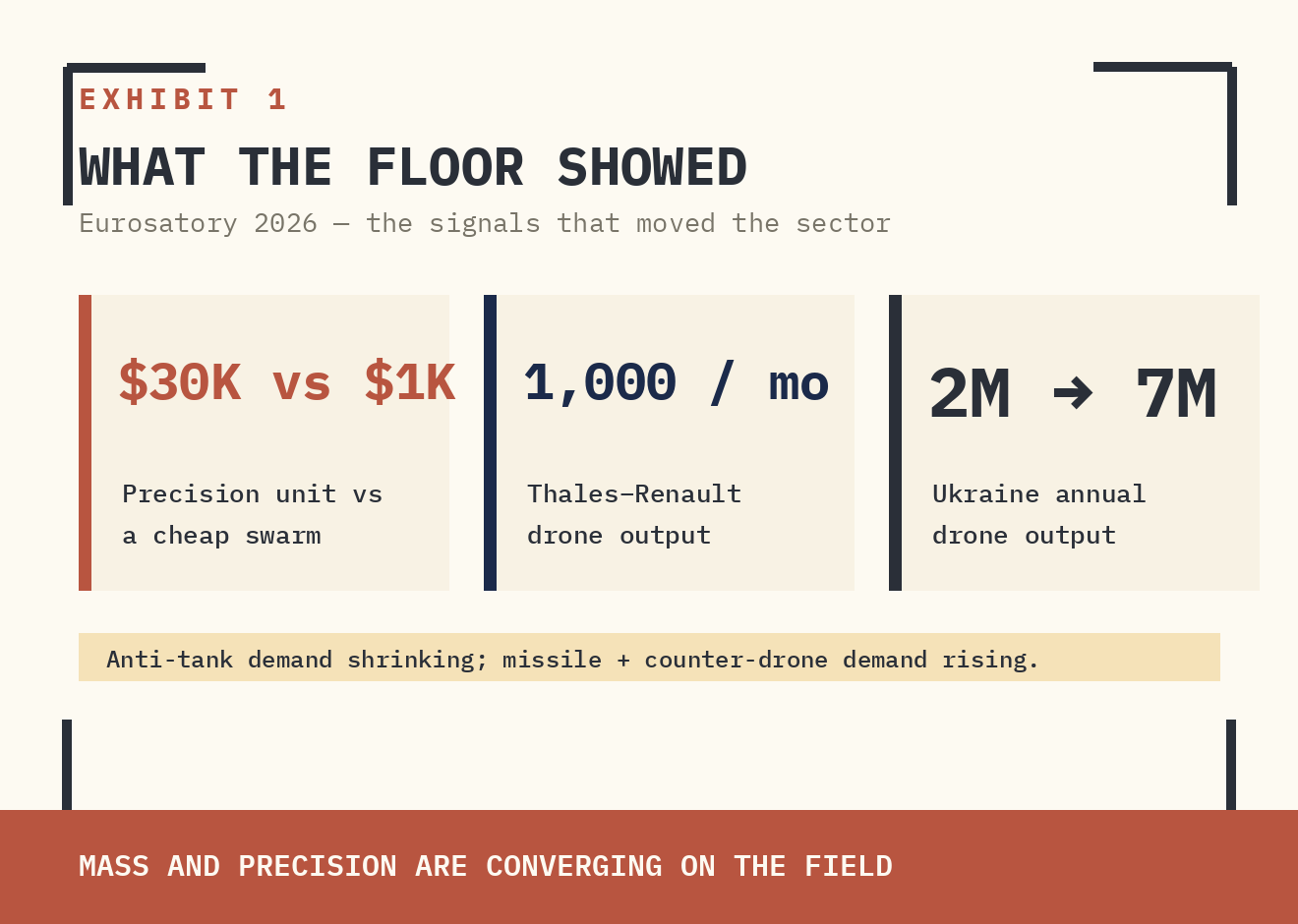
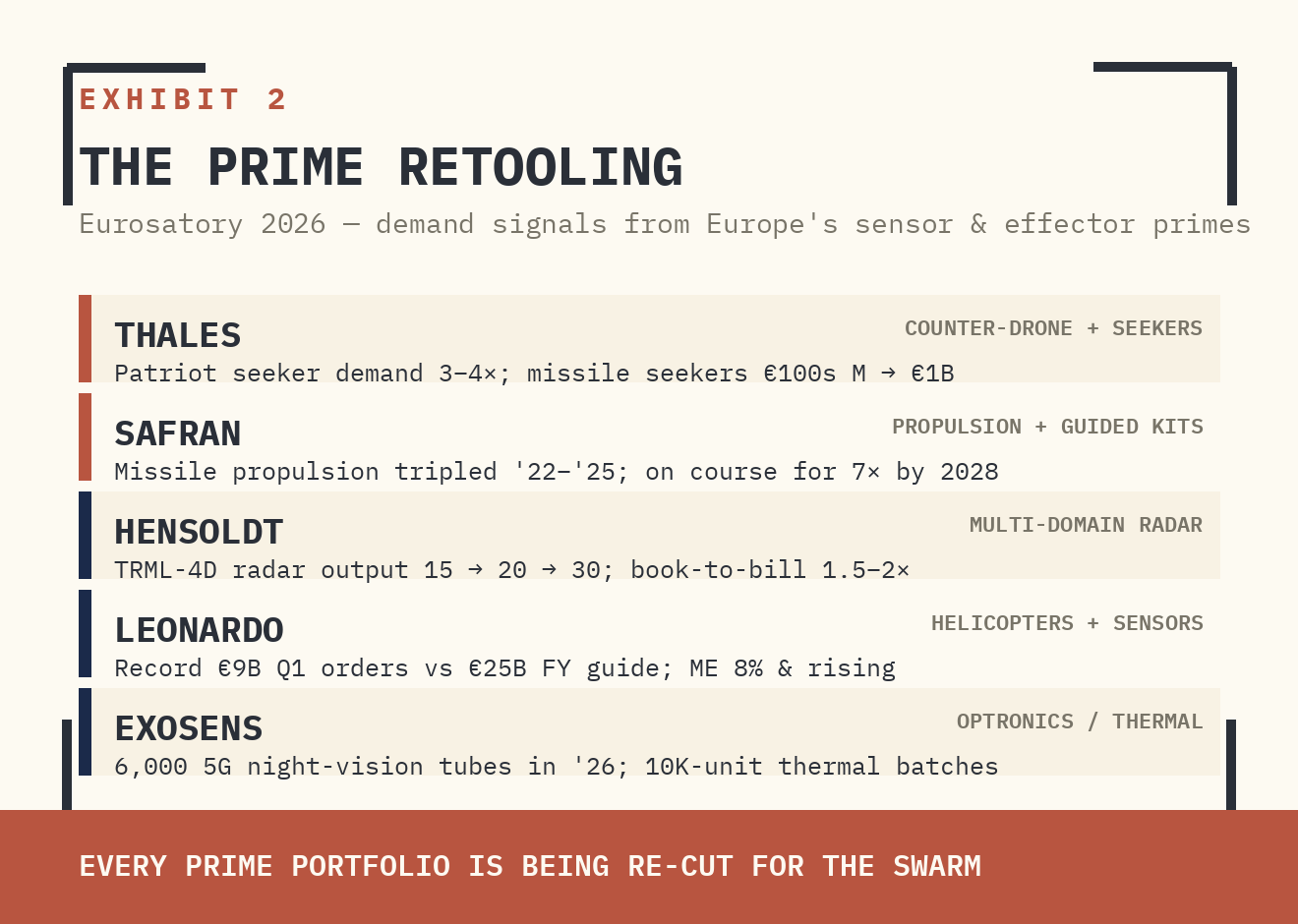
- Thales is scaling counter-drone effectors, SAMP/T NG and Patriot seekers (3–4×), targeting a billion-euro seeker franchise; its Renault venture aims for 1,000 low-cost drones a month.
- Safran has tripled missile propulsion since 2022 and guides to a seven-fold rise by 2028, with guided-kit demand up five-to-six times.
- Hensoldt is doubling radar output on a 1.5–2× book-to-bill; Leonardo booked record €9B Q1 orders; Exosens supplies night-vision into the drone industry.
- Positioning is a single European sensor-and-effector basket — radar, seekers, optronics, guided kits and propulsion — funded largely by European budgets.
TRIGGER
The View From The Floor
Eurosatory 2026, near Paris, is the clearest read on where European defense capital is heading. A note penned from the floor by a major continental broker took the pulse of the sector: sentiment is firmly bullish, and the most striking feature of the show was the prominence of drones and counter-drones — appearing both as add-ons to incumbent portfolios and as the core product of a new wave of defense-tech players. The Ukrainian delegation came in force, underlining how central unmanned systems have become to modern combat.
Supplied archive exhibit · original labels. Read alongside the editorial corrections.
The production backdrop explains the urgency. Ukrainian drone output is annualizing from roughly two million units in 2025 toward seven million by year-end; the kill zone has widened from five kilometres to fifty. Lasers and counter-drone effectors were ubiquitous as science turns into fielded capability. Anti-tank missile demand is shrinking even as overall missile and counter-drone demand grows — a mix shift every prime is now racing to capture.
FLOW
Prime By Prime
Thales framed itself as a technology company with a four-billion-euro research budget, positioning in counter-drone effectors, its SAMP/T NG air-defense system and electronic warfare. Patriot seeker demand is running three-to-four times higher, and management sees the missile-seeker franchise scaling from a few hundred million euros toward a billion; its venture with Renault targets a thousand low-cost Toutatis drones a month at roughly thirty thousand dollars each. The group is platform-agnostic — it sells the same growing volume of sensors and radars whether the platform is manned or unmanned — and aims to double its US business by 2030, with the Middle East a recurring upside.
Safran has tripled missile-propulsion revenue since 2022 and guides toward a seven-fold increase by 2028, sitting on ten missile platforms, while guided-kit demand has grown five-to-six times in three years. Hensoldt is expanding radar output toward a doubling of capacity on a book-to-bill between 1.5 and 2.0, with Middle East demand expected to double over time. Leonardo booked record first-quarter orders near nine billion euros against a full-year guide of twenty-five billion, with the Middle East at eight percent of revenue and rising. Exosens is supplying thermal and night-vision sensing directly into the drone industry, on track for thousands of next-generation tubes this year.
Supplied archive exhibit · original labels. Read alongside the editorial corrections.
RISK
Figure 01 · Qualitative comparison
Read a defence-company update correctly
| Measure | What it can show | What it cannot prove alone |
|---|---|---|
| Order intake | New commitments in a period | Delivery speed |
| Backlog | Work still to be performed | Cash already collected |
| Capacity plan | Potential future output | Orders or realised revenue |
| Management guidance | A forecast subject to execution | An achieved result |
What Breaks The Thesis
Multiples have expanded materially across European defense, leaving little room for execution error. Hensoldt has already de-rated on ceasefire concerns, and peace headlines remain the sector's primary drawdown vector. Possible delays to the British budget are a localized risk, though management views them as more than offset by a thirty-six-billion-euro French programme top-up. The clearest portfolio risk is mix: anti-tank missile demand is shrinking, so exposure concentrated in legacy platform categories will lag the sensor, seeker and counter-drone lines that are actually inflecting.
Whether the platform is manned or unmanned, the primes sell the same growing volume of sensors, seekers and radars. The bid is on the electronics, not the chassis.
PRICE
What The Tape Already Shows
Order intakes are running above expectations, with jumbo air-defense and combat-aircraft orders expected and European orders dominating the book — roughly two-thirds of the largest prime's revenue comes from the region, which also benefits from lending facilities that favor European-made equipment. The cited multiples mix reported orders, production plans and management forecasts; they should be read on their stated bases. Geography matters: the European bid is largely European-funded, with Middle East demand the recurring upside surprise across the radar and sensor names.
POSITION
One Basket, Tilted
Positioning is a single sub-sector expression, held at the layer rather than the security. Named companies illustrate where the spending concentrates and are not recommendations.
European sensor and effector primes. Radar, seekers, optronics, guided kits and propulsion. The tilt within the basket is toward the platform-agnostic, recurring content — sensors, seekers and counter-drone effectors — over pure platform exposure, since that is where demand is inflecting and mix risk is lowest.
The discipline is to own the recurring electronics content that sells into every platform, fund the position through the European order book rather than the headline, and treat any ceasefire-driven de-rating as an accumulation window. The continent is rearming, and the drone is the organizing principle.