Original Lens and publication context
Chinese AI models now do 95% of what the best US models can do, at 10% of the price — and that changes the economics of the entire AI industry.
- Two big Wall Street research houses now agree: Chinese AI models deliver about 95% of what the best US models can do, at roughly 10% of the price — and the gap keeps shrinking.
- The China story has changed. Last year it was about being cheap (DeepSeek). This year it is about being smart (Zhipu's GLM) — Chinese models now handle real coding and agent work at near-frontier quality.
- A self-feeding loop has started: 90% of code at big Chinese tech firms is now written by AI, and all that usage data trains the models further. They no longer need to copy from US models to improve.
- Companies worldwide are done burning money on tokens. The new question is 'what does each completed task cost?' — and on that question, cheap Chinese models win. They are already available on Amazon and Google clouds.
- What this means for portfolios: AI models are becoming a commodity faster than the market believes. Favor the businesses that benefit from cheap AI; be careful with businesses that depend on charging premium prices for AI models.
I. WHAT HAPPENED
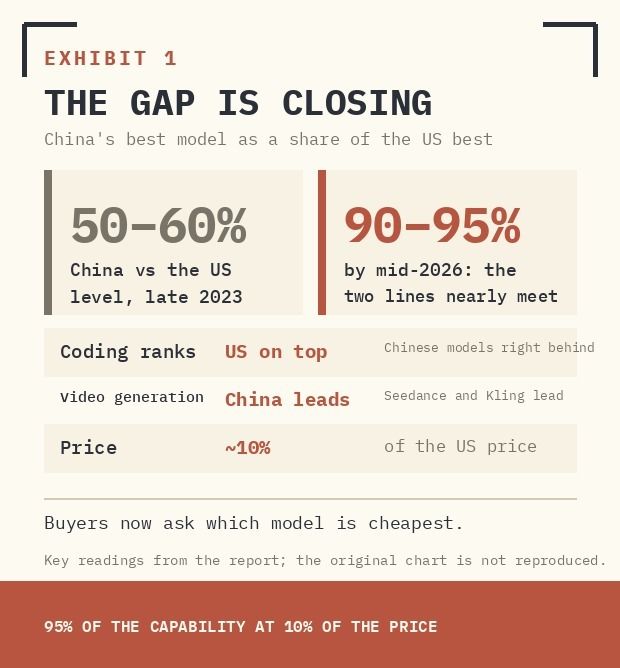
In the space of three weeks, two of the world's biggest investment banks reached the same conclusion. UBS said it first: Chinese AI models now do about 95% of what the best American models can do, at roughly 10% of the cost. This week, Goldman Sachs published a 50-page study on Chinese AI models that agrees. Goldman's view: Chinese models have hit a turning point in raw intelligence, Chinese companies are adopting them at speed, and every new user makes the models better.
Here is why the shift in the story matters. A year ago, Chinese AI was a story about being cheap — DeepSeek shocked the world with its low costs. This year, it is a story about being smart. Zhipu's GLM model now performs close to the best US models in coding and in 'agent' tasks, where the AI works on its own to complete a job. Once a model is good enough for most work, buyers stop asking 'which model is the smartest?' and start asking 'which model gets the job done cheapest?' That is the moment a premium product turns into a commodity — and commodities compete on price.
The last AI race was about who builds the smartest model. The next one is about who can afford to run AI at scale.
EXHIBIT 1 — THE GAP IS CLOSING (UBS)
Supplied archive exhibit · original labels. Read alongside the editorial corrections.
II. HOW CAN IT BE 10X CHEAPER?
The low cost is not a trick or a subsidy. It is built into how the models are designed. Chinese models are simply much smaller — 0.4 to 1.6 trillion parameters, versus tens of trillions for the biggest US models. That is just 2–10% of the size. On top of that, they use a design called Mixture-of-Experts: for any given question, only 3–5% of the model actually 'wakes up' to answer it. Less computing per answer means a much lower cost per answer. Smart engineering adds more savings — for example, DeepSeek's new serving method made its models 57–85% faster without changing the models at all.
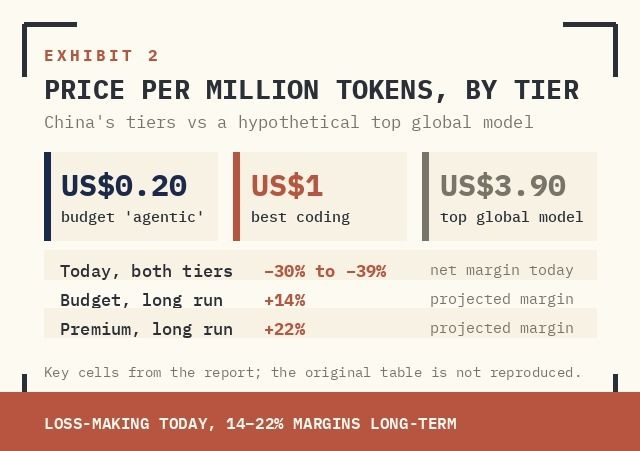
The prices reflect this. Top Chinese models cost about US$1 per million tokens (units of text that are not equivalent to words; the conversion varies by language and tokenizer). Comparable US models cost US$4–8. The budget tier of Chinese models costs as little as 6 to 20 cents. And one more milestone matters: food-delivery giant Meituan just trained a full trillion-parameter-class model entirely on Chinese chips — 50,000 of them — with no American hardware in the training process. The chip restrictions the US designed to slow China down are being engineered around.
EXHIBIT 2 — THE UNIT ECONOMICS: WHAT A MILLION TOKENS COSTS AND EARNS (GOLDMAN SACHS)
Supplied archive exhibit · original labels. Read alongside the editorial corrections.
Figure 01 · Conceptual framework
Compare the cost of a completed task
III. WHY ADOPTION IS EXPLODING
Three forces are driving usage. First, the learning loop. At some large Chinese tech companies, AI now writes 90% of all code — up from 20–30% just a year ago. Every success and every failure becomes training data that makes the models better. This is a big deal: Chinese labs used to improve by studying the answers of US models. They no longer need to. The student has stopped needing the teacher.
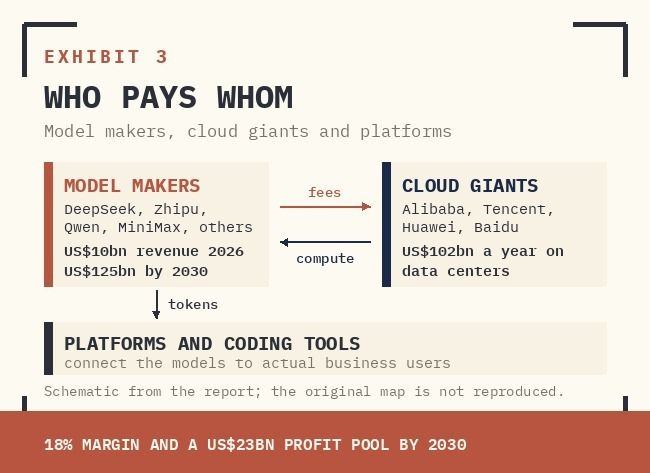
Second, sheer demand. China processed 140 trillion tokens a day in March 2026, and several hundred trillion by June. Goldman expects Chinese AI usage to grow 25 times by 2030, with industry revenue growing from Rmb35bn to Rmb879bn. AI usage is exploding everywhere in the world — the real question is whose models, at whose prices, will serve that demand.
Third — and this is the part most people miss — Chinese models are already inside American cloud platforms. DeepSeek, GLM, Qwen and MiniMax are available today on Amazon's and Google's clouds, fully managed. Microsoft has openly said it may offer DeepSeek inside Copilot as a cheaper option, run safely inside its own data centers. Because these models are open-source — free for anyone to download and run — no trade deal was needed. The free license turned America's biggest tech companies into distribution channels for Chinese AI.
The free open-source license did what no trade negotiation could — it turned rivals into distributors.
EXHIBIT 3 — THE FULL CHINESE AI ECOSYSTEM: WHO PAYS WHOM (GOLDMAN SACHS)
Supplied archive exhibit · original labels. Read alongside the editorial corrections.
IV. BUT HOW DO THEY MAKE MONEY?
The obvious question: if the models are free to download, where is the business? Today, the cheapest tier is indeed a price war — some firms are selling AI at a loss, funded by the billions they raised from investors. But three paths to profit are already visible. One, licensing: Open-weight licensing and commercial-use terms vary by model; buyers must check the applicable licence. Goldman expects the rest of the industry to follow this template. Two, premium pricing at the top: the best Chinese models hold their US$1 price and earn positive margins — and DeepSeek just introduced peak-hour pricing at double the normal rate, a classic sign that demand is exceeding supply. Three, tools and platforms: coding products like Zhipu's ZCode and Alibaba's Qoder charge for the workflow, not the raw model.
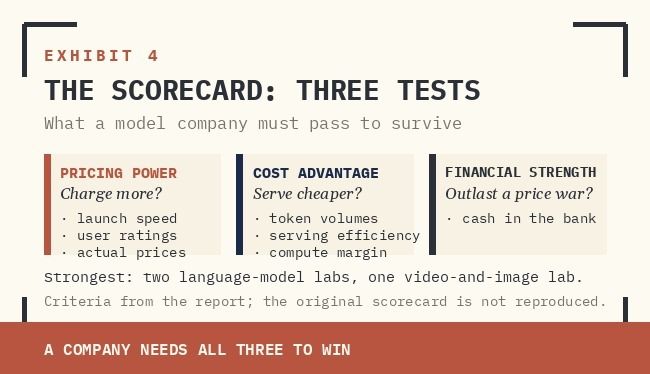
Goldman's picks for long-term winners sit in language models and in video and image generation. Together, China's independent AI labs are already valued at more than US$200bn. Video generation is the most profitable corner — ByteDance's video model reportedly earns 70% gross margins on over US$2bn of annual revenue, because demand far exceeds available computing power.
EXHIBIT 4 — HOW GOLDMAN SCORES THE WINNERS (GOLDMAN SACHS)
Supplied archive exhibit · original labels. Read alongside the editorial corrections.
Figure 02 · Qualitative comparison
Keep three cost measures separate
| Measure | What is included | Why it matters |
|---|---|---|
| API price | What the customer pays per defined unit | Published prices need matching input/output and cache assumptions |
| Inference gross margin | Revenue less serving cost on a stated basis | May exclude training and wider research |
| Full profitability | Relevant operating and development costs | A positive gross margin can coexist with losses |
V. THE RISKS — POLITICS NOW CUTS BOTH WAYS
The new risk in this story is that both governments can now pull the plug. The familiar risk is American: Washington restricting China's access to advanced chips, which slows model training. The new risk is Chinese: reports say Beijing is considering limits on foreign access to its most advanced models, because cutting-edge AI is now treated as a national asset. If both superpowers lock up their best models, the global AI world splits in two. There is also a precedent to watch — TikTok. It grew fast in the West, then faced years of regulation and forced localization. Chinese AI models could travel the same road.
Other risks: the price war at the bottom could last longer than expected and burn through cash; US sanctions could cut Chinese labs off from suppliers and capital; and new model designs could make today's leaders obsolete. But note the twist Goldman itself concedes — every new US restriction pushes China to build its own full technology stack, chips included. Pressure is accelerating self-sufficiency, not preventing it.
VI. WHAT THE MARKET IS MISSING
The most underestimated force is a change in how companies buy AI. Through late 2025 and early 2026, firms equated heavy AI usage with productivity — a phase now called 'token-maxxing.' The data killed that idea: heavy users consumed 10 times more tokens but produced only 2 times more output. Some companies burned a full year's AI budget in four months. The new discipline asks one question — what does each completed task cost? Routine work gets moved to cheap models; only the highest-value work gets the expensive frontier models. Every step of that shift moves money toward the cheap curve — which today is largely Chinese. Global token prices have been falling since early June for exactly this reason.
Now hold that against the American side of the ledger. US tech giants are spending hundreds of billions on data centers, on the assumption that top AI models will keep commanding premium prices. If 95% of the capability is available at 10% of the price for most business tasks, the returns on a meaningful part of that spending shrink. The market treats Chinese AI as a political story. The evidence says it is a profit-margin story — for the entire global AI industry.
The market prices China AI as a geopolitical discount. The evidence says it is a margin repricing for the whole model industry.
VII. WHAT TO DO WITH THIS
The practical read, on a twelve-month view. Lean toward the winners of cheap AI: software and platform businesses whose biggest input cost — intelligence — is collapsing in price; Chinese video and multi-modal leaders who still hold pricing power; and Asian technology-infrastructure names that benefit as China builds its own chip stack. Be cautious on anything that needs US$4–8 per million tokens to stay profitable — those business models are on the wrong side of a 25x demand explosion arriving at commodity prices. And respect the political tail risk: a restriction headline from either Washington or Beijing can shake the whole sector overnight, and a TikTok-style clampdown on Chinese model access in the West is the one scenario that breaks the global growth leg of this story.