Original Lens and publication context
A World Cup called in advance, a machine that solved the Olympiad, a father, two sons — and the announcement of Future Intelligence.
- Today, Buy Side Lens announces FUTURE INTELLIGENCE — my third act: education in mathematical, logical and rational thinking, for young curious minds and for adults set on mastering markets, macro and geopolitics. Launching next month; everything below is proof the method works.
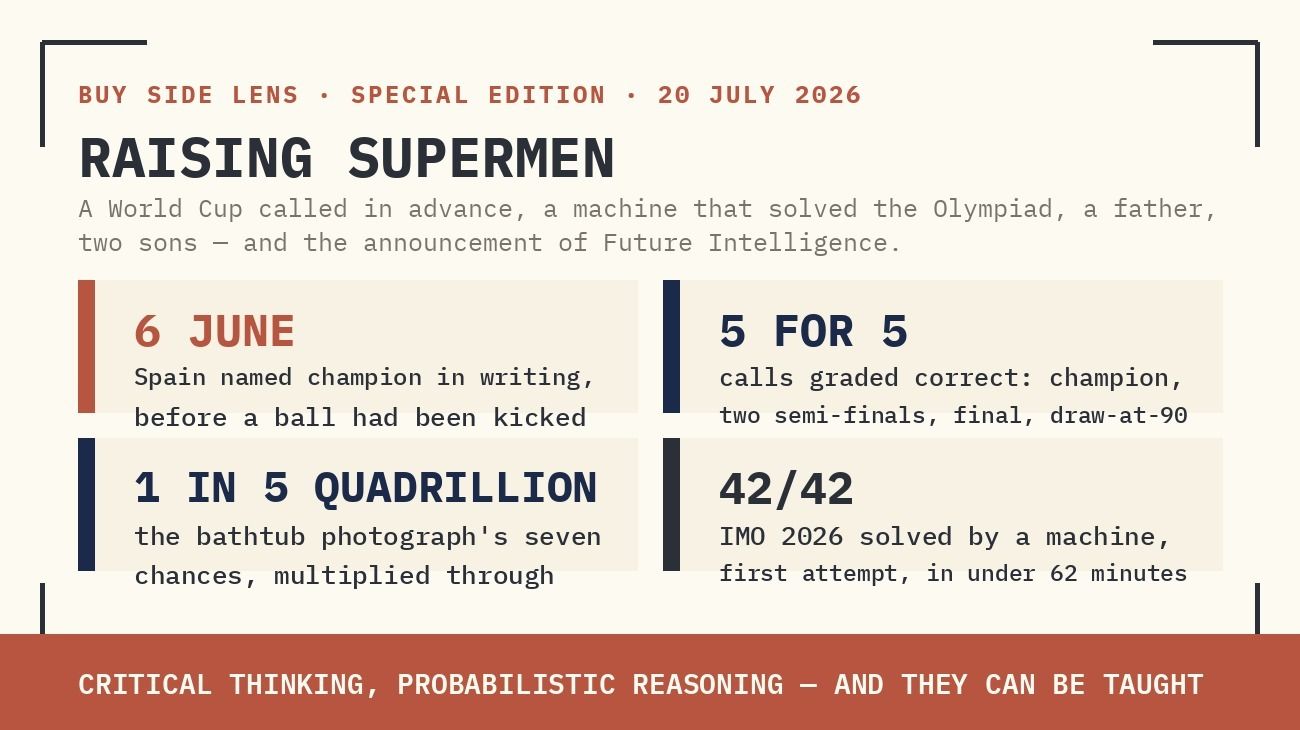
- The credential: on 6 June, before a ball had been kicked, the BSL Elo–Poisson model named Spain the most likely world champion — in writing, on the public record. On Sunday night, Spain lifted the trophy.
- The graded ledger: both semi-finals called correctly — Spain 2–0 France, Argentina 2–1 England — and the final word, published twenty-four hours before kick-off, backed Spain while flagging a high chance that ninety minutes would not separate the sides. It finished 0–0 at ninety.
- In stoppage time a red card to Enzo Fernández made it eleven-versus-ten — the live probabilities flipped decisively to Spain, who won 1–0 in extra time. One changed variable, one re-run, one correct answer: conditional probability, live.
- The same month, an AI solved all six International Mathematics Olympiad 2026 problems unaided at the first attempt — education built on memorisation is finished. The superpowers of this century are critical thinking, probabilistic reasoning, and the mathematics to see the future first — and they can be taught.
Supplied archive exhibit · original labels. Read alongside the editorial corrections.
I. THE ANNOUNCEMENT
Ten seconds of your attention, before the story. My career has been institutional trading floors — Goldman Sachs, then HSBC — using mathematics to read markets; my evenings, teaching quantitative finance and derivatives to students and working professionals. Those were the first two acts. Today I declare the third.
FUTURE INTELLIGENCE is an education venture with one aim: mathematical, logical, rational thinking — the discipline that begins with probability and ends wherever you point it. Markets, macro and geopolitics. Autonomous systems and frontier technology. The geometry of a football match. Built for two audiences: young, curious minds meeting this thinking for the first time, and serious adults — investors, professionals, lifelong students of the world — set on mastering it. It began at home. It launches next month, with Buy Side Lens as its research publication.
That is the announcement. What follows is the reason to take it seriously. Judge the ambition by the ledger.
II. THE PHOTOGRAPH
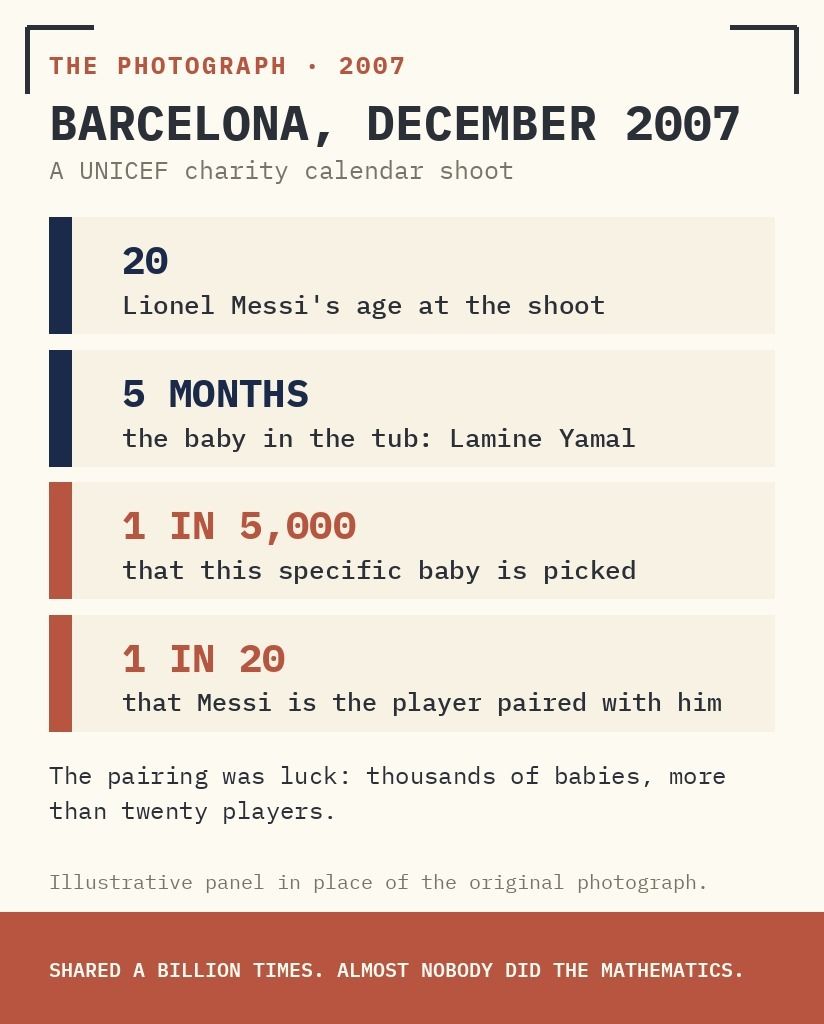
You have seen the photograph. December 2007, Barcelona: a twenty-year-old Lionel Messi bathing a five-month-old baby for a UNICEF calendar. The baby was Lamine Yamal. Nineteen years later they walked out of the same tunnel at MetLife Stadium — opposite sides of a World Cup final. The internet shared the picture a billion times. Almost nobody did the mathematics. We did — the mathematics is the lesson.
 Supplied archive exhibit · original labels. Read alongside the editorial corrections. | 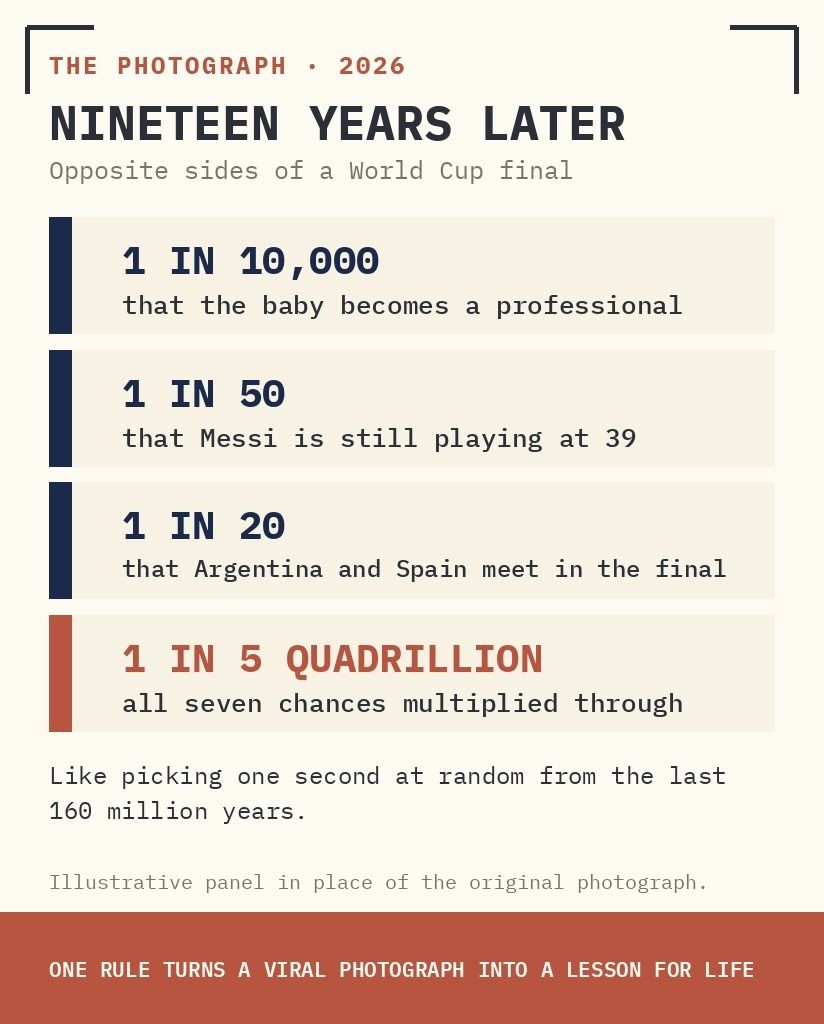 Supplied archive exhibit · original labels. Read alongside the editorial corrections. |
The rule: when several independent things must ALL happen, you multiply their chances. One coin flip, heads is one in two; ten heads in a row is one in roughly a thousand. Small chances, multiplied, become astronomically small very fast.
Apply it to the photograph. Seven things had to happen for the baby in the bathtub to face Messi in a final. A rough, honest guess for each:
1 | That specific baby gets picked for the shoot Thousands of babies in and around Barcelona could have been chosen for a charity calendar. One was. | 1 in 5,000 |
2 | Messi is the player he is paired with More than twenty players could have been handed that bathtub. The pairing was luck. | 1 in 20 |
3 | The baby grows up to become a professional footballer Millions of children play football. Only a tiny fraction ever sign a professional contract. | 1 in 10,000 |
4 | Messi is still playing nineteen years later, at 39 Almost no footballer — even the very best — is still at the top level at thirty-nine. | 1 in 50 |
5 | Argentina and Spain both survive a 48-team bracket and meet in the final Forty-eight teams entered. For these two exact teams to be the last two standing is a long road of wins. | 1 in 20 |
6 | Messi becomes the greatest Argentine player ever Argentina has produced generations of legends — Di Stéfano, Maradona. To rise above all of them. | 1 in 10 |
7 | Yamal becomes the best player in Spain Of every boy in Spain who makes it as a professional, to end up as the single best one. | 1 in 500 |
Multiply the seven numbers through — 5,000 × 20 × 10,000 × 50 × 20 × 10 × 500 — and you get roughly one in five quadrillion. A five followed by fifteen zeroes — like picking one second at random from the last 160 million years and landing on the exact moment Messi held that baby.
Argue with any single guess — reasonable people will. The arithmetic follows the chosen guesses, but the events are not independent and were selected after the outcome. The product is an illustration, not an estimate of the real probability. One rule, taught to a child, turns a viral photograph into a lesson for life.
III. THE LEDGER
In June, BSL rebuilt a Goldman Sachs-style World Cup framework into our own Elo–Poisson engine (“Model Versus Market”, BSL Daily Brief, 06 June 2026) — a model that rates every team from its match history and simulates the tournament thousands of times. We committed to publishing its calls before matches, not after.
And before a single ball had been kicked, it named Spain the most likely world champion. Not after the group stage. On the sixth of June, forty-eight teams in, tournament unplayed — a call that sat on the public record for six weeks.
Through the knockouts: Spain over France — won 2–0. Argentina over England — won 2–1. Two calls, two correct, both published before kick-off.
The final word, published twenty-four hours before kick-off, favoured Spain — and flagged an unusually high probability that ninety minutes would not separate the two sides. Two elite defences; the most likely ninety-minute outcome was a draw. Full time on Sunday: 0–0. Argentina had not registered a shot.
Then stoppage time delivered a live lesson in the exact discipline this report teaches. Enzo Fernández, already booked, launched into Pau Cubarsí: second yellow, off. Eleven-versus-eleven became eleven-versus-ten with extra time to play. One input variable changed — and everything downstream changed with it. Before the card: coin-flip, edge Spain. After it: Spain, decisively. That is conditional probability — the same update a trading desk runs when a central bank surprises. A man down is not a detail; it is a regime change. Sixteen minutes into extra time, Ferran Torres scored. Spain 1–0. A second World Cup.
So the ledger closes graded, in full: champion call, published 6 June — correct. Semi-final one — correct. Semi-final two — correct. Final call — correct. Draw-at-ninety flag — correct. All written down before the event, where being wrong would have been public. That is the only track record this house will claim — and every market call we publish will be graded the same way, wins and losses alike.
IV. THE MACHINE THAT SOLVED THE OLYMPIAD
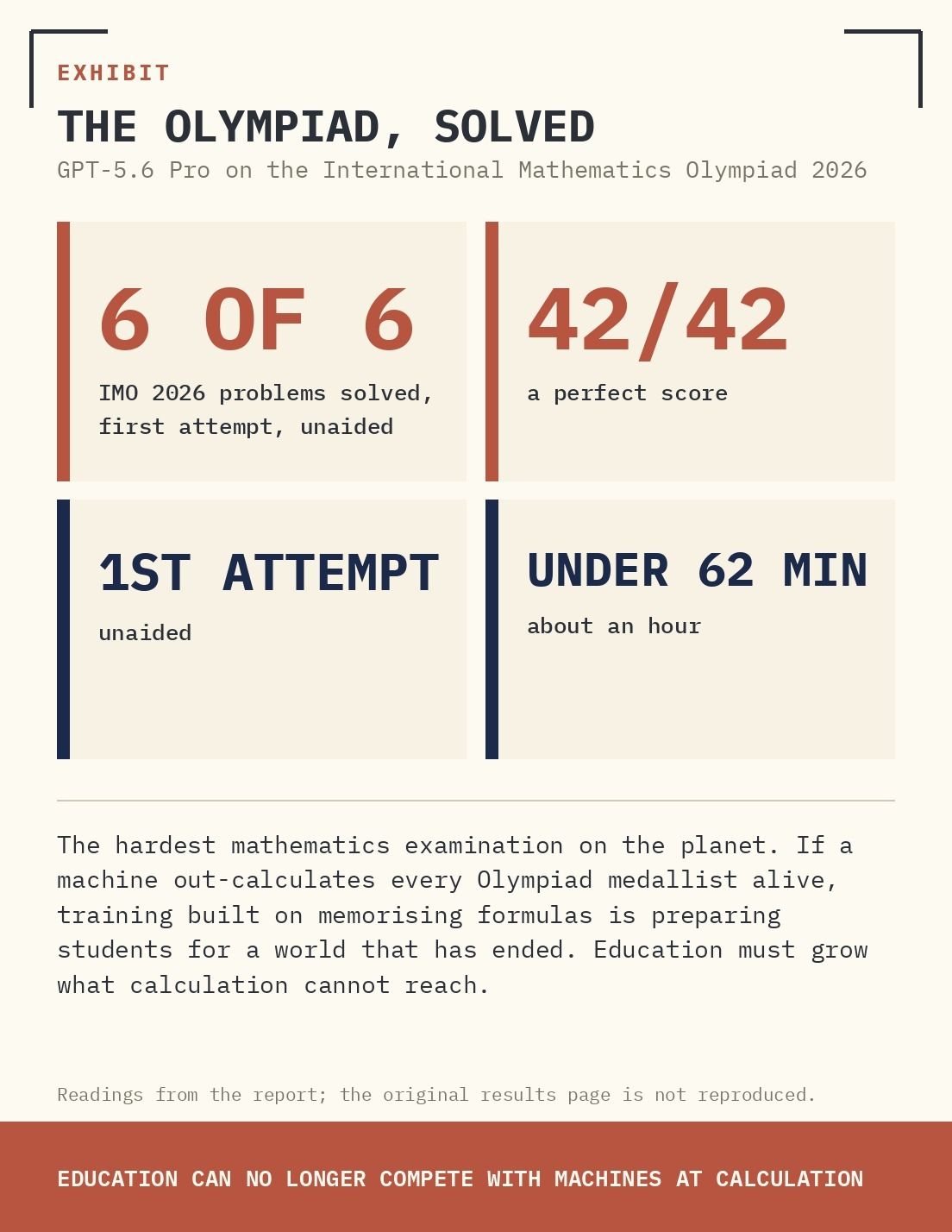
Now place a second image beside the bathtub. This month an AI system — GPT-5.6 Pro — solved all six problems of the International Mathematics Olympiad 2026 at its first attempt, unaided. The hardest mathematics examination on the planet: a perfect score, in about an hour.
That is not a story about machines; it is a story about education, at every age. If a machine out-calculates every Olympiad medallist alive, then any training built on memorising formulas — in a school, a university, or a trading floor induction — is preparing students for a world that has ended. Education can no longer compete with machines at calculation. It must grow what calculation cannot reach: curiosity, judgment, deep understanding, the ability to ask a question worth answering.
Supplied archive exhibit · original labels. Read alongside the editorial corrections.
The superpowers of this century are not Superman’s heat vision and flight. They are critical thinking, probabilistic reasoning, and the mathematical ability to see the future before it arrives.
The two images point the same way. The photograph teaches probability — putting a number on the future. The Olympiad teaches what stays valuable when calculation becomes free. The next fifty years belong to minds that can see the mathematics underneath a noisy world.
V. SMALLVILLE
Here the report becomes personal, and I make no apology for it.
TWO FATHERS. For months, the evening ritual at home has been one episode of Smallville — the series about Superman’s growing-up years — with my sons, seven and eight, beside me. They love the speed and the heat vision. I love something quieter: Clark is raised by two fathers. Jor-El, the scientist — the architect, training his son for a destiny larger than himself. Jonathan Kent, the farmer — the heart, the reason the most powerful being on Earth grows up gentle. Every father lives somewhere on the line between those two men. I am no exception.
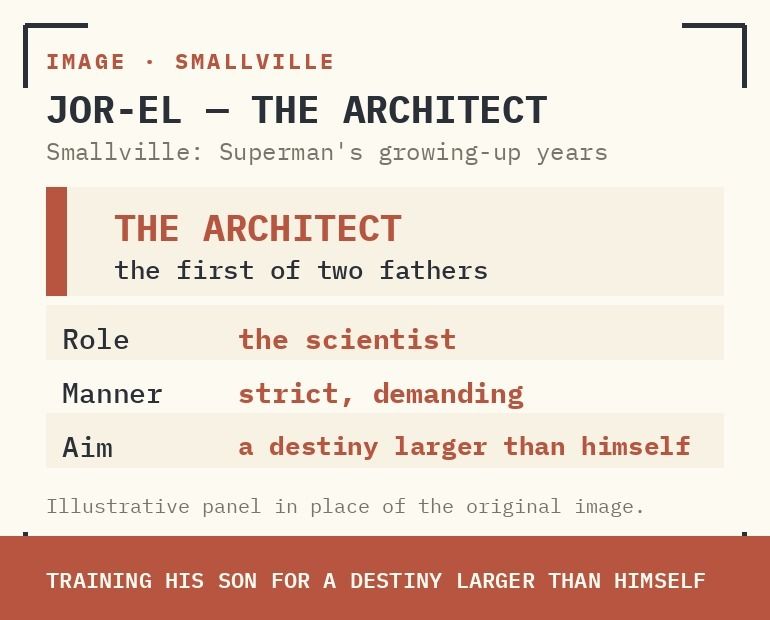 Supplied archive exhibit · original labels. Read alongside the editorial corrections. | 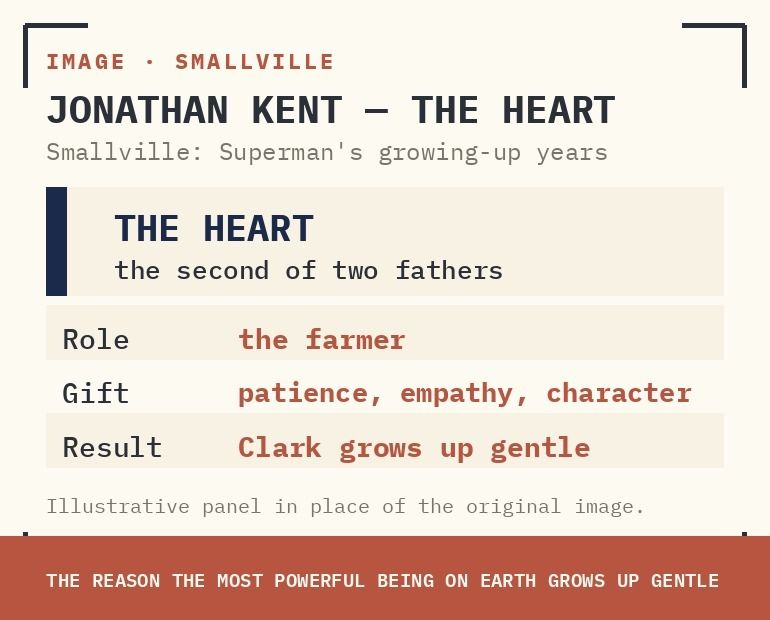 Supplied archive exhibit · original labels. Read alongside the editorial corrections. |
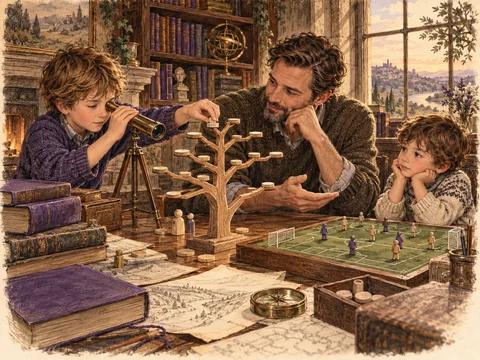
THE EXPERIMENT. So in early June I tried something. I told my boys that with mathematics you could try to read the ending before the story began. On the sixth of June we ran the model together and wrote its predictions on paper: these teams go far; these two meet at the end.
THE PAPER KNEW. They would not let it go. Week after week, two small boys checked the bracket against our sheet. “Papa, are you sure?” I was not sure — nobody can be — but the mathematics said likely, and likely is the strongest honest word there is. The tournament bent toward the numbers. When Spain beat France and Argentina beat England — exactly the semi-finals written down a month before — they were beside themselves. Not because their teams won. Because the paper knew.
THE REAL SUPERPOWERS. That is when I understood what I was building on that sofa: the superpowers of their century, installed one evening at a time — critical thinking, probabilistic reasoning, the craft of building a model and the humility to update it. Its kryptonite is the opposite: memorising without understanding, repeating without questioning. On Sunday night they watched the final with one eye on the pitch and one on the sheet of paper. At the whistle, the team at the top of that sheet was the team holding the trophy. The paper knew, one last time.
VI. THE ASK
This venture was not born in a boardroom. It was born purely out of love — a father trying to be Jor-El and Jonathan Kent at once, realising that what he built for two children deserved to be built for many. Buy Side Lens does not go anywhere; from today it is a publication of Future Intelligence. The platform goes live next month.
Plainly, reader to reader: life is limited, and I have decided what mine is for. This is the most personal thing I have ever built, and I will need your support — your readership, your criticism, your word passed on. You have given it twice. I am asking once more.
On Sunday night, both ends of a one-in-five-quadrillion chain walked out of the same tunnel, and the one our model named six weeks earlier left with the trophy. In a quiet living room far away, a father and two boys watched with a sheet of paper in hand. The sheet was right. The method is teachable. Teaching it — to my sons, my students, and now you — is what Future Intelligence is for.