Original Lens and publication context
Goldman calls the next leg of the AI trade — the rotation out of compute infrastructure into humanoid robotics. The clearest US-side beneficiary is not a robot maker. It is the platform that arms all of them.
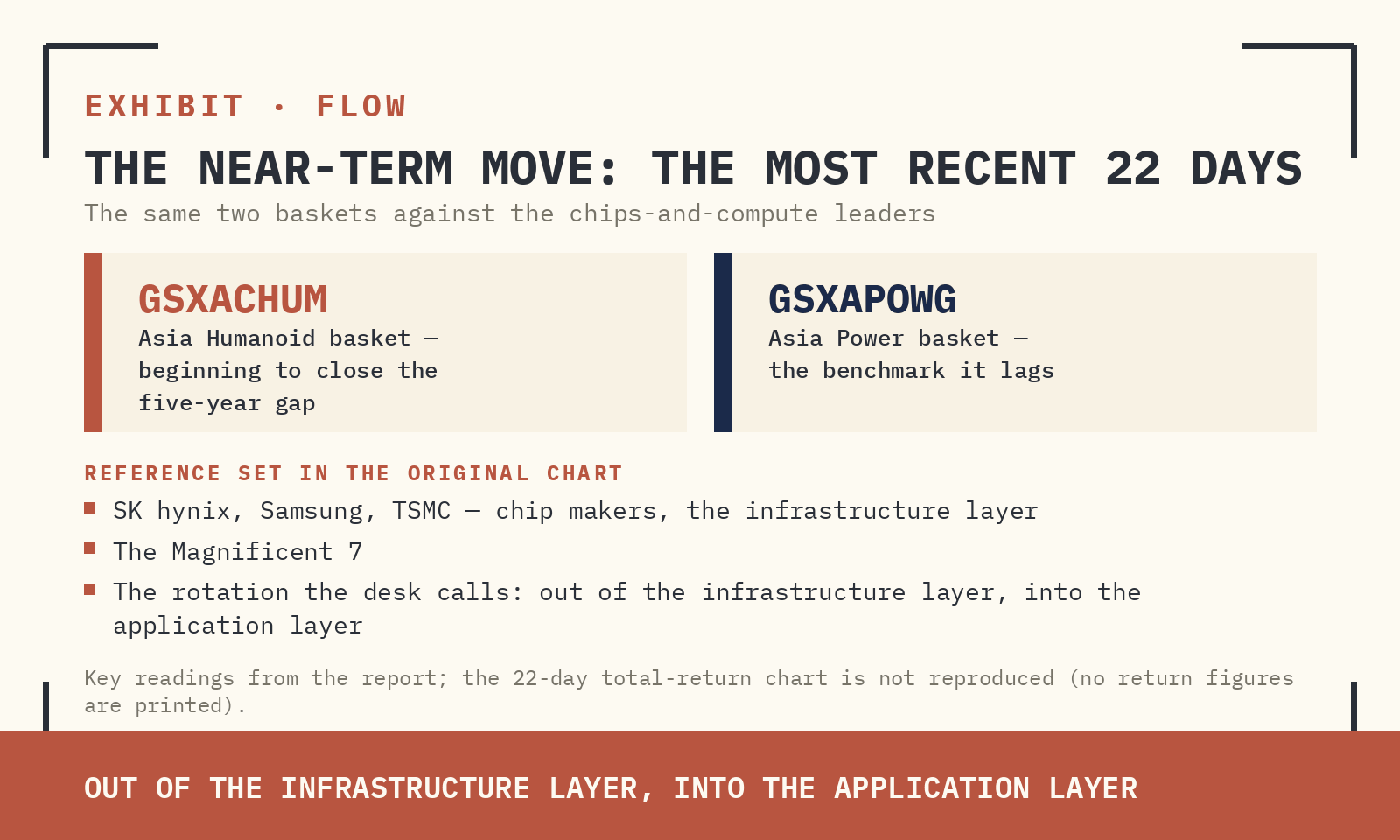
- A top Street house's Asian trading desk has moved the AI trade one step forward — out of the infrastructure layer of chips, compute and data-centre buildout, into the application layer — naming humanoid robotics the clearest monetization frontier and an early-cycle entry.
- The call rests on reported fieldwork with Chinese embodied-AI and robotics companies in May: models are moving to 40B–80B-parameter execution stacks, real-world physical data is the bottleneck, commercialization is staged from 3–6 month POCs toward 50–100-unit pilots, and scale deployment is a 2027–2029 event.
- Flow is early and in components, not bodies: Korean and Chinese auto components, industrial automation and precision suppliers, with passive rebalancing amplifying mid-cap moves. Over five years the Asia power basket compounded to ~582 while the humanoid basket sits near ~242.
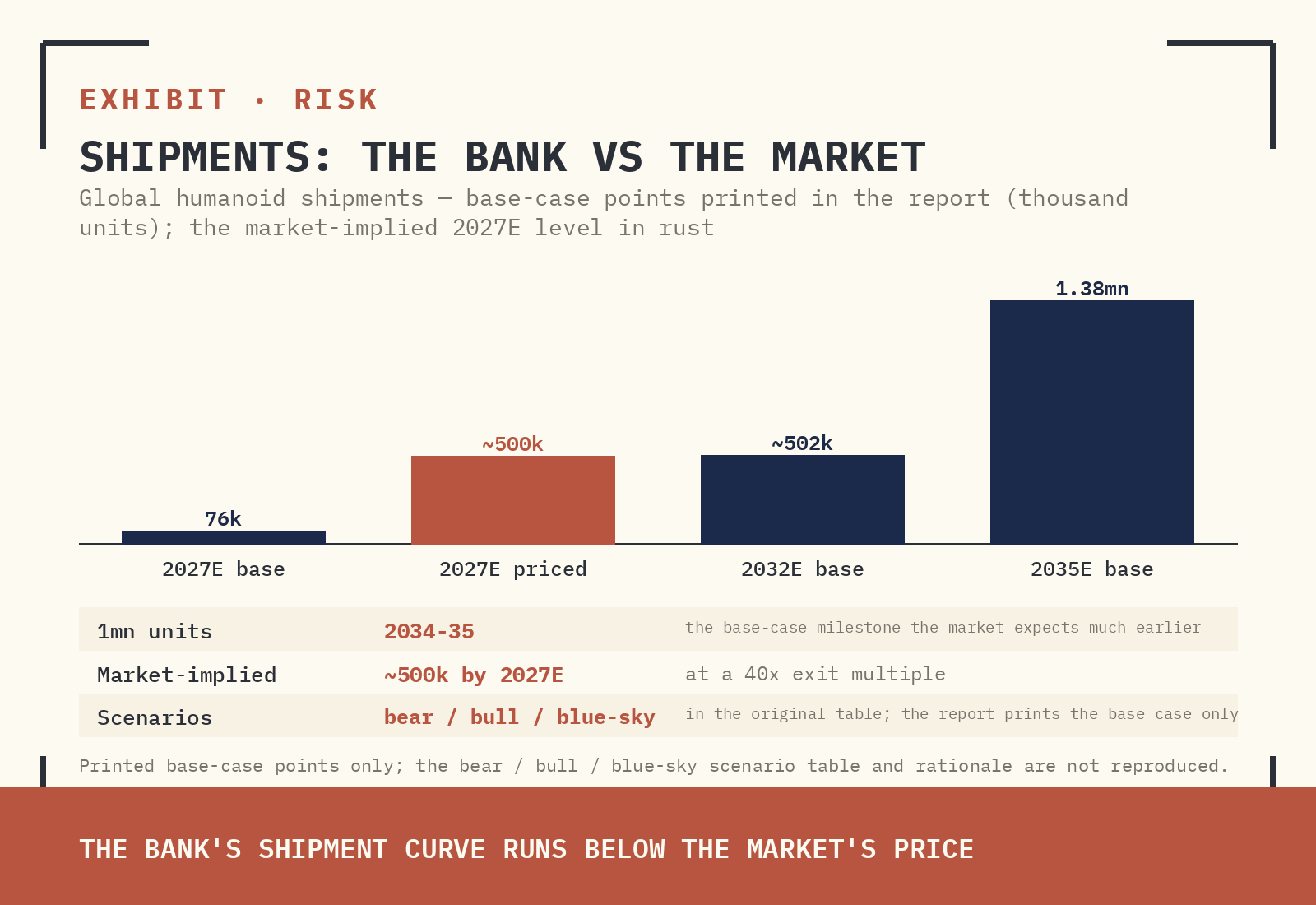
- The roadmap is not converged: the bank forecasts ~76k humanoid shipments by 2027E and ~502k by 2032E, against a market that has likely priced ~500k units at a 40x exit multiple; 1mn units lands in 2034–35. Asia-Pac robotics trades at 22.0x median, US 28.0x.
- Position: own the toll road — the AI platform layer many robot makers use — and the picks-and-shovels in actuator assembly and harmonic reducers; rent the bodies through baskets; underweight dexterous hands, roller screws and pure-play humanoid makers at current multiples until the technology inflection clears.
The Call in One Line
Goldman's Asian trading desk has formally moved the AI trade forward one step: out of the infrastructure layer — chips, compute, data-centre buildout — and into the application layer, with humanoid robotics named as the clearest monetization frontier. The desk frames it as an early-cycle entry ahead of a multi-year capital rotation into the robotics ecosystem, expressed primarily through Korea, Japan and China component names trading at a discount to US peers.
“This is an early-cycle opportunity to position ahead of a multi-year capital rotation into the robotics ecosystem.”
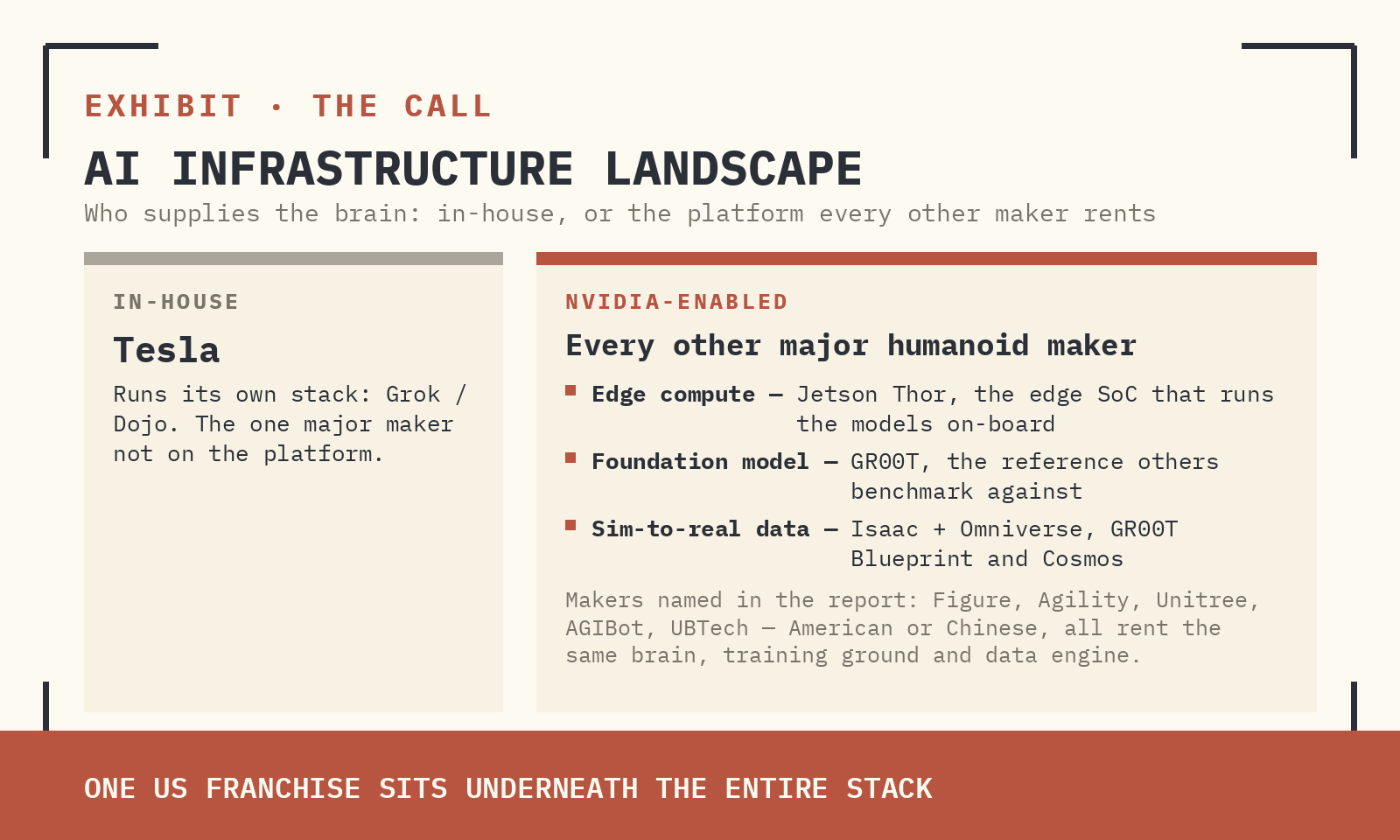
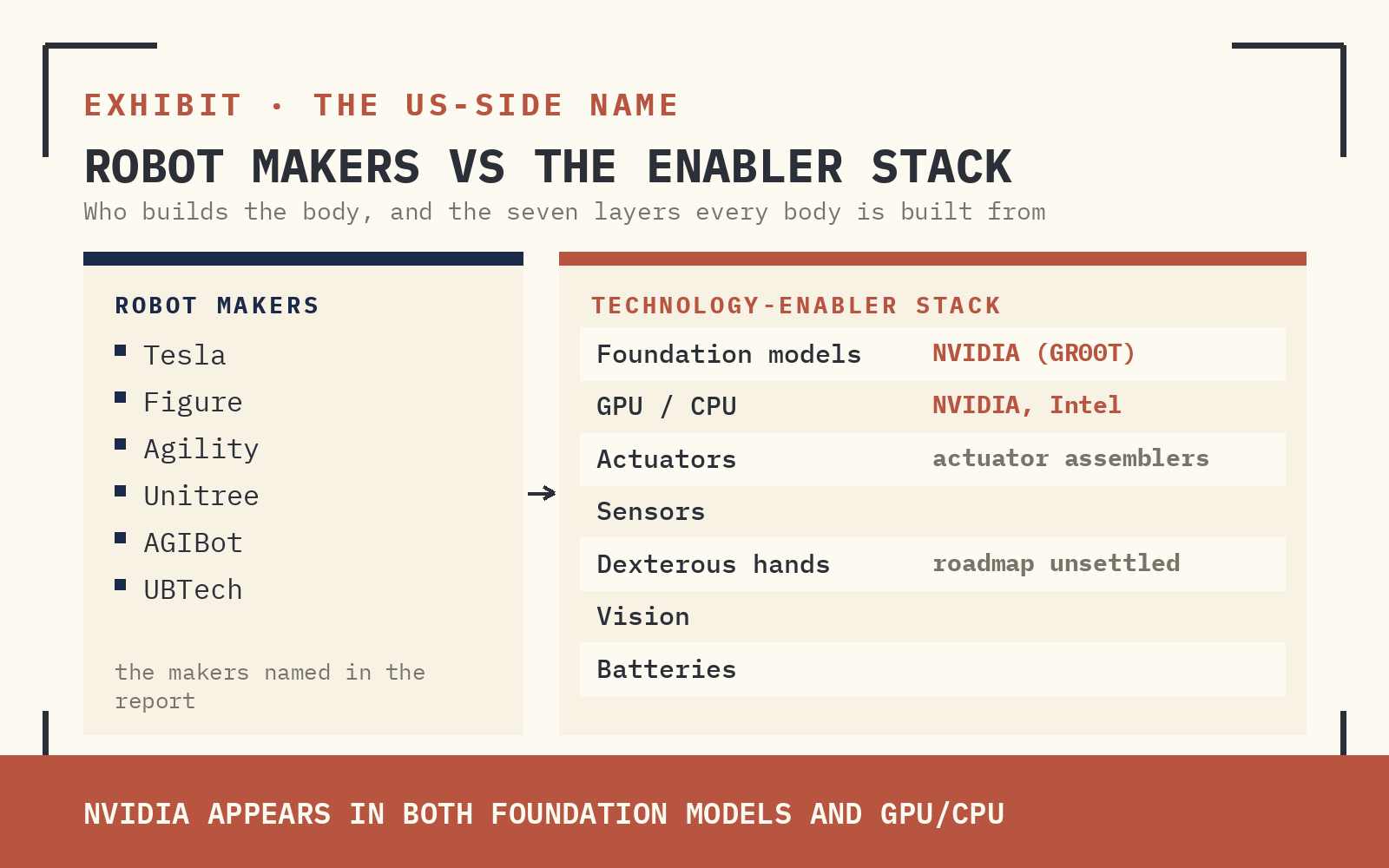
The note you are reading inverts the desk's geographic emphasis. The trade is being routed through Asia because that is where the hardware and the valuation discount sit. But the single US-side name that recurs as the structural enabler across every company Goldman visited is NVIDIA. It does not build a robot. It builds the brain, the training ground, and the data engine that many robot makers use; commercial terms and dependence vary. The AI platform layer — the chips and robot software many developers use — is the cleanest US-listed expression of this thesis.
Supplied archive exhibit · original labels. Read alongside the editorial corrections.
TRIGGER
What Goldman Actually Saw
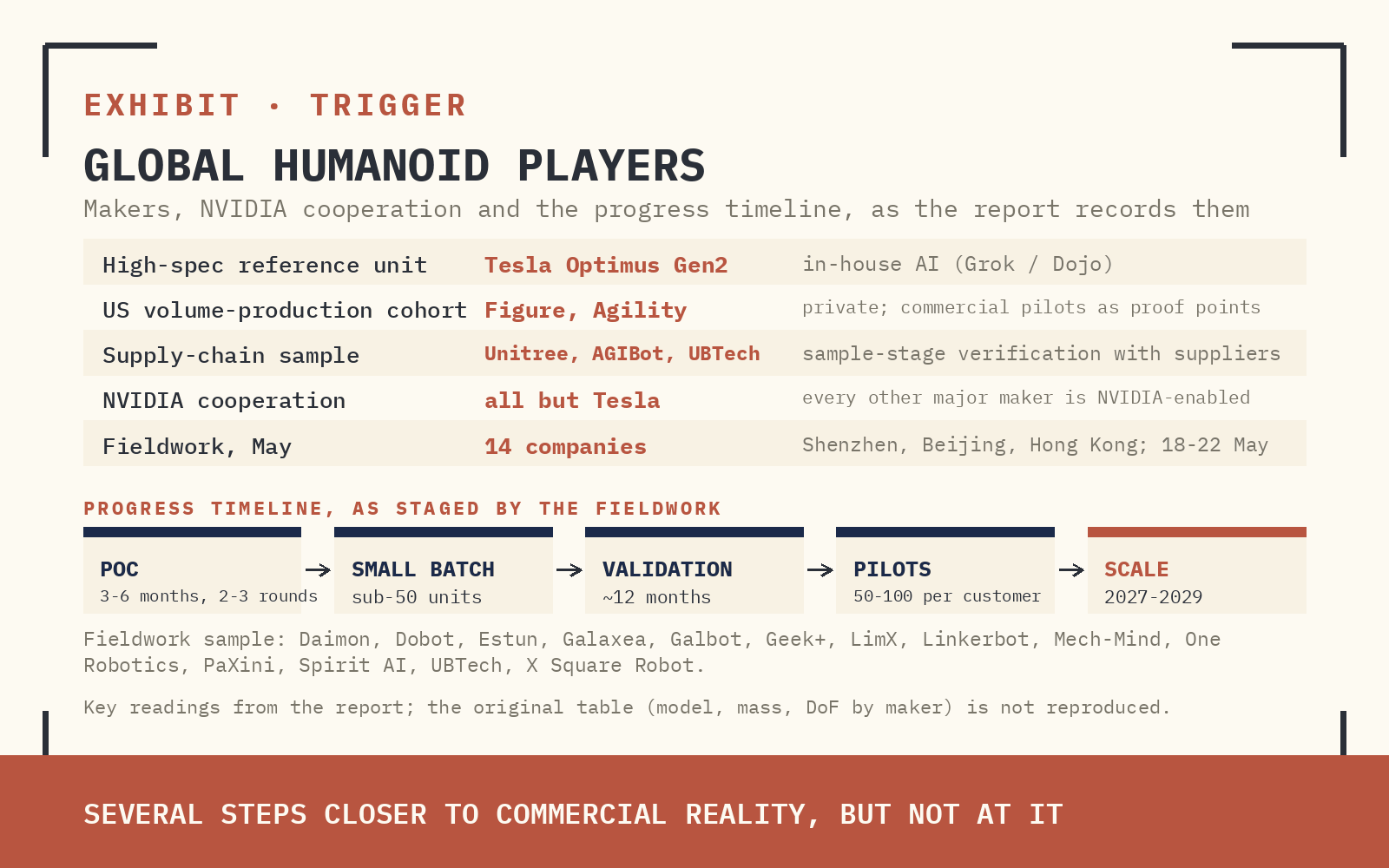
The call is grounded in primary fieldwork, not a desk model. Around the GS Asia Communacopia + Technology Conference (Hong Kong, 18–19 May) and a China AI Robotics trip (Shenzhen and Beijing, 20–22 May), Goldman's robotics desk met a group of companies spanning embodied AI, robotics and automation — a cross-section of the Chinese ecosystem including Daimon, Dobot, Estun, Galaxea, Galbot, Geek+, LimX, Linkerbot, Mech-Mind, One Robotics, PaXini, Spirit AI, UBTech and X Square Robot.
The mid-year read: the field is several steps closer to commercial reality, but not at it. Four shifts define the inflection.
- Models — Model architecture is moving beyond a narrow VLA-only framing toward execution-oriented multimodal stacks — VLA/VTLA for policy and action, fused with world models for next-state prediction, action validation and robustness. Stack sizes are climbing into the c.40B–80B parameter range versus single-digit-billion pre-training systems.
- Data — High-quality, real-world physical data is the primary bottleneck. The debate has moved past 'data recipes' to data-acquisition architecture: centralized data factories (PaXini runs five nationwide, with government support) and distributed, human-centric collection (wearables, VR, egocentric POV). Multiple firms guide to a higher data-related revenue mix into 2026.
- Commercialization — Commercialization is broadening but staged — POC (3–6 months, 2–3 rounds), sub-50-unit small-batch testing, ~12 months validation, then pilots toward 50–100 units per customer. Near-term wins are sorting, material handling, pick-and-place and inspection. Scale deployment is a 2027–2029 event.
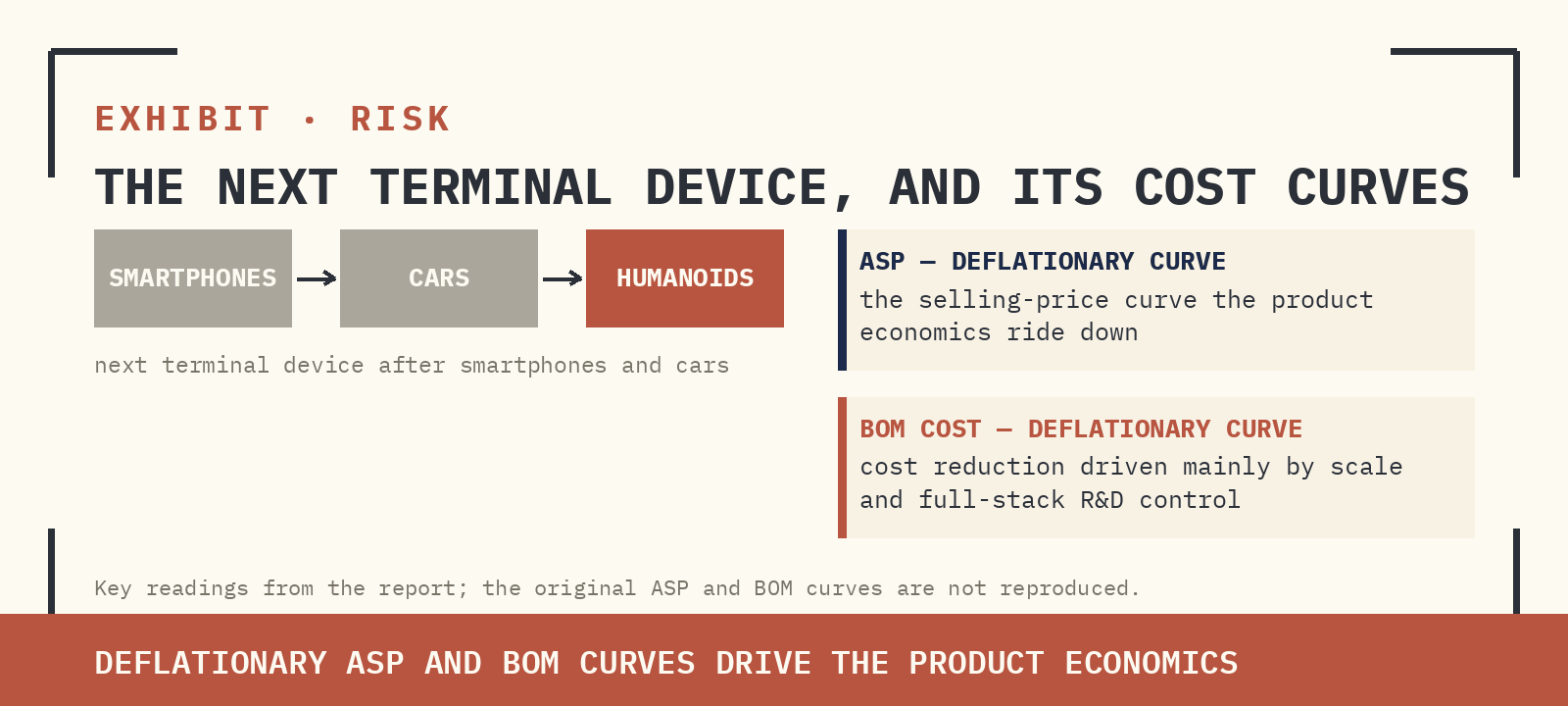
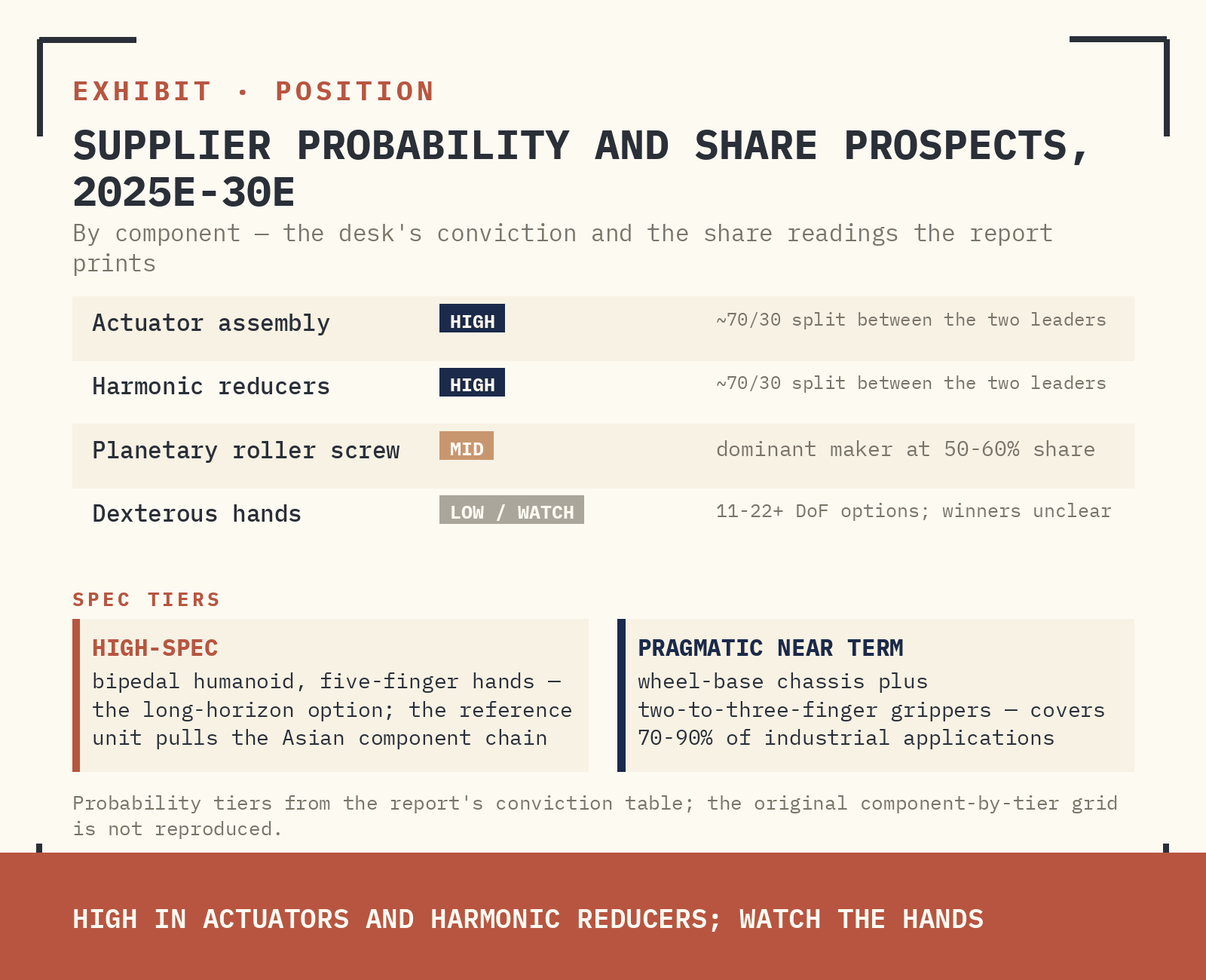
- Cost & form factor — Cost reduction is driven mainly by scale and full-stack R&D control. Tellingly, many players favour a wheel-base chassis plus two-to-three-finger grippers as the pragmatic near-term form factor — it covers 70–90% of industrial applications — while keeping bipedal humanoids with five-finger hands as the long-horizon option.
Supplied archive exhibit · original labels. Read alongside the editorial corrections.
FLOW
Where the Money Is Already Moving
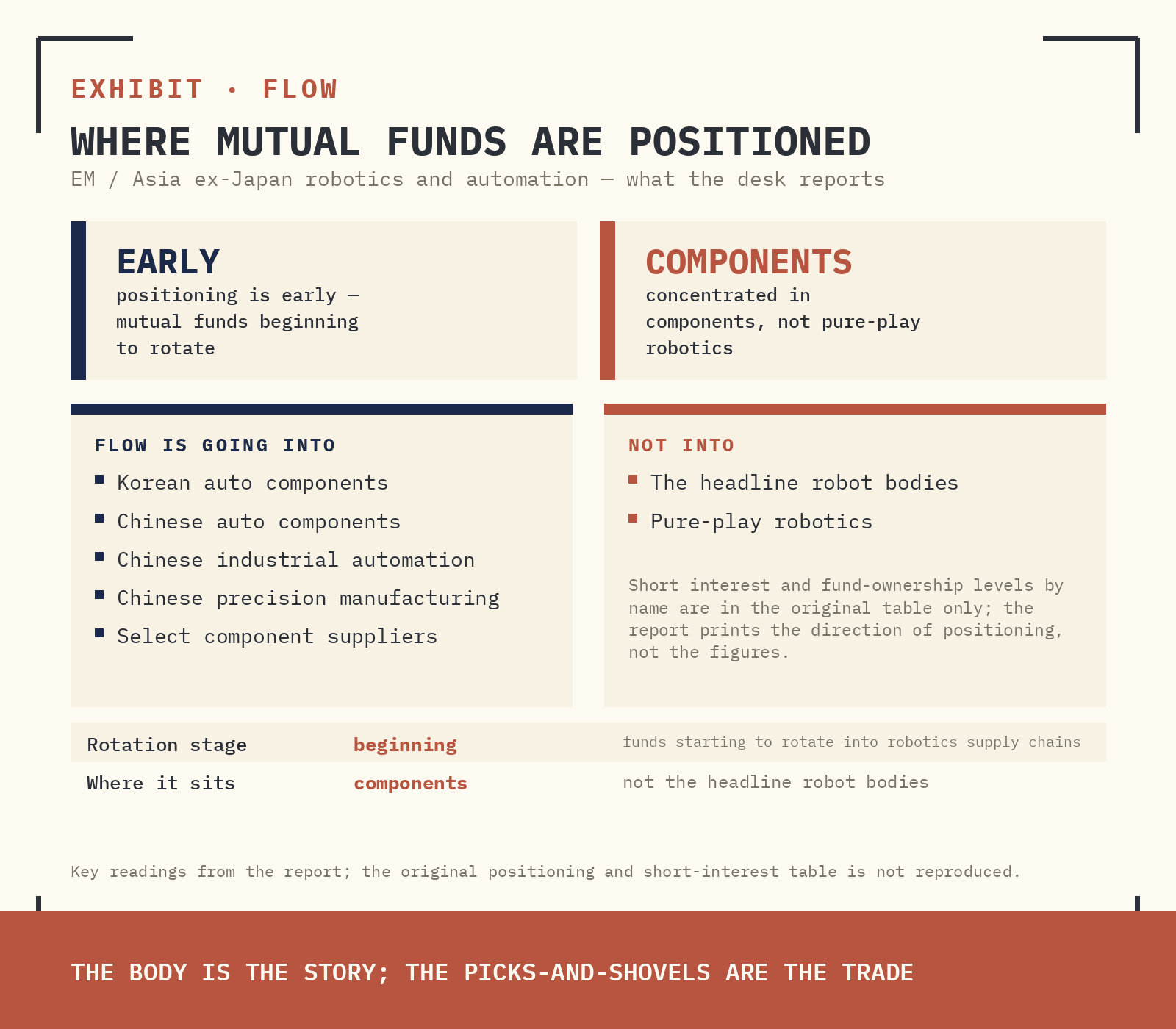
The desk reports that mutual funds are beginning to rotate into robotics-linked supply chains, but positioning is early and concentrated in components rather than pure-play robotics. Flow is going into Korean and Chinese auto components, Chinese industrial automation and precision manufacturing, and select component suppliers — not into the headline robot bodies.
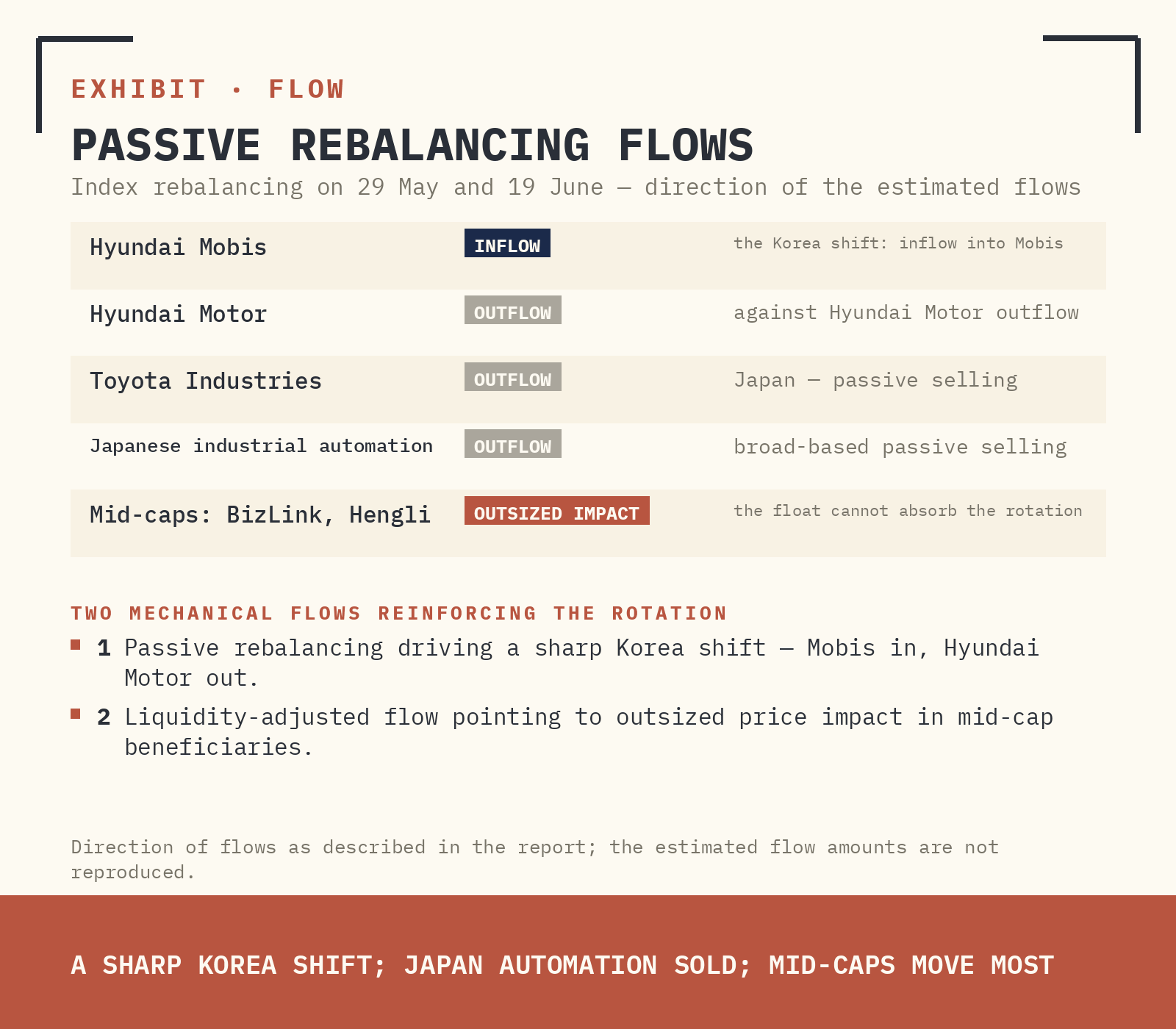
Two mechanical flows reinforce the rotation. Passive rebalancing is driving a sharp Korea shift — inflow into Mobis against Hyundai Motor outflow — while Japanese industrial automation faces broad-based passive selling. Liquidity-adjusted flow points to outsized price impact in mid-cap beneficiaries such as BizLink and Hengli, where the float cannot absorb the rotation cleanly.
Positioning is early and concentrated in components, not pure-play robotics. The body is the story; the picks-and-shovels are the trade.
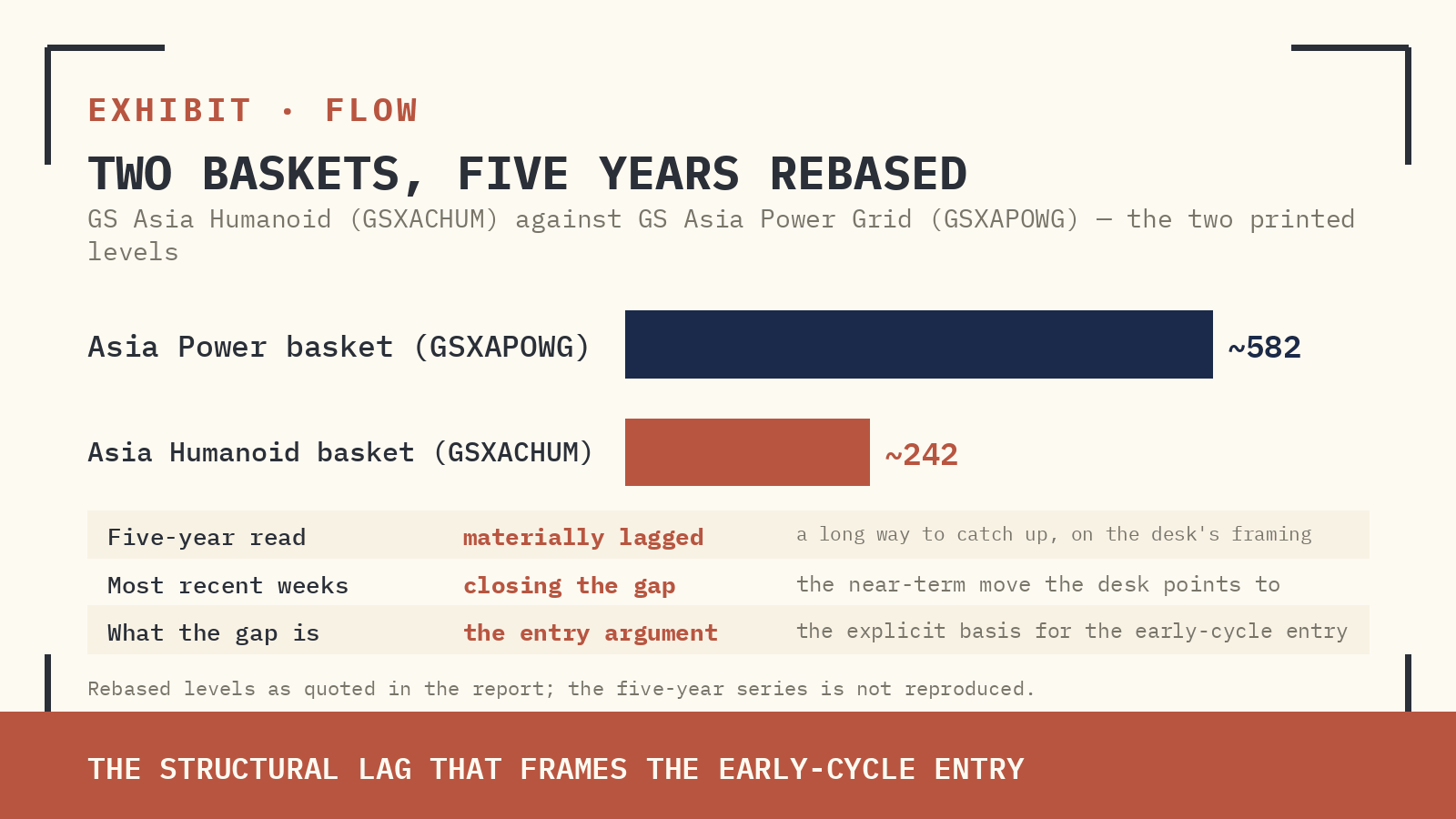
Goldman tracks the theme through the GS Asia Humanoid basket (GSXACHUM), benchmarked against the Asia Power basket (GSXAPOWG). Over five years the divergence is stark: the power basket has compounded to roughly 582 while the humanoid basket sits near 242 — it has materially lagged and, on the desk's framing, has a long way to catch up. That gap is the explicit basis for the early-cycle entry argument; the most recent weeks show the humanoid basket beginning to close it.
Supplied archive exhibit · original labels. Read alongside the editorial corrections.
Supplied archive exhibit · original labels. Read alongside the editorial corrections.
Supplied archive exhibit · original labels. Read alongside the editorial corrections.
Supplied archive exhibit · original labels. Read alongside the editorial corrections.
Supplied archive exhibit · original labels. Read alongside the editorial corrections.
Figure 01 · Conceptual framework
From a promising model to a useful robot
The US-Side Name: NVIDIA as the Physical-AI Platform
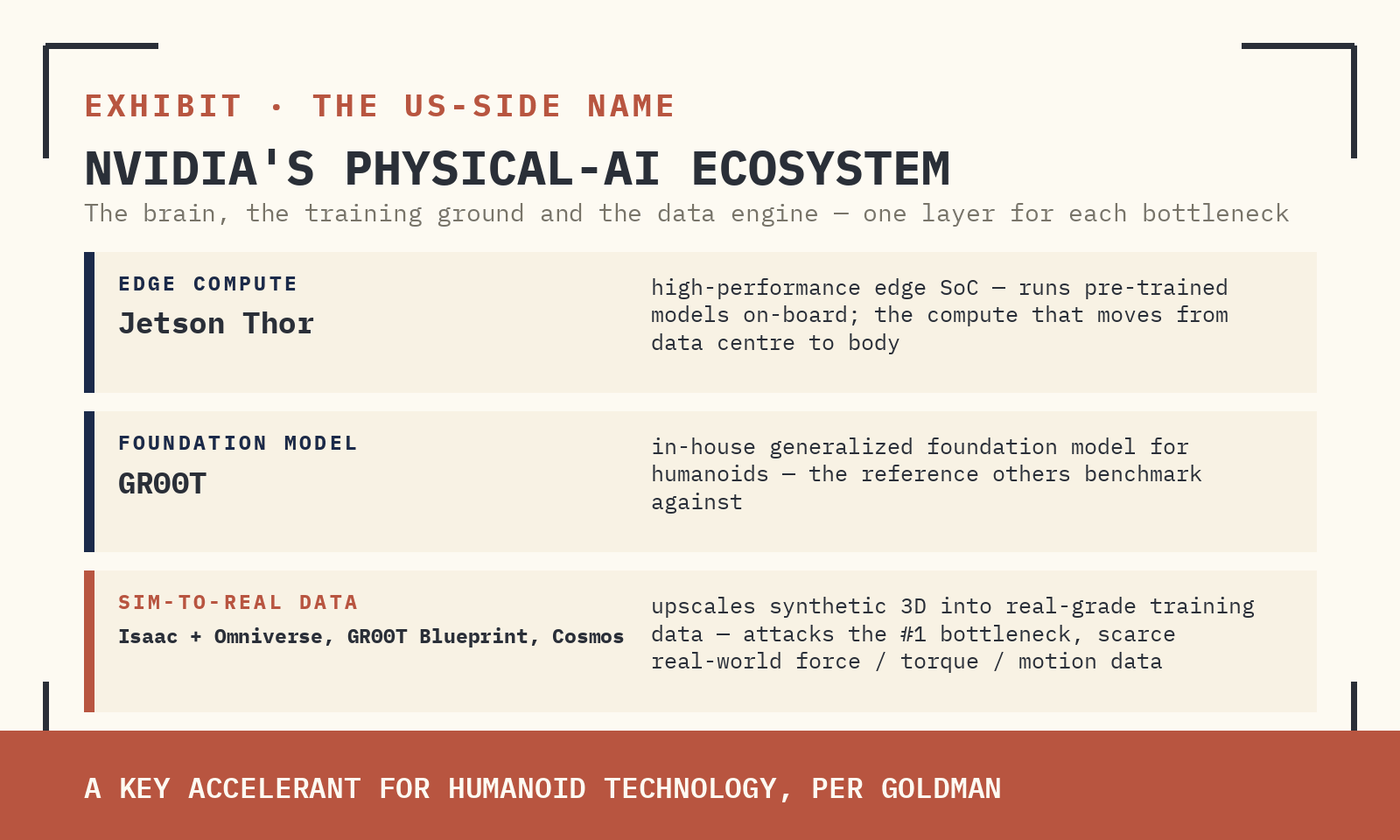
Strip out the Asian hardware and one US franchise sits underneath the entire stack. Goldman is explicit that NVIDIA's Physical-AI R&D ecosystem is a key accelerant for humanoid technology — and it touches all three of the bottlenecks the China trip identified.
- Edge compute — Jetson Thor — the high-performance edge SoC that lets a humanoid run pre-trained AI models on-board. This is the compute that moves from data centre to body.
- Foundation model — GR00T — NVIDIA's in-house generalized foundation model for humanoids, the reference others benchmark against.
- Sim-to-real data — Isaac + Omniverse, extended by Isaac GR00T Blueprint and Cosmos — a simulation framework and world-foundation-model pipeline that upscales synthetic 3D into real-grade training data. This directly attacks the #1 bottleneck: scarce real-world force/torque/motion data. Synthetic data acts as a proxy for physical data and compresses training time.
The investment logic: in a field where the model, data and hardware roadmaps have not converged — Goldman's own words, echoed by Geek+ management — the highest-certainty position is not the firm that wins the body, but the platform layer that supplies the training substrate to every contender. NVIDIA may benefit across multiple developers, but revenue depends on actual adoption, usage and commercial arrangements. It is the toll road on the rotation Goldman is calling.
In a field where model, data and hardware roadmaps have not converged, own the training substrate, not the body.
Supplied archive exhibit · original labels. Read alongside the editorial corrections.
Supplied archive exhibit · original labels. Read alongside the editorial corrections.
RISK
The Roadmap Is Not Converged
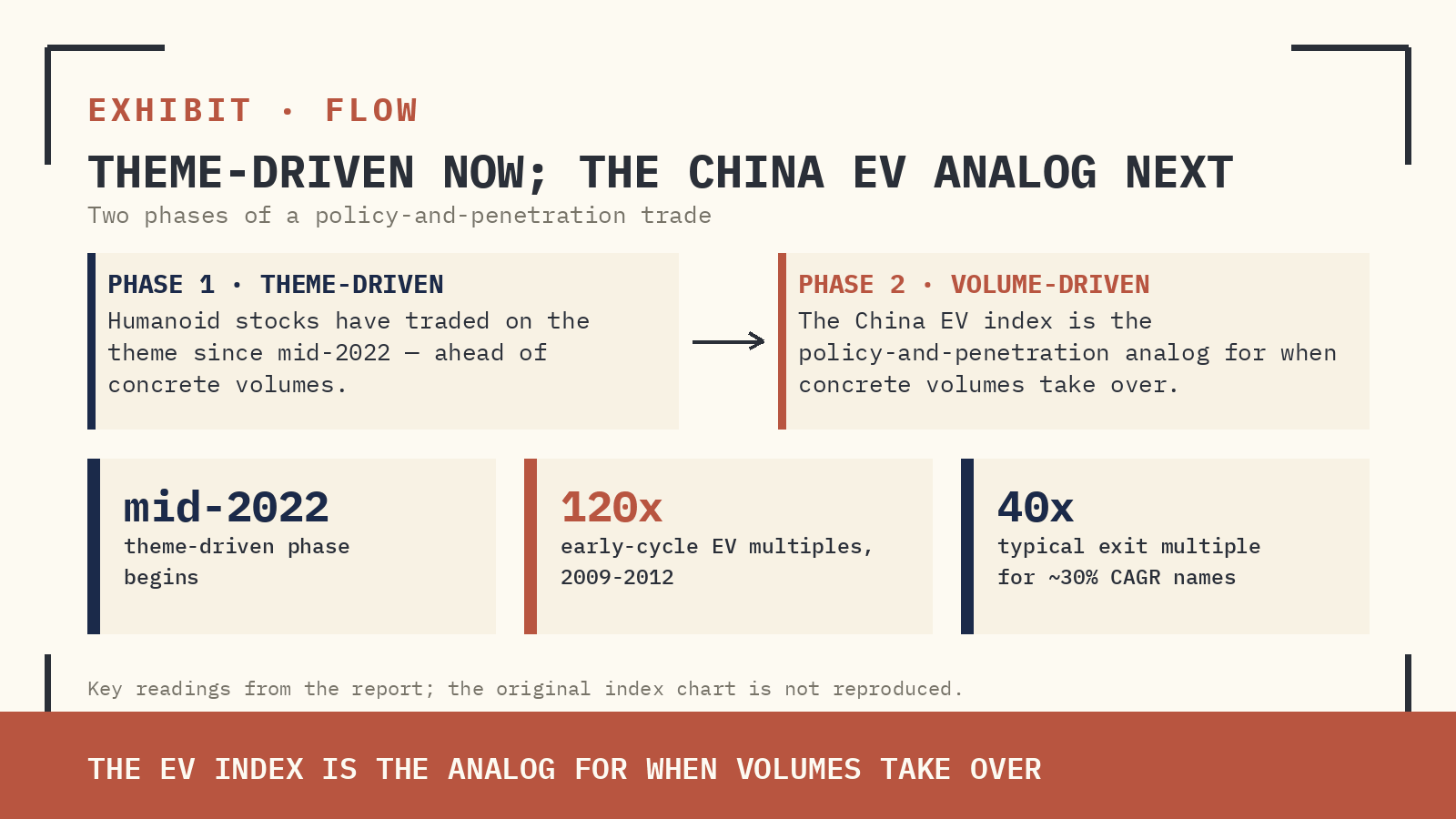
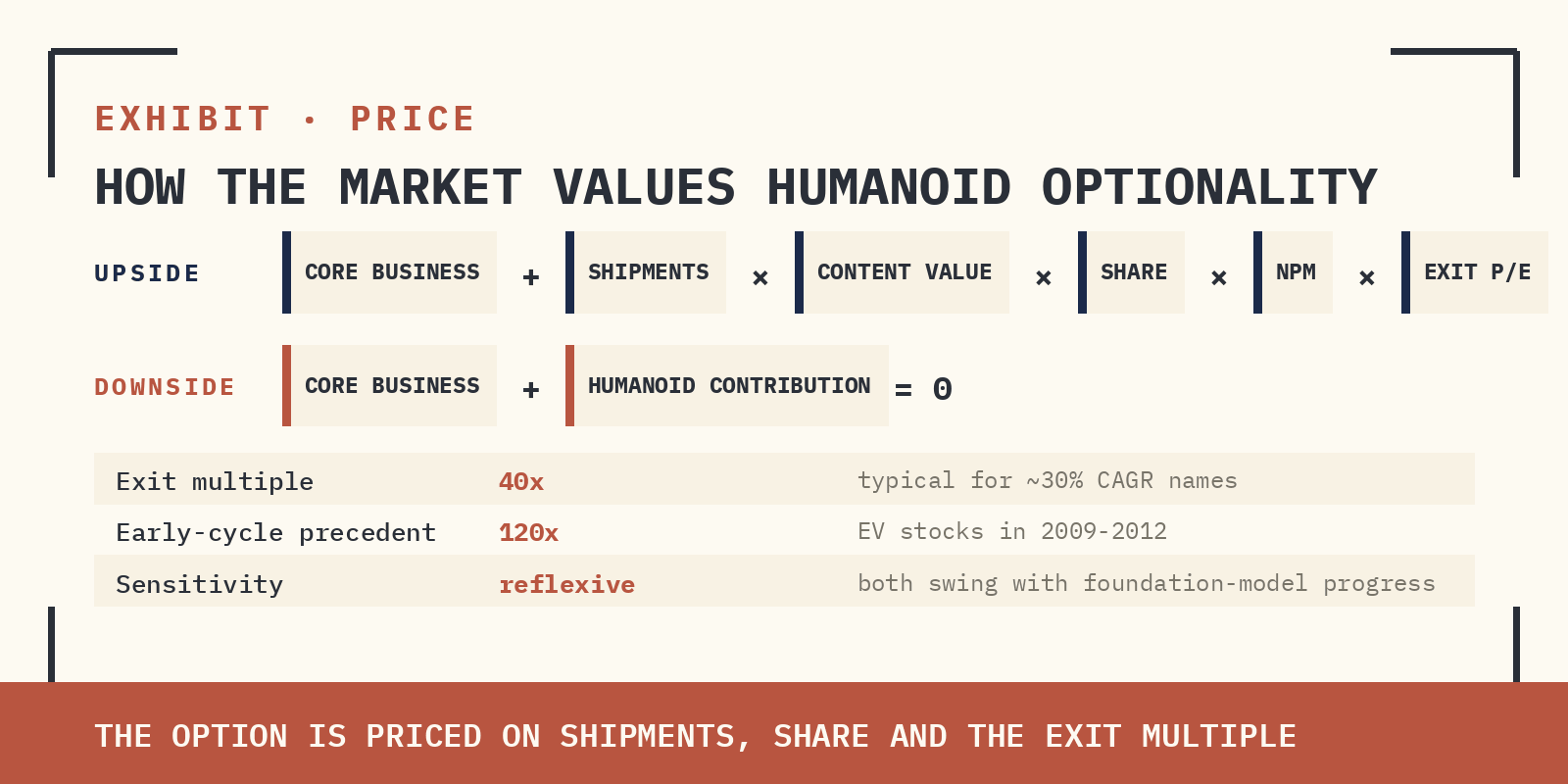
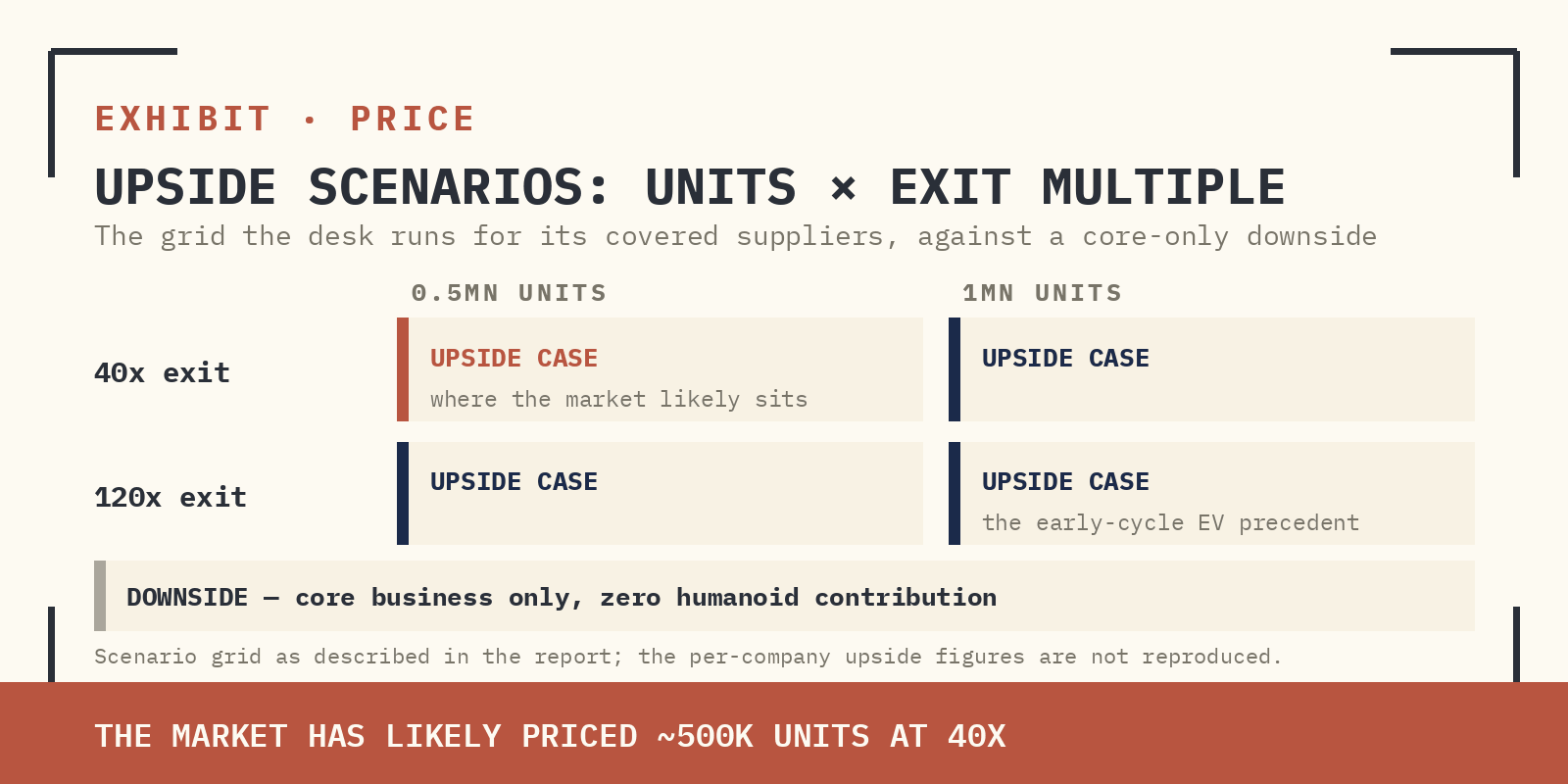
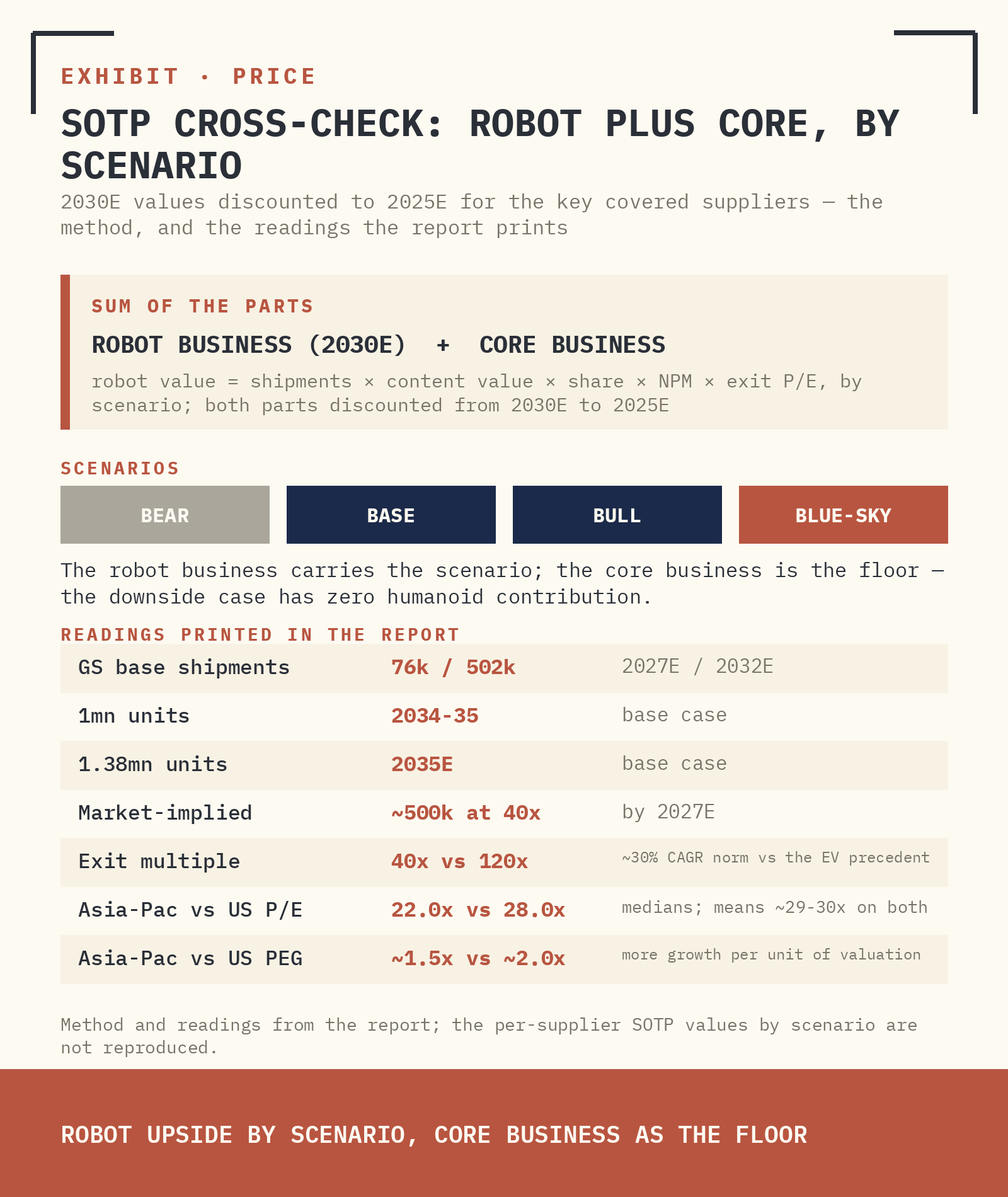
This is not a clean trade, and Goldman does not pretend otherwise. Its valuation work runs below the market: the bank forecasts ~76k global humanoid shipments by 2027E and ~502k by 2032E, against a market that has likely already priced ~500k units by 2027E on a 40x exit multiple. The market expects 1mn units; Goldman puts that milestone at 2034–35 in its base case. The gap between price and the bank's own shipment curve is the central risk to the long thesis.
Component-level risk is uneven. Goldman maps the supply chain by conviction:
COMPONENT | WHY IT MATTERS | GS PREFERRED SEGMENT | CONVICTION |
|---|---|---|---|
Actuator assembly | Lowest risk from hardware config changes; supply-chain integration role | Leading actuator assemblers | High |
Harmonic reducers | High precision / torque / weight barrier | Leading harmonic-reducer makers | High |
Planetary roller screw | Yield + capacity readiness in question | Dominant roller-screw maker (50–60% share) | Medium |
Dexterous hands | Roadmap unsettled (11–22+ DoF options) | Dexterous-hand component makers | Low / Watch |
- Inflection risk — Technology inflection is undefined. The bank's own bar: 5–10 generalized tasks at high success rate, continuous robustness under long hours, and quick reasoning. None is cleared today.
- Multiple risk — Valuation is reflexive. A 40x exit multiple is typical for ~30% CAGR names, but early-cycle EV stocks ran to 120x in 2009–2012. Shipment outlook and exit multiple are both highly sensitive to foundation-model progress — small changes swing the valuation hard in both directions.
- Supply-chain risk — Customer relationships are fluid. Goldman flags the supply chain is taking shape but bonds between robot makers and suppliers are dynamic — sample-stage today, not locked sole-source. Share assumptions (e.g. Sanhua/Tuopu 70/30, HDS/LeaderDrive 70/30) can move.
Supplied archive exhibit · original labels. Read alongside the editorial corrections.
Supplied archive exhibit · original labels. Read alongside the editorial corrections.
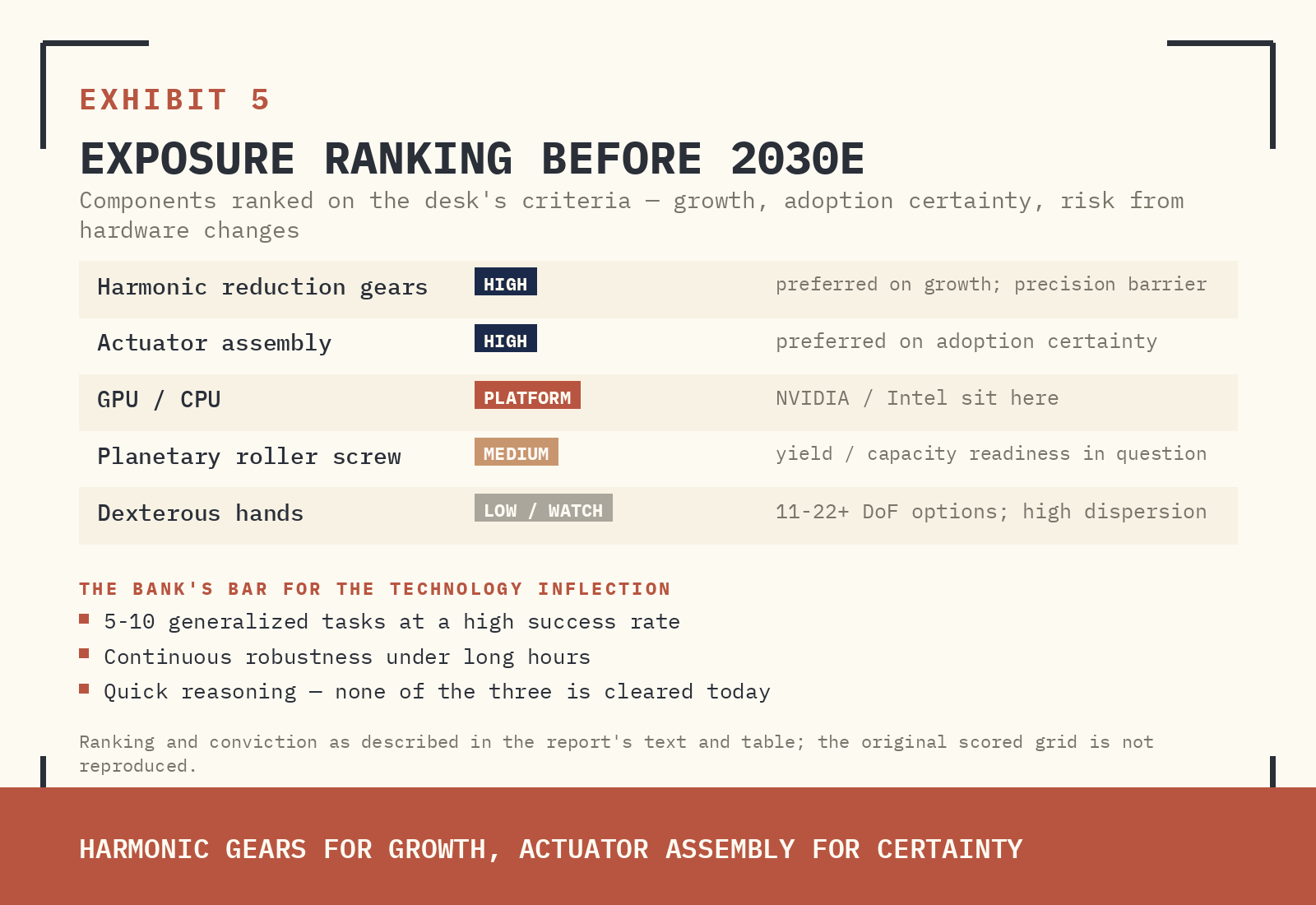
Supplied archive exhibit · original labels. Read alongside the editorial corrections.
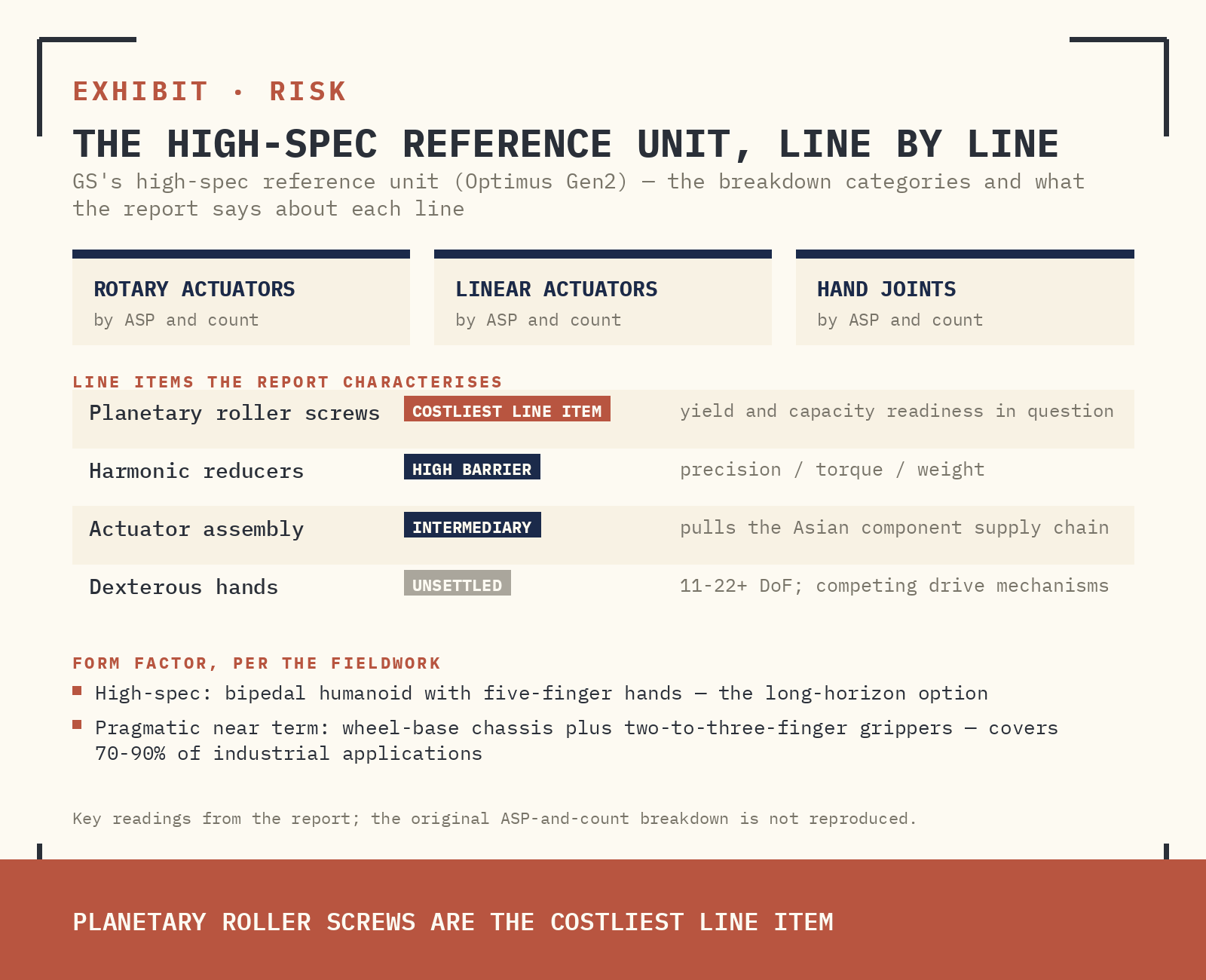
Supplied archive exhibit · original labels. Read alongside the editorial corrections.
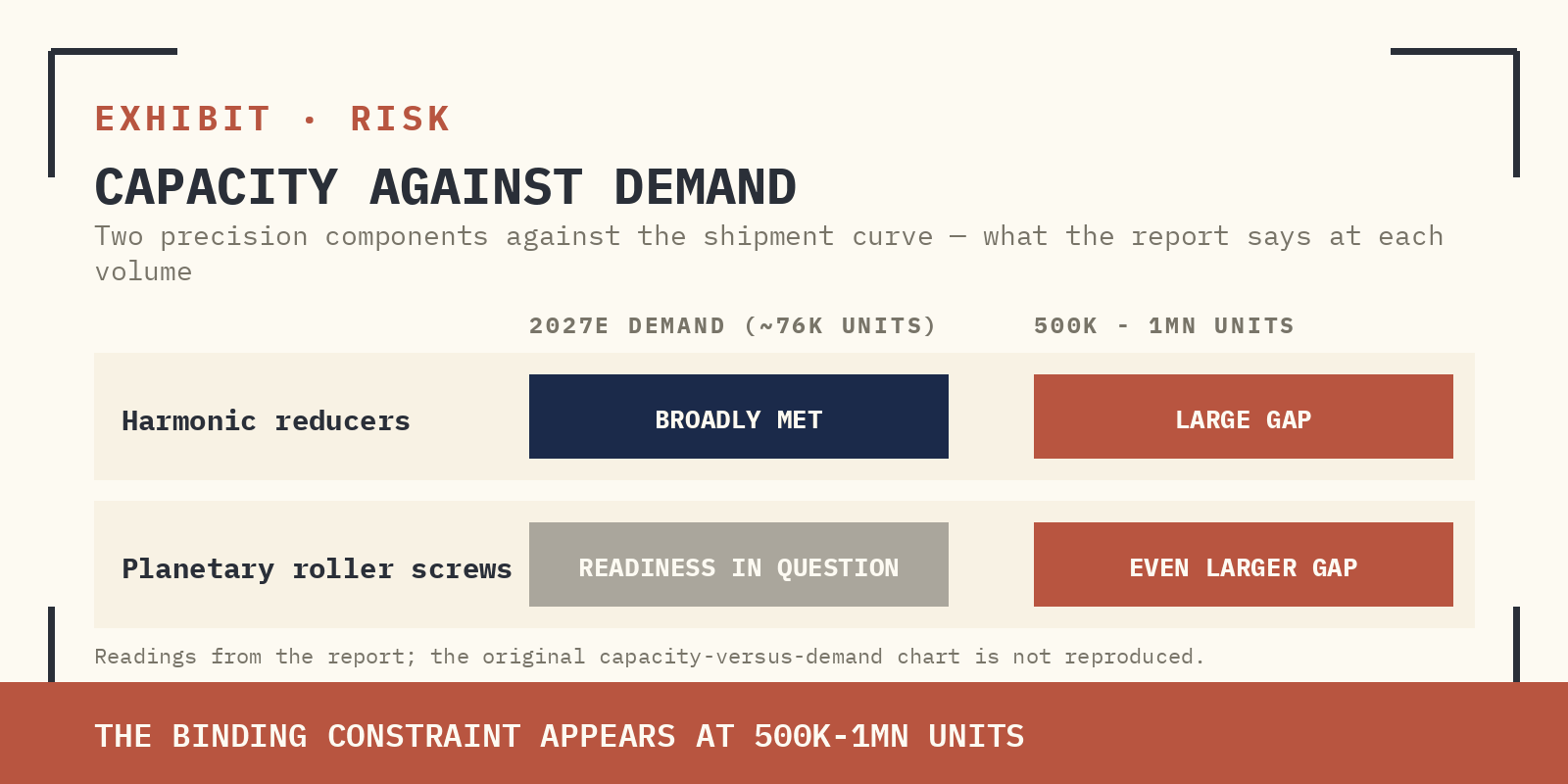
Supplied archive exhibit · original labels. Read alongside the editorial corrections.
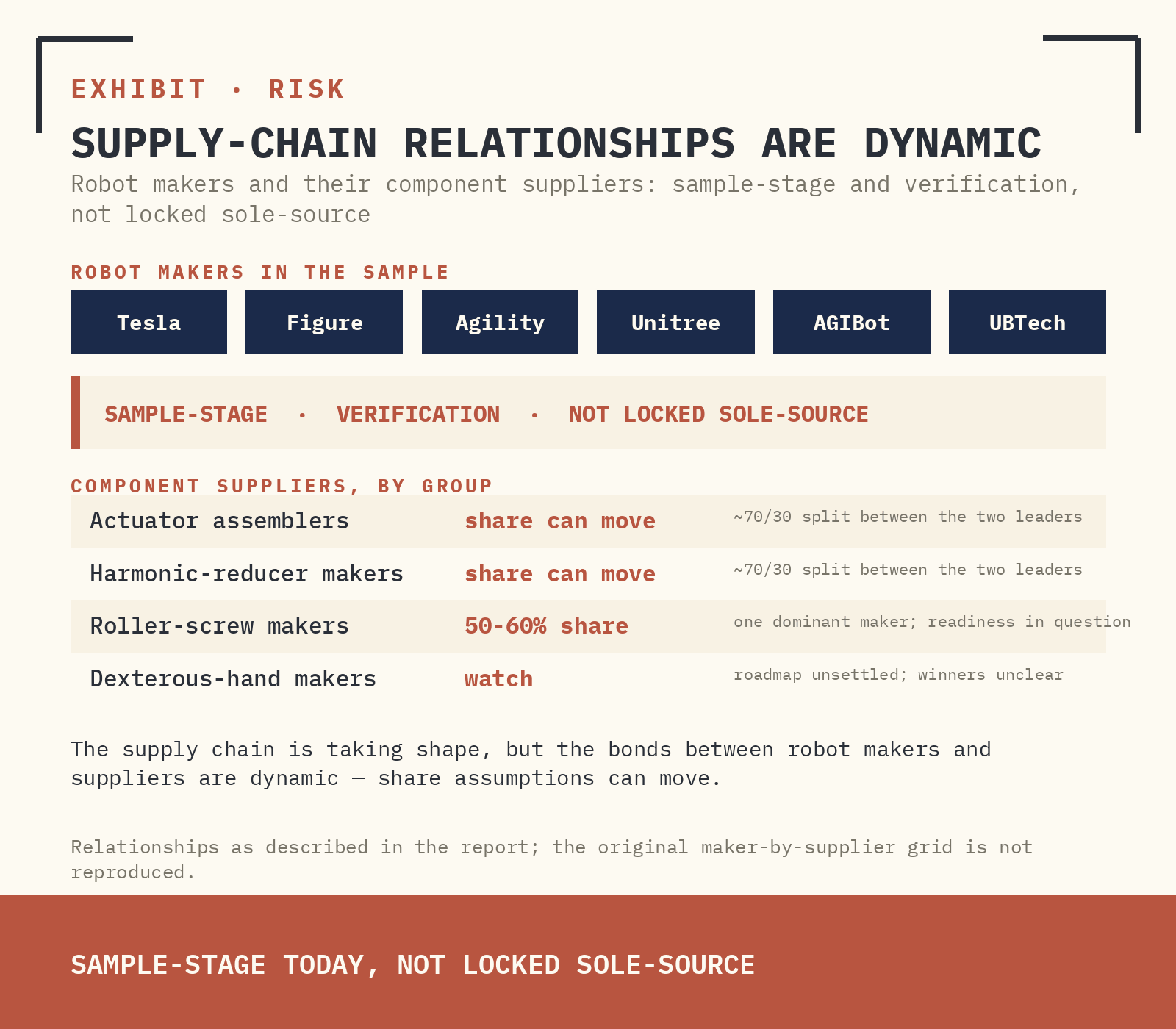
Supplied archive exhibit · original labels. Read alongside the editorial corrections.
PRICE
Discount Is the Entry, Not the Edge
On the desk's basket math both the Asia-Pac and US robotics baskets trade near ~29–30x P/E on a mean basis, so the means look comparable. The signal is in the median: the Asia-Pac median (22.0x) sits well below the US median (28.0x) — the typical Asian industrial/robotics name trades at roughly a 21% discount to its US peer. The Asia mean is inflated by outliers — Leader Harmonious Drive (~95x) and Harmonic Drive Japan (~85x).
Growth-adjusted, the case sharpens: the Asia-Pac basket's median PEG is ~1.5x versus ~2.0x for the US — more earnings growth per unit of valuation, driven by higher expected growth in Chinese and Korean names (Tuopu, Sanhua, Hengli Hydraulic) relative to their multiples. The discount plus the growth differential is the entry. It is not, on its own, the edge — the edge is owning the converged winners before the roadmap settles.
Supplied archive exhibit · original labels. Read alongside the editorial corrections.
Supplied archive exhibit · original labels. Read alongside the editorial corrections.
Supplied archive exhibit · original labels. Read alongside the editorial corrections.
POSITION
How to Express It
Figure 02 · Qualitative comparison
Three ways to participate in physical AI
| Layer | Potential strength | Main uncertainty |
|---|---|---|
| Platforms | Serve several developers | Adoption, competition and pricing |
| Components | Industrial manufacturing know-how | Architecture shifts and customer concentration |
| Robot makers | Own the finished solution | Reliability, deployment cost and scale |
Sectors set to outperform
- Physical-AI platform (US) — Highest-certainty layer. The training/compute substrate that many robot makers use, regardless of body winner.
- Actuator & harmonic-gear supply chain (Asia) — Where flow is already going and where the technology barrier is real (precision, torque, weight). Actuator assemblers and harmonic-reducer leaders screen best on risk-adjusted certainty.
- Industrial automation & precision components — The Korea/China auto-component complex is the passive-rebalancing and active-rotation beneficiary — earlier and cheaper than pure-play robotics.
Sectors to underweight / watch
- Dexterous hands — Roadmap unsettled (11 to 22+ DoF, competing drive mechanisms). High dispersion, low visibility on winners. Watch, don't anchor.
- Planetary roller screws — Yield, production consistency and capacity readiness unproven at volume; long-term share winner unclear. Position only through diversified suppliers.
- Headline robot bodies at current multiples — Pure-play full-humanoid bodies, where the market has arguably already priced the TAM the bank's own model does not reach until the 2030s.
Expressions by layer
The cleanest US-side and Asia-side layers recurring across Goldman's coverage:
US-SIDE EXPRESSION | LAYER | THE ANGLE |
|---|---|---|
AI platform layer | Platform / enabler | Edge SoC, foundation model and sim-to-real data pipelines — the chips and robot software many developers use. Can supply multiple developers, subject to actual technology adoption. |
High-spec humanoid makers | Full humanoid (high-spec) | GS's high-spec reference unit pulls the Asian component supply chain, needs actuator assembler intermediary. |
Figure AI | Full humanoid (private) | US volume-production cohort alongside Agility; commercial pilots the near-term proof points. |
Agility Robotics | Full humanoid (private) | Logistics-first deployment; furthest along in structured-workflow commercialization in the US. |
Supplied archive exhibit · original labels. Read alongside the editorial corrections.

Supplied archive exhibit · original labels. Read alongside the editorial corrections.
Asia hardware beneficiaries flagged by the desk: actuator assemblers; harmonic-reducer makers; roller-screw makers; the flow / passive-rebalancing beneficiaries; and the listed Chinese robot makers for direct ecosystem exposure.
For allocators who want the theme without single-name roadmap risk, the desk notes a thematic ETF now exists — and the GSXACHUM basket is the institutional benchmark.
Own the toll road (the AI platform layer) and the picks-and-shovels (actuators, harmonic gears). Rent the body through baskets. Let the roadmap converge before paying full multiple for a winner.
The Bottom Line
Goldman is calling the rotation from AI infrastructure to AI application, and humanoid robotics is the vehicle. The trade is real but early — flow is in components, not bodies; commercialization is POC, not scale; the bank's shipment curve runs below the market's price. The disciplined expression is to own the enabler and the supply chain, rent the bodies through baskets, and wait for the technology inflection — 5–10 generalized tasks at high reliability — before paying up for a converged winner. On the US side, that enabler is the AI platform layer — the chips and robot software many developers use.