
Original Lens and publication context
Why China’s cost-efficient models — not a collapse in demand — are the real threat to US AI economics, and how a tiered global market re-rates the winners.
- Chinese frontier models have reached roughly 90% of US intelligence at about a tenth of training cost and under a fifth of API price — while holding 20–40% gross margins, proving the discount is structural efficiency, not subsidy.
- The trigger is GLM-5.2 and DeepSeek V4 — open-weight and benchmark-competitive — plus Microsoft evaluating a self-hosted DeepSeek for Copilot, signalling that frontier intelligence is no longer a durable moat.
- Enterprises are flipping from “token-maxxing” to ROI discipline (Uber, Walmart, Amazon, Meta caps), and only ~18% of AI-coding spend reaches production output — a setup that hands volume to the cheap, good-enough tier.
- The real risk to US AI equities is reflexive: the first hyperscaler to credibly slow capex gets rewarded, stalling the cycle from the funding side — watch compute-rental prices and the check-receiver vs check-writer spread.
- Base case is a tiered global market — frontier models as scarce premium capacity, Chinese cost-performance models taking 30–50% of high-volume workloads (the EV/smartphone analogy) — so position for tiering, not takeover.
TRIGGER
The frontier stopped being a moat
Two developments collapsed into one signal this month. A new wave of Chinese open-weight models — GLM-5.2 the latest — landed within touching distance of the best closed US systems on software-engineering benchmarks, shipping under permissive licences that allow distillation, quantisation and self-hosting. At the same time, Microsoft began evaluating a self-hosted, fine-tuned DeepSeek V4 for Copilot, already onboarded to its Azure foundry, as a substitute for more expensive US frontier APIs. Set against Washington’s containment posture — the export restriction that forced Anthropic to disable foreign access to its newest tier — the message to any cost-conscious buyer is blunt: the frontier is no longer a durable moat, and the next-best model now costs a fraction of the best one.
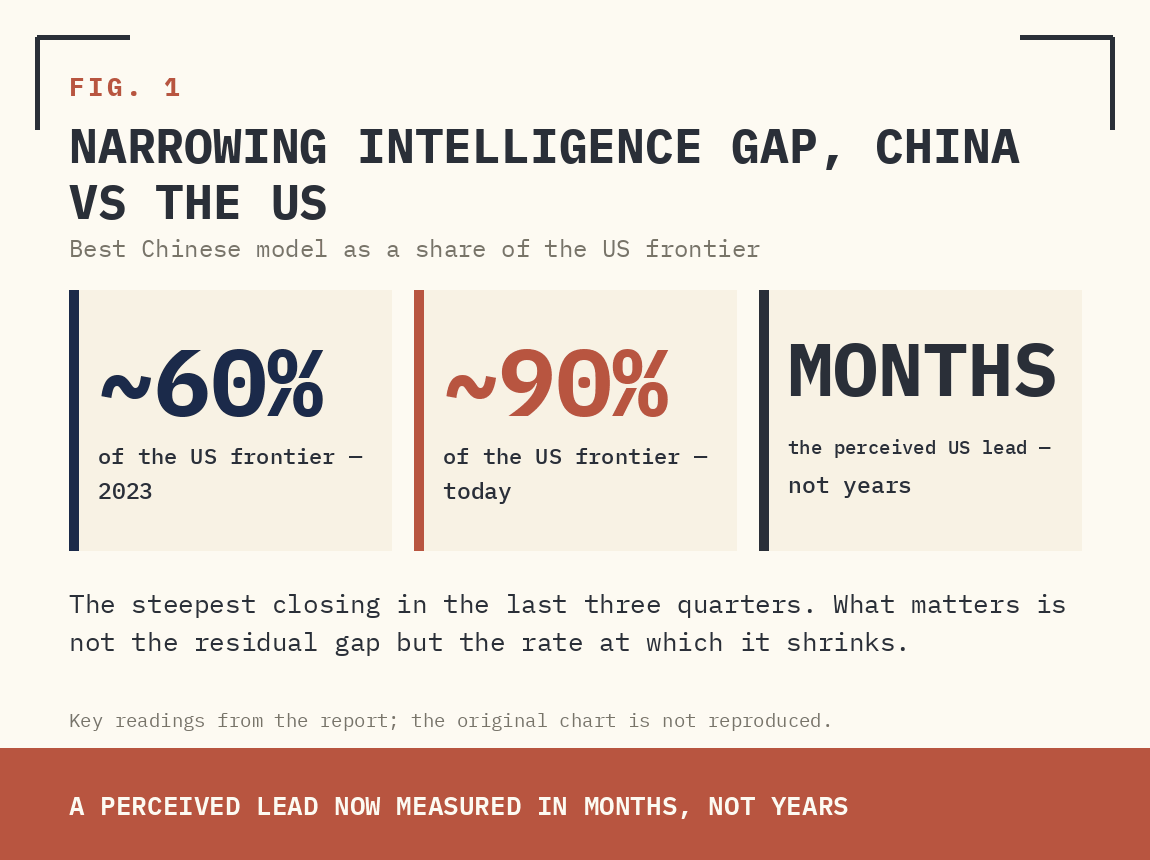
The best Chinese model has climbed from roughly 60% of the US frontier in 2023 to about 90% today, the steepest closing in the last three quarters. What matters is not the residual gap but the rate at which it shrinks — a perceived lead now measured in months, not years.
Supplied archive exhibit · original publication context.
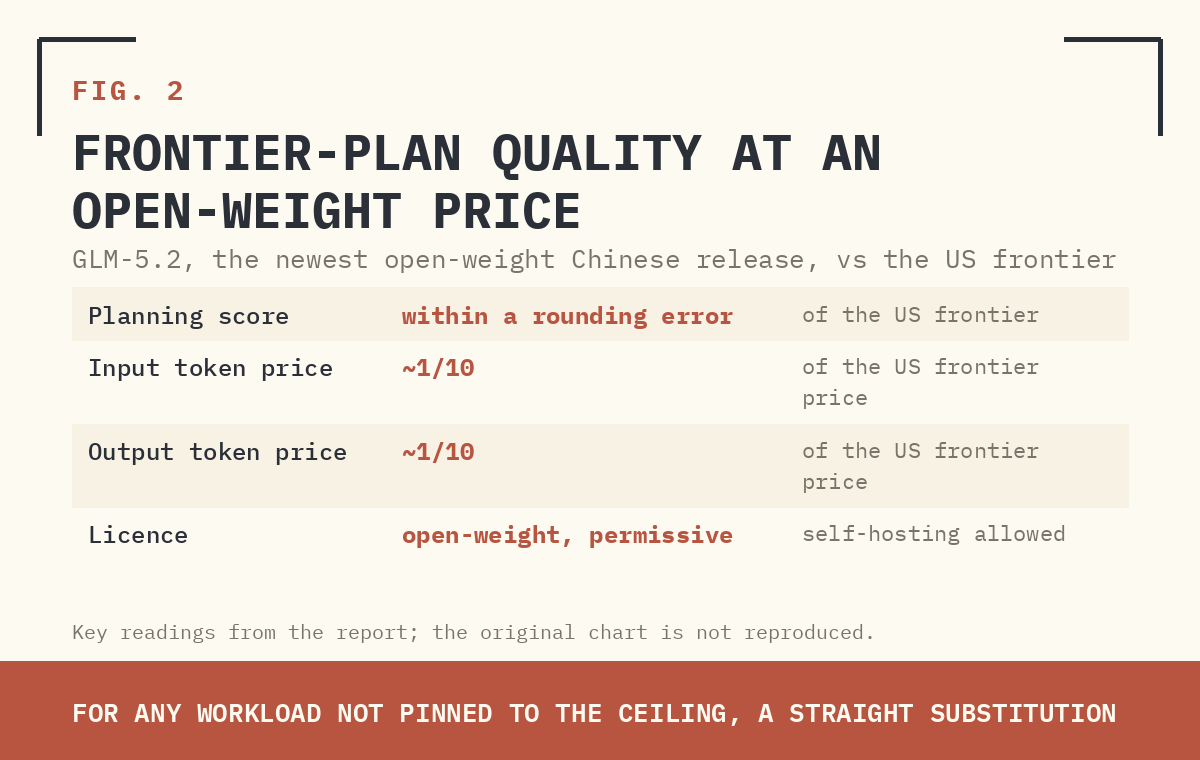
The trade in one card: the newest open-weight Chinese release matches the US frontier’s planning score within a rounding error, at roughly a tenth of the price on both input and output tokens. For any workload not pinned to the absolute ceiling, that is a straight substitution.
Supplied archive exhibit · original publication context.
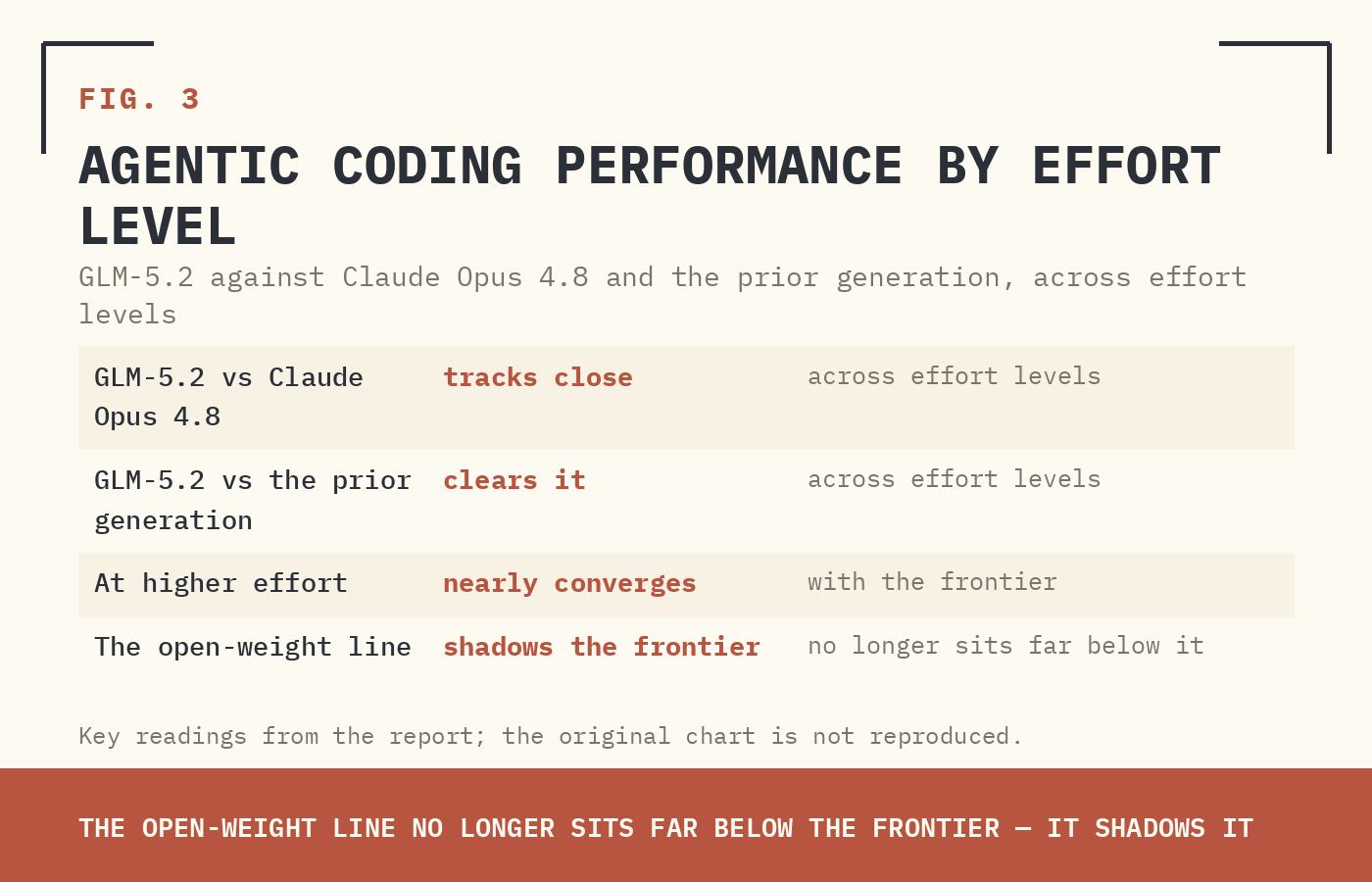
Across effort levels, GLM-5.2 tracks close to Claude Opus 4.8 and clears the prior generation; at higher effort it nearly converges. The open-weight line no longer sits far below the frontier — it shadows it.
Supplied archive exhibit · original publication context.
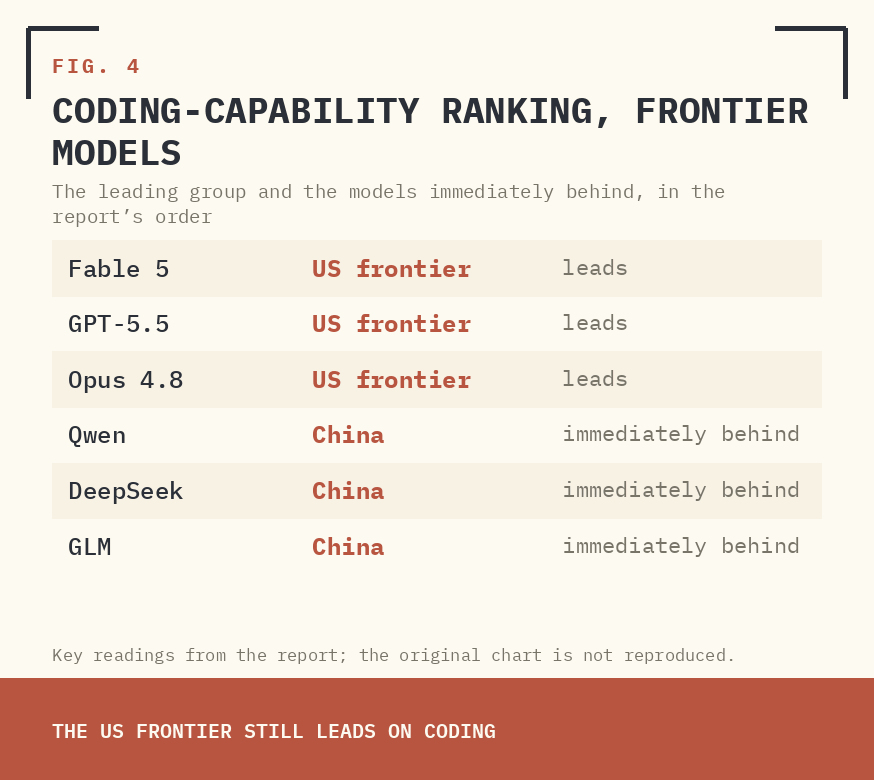
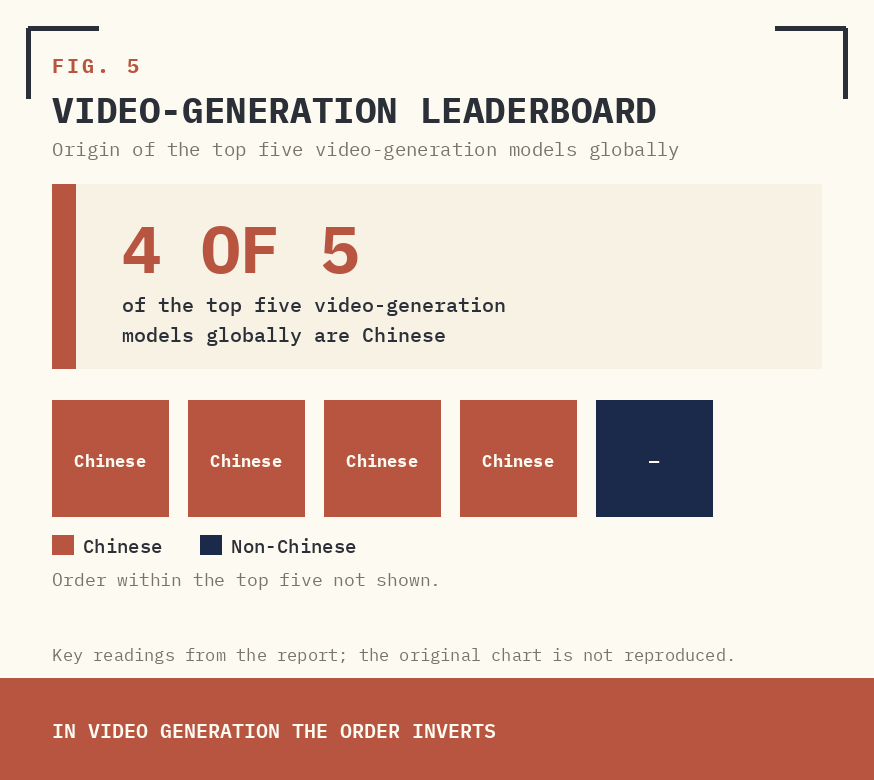
On coding the US frontier still leads — Fable 5, GPT-5.5, Opus 4.8 — but Qwen, DeepSeek and GLM sit immediately behind. In video generation the order inverts: four of the top five models globally are Chinese.
Supplied archive exhibit · original publication context.
Supplied archive exhibit · original publication context.
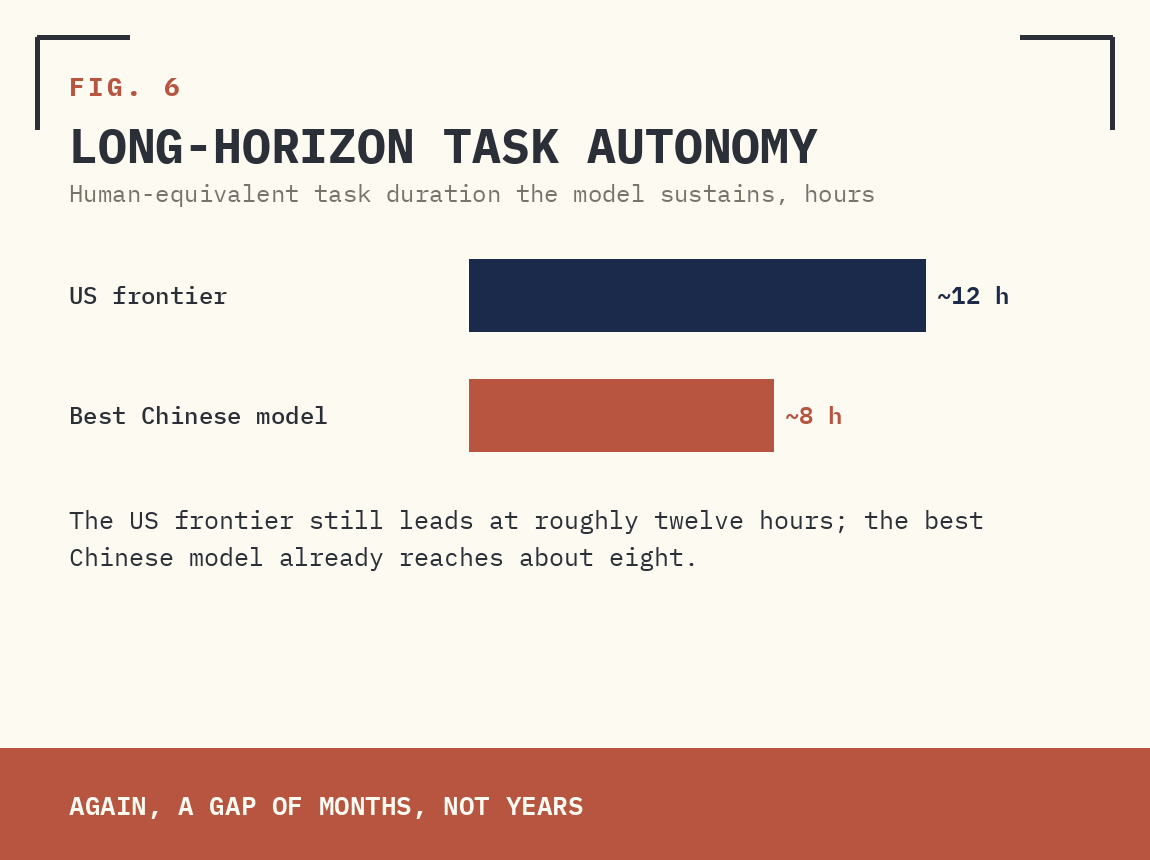
On long-horizon autonomy the US frontier still leads at roughly twelve hours, but the best Chinese model already reaches about eight — again, a gap of months, not years.
Supplied archive exhibit · original publication context.
The next-best model now costs a fraction of the best one. That is not a demand story. It is a margin story.
The question is therefore no longer whether intelligence keeps improving. It is whether falling intelligence costs create more incremental demand than they destroy in pricing power. That is the trillion-dollar question — and it now routes through Beijing.
FLOW
Figure 01 · Conceptual framework
Why cheaper intelligence does not settle who wins
Usage is migrating to the cheap tier
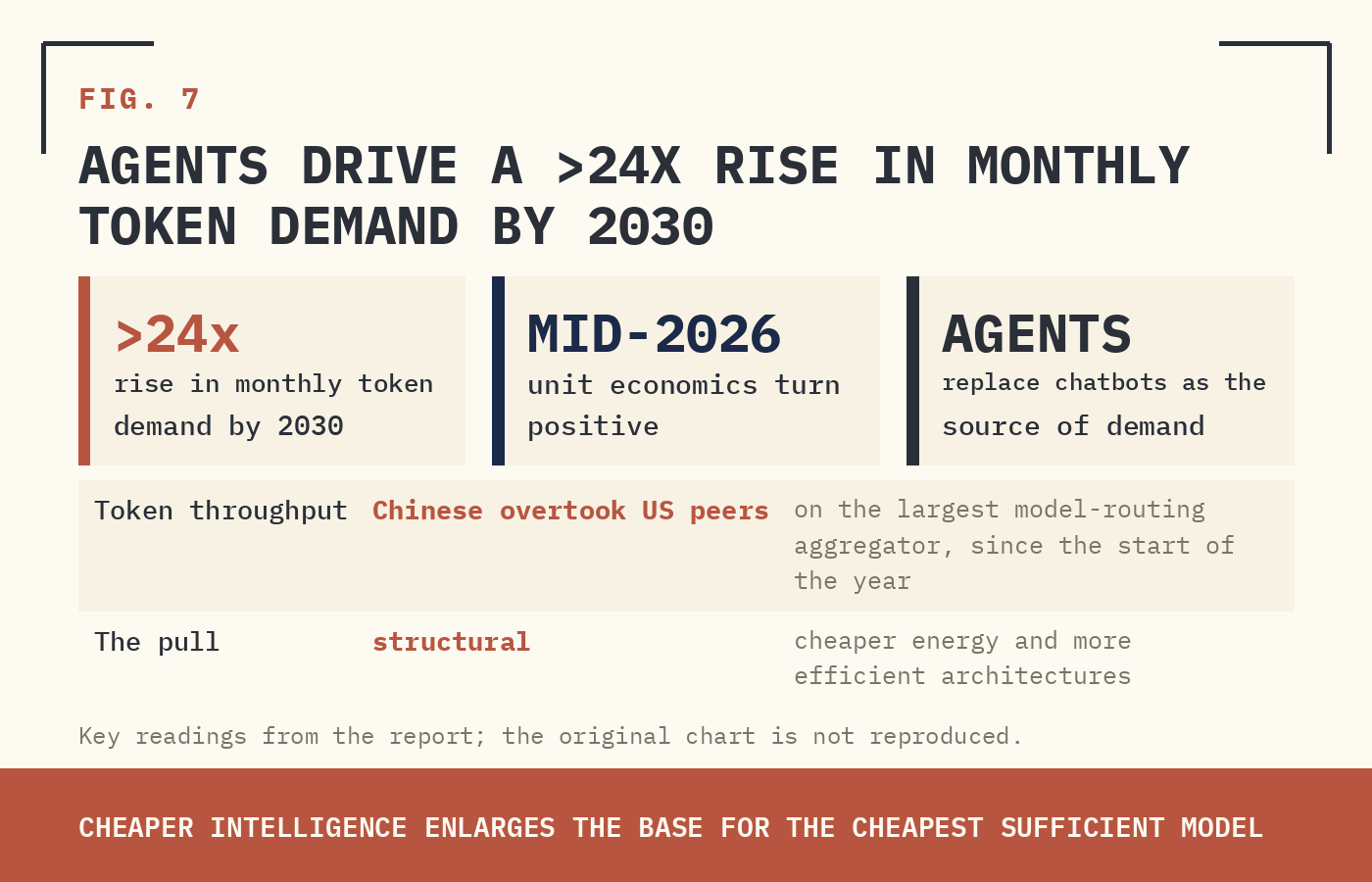
Follow the tokens. Since the start of the year, Chinese models have overtaken their US peers in token throughput on the largest model-routing aggregator — a direct read on where marginal usage is being placed. The pull is structural: cheaper energy and more efficient architectures let Chinese labs price tokens at a deep discount while preserving throughput.
As agents replace chatbots, monthly token consumption is projected to rise more than twenty-fold by 2030, with unit economics turning positive around mid-2026. Cheaper intelligence enlarges the base over which the cheapest sufficient model is run — the question is which tier captures the new volume.
Supplied archive exhibit · original publication context.
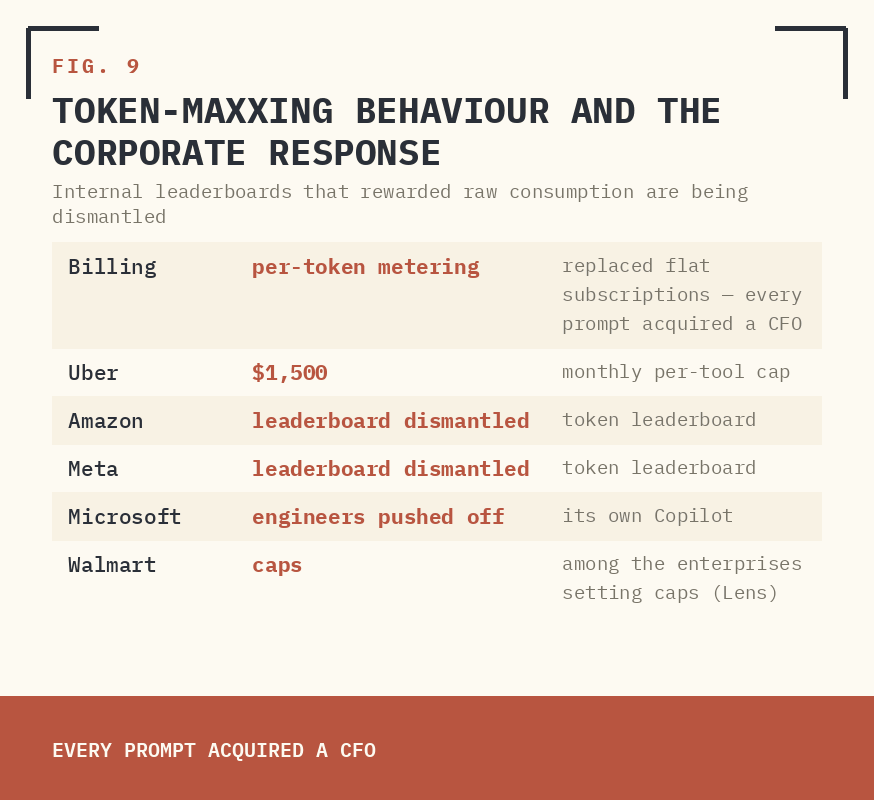
The demand side is turning disciplined at the same moment. The era of “token-maxxing” — internal leaderboards that rewarded raw consumption — is being dismantled. As billing shifted from flat subscriptions to per-token metering, every prompt acquired a CFO, and enterprises began auditing whether incremental tokens translate into output.
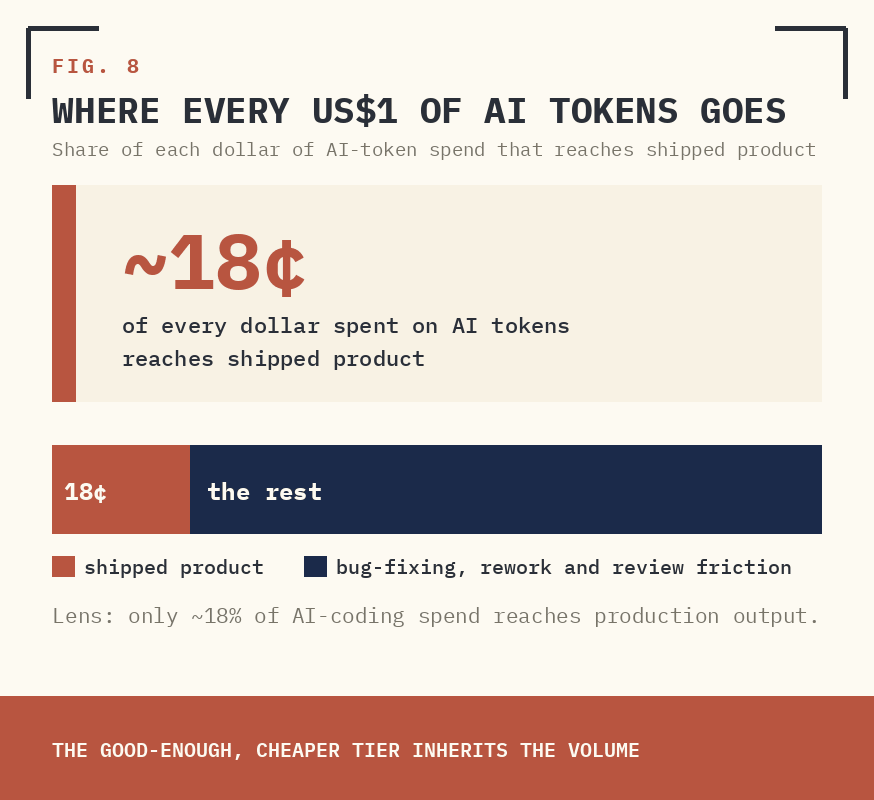
Of every dollar spent on AI tokens, only about eighteen cents reaches shipped product; the rest is lost to bug-fixing, rework and review friction. The response is catalogued alongside: Uber’s $1,500 monthly per-tool cap, Amazon and Meta dismantling token leaderboards, Microsoft pushing engineers off its own Copilot. When buyers move from maximising usage to maximising return, the good-enough, cheaper tier inherits the volume.
Supplied archive exhibit · original publication context.
Supplied archive exhibit · original publication context.
RISK
Reflexivity, not demand, breaks the cycle
The bullish frame says cheaper intelligence expands the market: lower unit costs, more tokens, more compute demand. That holds in aggregate. The bearish frame is reflexive and nearer-term. The market has already split the AI trade in two — the “check-writers” (hyperscalers funding the capex) against the “check-receivers” (the picks-and-shovels hardware that benefits from the spend) — and has stopped rewarding the writers for outlay alone.
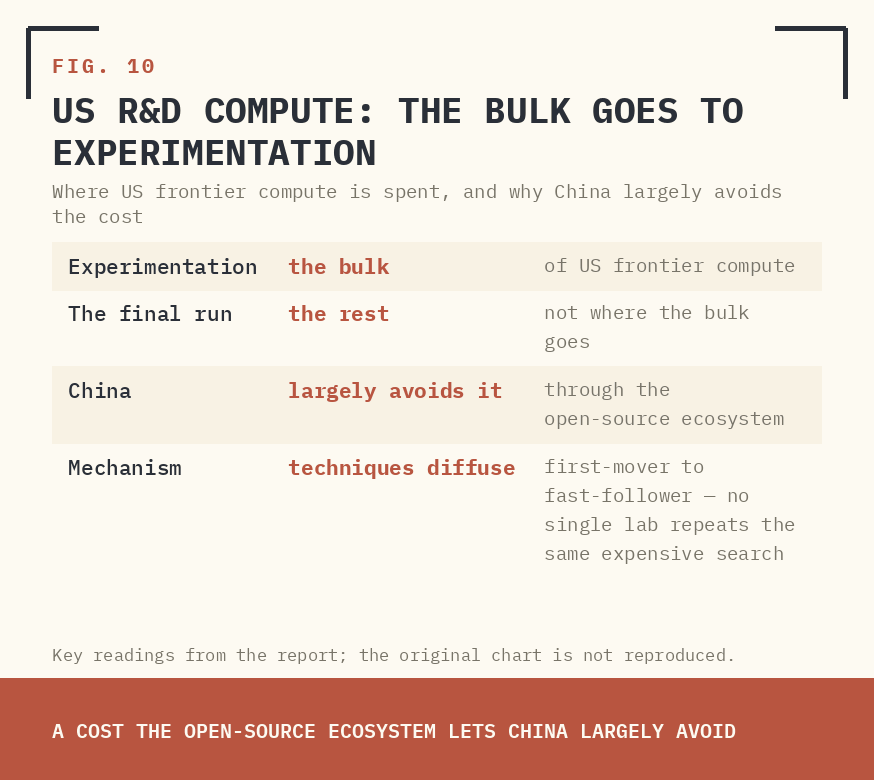
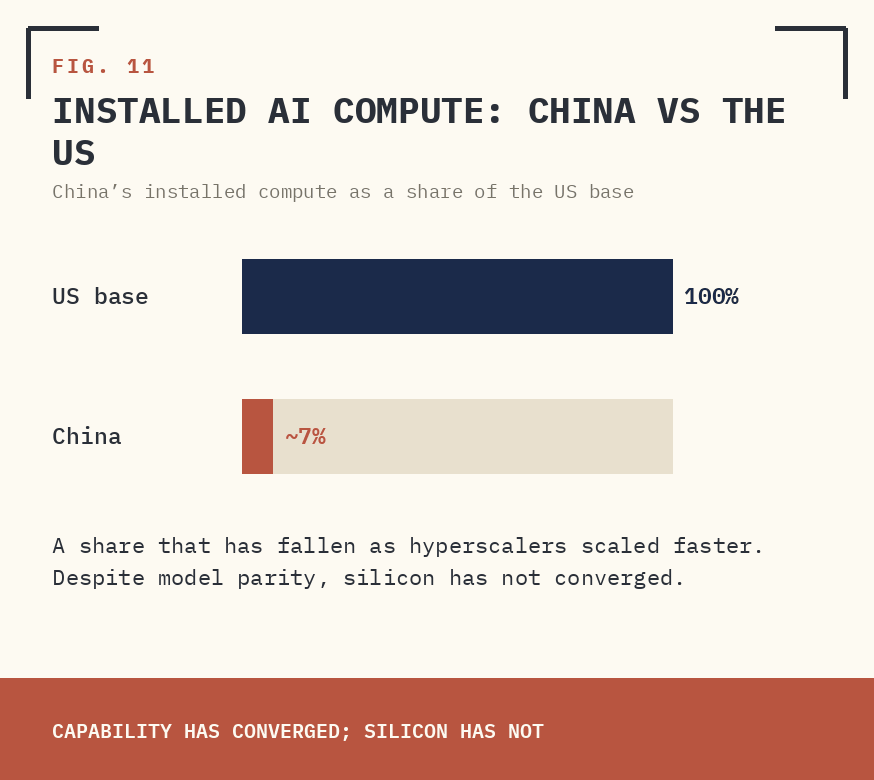
Two reasons the funders keep funding. The bulk of US frontier compute goes to experimentation rather than the final run — a cost the open-source ecosystem lets China largely avoid. And despite model parity, China’s installed compute is only ~7% of the US base, a share that has fallen as hyperscalers scaled faster. Capability has converged; silicon has not, which keeps a wholesale Chinese capture of the frontier in the low-probability tail.
Supplied archive exhibit · original publication context.
Supplied archive exhibit · original publication context.
The single most dangerous catalyst is not a demand air-pocket. It is the first hyperscaler that credibly signals it can deliver equivalent output for less. That share price gets rewarded, the others take notice, and the capex cycle stalls from the funding side — a decision that the next dollar of spend no longer earns its return, not a collapse in end-usage. Two tells matter more than headline token growth: compute-rental prices, because the entire bull case rests on scarcity and the pain shows up first in hardware; and the check-receiver versus check-writer spread itself. Chinese competition cuts both ways — by narrowing the perceived gap to a few months it raises the perceived necessity to spend, an arms-race dynamic that can lift aggregate investment even as it deflates token economics.
The capex cycle will not stall on weak demand. It stalls the moment investors decide the next dollar of spend no longer earns its return.
PRICE
Figure 02 · Qualitative comparison
Three possible market structures
| Structure | What drives selection | Economic implication |
|---|---|---|
| Cost-led | Price and acceptable output | Strong volume pressure on premium APIs |
| Ecosystem-led | Workflow integration and switching costs | Distribution can defend pricing |
| Cost-performance tiering | Task requirements and sufficient quality | Several model tiers coexist |
The discount is engineered, not subsidised
The instinctive dismissal — that Chinese pricing is a loss-leading land-grab — does not survive the data. The exhibits dismantle it in sequence: first the size of the price gap, then the margin it leaves intact, then the cost base that makes both possible.
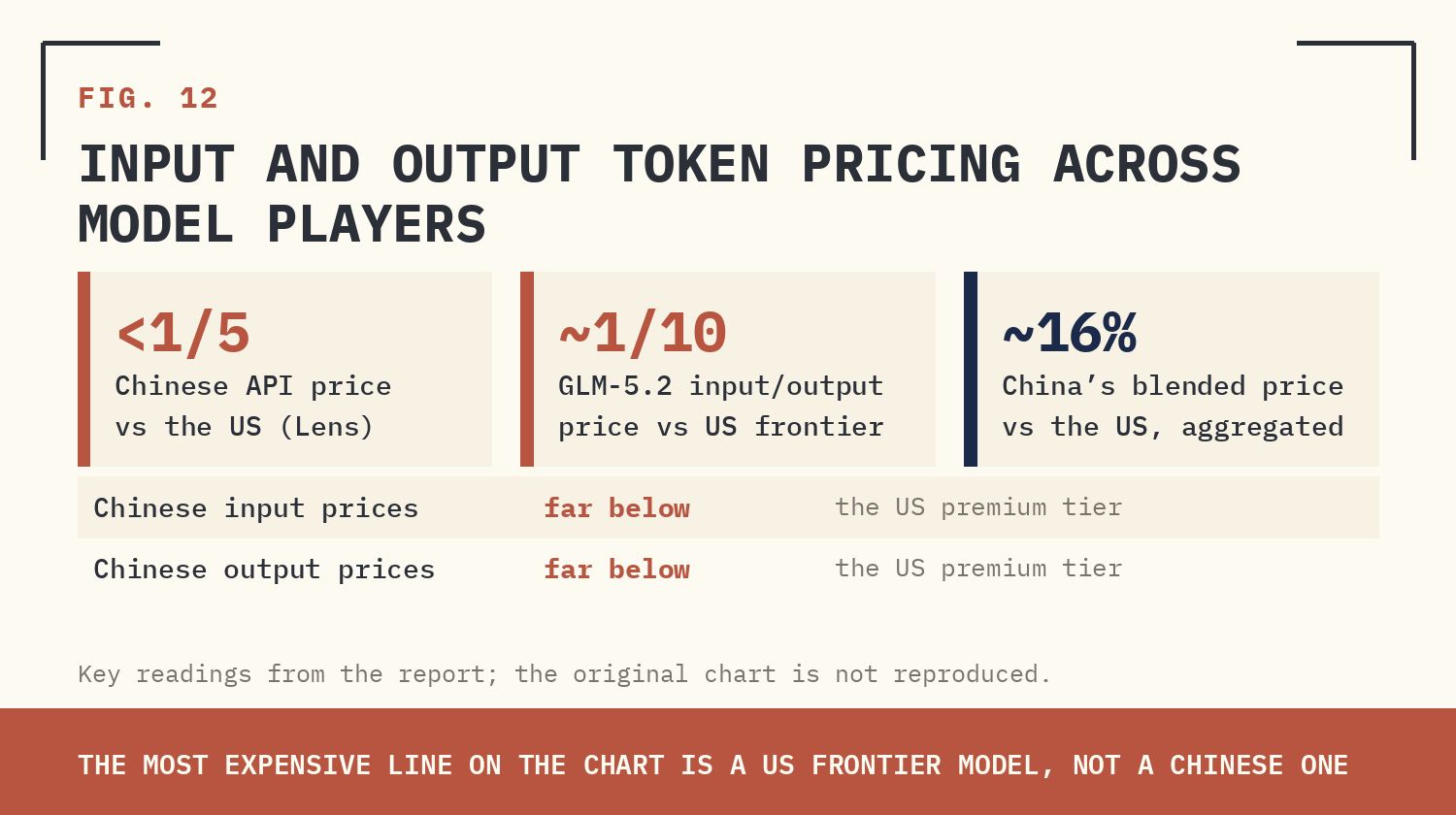
Model-level pricing makes the gap concrete: Chinese input and output prices sit far below the US premium tier, with the most expensive line on the chart a US frontier model rather than a Chinese one.
Supplied archive exhibit · original publication context.
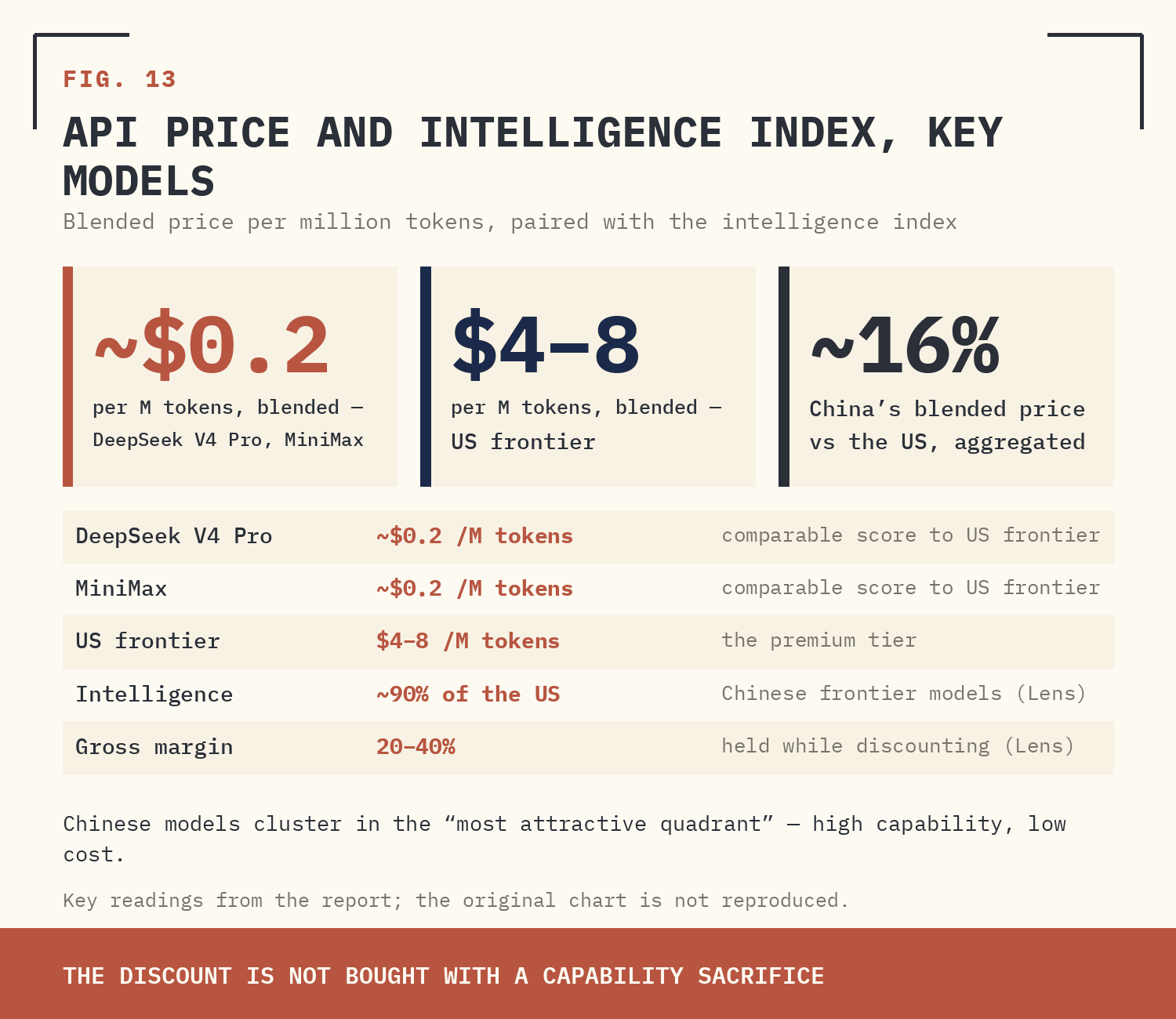
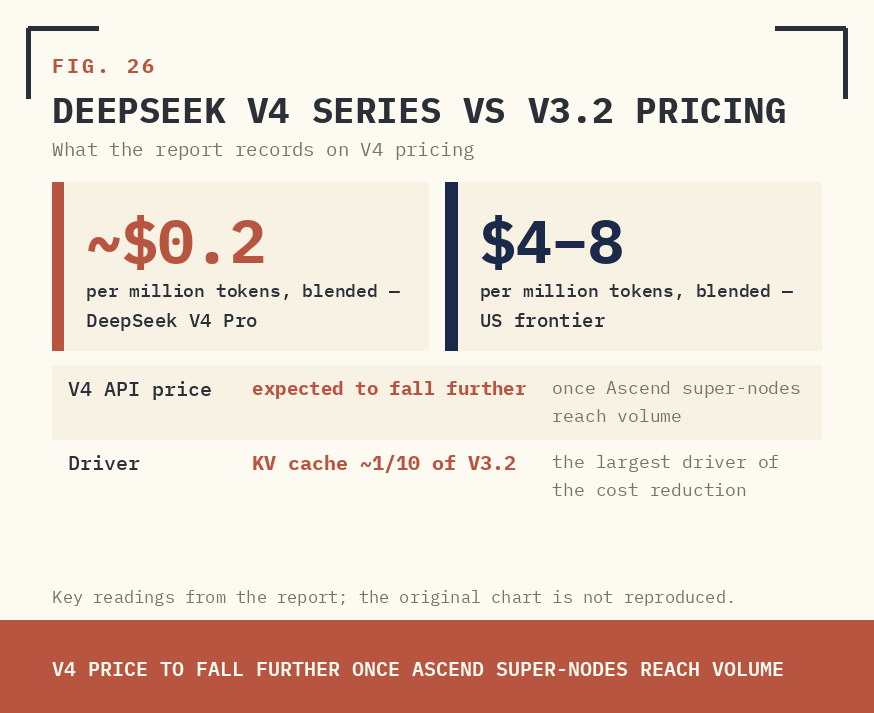
The master table pairs blended price with the intelligence index. DeepSeek V4 Pro and MiniMax blend near $0.2 per million tokens against $4–8 for the US frontier, at comparable scores — the discount is not bought with a capability sacrifice.
Supplied archive exhibit · original publication context.
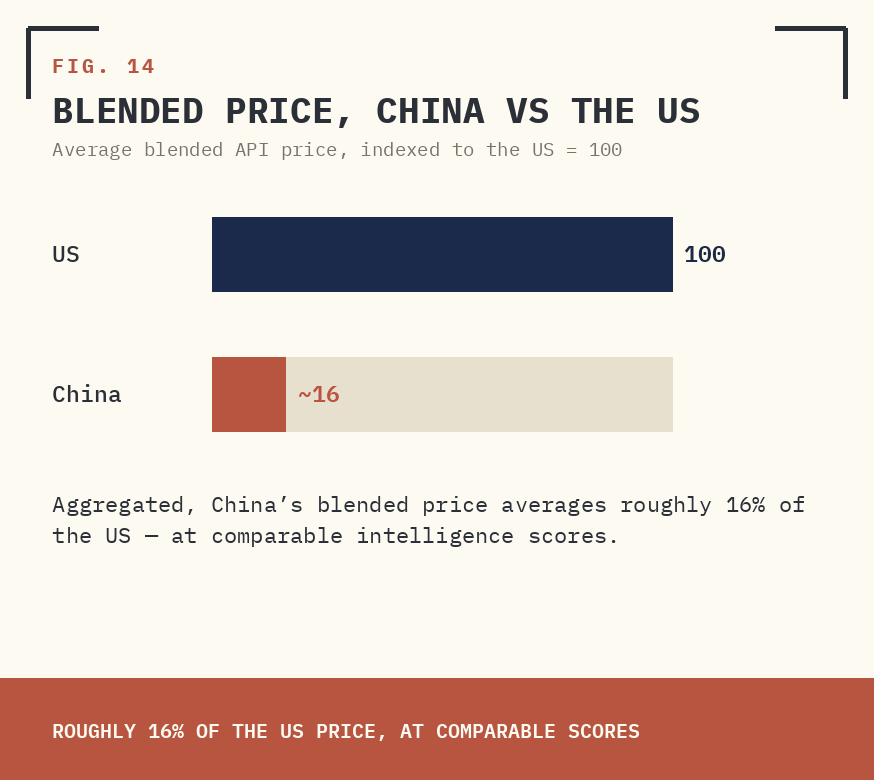
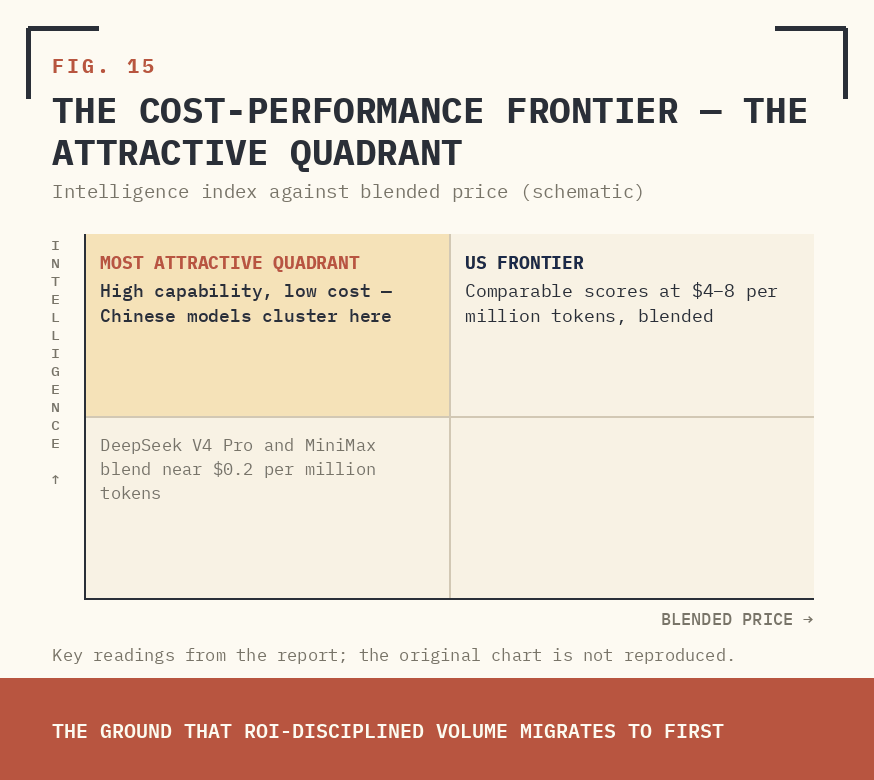
Aggregated, China’s blended price averages roughly 16% of the US. Plotting score against price, the Chinese models cluster in the “most attractive quadrant” — high capability, low cost — the ground that ROI-disciplined volume migrates to first.
Supplied archive exhibit · original publication context.
Supplied archive exhibit · original publication context.
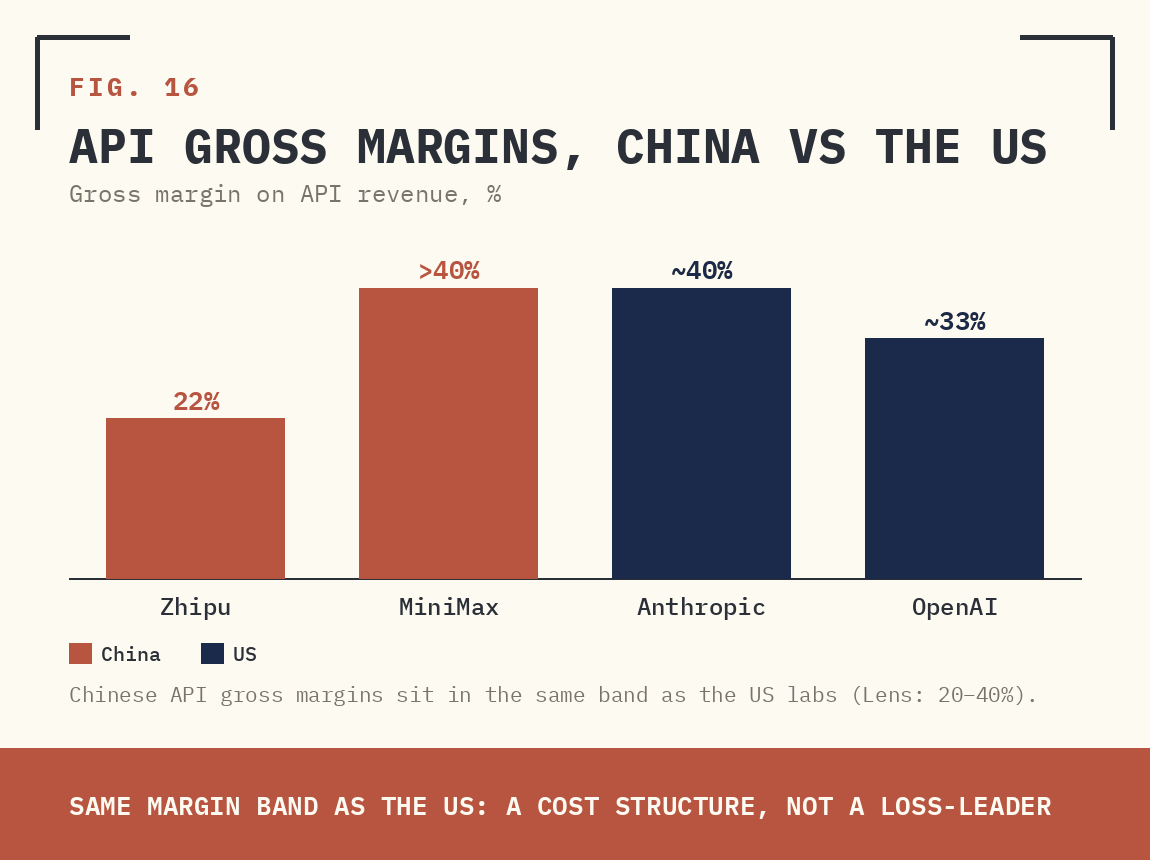
Yet the discount is not a subsidy. Chinese API gross margins — Zhipu 22%, MiniMax above 40% — sit in the same band as Anthropic (~40%) and OpenAI (~33%). A price cut that holds at a comparable margin is a cost structure, not a loss-leader.
Supplied archive exhibit · original publication context.
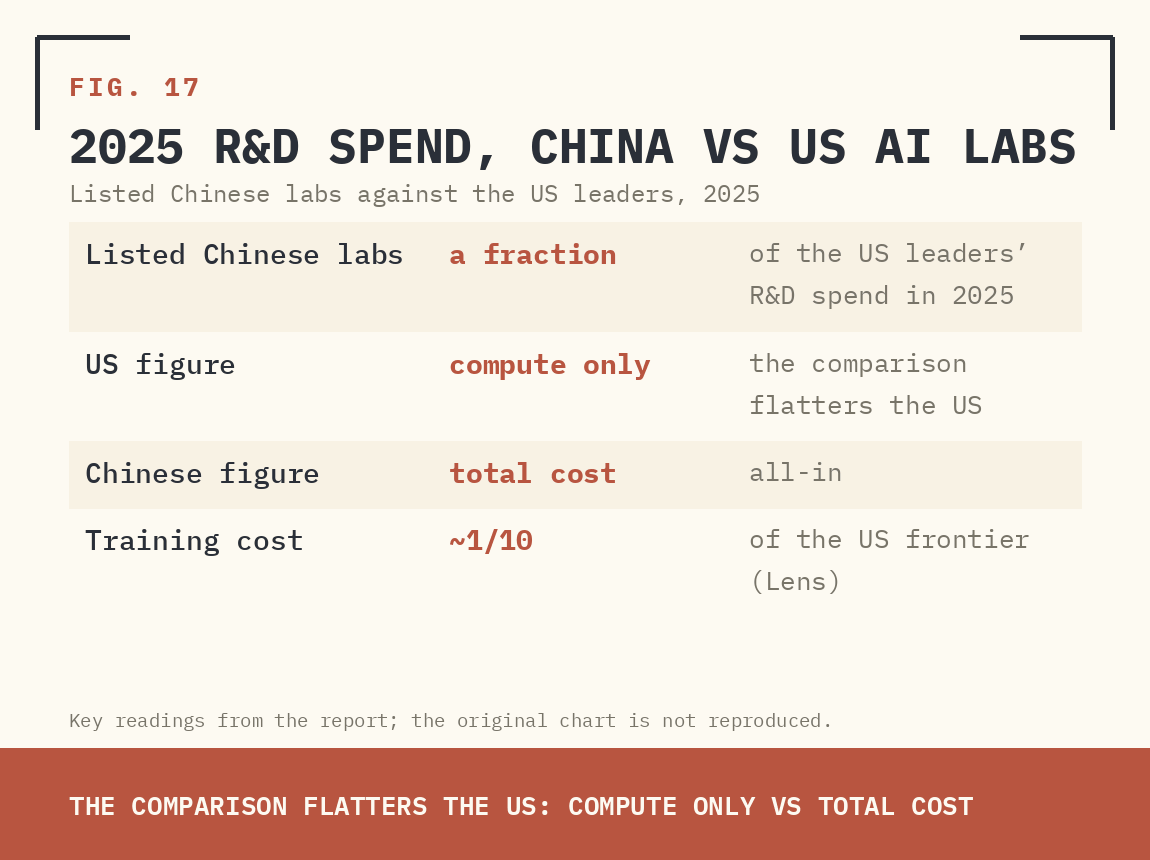
The capability is also bought cheaply: listed Chinese labs spent a fraction of the US leaders on R&D in 2025 — and the comparison flatters the US, whose figure counts compute only while the Chinese figure is total cost.
Supplied archive exhibit · original publication context.
A discount that survives at a comparable margin is not a subsidy. It is a cost structure — and cost structures built into architecture do not mean-revert on command.
Why the cost base is so much lower comes down to a stack of structural advantages — focused R&D, open-source leverage and relentless engineering at the model, serving and hardware layers. The exhibits below walk that stack from training through inference to silicon.
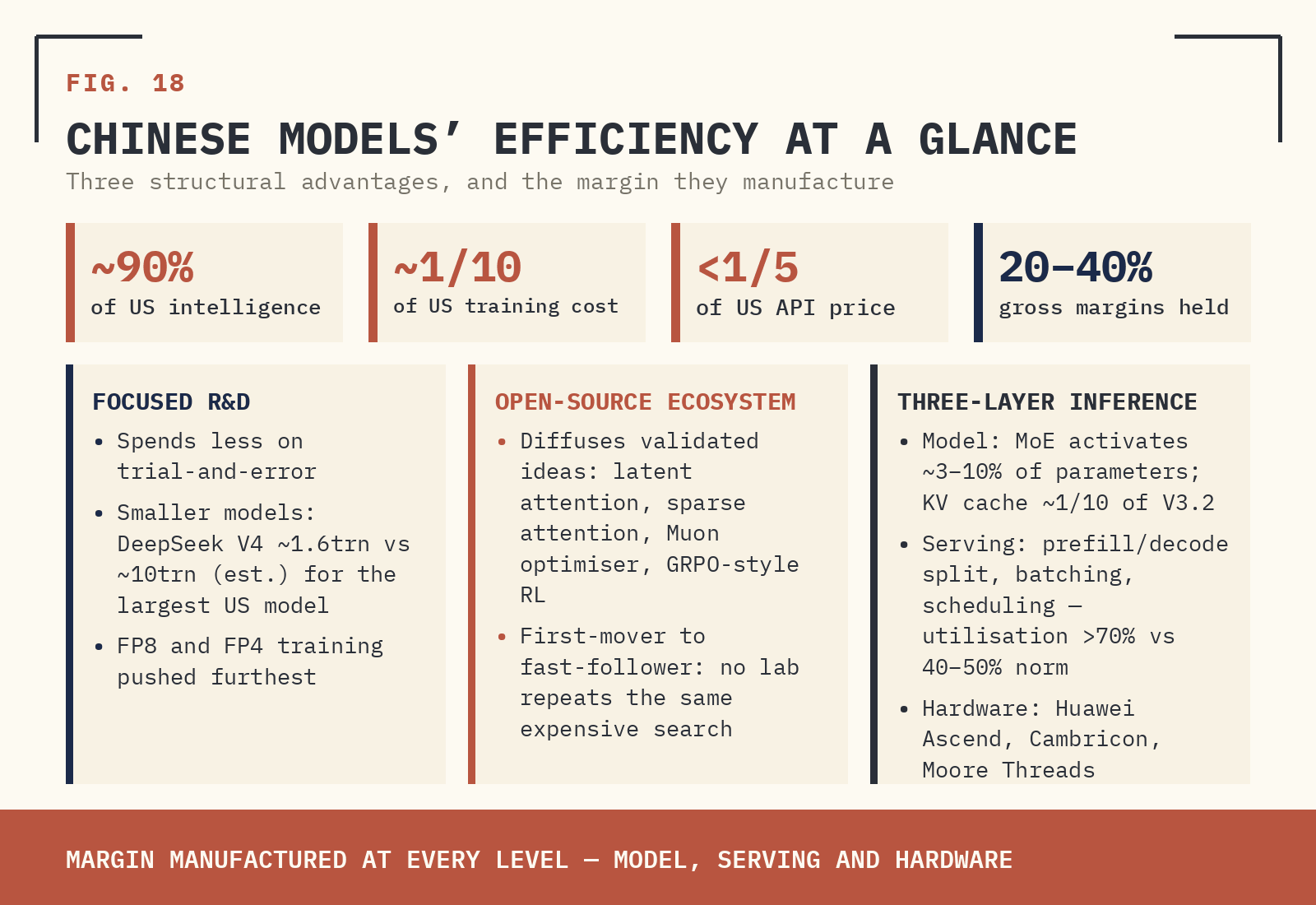
The composite case: a focused R&D path that spends less on trial-and-error, an open-source ecosystem that diffuses validated ideas, and a three-layer inference design — model, serving and hardware — that manufactures margin at every level.
Supplied archive exhibit · original publication context.
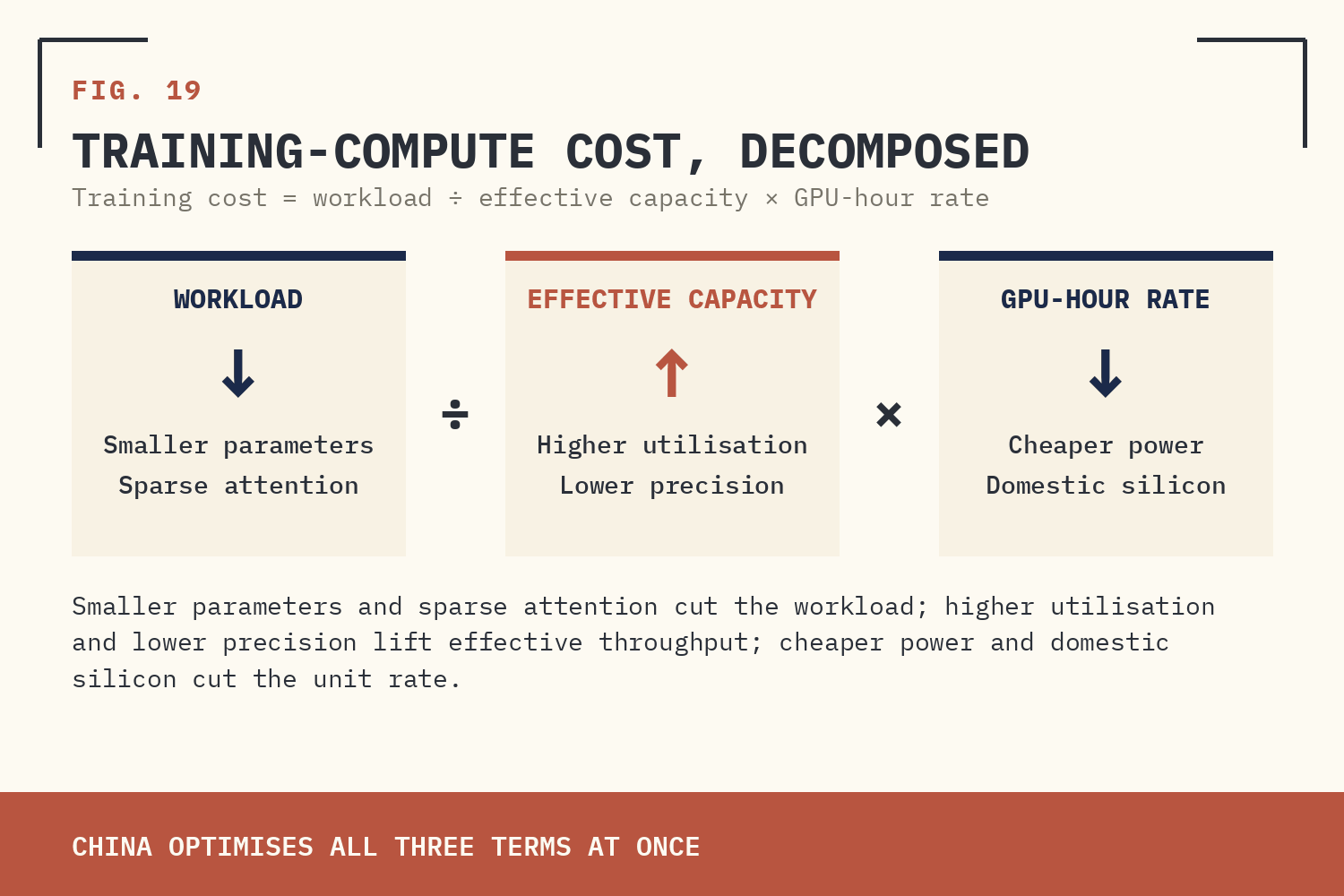
Training cost is workload divided by effective capacity, times the GPU-hour rate. Smaller parameters and sparse attention cut the workload; higher utilisation and lower precision lift effective throughput; cheaper power and domestic silicon cut the unit rate. China optimises all three terms at once.
Supplied archive exhibit · original publication context.
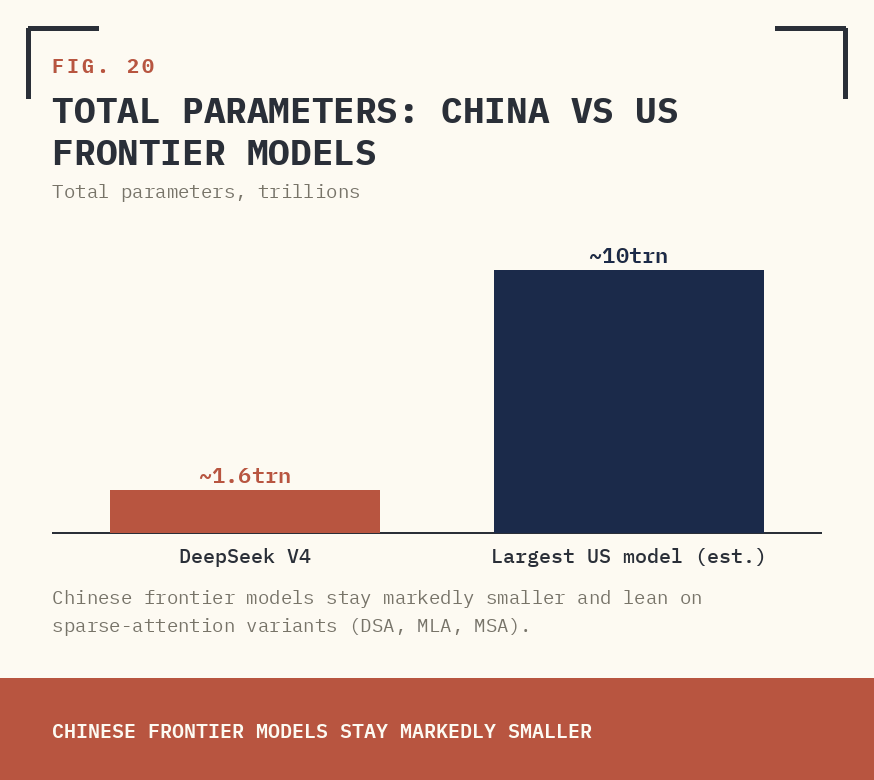
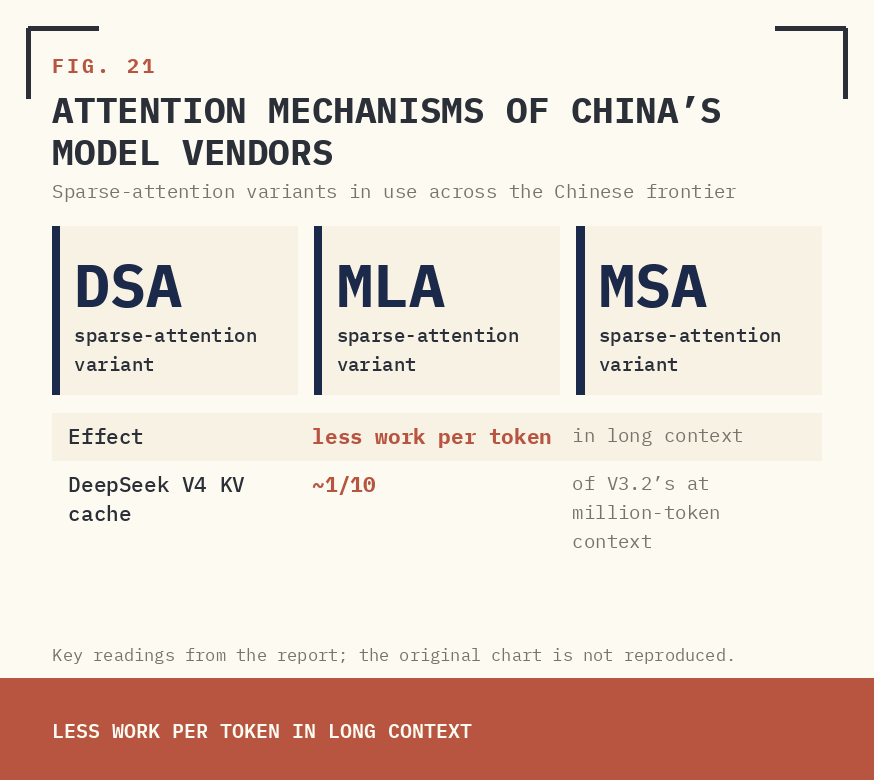
Chinese frontier models stay markedly smaller — DeepSeek V4 near 1.6trn against an estimated ~10trn for the largest US model — and lean on sparse-attention variants (DSA, MLA, MSA) that cut the work done per token in long context.
Supplied archive exhibit · original publication context.
Supplied archive exhibit · original publication context.
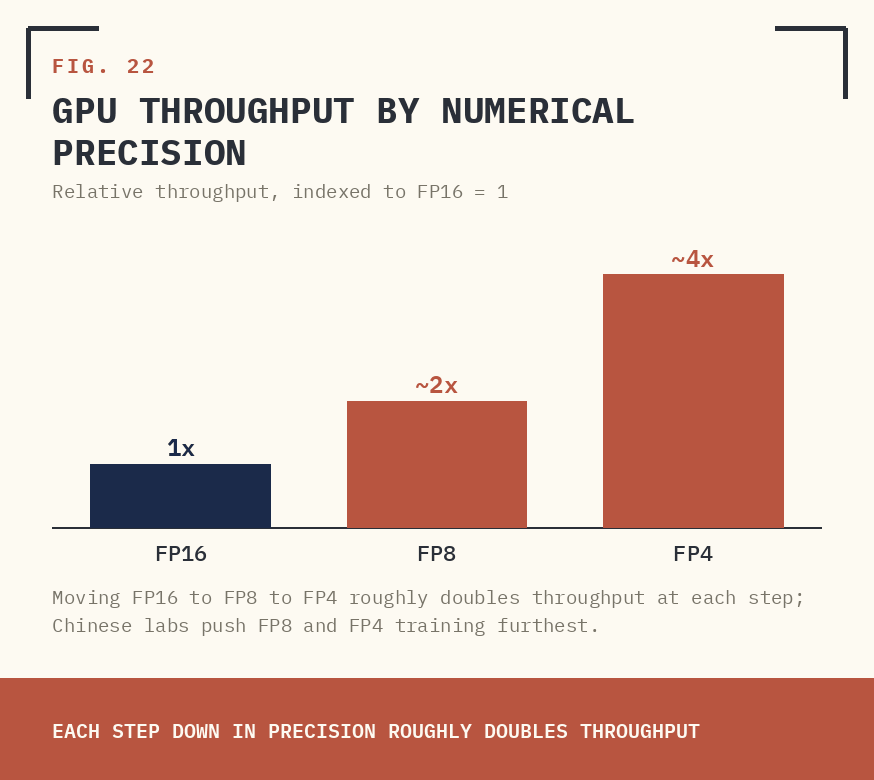
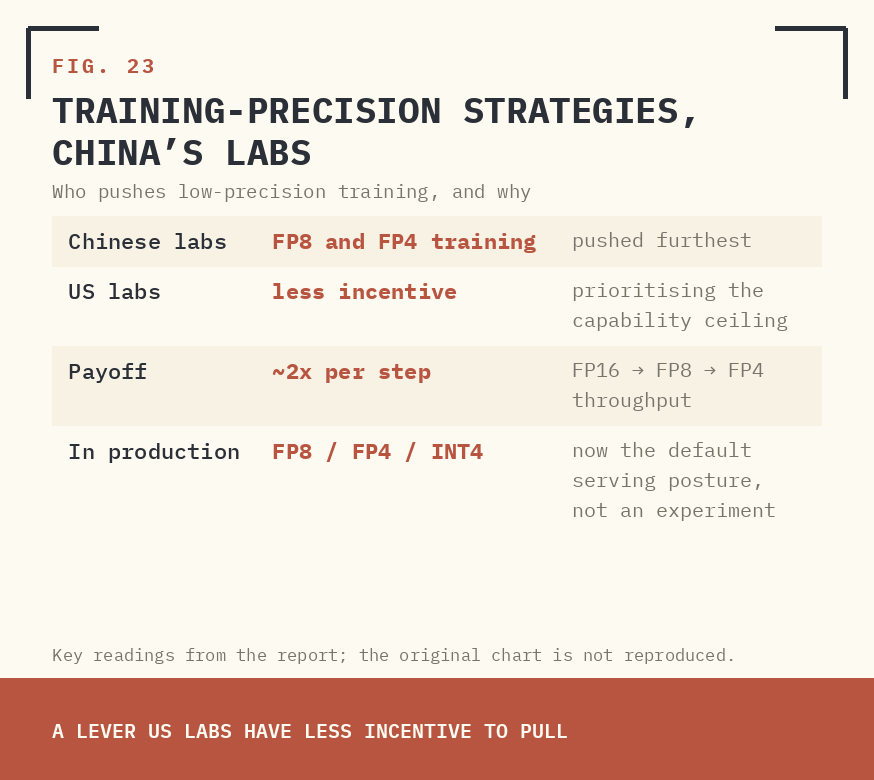
Lower precision compounds the saving: moving FP16 to FP8 to FP4 roughly doubles throughput at each step, and Chinese labs are pushing FP8 and FP4 training furthest — a lever US labs, prioritising the capability ceiling, have less incentive to pull.
Supplied archive exhibit · original publication context.
Supplied archive exhibit · original publication context.
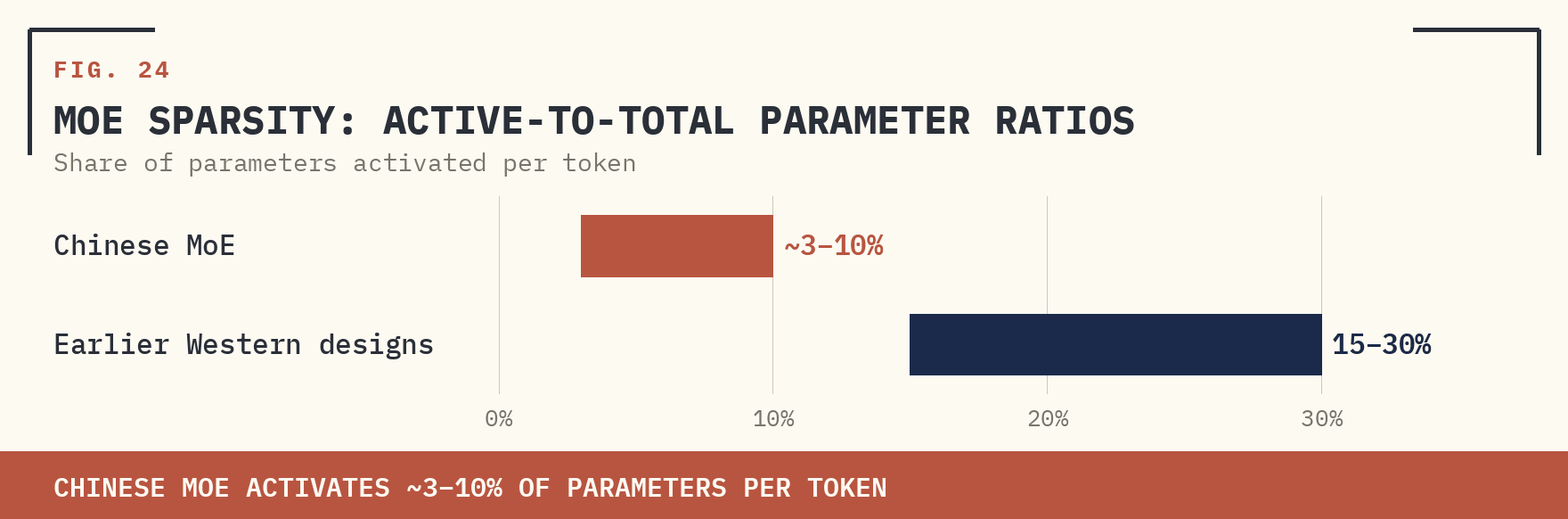
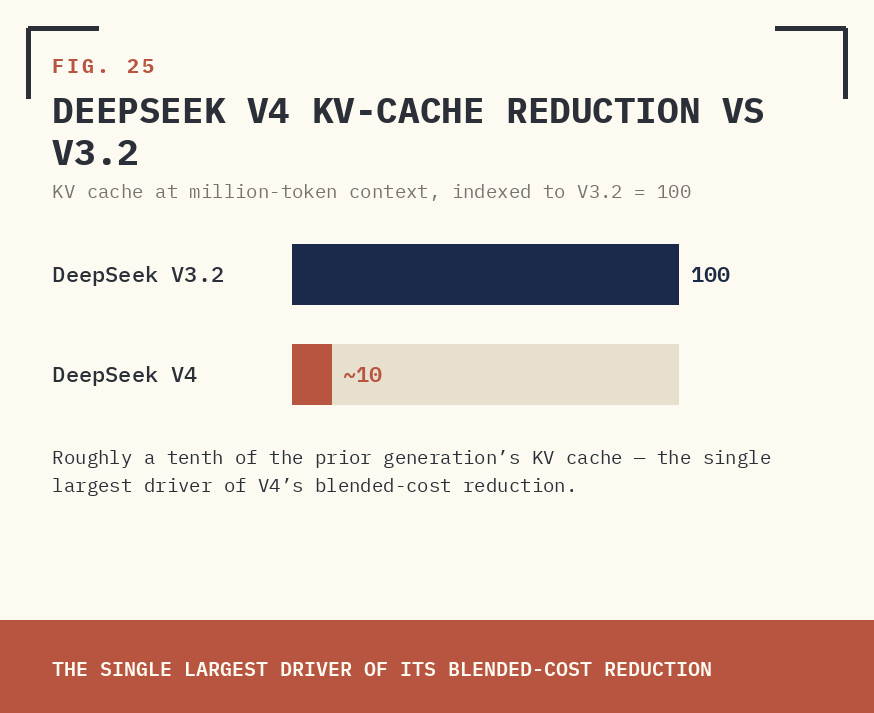
On the model side: Chinese MoE activates only ~3–10% of parameters per token against 15–30% for earlier Western designs, and DeepSeek V4 needs roughly a tenth of the prior generation’s KV cache at million-token context — the single largest driver of its blended-cost reduction.
Supplied archive exhibit · original publication context.
Supplied archive exhibit · original publication context.
Supplied archive exhibit · original publication context.
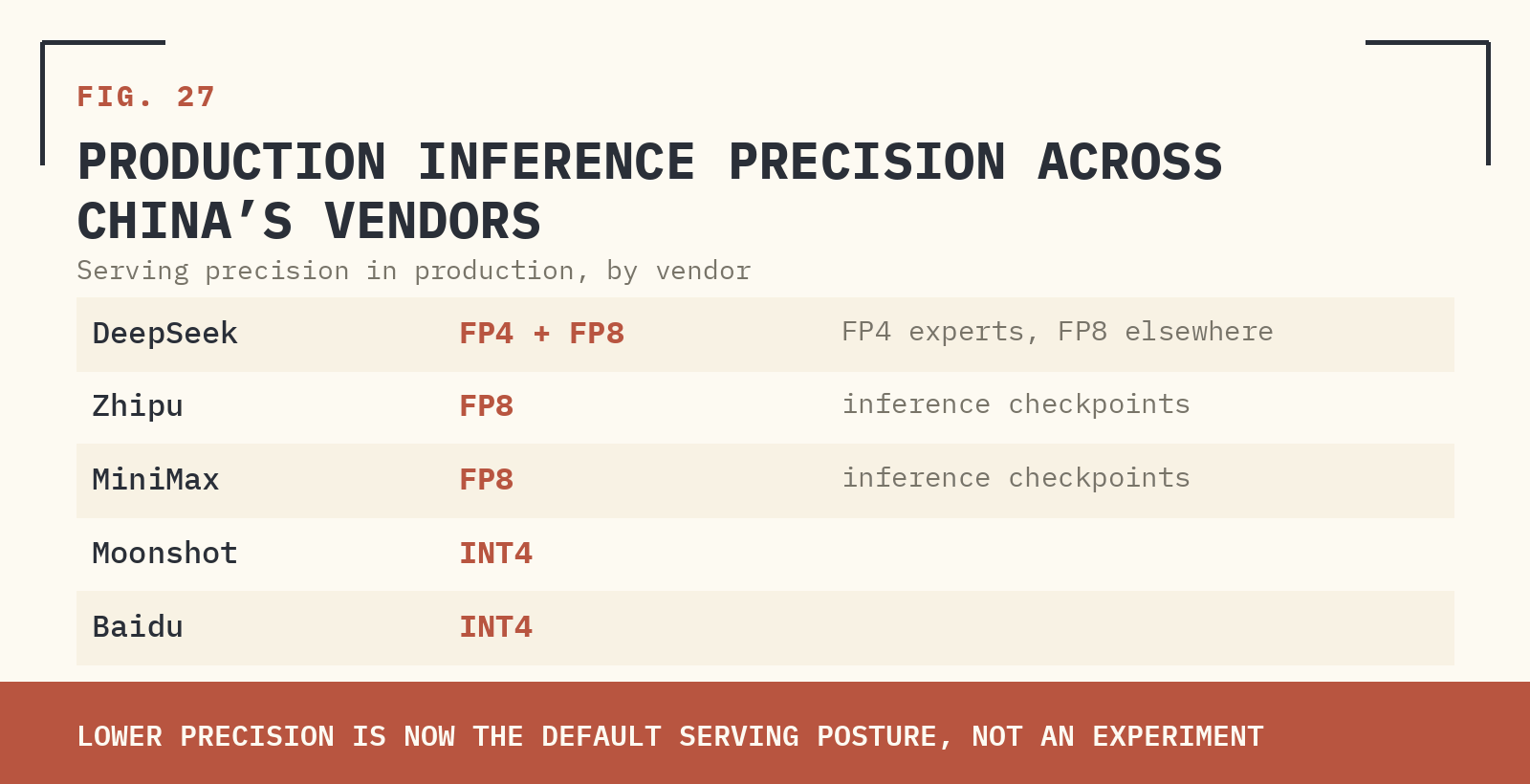
The precision push runs into production: DeepSeek routes FP4 experts with FP8 elsewhere, Zhipu and MiniMax ship FP8 inference checkpoints, Moonshot and Baidu use INT4. Lower precision is now the default serving posture, not an experiment.
Supplied archive exhibit · original publication context.
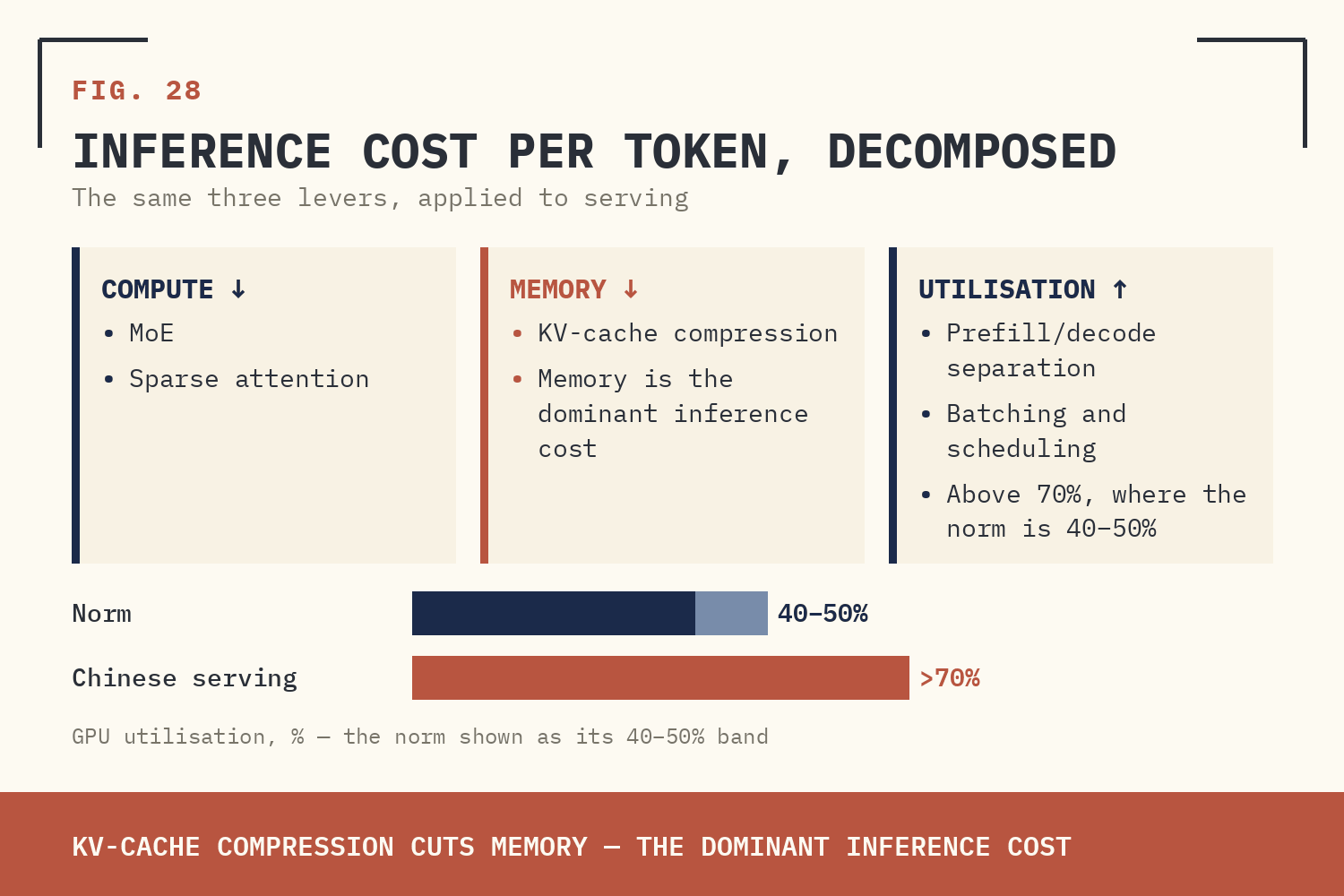
On inference the same logic repeats: MoE and sparse attention cut compute, KV-cache compression cuts memory (the dominant inference cost), and prefill/decode separation, batching and scheduling lift utilisation above 70% where the norm is 40–50%.
Supplied archive exhibit · original publication context.
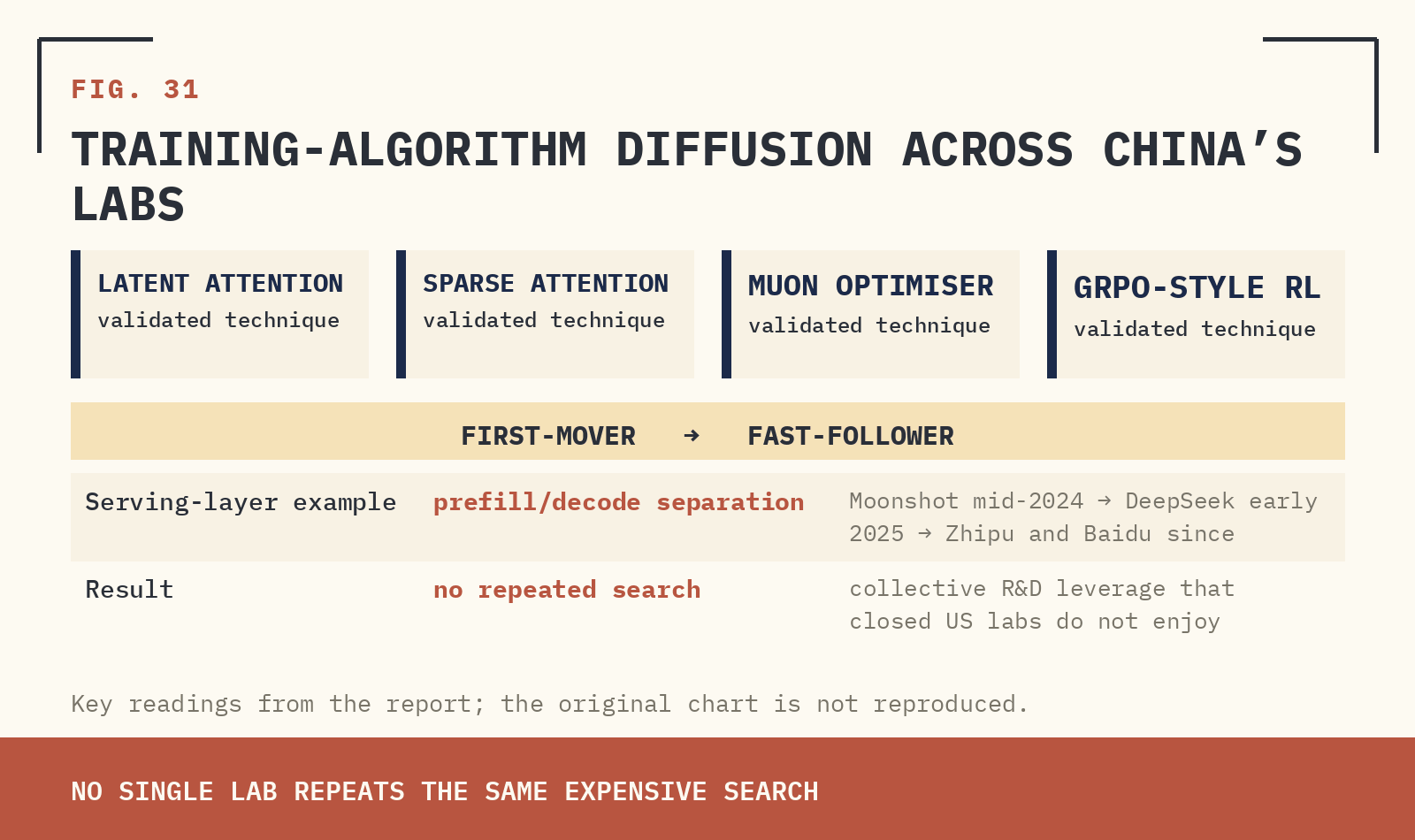
That serving layer is now standard practice rather than an edge. Chinese vendors have moved en masse to prefill/decode separation — Moonshot from mid-2024, DeepSeek in early 2025, and Zhipu and Baidu since — splitting the compute-heavy prefill and memory-heavy decode phases into separate clusters with cache-aware scheduling, the disaggregation that lifts utilisation and throughput on the same silicon.
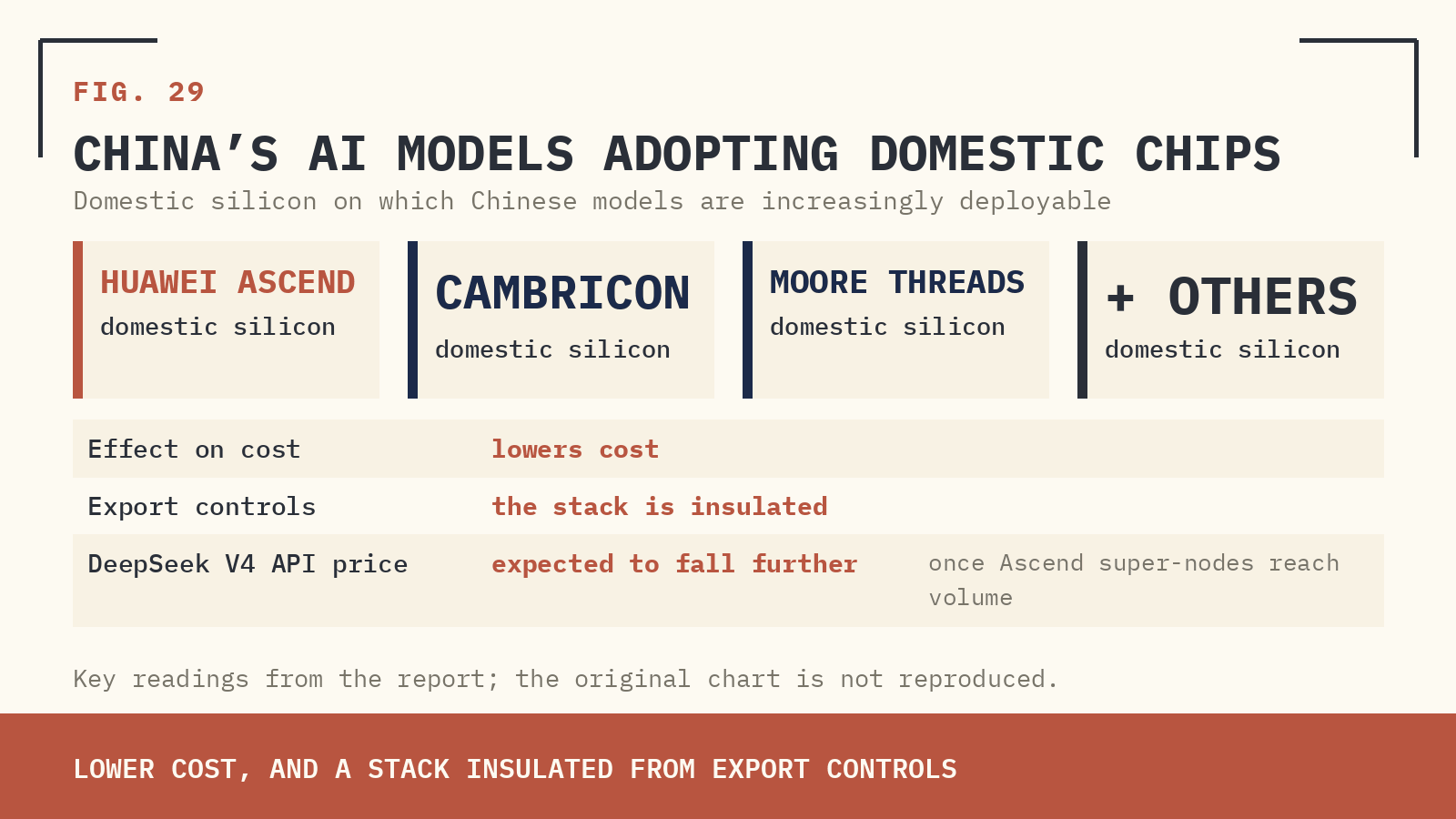
The hardware layer is localising. Chinese models are increasingly deployable on domestic silicon — Huawei Ascend, Cambricon, Moore Threads and others — which lowers cost and insulates the stack from export controls; DeepSeek’s V4 API price is expected to fall further once Ascend super-nodes reach volume.
Supplied archive exhibit · original publication context.
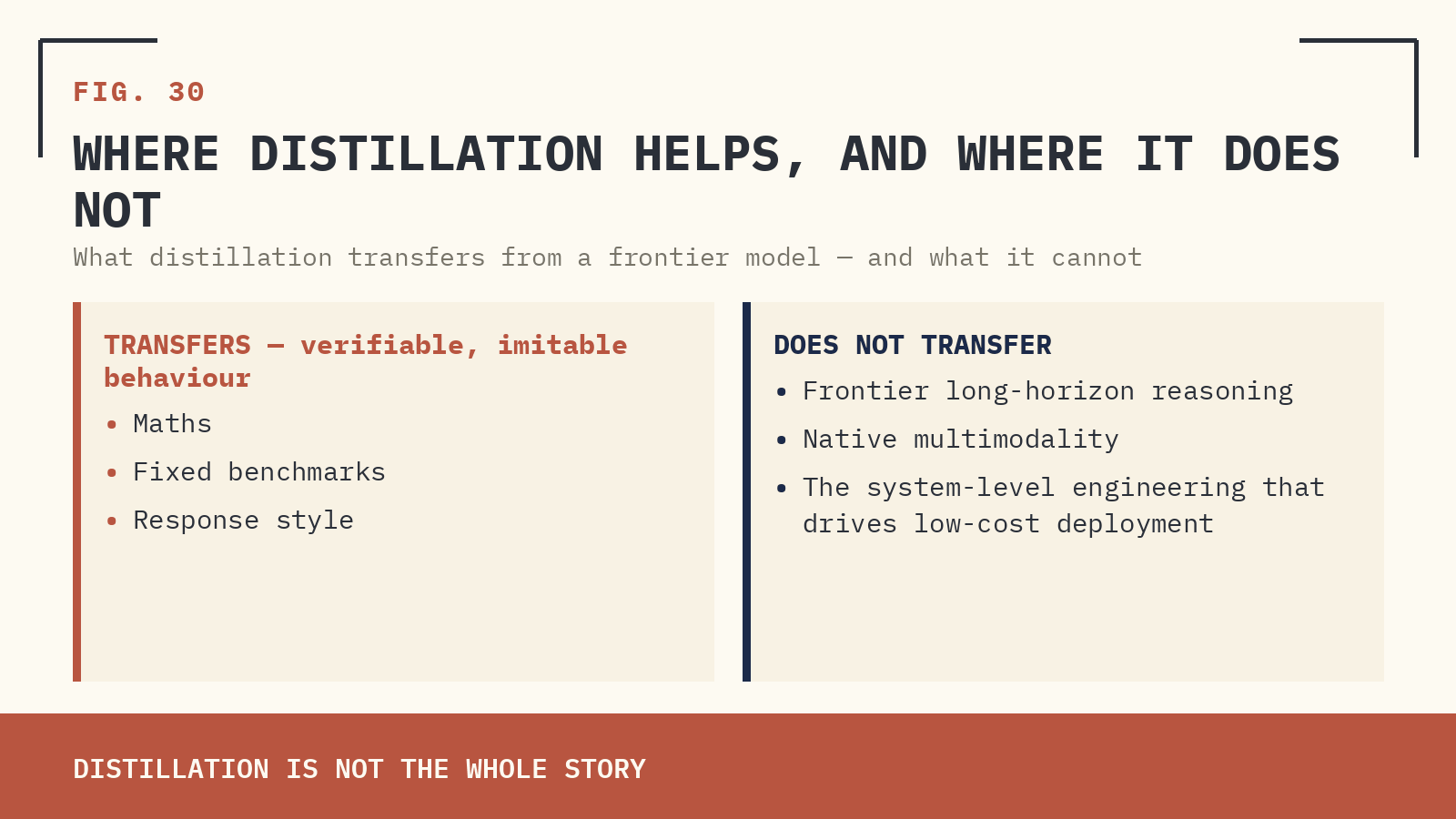
Distillation is not the whole story. It transfers verifiable, imitable behaviour — maths, fixed benchmarks, response style — but not frontier long-horizon reasoning, native multimodality, or the system-level engineering that drives low-cost deployment.
Supplied archive exhibit · original publication context.
The real lever is the open-source ecosystem. Validated techniques — latent attention, sparse attention, the Muon optimiser, GRPO-style reinforcement learning — diffuse from first-mover to fast-follower, so no single lab repeats the same expensive search. That is collective R&D leverage closed US labs do not enjoy.
Supplied archive exhibit · original publication context.
POSITION
A tiered market, priced accordingly
Before choosing winners, size the prize — and note who is allowed to compete for it. Both framings argue against reading this as a zero-sum duel.
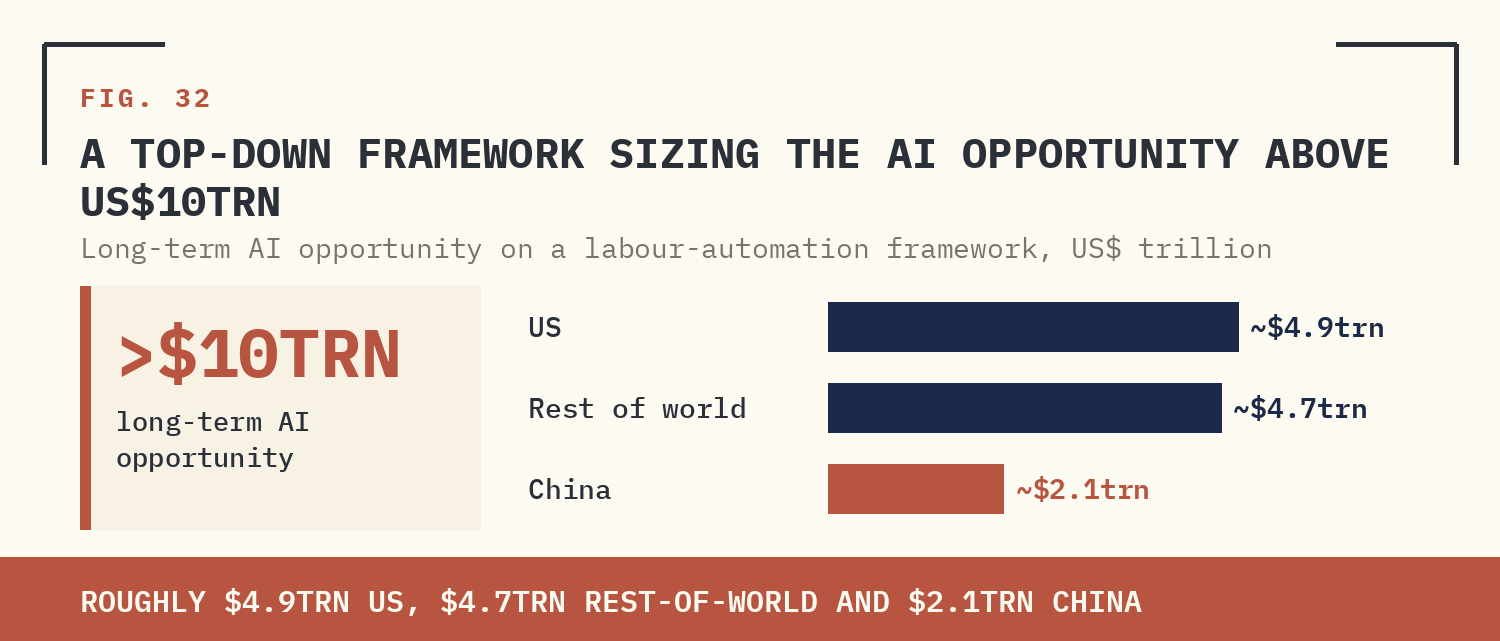
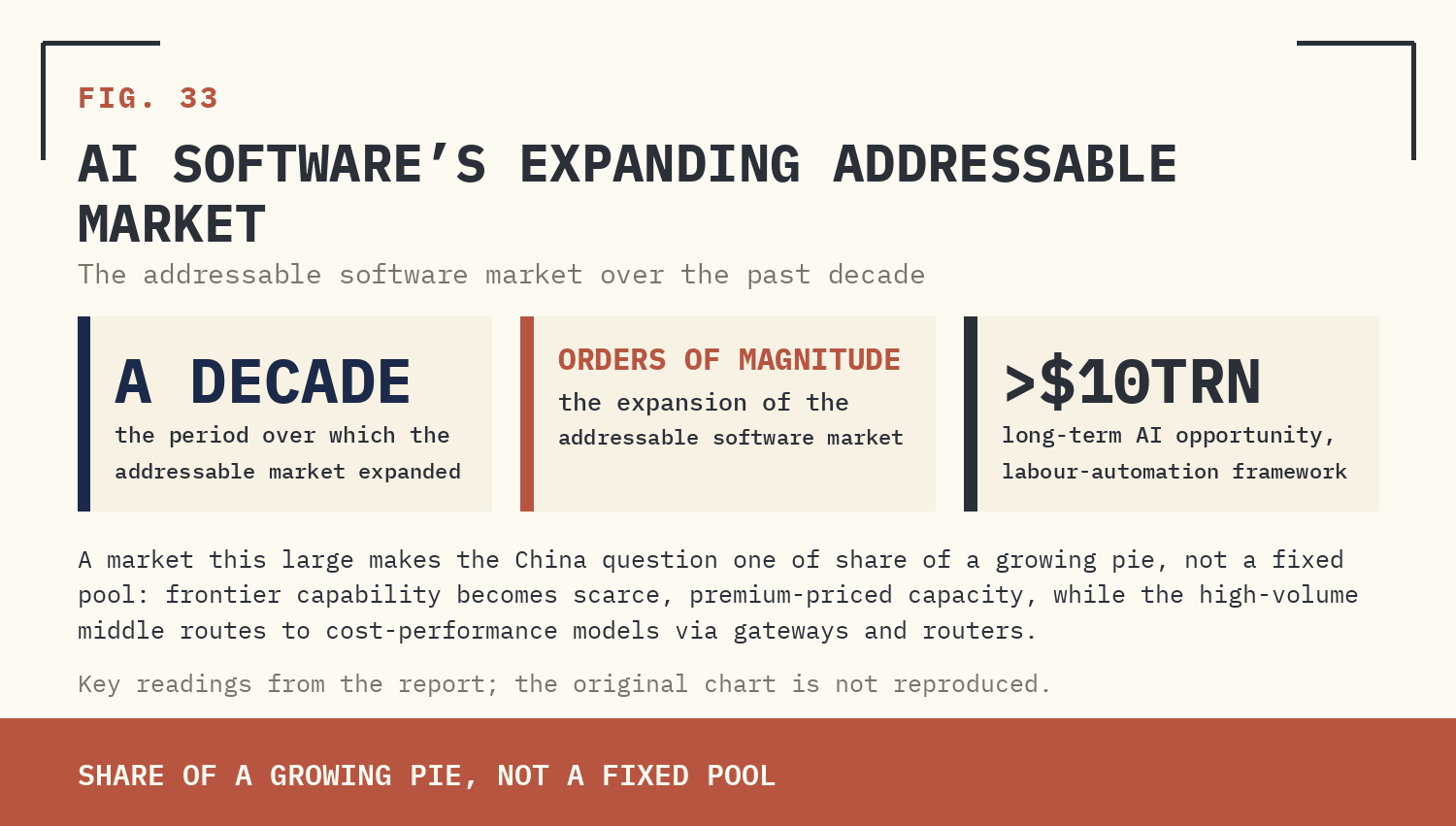
On a labour-automation framework the long-term AI opportunity exceeds $10trn — roughly $4.9trn US, $4.7trn rest-of-world and $2.1trn China — and the addressable software market has expanded by orders of magnitude in a decade. A market this large makes the China question one of share of a growing pie, not a fixed pool.
Supplied archive exhibit · original publication context.
Supplied archive exhibit · original publication context.
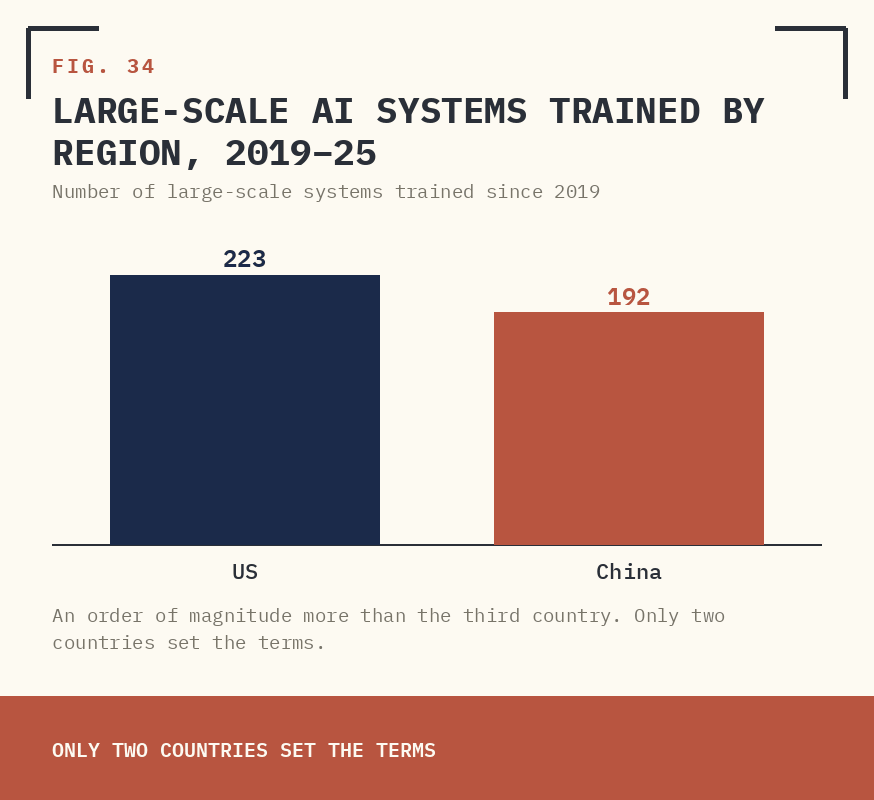
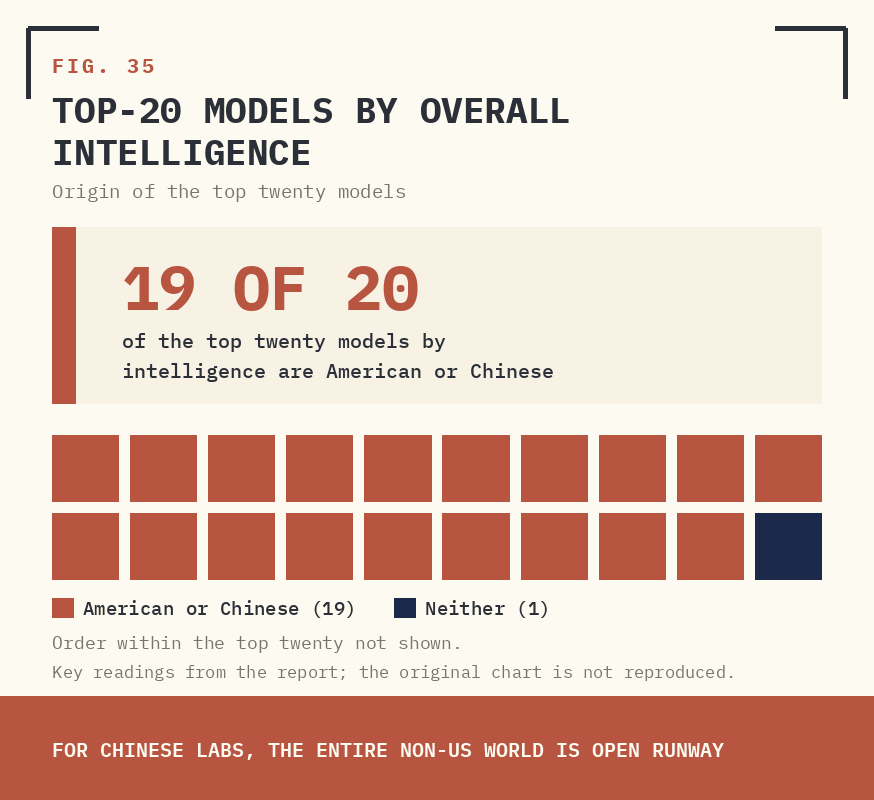
And only two countries set the terms: since 2019 the US and China have trained 223 and 192 large-scale systems respectively, an order of magnitude more than the third country, and nineteen of the top twenty models by intelligence are American or Chinese. For Chinese labs, the entire non-US world is open runway.
Supplied archive exhibit · original publication context.
Supplied archive exhibit · original publication context.
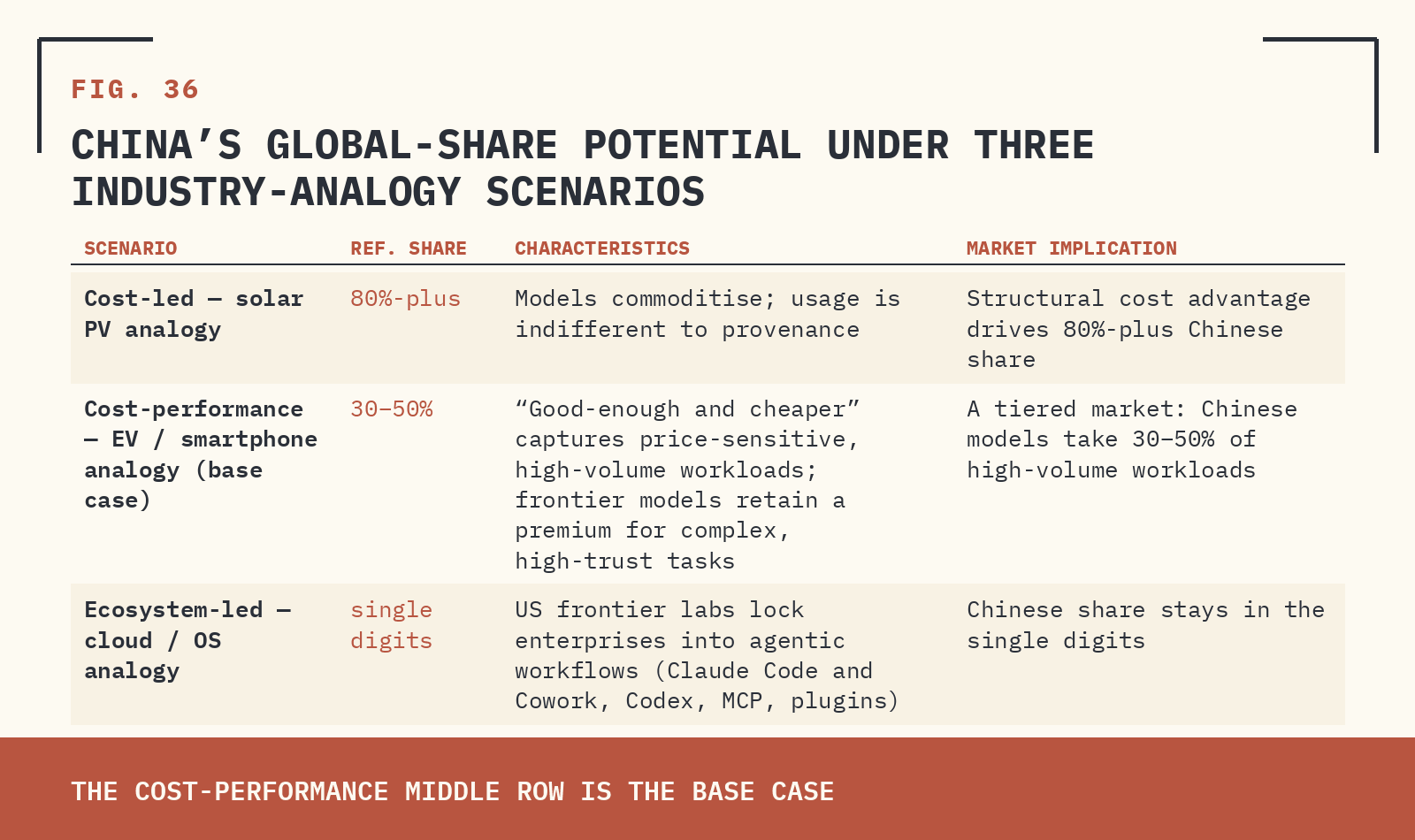
The destination, then, is not a Chinese takeover of global AI; it is a tiered market. Three scenarios bound the outcome. In a cost-led world where models commoditise and usage is indifferent to provenance, the analogy is solar PV — structural cost advantage drives 80%-plus share. In an ecosystem-led world where US frontier labs lock enterprises into agentic workflows (Claude Code and Cowork, Codex, MCP, plugins), the analogy is cloud or operating systems, and Chinese share stays in the single digits. The base case sits between: a cost-performance world, the EV and smartphone analogy, where “good-enough and cheaper” captures 30–50% of price-sensitive, high-volume workloads while frontier models retain a premium for complex, high-trust tasks.
The scenarios in full — reference share, characteristics and market implication for each. The cost-performance middle row is the base case; the panel below distils the three paths.
Supplied archive exhibit · original publication context.
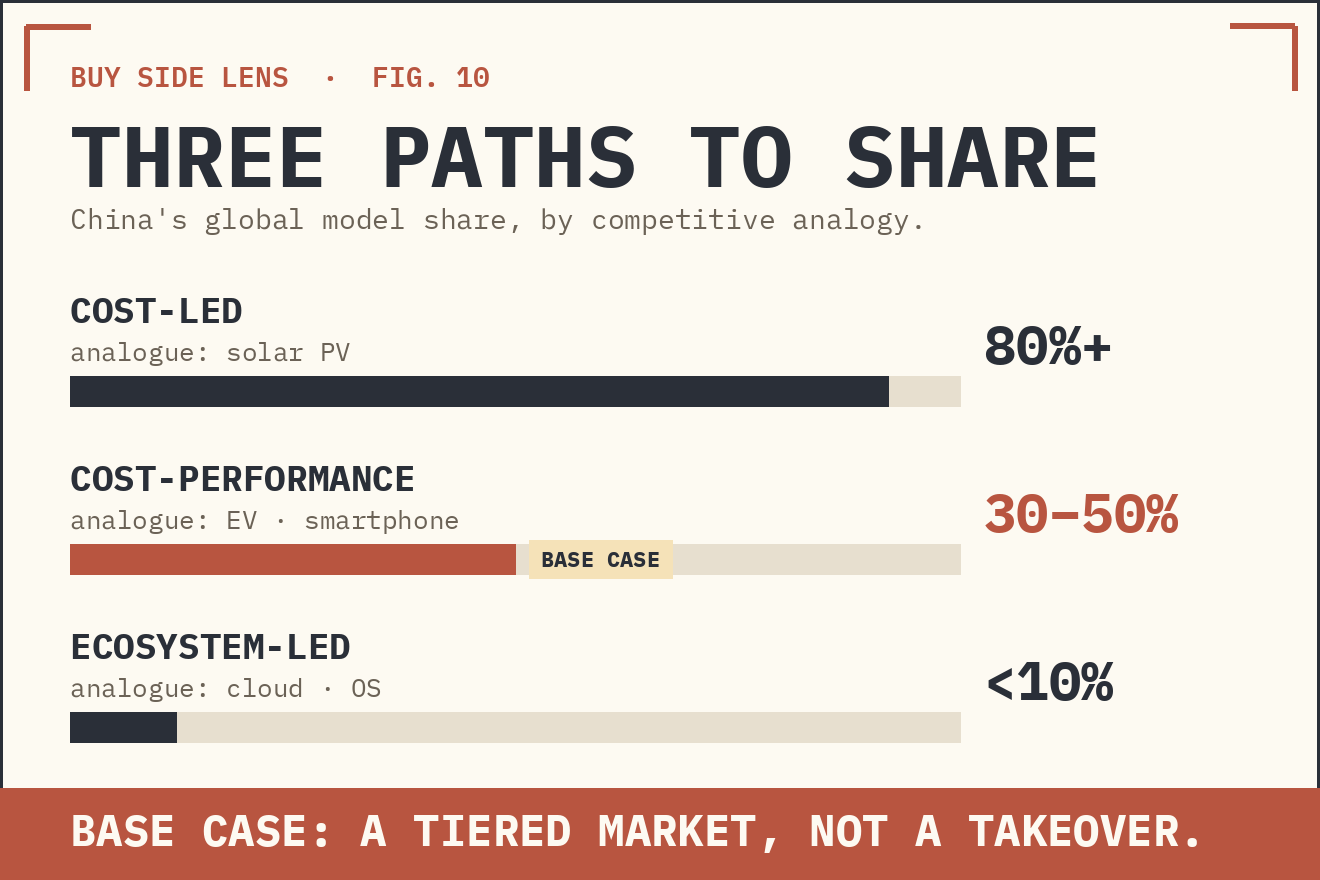
Supplied archive exhibit · original publication context.
For positioning, the implications are directional. Frontier capability becomes scarce, premium-priced capacity — rationed to the high-value tasks that justify it, and increasingly gated for safety and security reasons, which paradoxically supports rather than erodes its pricing. The high-volume middle routes to cost-performance models via gateways and routers that match each task to the cheapest sufficient model. Within the US complex, the structural beneficiaries through this phase are the hyperscalers that own distribution, the largest installed compute base and the most cohesive software stack — provided they convert capex into demonstrable operating leverage. The most exposed sit upstream in hardware and infrastructure, where expectations are still priced for permanent scarcity.
The trillion-dollar question — does cheaper intelligence create more demand than it destroys in pricing power — does not resolve as a single number. It resolves as a structure: frontier rents at the top, Chinese-led cost-performance volume in the middle, and a capex cycle that turns on funder psychology rather than end-demand. Watch the hyperscaler that blinks first on spending; its re-rating is the signal that the market has repriced the whole chain. Position for the tiering, not the takeover.