Original Lens and publication context
A buzzer-beating rights grab at a reported fraction of FIFA's ask is not a tournament bet. It is an eight-year wager on the only mass audience in India that Reliance does not already own — placed exactly as Zee's core business swings into the red.
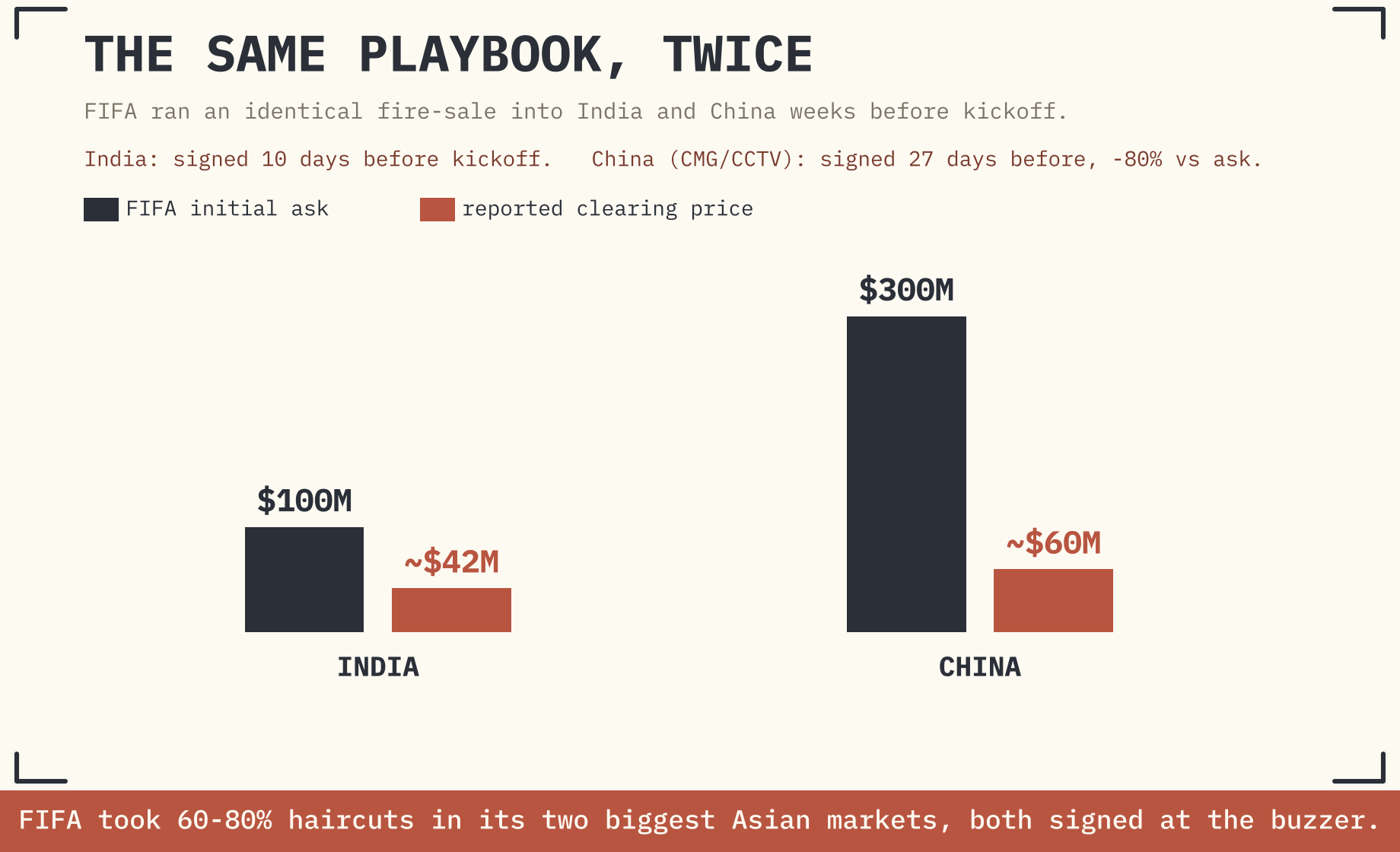
- FIFA sold India ten days before kickoff, with the ask cut from near USD 100 million to about USD 60 million; the package is reported at USD 30–35 million to above USD 40 million, against the only live bid near USD 15 million.
- The purchase is not one tournament but 39 FIFA events from 2026 to 2034 — two men's World Cups, the 2027 Women's World Cup and youth, futsal and documentary rights — carried on four linear channels and ZEE5: an eight-year content calendar, not a marketing spend.
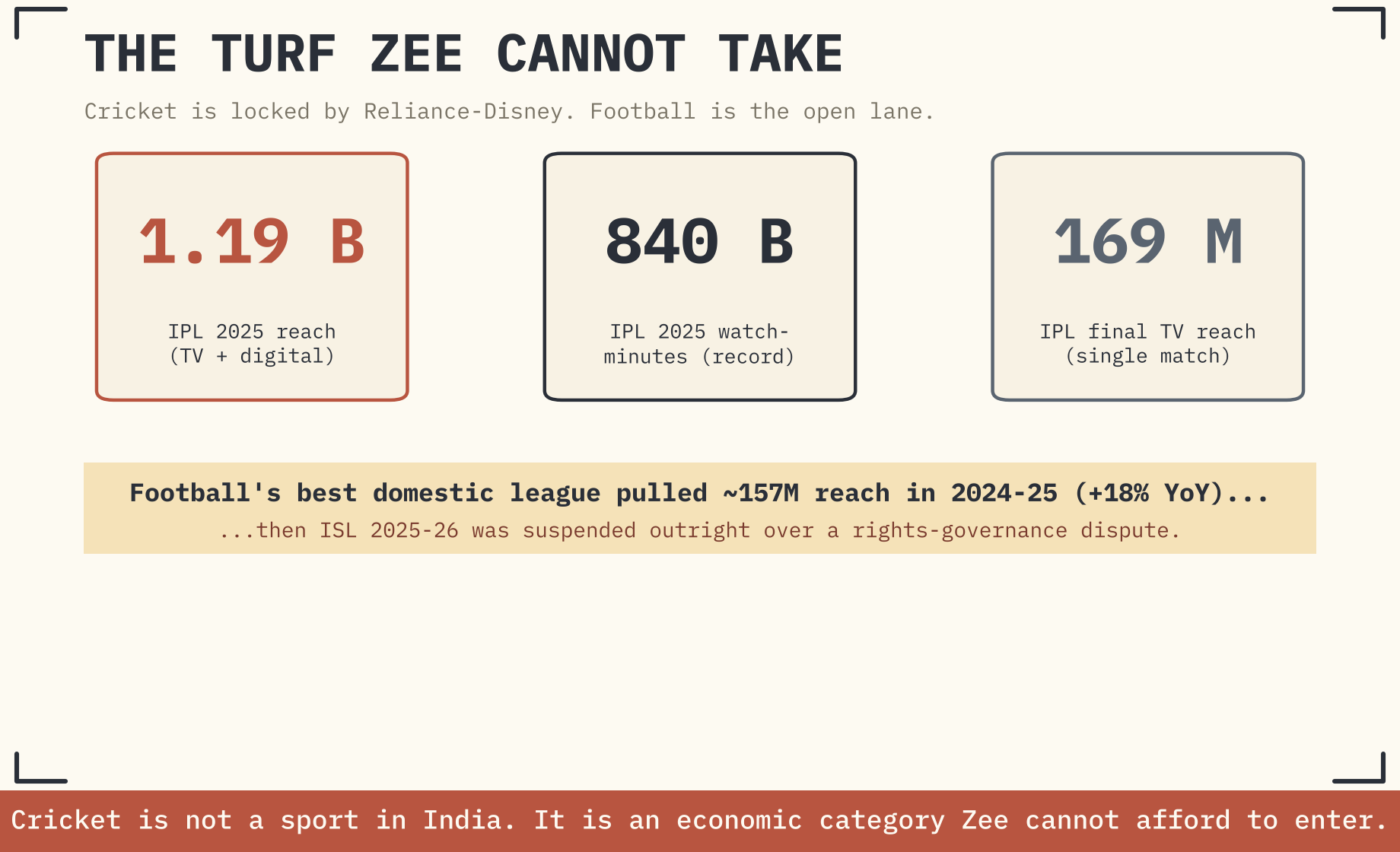
- Cricket is not for sale: the Reliance-Disney combine owns the IPL, which reached 1.19 billion viewers in 2025 with 840 billion watch-minutes; football is the largest audience Zee can acquire without bidding against Reliance, though the ISL is suspended for 2025-26.
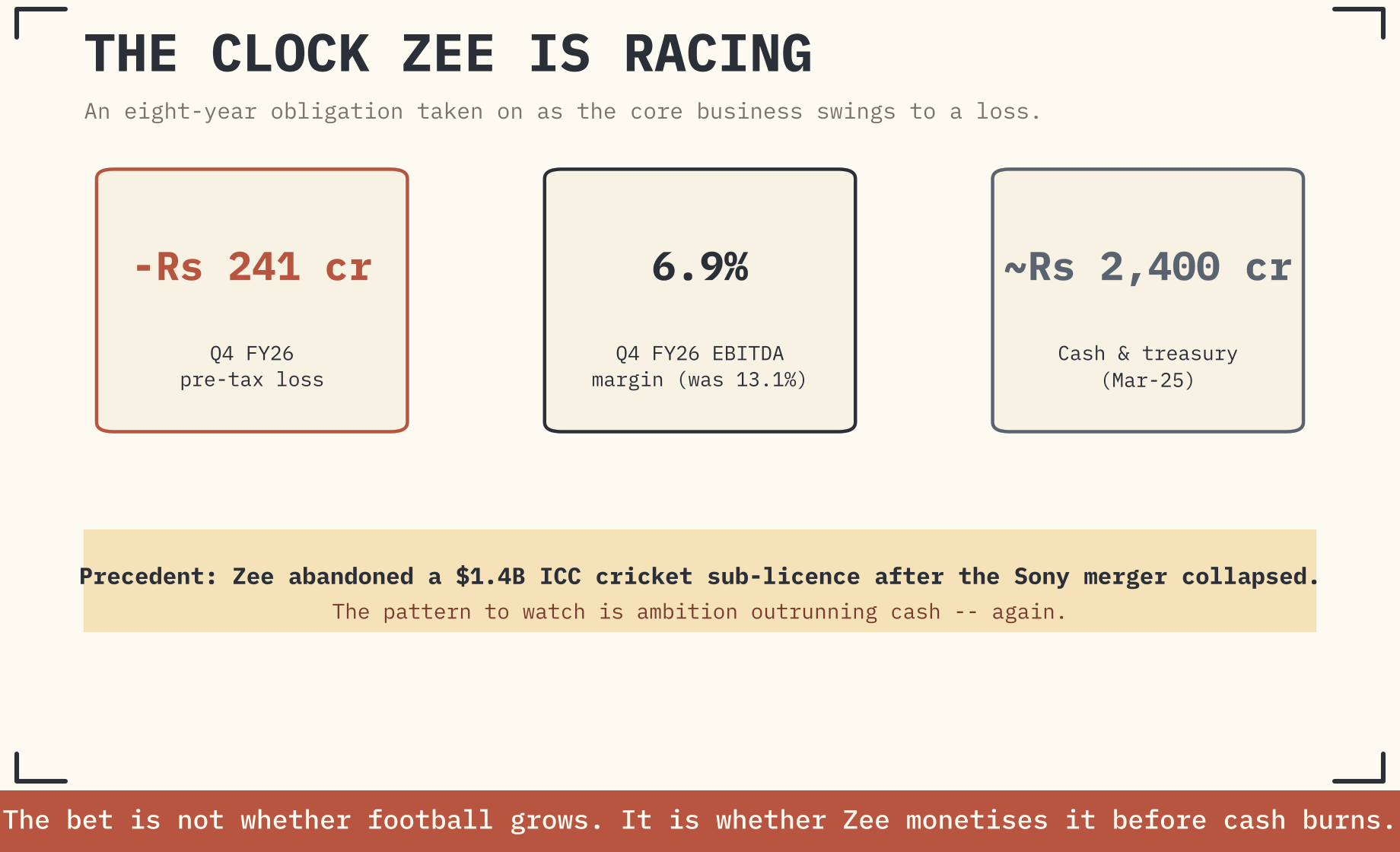
- The timing is the risk: Zee posted a Q4 FY26 pre-tax loss of about ₹241 crore, EBITDA margin fell to 6.9 percent from 13.1 percent, and cash and treasury of near ₹2,400 crore (March 2025 balance sheet) now backs an eight-year obligation.
- The same fire-sale ran in China, where rights cleared at a reported USD 60 million against a USD 300 million target. Watch ZEE5 subscriber retention through the World Cup, football ad fill rates and CPMs versus cricket, and leverage and margins in coming earnings.
TRIGGER
Ten days before the 2026 World Cup kicks off, FIFA finally sold India. The story circulating is clean and almost cinematic: FIFA wanted USD 100 million, JioStar offered 20, talks collapsed, and Zee walked in. The clean version is right in spirit and wrong in two specifics that change the read.
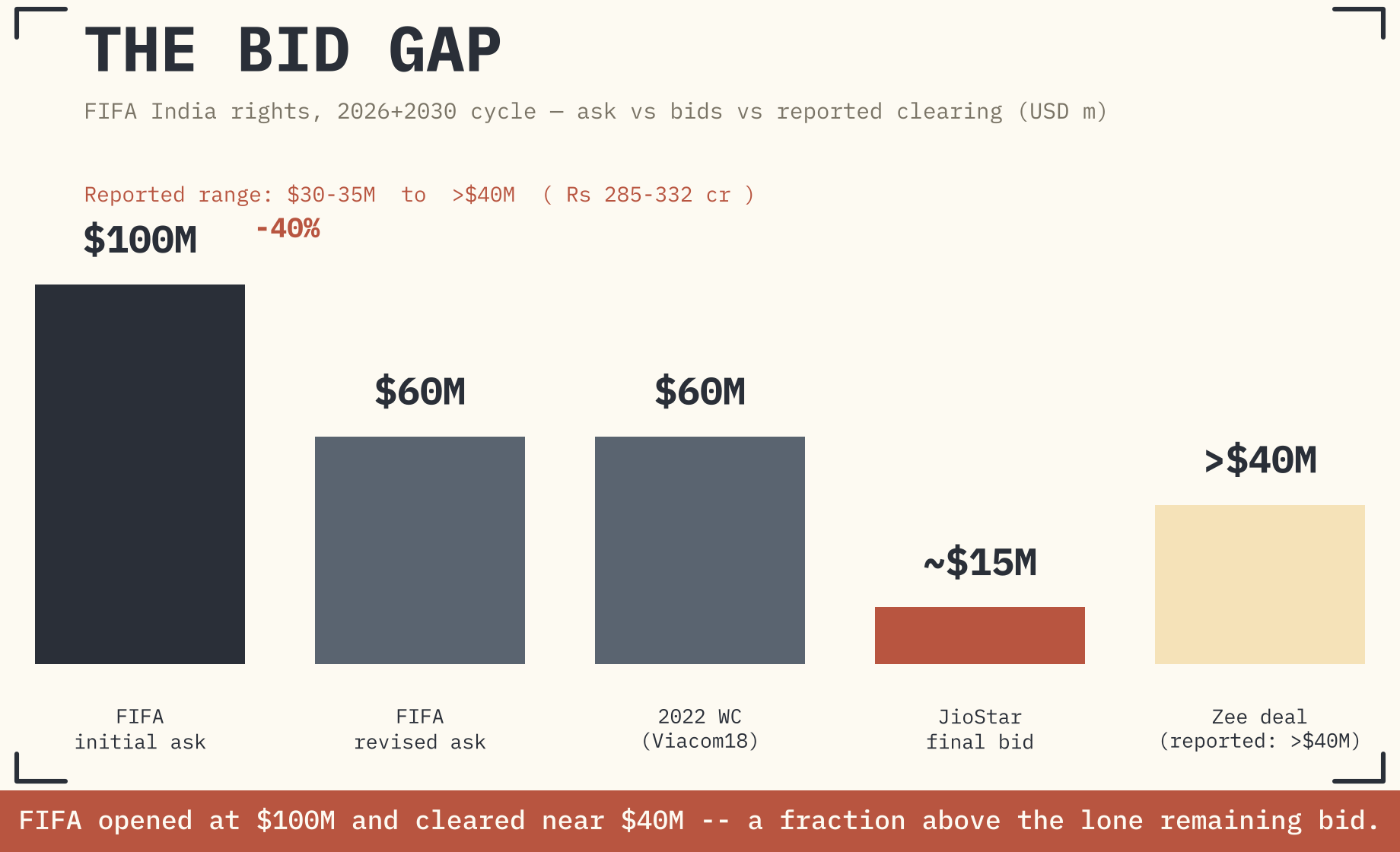
First, the price was not undisclosed in the way the headline suggested. FIFA opened near USD 100 million for the 2026 and 2030 cycle and cut its ask to about USD 60 million as the calendar ran out. Financial terms were not officially announced, but Indian business press pegs the Zee package at above USD 40 million for the two World Cups, with most of the value loaded onto 2030; other reports put it at USD 30–35 million, and Indian outlets at ₹285–332 crore. Second, JioStar's final number is reported as roughly USD 15 million for 2026 — below the USD 20M figure in circulation — before it withdrew. Sony and Doordarshan looked and passed. For benchmark, Viacom18 paid around USD 60 million for the 2022 Qatar edition, in far friendlier Indian time zones.
Supplied archive exhibit · original publication context.
FLOW
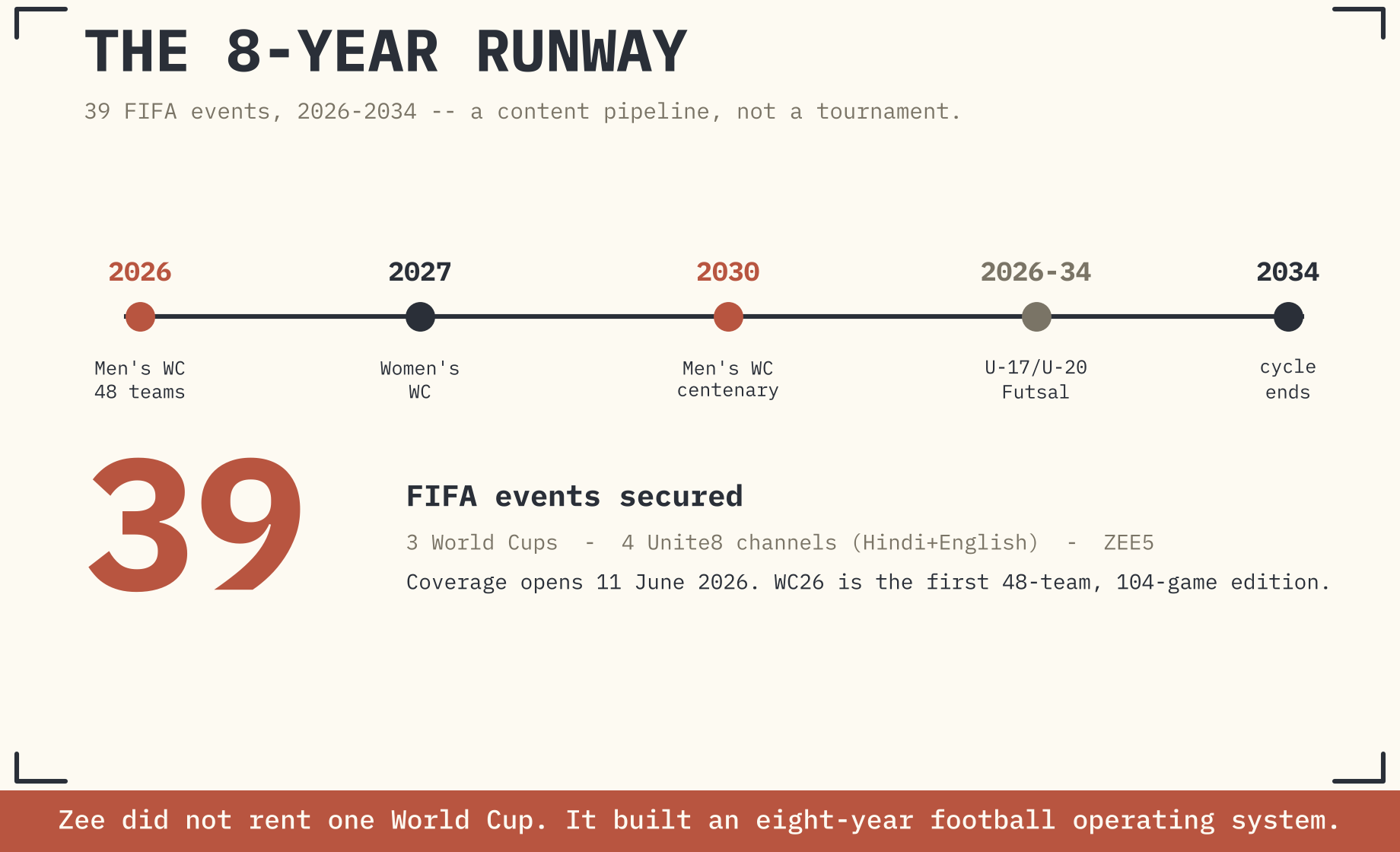
What Zee actually bought is not one World Cup. It is 39 FIFA events spanning 2026 to 2034 — the men's World Cups of 2026 and 2030, the 2027 Women's World Cup, and a deep bench of U-17, U-20, futsal, women's youth and intercontinental properties, plus documentary rights tied to each. Coverage opens 11 June across four newly launched linear channels under the Unite8 Sports brand — two Hindi, two English, all with HD feeds — and streams on ZEE5. The 2026 edition is itself the largest in history: the first 48-team, 104-game World Cup, a tournament FIFA projects will earn it over USD 11 billion.
This is not a one-tournament bet. It is full-stack sports infrastructure, built around football, with an eight-year amortisation runway.
The distinction is the entire thesis. A single World Cup is a marketing spend. A locked eight-year content calendar — flagship events, women's football, youth pipelines, documentaries — is an operating system. Zee is not buying a broadcast; it is standing up a sports vertical it can sell subscriptions and advertising against for nearly a decade, while spreading the rights cost across multiple tournaments rather than one window.
Supplied archive exhibit · original publication context.
RISK
The strategic logic begins with what Zee cannot do. JioStar — the Reliance-Disney combine — owns Indian cricket: the IPL, most bilateral series, the domestic ICC television window, and even the English Premier League. In India, cricket is not a sport. It is an economic category in itself. IPL 2025 reached 1.19 billion viewers across TV and digital and set a record 840 billion watch-minutes; the final alone drew 169 million on television. Competing on that turf is not an option for a balance-sheet-constrained Zee — and the Reliance-Disney merger has stripped most of the competitive tension out of every Indian rights auction, which is precisely why FIFA's price collapsed.
Supplied archive exhibit · original publication context.
But India is changing — slowly. Football's reach has compounded in the east, the south, and among younger urban audiences over the past decade, the Messi-and-Ronaldo generation that grew up streaming European football. The Indian Super League pulled unique reach near 157 million in 2024-25, up 18 percent year-on-year, and the 2018 World Cup briefly out-rated cricket on Indian sports TV with India not even playing. The demand curve is real.
The fragility is just as real, and it is worse than the optimists admit. The ISL — the single best proof that domestic football can scale — has been suspended for the entire 2025-26 season, put on hold over a Master Rights Agreement dispute between organiser FSDL (a Reliance-backed entity) and the AIFF, frozen further by a Supreme Court directive. India's flagship football league is dark at the exact moment Zee bets on football. Add brutal North American kickoff times for Indian prime time, thin football monetisation, and high-burn, low-return ISL club economics, and the demand story carries an asterisk.
Then there is Zee itself. The company has a documented history of broadcast ambition outrunning cash: the collapsed Sony merger that wiped roughly 30 percent off the stock, and the abandoned USD 1.4 billion ICC cricket sub-licence after Zee missed an early payment. The current quarter is not reassuring. In Q4 FY26 Zee reported a pre-tax loss of about ₹241 crore against a profit a year earlier, with EBITDA margin collapsing to 6.9 percent from 13.1 percent and advertising revenue still soft. Cash and treasury sat near ₹2,400 crore at the March 2025 year-end, the last full balance sheet — a real cushion, but not an unlimited one against an eight-year obligation.
Supplied archive exhibit · original publication context.
Figure 01 · Conceptual framework
From a football audience to a media asset
PRICE
Triangulate the value and a band emerges. FIFA's revised ask was near USD 60M for 2026+2030 alone; the 2022 single edition cleared around the same figure. JioStar anchored the floor near USD 15M. The reported Zee number — USD 30–35M to >USD 40M for the two World Cups — sits exactly where a thin, late, low-competition auction should clear: a touch above the only live bid, well below the early ask. Layer in the youth, women's and futsal properties through 2034 and the all-cycle figure plausibly runs higher; layer in the cost of launching four linear channels plus a ZEE5 push and Zee's all-in commitment is materially larger than the rights line.
The China precedent confirms this is structural, not Zee-specific. Two weeks before the India deal, FIFA sold mainland China rights to state broadcaster CMG for a reported USD 60 million against an original USD 300 million target — an 80 percent haircut, signed 27 days before kickoff, in a market where the national team did not qualify and kickoff times fall between midnight and dawn. India and China are the same trade: late, unsold, time-zone-cursed, and cleared at the buzzer for a fraction of the ask.
Supplied archive exhibit · original publication context.
Read correctly, the price is per-impression optionality, not headline cost. Zee is paying for an eight-year, low-competition audience-acquisition channel into a young, urban, multilingual demographic it can cross-sell across ZEE5 and its entertainment catalogue. If even a fraction of World Cup viewers convert to retained ZEE5 users, the football line subsidises the wider platform. The discount FIFA was forced to accept is the upside: Zee bought a global property cheaply because there was nobody else left in the room.
POSITION
Zee now owns football in India for eight years. The bet is not that football overtakes cricket — it will not, on any horizon that matters; the audience gap is an order of magnitude. The bet is that football is the largest, fastest-growing audience Zee could acquire without ever bidding against Reliance, bought at a structural discount, and that owning a continuous eight-year content calendar is worth more than renting a single trophy.
Zee bought the No. 2 sport in India because the No. 1 sport was never for sale. The open question is whether a No. 2 platform, now loss-making, can monetise a No. 2 sport before the cash runs down.
Watch three signals. First, ZEE5 subscriber adds and retention through the World Cup window — the only metric that converts a marketing spend into an asset, and the one Zee will tout first if it works. Second, Unite8 advertising fill rates and CPMs on football versus the cricket benchmark, against a backdrop of already-soft ad revenue. Third, Zee's leverage, margin trajectory and any confirmed deal terms in coming earnings; a pre-tax loss this quarter means the football outlay competes directly with balance-sheet repair. If Zee monetises the runway, this is a smart, contrarian entry into an under-leveraged category at a forced-seller price. If it cannot, an eight-year obligation against a loss-making core becomes the next chapter in Zee's pattern of ambition exceeding capacity.
SOURCING & DATA INTEGRITY
Deal terms are unofficial. FIFA and Zee did not disclose the price; figures here are drawn from Indian business-press reports (>USD 40M, 2026+2030), corroborating reports (USD 30–35M), and Indian-language coverage (₹285–332 crore), and should be treated as a reported range, not a confirmed number. JioStar's final bid (~USD 15M) and the prior USD 20M figure both appear in reporting; the lower number is the more recent. Viewership figures (IPL 2025: 1.19B reach, 840B minutes, 169M final TV reach; ISL 2024-25: ~157M reach, +18% YoY) are platform- and audience-measurement-sourced. The China comparison (CMG ~USD 60M vs ~USD 300M ask) and Zee's Q4 FY26 financials (pre-tax loss ~₹241 cr; EBITDA margin 6.9%; cash/treasury ~₹2,400 cr as of Mar-25) are from earnings disclosures and wire reporting. Where sources conflict, the report states the range rather than a single point.