Original Lens and publication context
As the Iran war enters its second week, India's emergency responses — LPG rationing, market volatility, airline groundings, and a monetary policy reversal — reveal the cascading depth of a crisis the world's fastest-growing economy was never prepared for.
- Week two of the Iran war has turned a price shock into a supply crisis on six fronts: energy, financial markets, aviation, agriculture, monetary policy and the power grid. The oil ministry invoked emergency powers to redirect LPG from industry to over 300 million households.
- LPG stocks stretch to roughly 30 days, with rationing possible before April; the subsidized refill interval is now 25 days, up from 21. LNG is in supply failure: March tenders from two of the largest importers went unawarded and Asian prices have more than doubled.
- Indian carriers are the hardest-hit airlines outside the Middle East: long-haul fares are up 15%, a domestic fuel surcharge is inevitable, and Middle Eastern airspace carries 41% to 100% of the main carriers' March international schedules while Pakistani airspace has been closed since mid-2025.
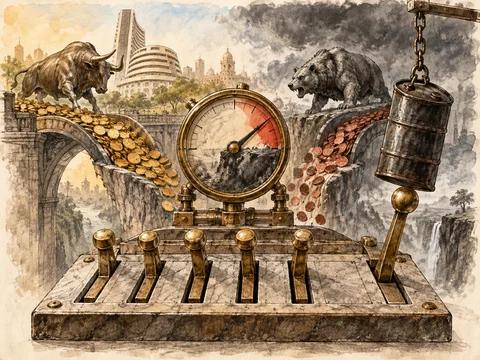
- Markets price a volatility regime shift: Nifty 50 implied volatility is at its highest since June 2024, more than 14 points above December's record low; the index fell 4.6% through March 10, and swap markets swung from pricing RBI cuts to hikes in ten days.
- Crude is near $87 after a spike toward $120; a sustained 10% rise adds 0.5–0.7 percentage points to headline inflation, and stress evenings need about 13 gigawatts of gas-fired power with only about 3 available. Official calm holds only if the war ends within weeks.
When US and Israeli forces effectively sealed the Strait of Hormuz in late February 2026, the geopolitical tremor was felt most acutely not in Washington or Tel Aviv — but in New Delhi. India, the world's most populous nation and one of its fastest-growing economies, had long been aware of its dangerous dependence on Persian Gulf energy. Now, that vulnerability has become a full-blown emergency, playing out simultaneously across six distinct but deeply interconnected fronts: energy supply, financial markets, aviation, agriculture, monetary policy, and the coming summer power grid.
What began as a price shock has rapidly become a supply crisis. Emergency orders, rationing directives, and market dislocations that would have been unthinkable two weeks ago are now daily realities. The composite picture, drawn from ground-level data and live market signals as of March 10, 2026, is more alarming than official communications have acknowledged.
I. The Cooking Gas Emergency: From Price Shock to Physical Rationing
India imports roughly 60% of its liquefied petroleum gas and sources two-thirds of its LNG from the Middle East — a structural exposure that left the country acutely vulnerable the moment Hormuz flows were disrupted. With March shipments stranded, the government's response has escalated from price adjustment to emergency powers in under two weeks.
The oil ministry invoked emergency powers to redirect LPG away from industrial users, barring refiners — including Reliance Industries' export-oriented unit — and petrochemical plants from using the fuel as a feedstock, while ordering them to maximize LPG output. The directive specifically safeguards the more than 300 million households that rely on LPG cylinders for daily cooking, while capping provisions to industries including fertilizers and manufacturing. Supplies to petrochemical plants operated by ONGC, GAIL, and Reliance, as well as to power plants, will be curtailed or halted altogether.
The government simultaneously raised cooking gas prices on Saturday for the first time in a year, and extended the minimum interval between subsidized refills from 21 to 25 days — a demand-moderation measure that signals just how tight the supply situation has become. Officials have directed gas producers and importers, including ONGC, Reliance, and Oil India, to disclose detailed information on stock levels and allocations as New Delhi tightens oversight.
"It is no longer just a price issue, but primarily a supply issue — and India's emergency reserves are being drawn down quickly. Any government will prioritize its citizens over industries during times of shortages. But industries are being hit, which will ultimately affect economic growth."
— Emkay Global Financial Services, economics desk
The shortages are already visible on the ground. Restaurants in parts of the country have halted operations. A crematorium in the western state of Maharashtra curtailed LPG-based incinerations due to fuel shortages. Existing LPG stocks can stretch to roughly 30 days — but if fresh cargoes do not begin moving within the week, rationing could become unavoidable before April.
India has sought alternatives. A long-term deal with the United States provides some LPG volumes, but these remain far smaller than Gulf supplies, freight costs are significantly higher, and emergency spot purchases from US terminals could not arrive in India before April. Incremental volumes from Russia and Argentina remain marginal at best, heavily dependent on freight economics and global spot availability.
India has limited flexibility when it comes to sourcing LPG from alternate suppliers.
II. The LNG Squeeze: Tenders Going Unawarded
India's LNG crisis has now moved beyond price shock into outright supply failure. GAIL and GSPC, two of the country's largest gas importers, have seen March delivery tenders go entirely unawarded — a stark signal that there is simply no immediately available fuel to be had at any price. Indian Oil is still seeking a second-half March LNG cargo on a delivered basis. HPCL has a tender outstanding for April 1–7 delivery to Chhara.
Asian LNG prices have more than doubled since the war broke out on February 28, following a war-related outage at Qatar's Ras Laffan plant — the world's largest LNG export facility. Bangladesh, facing its own domestic energy crisis, locked in two emergency shipments at approximately 2.5 times the January rate. The tight supply arrives precisely as Southeast Asia anticipates hotter weather in the months ahead, raising power demand and intensifying regional competition for a diminishing pool of available cargoes.
To preserve essential services reliant on LNG after Qatar halted production, the government has ringfenced households receiving piped natural gas and the transport sector. Provisions to industries including fertilizers and manufacturing have been capped. The interconnectedness of Asian LNG markets, once a source of resilience, has become a transmission mechanism for shared vulnerability: every major regional economy is now competing for the same shrinking non-Gulf supply.
III. Aviation in Freefall: Caught Between Two Closed Skies
If the energy crisis is a slow-building emergency, the damage to Indian aviation has been immediate and spectacular. Indian carriers have emerged as the hardest-hit airlines outside the Middle East itself — and the reasons are structural, not situational.
SpiceJet's chairman stated publicly that crude oil at even $90 a barrel is unsustainable for Indian carriers. Indian airlines have already hiked long-haul international fares by 15%, and a domestic fuel surcharge is now inevitable. SpiceJet's entire international schedule for March is routed through Middle Eastern airspace. Air India Express has 60% exposure. IndiGo, India's largest carrier, stands at 41%. SpiceJet's stock fell as much as 9.2% in a single session, with IndiGo slumping nearly 8% before partially recovering.
"We don't know where things are really going. Does it make sense to keep flying planes when it loses you money? That will have to be calculated."
— Ajay Singh, Chairman & Managing Director, SpiceJet
What makes India's predicament uniquely painful is a compounding factor from an entirely different conflict. Indian carriers have been unable to use Pakistani airspace since mid-2025, following a bilateral confrontation. Rerouting over Iran had already added more than two and a half hours to US-bound flight times. With Iranian airspace now also closed, alternative paths add even more time — placing Indian airlines at a severe competitive and operational disadvantage.
Airlines in the region hedge fuel less aggressively than European and North American peers, meaning cost shocks flow through faster to the P&L. International routes have historically served as a natural currency hedge against rupee depreciation, generating dollar revenues that offset the impact of a weakening domestic currency. As crude prices surge, that hedge is precisely what is now being stripped away.
"Asia's airlines are structurally more exposed to Middle East disruptions than their Western peers. Many Asian carriers also hedge fuel less aggressively, which means cost shocks flow through faster to the P&L."
— Aviation industry consultant
IV. Financial Markets: Volatility Regime Shift
India's financial markets are pricing a fundamental regime shift. Implied volatility on the Nifty 50 has surged to its highest level since June 2024 — up more than 14 points from its record low in December — as investors grapple with the country's structural exposure to Middle East disruptions. Critically, implied volatility now sits well above realized volatility, indicating that traders are positioning for significantly more turbulence than recent weeks have delivered.
The Nifty 50 tanked 4.6% through March 10, with India's $4.8 trillion equity market facing headwinds across every sector. The India VIX ratio against the Cboe Volatility Index reached its highest level since last May. The cost of hedging against declines in the Nifty 50 over the next three months has also jumped materially. Selling has been broad-based and indiscriminate — a domino effect driven by oil price pass-through into transport, food, and manufactured goods.
"Implied volatility doesn't spike without a reason — it's the market's insurance premium going up. Investors are preparing for a regime shift. The options market is clearly pricing in the risk that calm conditions won't last."
— Kai Securities, derivatives desk
The structural buffer that had shielded Indian equities — five years of domestic institutional inflows totaling $223 billion against $11 billion in net foreign selling — is now under strain. Net domestic fund purchases trailed foreign purchases for most of February. Retail traders dabbling in the derivatives market have faced margin calls that triggered cascading portfolio selloffs to compensate for mark-to-market losses. India sources approximately 40% of its crude imports through the Strait of Hormuz, making the equity market's sensitivity to the conflict acute and direct.
V. Rate Cut Dreams Evaporate: The Monetary Policy Reversal
Perhaps the most telling indicator of the war's economic shock is what has happened in India's interest rate swap markets over the past ten days. At the start of February, traders were confidently pricing in a series of rate cuts by the Reserve Bank of India. As of this week, those same markets are pricing in rate hikes — one of the sharpest swings in Asia, from an easing to a tightening bias, all driven by the prospect of a sustained oil price shock feeding into domestic inflation.
The arithmetic is brutal. India imports approximately 90% of its oil, with about half originating from Persian Gulf countries where Hormuz transit has halted. A sustained 10% rise in oil prices from their January-February average would lift annual headline inflation by 0.5 to 0.7 percentage points, per OCBC Bank estimates. Crude oil traded near $87 a barrel on March 10, having spiked toward $120 earlier in the week before retreating on diplomatic signals. Analysts warn that $100 is increasingly plausible if disruptions persist.
"The window may be closing earlier, especially if there is real oil supply losses from a prolonged Iran conflict."
— OCBC Research
The RBI now faces a dilemma that monetary policymakers dread: a supply shock that is simultaneously inflationary and growth-dampening. Rate hikes to fight inflation would further squeeze an economy already facing energy shortages and aviation disruptions. Rate cuts to support growth would risk a currency rout and runaway imported inflation. A weakening rupee — already under pressure from capital outflows — makes all imports more expensive, adding a second inflationary impulse. The current account, which was beginning to improve, faces renewed pressure. For now, the central bank has chosen watchful silence — but markets are not waiting.
VI. Fields Under Pressure: The Fertilizer Shock Threatening India's Harvest
Less visible than empty gas cylinders or canceled flights, but potentially more consequential for India's long-term food security, is the disruption now rippling through its fertilizer industry. LNG is not just a fuel for industrial plants — it is the primary feedstock for urea, the most widely used fertilizer in the world. India's LNG supply from Qatar has effectively been cut off.
Fertilizer manufacturers, including IFFCO, have begun reducing output at urea plants as Qatari LNG flows dried up. If the disruption persists, companies may be forced into full shutdowns. For India, the timing is deeply problematic. The country's peak agricultural demand season arrives with the monsoon in June. Fertilizers ordered and applied in the weeks before the rains determine crop yields across millions of hectares of paddy, wheat, sugarcane, and cotton. India is the world's largest grower and exporter of rice, and the second-largest producer of sugar, wheat, and cotton.
Should domestic urea output remain curtailed, India would be forced to accelerate costly imports at a moment when global commodity prices are spiking. That would drive up government fertilizer subsidies — a politically sensitive line item — and places additional strain on a fiscal deficit target of 4.3% of GDP already under pressure from energy subsidies. An agricultural crisis layered onto an energy crisis would make that target nearly impossible to meet.
VII. Lights Out After Sunset: The Coming Power Grid Crisis
Of all the cascading consequences of the Hormuz blockade, one of the least discussed — and most dangerous — is the threat to India's electricity supply during the coming summer months. India's gas-fired power plants represent only a small fraction of total generation capacity, but they play an outsized and irreplaceable role: meeting the surge in demand that occurs every evening, after solar panels go dark and urban India turns on its air conditioners.
The India Meteorological Department has already warned of above-normal temperatures and an elevated likelihood of heatwave days across many parts of the country through May 31. Tata Power's CEO estimated in February that peak demand could breach 270 gigawatts this summer — a record, surpassing the all-time high of 250 gigawatts set in 2024.
The math of the impending crunch is stark. India needs approximately 13 gigawatts of gas-fired power on peak stress evenings to bridge the gap between firm demand and what coal, wind, and hydro can reliably provide. But with LNG supply curtailed, only about a quarter of that capacity — roughly 3 gigawatts — may be available. The remainder would have to come from wind power, which is inherently unpredictable.
"On days of stress, we need about 13 gigawatts of gas power to meet the evening demand. If LNG supplies remain curtailed, we would be left with only a quarter of that. It would leave us heavily dependent on wind, which is very unpredictable."
— S.R. Narasimhan, Former Chief, Grid Controller of India
Should peak demand breach 240 gigawatts — as is expected during the hottest weeks of April and May — without adequate gas-fired backup, India faces rolling blackouts in the evenings, precisely when heat-related health risks are at their greatest.
VIII. The Diplomatic and Geopolitical Dimension
With the crisis deepening, Washington made a significant, if carefully circumscribed, concession. The US Treasury Department issued a 30-day general license authorizing Indian refiners to purchase Russian crude oil and petroleum products — specifically, cargoes already loaded onto vessels before March 5 and bound for Indian ports. The move is a striking reversal: just months ago, the Trump administration had imposed tariffs on Indian goods in part to pressure New Delhi into curtailing purchases of Russian oil. Treasury Secretary Scott Bessent framed the measure as deliberately short-term, and analysts note its 30-day duration may signal the administration's expected timeline for the military operation against Iran.
Simultaneously, China has ordered its top state refiners — PetroChina, Sinopec, CNOOC, Sinochem, and Zhejiang Petrochemical — to suspend exports of diesel and gasoline with immediate effect. China receives close to half its oil imports from the Gulf, making it acutely vulnerable to the Hormuz closure. The directive eliminates one of the potential buffer options in India's supply crunch: refined product flows from Chinese refiners, which had historically served as a marginal but real source of supply flexibility for Asian buyers, are now off the table. It also signals that the Asian scramble for energy self-sufficiency is well underway — every major economy in the region is now competing for the same shrinking pool of non-Gulf supply.
The Reckoning
In one sense, the Iran war has done nothing more than expose vulnerabilities that Indian policymakers have long known about. The country's extreme energy dependence on the Persian Gulf, the structural constraints facing its aviation sector, its agricultural reliance on imported fertilizer feedstocks, its exposure to imported inflation, and its gas-dependent power grid — none of these are new. What is new is that all of them are being stress-tested simultaneously, in real time, with markets, supply chains, and policy frameworks all under pressure at once.
The government's posture remains one of managed calm. Officials describe stocks as adequate, express optimism that hostilities will end soon, and point to contingency measures — Russian oil waivers, emergency LNG tenders, strategic reserves — as evidence of resilience. That may prove sufficient if the conflict wraps up within weeks. But the financial markets are telling a different story: a volatility regime shift, a monetary policy U-turn, and the fastest erosion of India's energy security buffers in a generation.
The deeper question — whether India can reduce its structural dependence on a single energy chokepoint it has no power to influence — will outlast this crisis by decades. For now, tens of millions of Indian families simply wait: for their cooking gas cylinders to be refilled, for their flights to resume normal schedules, for the lights to stay on after sunset. The rest of the world watches to see whether the world's fastest-growing large economy can weather a storm it did not make, cannot control, and was never fully prepared for.