Original Lens and publication context
From cooking gas in village kitchens to the evening power grid, from monetary policy to monsoon harvests, the Strait of Hormuz blockade is delivering a cascading shock across every artery of Indian economic life — while a regional scramble for energy self-sufficiency leaves New Delhi increasingly isolated.
- The Hormuz closure hits India on four fronts at once: energy supply, aviation, agriculture and monetary policy. India imports about 60% of its LPG consumption, with about 90% of those imports transiting Hormuz; official stocks stretch to roughly 30 days, and rationing could become unavoidable before April.
- Indian carriers are the hardest-hit airlines outside the Middle East: over 350 flights were cancelled on a single Sunday, and with Pakistani airspace closed since mid-2025, Middle Eastern airspace carries between 41% and 100% of the main carriers' March international schedules.
- Swap markets have swung from pricing RBI rate cuts to pricing hikes within ten days. A sustained 10% rise in oil from the $67 January–February average would add 0.5 to 0.7 percentage points to headline inflation; Brent was near $83 and $100 is plausible.
- Fertilizer plants are cutting urea output as Qatari LNG stops, ahead of the June monsoon demand peak, and the 4.3%-of-GDP fiscal deficit target is already under strain. Washington's 30-day licence for Russian crude loaded before March 5 expires on April 4.
- Stress evenings need about 13 gigawatts of gas-fired power; curtailed LNG may leave roughly 3, while peak demand could breach 270 gigawatts against a 240-gigawatt stress threshold. Official calm holds only if the war ends within weeks; China's fuel-export halt removes Asia's buffer.
When US and Israeli forces effectively sealed the Strait of Hormuz in late February 2026, the geopolitical tremor was felt most acutely not in Washington or Tel Aviv — but in New Delhi. India, the world's most populous nation and one of its fastest-growing economies, had long been aware of its dangerous dependence on Persian Gulf energy. Now, that vulnerability has become an emergency playing out simultaneously across five distinct but deeply interconnected fronts: energy supply, aviation, agriculture, the power grid, and monetary policy.
The combined picture is sobering. India imports roughly 60% of its liquefied petroleum gas (LPG) and about 90% of its crude oil, roughly half of it from the Persian Gulf. Its airline industry is already reeling from simultaneous airspace closures. Its fertilizer plants are beginning to curtail output. And its central bank, the Reserve Bank of India, is watching helplessly as market expectations swing from rate cuts to potential rate hikes — all within the span of days.
India has limited flexibility when it comes to sourcing LPG from alternate suppliers.
The Cooking Gas Crisis: 30 Days and Counting
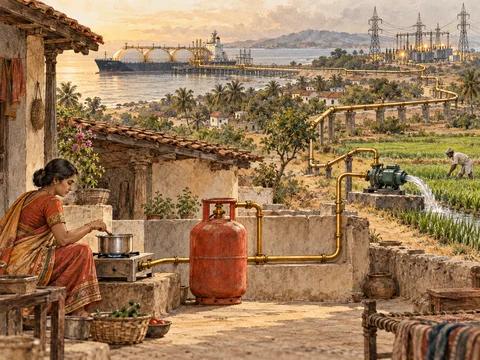
For the hundreds of millions of Indian families who cook with LPG — the compressed gas delivered in bright red cylinders to homes across the country — the crisis is visceral and immediate. India is the world's second-largest LPG buyer, and about 90% of its imported supply transits the Strait of Hormuz.
With Hormuz effectively closed, March shipments that should already be on their way to Indian ports are stranded. Government officials have confirmed that existing LPG stocks can stretch to roughly 30 days. But if cargoes do not begin moving within the week, rationing could become unavoidable before April, according to people familiar with the contingency planning. They asked not to be identified as they are not authorized to speak publicly.
India has sought alternatives. A long-term deal with the United States provides some LPG volumes, but these remain far smaller than Gulf supplies, freight costs are significantly higher, and crucially, even emergency spot purchases from US terminals could not arrive in India before April. Incremental volumes from Russia and Argentina are possible in theory, but traders describe them as marginal at best.
Some incremental volumes could potentially be secured from the US, Russia or Argentina, but these would remain marginal and highly dependent on freight economics and global spot availability.
The oil ministry, projecting calm, said it was "reasonably comfortable in terms of stocks" and optimistic that mitigation measures could be found. For now, that assessment is holding — but the clock is ticking.
Aviation in Freefall: Caught Between Two Closed Skies
If the energy crisis is a slow-building emergency, the damage to Indian aviation has been immediate and spectacular. Indian carriers have emerged as the hardest-hit airlines outside the Middle East itself — and the reasons are structural, not merely situational.
Airlines in India canceled over 350 flights on a single Sunday in early March as the closure of Middle Eastern airspace forced mass diversions that overwhelmed Indian airport capacity. The disruptions extended into a third consecutive day, with no clear end in sight. Air India suspended services to Birmingham, Zurich and Copenhagen, while operating technical stops in Rome for transatlantic routes. IndiGo, India's largest carrier by market share, halted select international services using Middle Eastern airspace and canceled flights to London, Manchester, Amsterdam and Copenhagen.
What makes India's predicament uniquely painful is a compounding factor with roots in an entirely different conflict. Indian carriers have been unable to use Pakistani airspace since mid-2025, following a brief bilateral confrontation. Rerouting over Iran had already added more than two and a half hours to US-bound flight times. Now, with Iranian airspace also closed, alternative paths skirting the entire Middle East add even more time — placing Indian airlines at a severe competitive and operational disadvantage compared to European and North American carriers, who retain corridors via Turkey and Egypt.
"The disruption is especially painful for Indian carriers as international routes provide a natural currency hedge against rupee depreciation — critical now with crude prices rising due to the war." — Aviation analysts
The financial exposure varies sharply by carrier. SpiceJet's entire international schedule for March is routed through Middle Eastern airspace. Air India Express has 60% exposure, while IndiGo stands at 41%. SpiceJet's stock fell as much as 9.2% on a single trading day, with IndiGo slumping nearly 8% before partially recovering.
The strategic dimension compounds the financial one: for Indian carriers, international routes have historically served as a natural hedge against rupee depreciation, with dollar-denominated revenues offsetting the impact of a weakening domestic currency. As the rupee faces pressure from rising crude import costs, that hedge is precisely what is now being stripped away.
Fields Under Pressure: The Fertilizer Shock Threatening India's Harvest
Less visible than empty gas cylinders or canceled flights, but potentially more consequential for India's long-term food security, is the disruption now rippling through its fertilizer industry. LNG — liquefied natural gas — is not just a fuel for industrial plants; it is the primary feedstock for urea, the most widely used fertilizer in the world. And India's LNG supply from Qatar has effectively been cut off.
Fertilizer manufacturers, including the Indian Farmers Fertiliser Cooperative Ltd. (IFFCO), have begun reducing output at urea plants as Qatari LNG flows dried up, according to people familiar with the matter. If the disruption persists, companies may be forced into full shutdowns. The impact has already crossed India's borders: Pakistan's Sui Northern Gas Pipelines has informed customers it cannot supply regasified LNG to fertilizer plants, with the suspension having taken effect from midnight Wednesday.
For India, the timing is deeply problematic. The country's peak agricultural demand season arrives with the monsoon in June. Fertilizers ordered and applied in the weeks before the rains determine crop yields across millions of hectares of paddy, wheat, sugarcane and cotton fields — India is the world's largest grower and exporter of rice, and the second-largest producer of sugar, wheat and cotton.
Should domestic urea output remain curtailed, India would be forced to accelerate costly imports at a moment when global commodity prices are spiking. That, in turn, would drive up government fertilizer subsidies — a politically sensitive line item that the Finance Ministry had been working hard to reduce. The government's fiscal deficit target of 4.3% of GDP for the coming year is already under stress from energy subsidies; an agricultural crisis would make that target nearly impossible to meet.
Senior officials from the fertilizer ministry have said there is no immediate shortage in gas supplies, and that existing stockpiles are adequate for the near term. The Fertiliser Association of India's director general, Suresh Kumar Chaudhari, remained publicly sanguine: "We are very much optimistic that the war may end soon," he said. "If the war continues, it will be a matter of concern."
Rate Cut Dreams Evaporate: The Monetary Policy Reversal
Perhaps the most telling indicator of the war's economic shock is what has happened in India's interest rate swap markets over the past ten days. At the start of February, traders were confidently pricing in a series of rate cuts by the Reserve Bank of India, part of a broader Asian easing cycle that was expected to support growth. As of this week, those same markets are now pricing in rate hikes.
The reversal is dramatic. Overnight index swaps, which reflect market expectations for future central bank policy, show that India — along with the Philippines — has experienced the sharpest swing in Asia, from an easing to a tightening bias, all driven by the prospect of a sustained oil price shock feeding into domestic inflation.
The arithmetic is straightforward and brutal. India imports approximately 90% of its oil, with about half of that originating from Persian Gulf countries where Hormuz transit has halted. OCBC Bank estimates that a sustained 10% rise in oil prices from their January-February average of $67 per barrel would lift annual headline inflation in India by 0.5 to 0.7 percentage points. Brent crude was trading around $83 per barrel in Asian markets on Friday — and analysts warn that $100 is increasingly plausible if disruptions persist.
"The window may be closing earlier, especially if there is real oil supply losses from a prolonged Iran conflict." — OCBC Research
The consequences cascade through the economy. Higher oil prices feed directly into transport costs, which lift the prices of food and manufactured goods. A weakening rupee — already under pressure from capital outflows as risk appetite retreats — makes all imports more expensive, adding a second inflationary impulse. The current account, which was beginning to improve, faces renewed pressure.
The RBI now faces a dilemma that monetary policymakers dread: a supply shock that is simultaneously inflationary and growth-dampening. Rate hikes to fight inflation would further squeeze an economy already facing energy shortages and aviation disruptions. Rate cuts to support growth would risk a currency rout and runaway inflation. For now, the central bank has chosen watchful silence — but markets are not waiting.
A Diplomatic Lifeline: Washington Unlocks Russian Oil
With the crisis deepening, Washington made a significant, if carefully circumscribed, concession on Thursday. The US Treasury Department issued a 30-day general license authorizing Indian refiners to purchase Russian crude oil and petroleum products — specifically, cargoes already loaded onto vessels before March 5 and bound for Indian ports.
The move is a striking reversal. Just months ago, the Trump administration had imposed tariffs on Indian goods in part to pressure New Delhi into curtailing its purchases of Russian oil — purchases India never actually stopped making. The temporary waiver, expiring April 4, acknowledges the reality that India cannot simply replace Gulf oil on short notice, and that a severe energy shock to the world's most populous nation would carry global economic consequences.
Treasury Secretary Scott Bessent framed the measure carefully, noting that it was "deliberately short-term" and would not provide significant financial benefit to the Russian government since it only authorizes oil already stranded at sea. The 30-day duration, analysts note, may itself be a signal about the administration's expected timeline for the military operation against Iran.
Indian state refiners and government officials had met earlier in the week to consider contingency measures, including drawing on Russian cargoes already loitering in Indian waters. The oil ministry had pushed diplomats to seek flexibility from Washington — and Washington, facing the prospect of a global recession, blinked first.
Lights Out After Sunset: The Coming Power Grid Crisis
Of all the cascading consequences of the Hormuz blockade, one of the least discussed — and most dangerous — is the threat to India's electricity supply during the coming summer months. India's gas-fired power plants represent only a small fraction of total generation capacity, but they play an outsized and irreplaceable role: meeting the surge in demand that occurs every evening, after solar panels go dark and urban India turns on its air conditioners.
The India Meteorological Department has already warned of above-normal temperatures and an increased likelihood of heatwave days across many parts of the country through May 31. Against that backdrop, Tata Power's CEO estimated in February that peak demand could breach 270 gigawatts this summer — a record, surpassing the previous all-time high of 250 gigawatts set in 2024. The highest overnight demand peak recorded was 237 gigawatts last June, only marginally below the daytime peak of 241 gigawatts, underlining just how little respite the grid gets after sundown.
The math of the impending crunch is stark. India needs approximately 13 gigawatts of gas-fired power on peak stress evenings to bridge the gap between firm demand and what coal, wind and hydro can reliably provide. But with LNG supply curtailed, only about a quarter of that capacity — roughly 3 gigawatts — may be available. The remainder would have to come from wind power, which is inherently unpredictable.
"On days of stress, we need about 13 gigawatts of gas power to meet the evening demand. If LNG supplies remain curtailed, we would be left with only a quarter of that. It would leave us heavily dependent on wind, which is very unpredictable." — S.R. Narasimhan, former Chief, Grid Controller of India
The evening demand threshold before the grid enters a stress state is around 240 gigawatts, according to energy analysts. Should peak demand breach that level — as is expected during the hottest weeks of April and May — without adequate gas-fired backup, India faces the prospect of rolling blackouts in the evenings, precisely when heat-related health risks are at their greatest.
The situation is further complicated by the potential extended shutdown of Tata Power's 4-gigawatt coal plant in Gujarat, one of India's largest single generation assets. Any overlap between that outage and summer peak demand would add further strain to an already stressed system. India does have the option of sourcing replacement LNG from US terminals, but analysts note that higher costs will deter many importers, who are more likely to pass shortfalls on to industrial users than absorb expensive spot cargoes — leaving the power sector to compete for limited supply.
The Global Ripple: China's Fuel Export Ban and What It Means for India
India's crisis does not unfold in isolation. Across Asia, governments are responding to the Hormuz shutdown by turning inward — and the implications for India are significant. China, whose vast refining sector normally serves as a supplier of last resort for fuel-hungry Asian markets, has ordered its top state refiners to suspend exports of diesel and gasoline with immediate effect.
The directive, issued by China's National Development and Reform Commission to major refiners including PetroChina, Sinopec, CNOOC, Sinochem and Zhejiang Petrochemical, covers all new export contracts and requires negotiation of cancellations on already-agreed shipments. China receives close to half its oil imports from the Gulf, making it acutely vulnerable to the Hormuz closure — and compelling it to prioritize domestic supply over regional trade.
The move is significant for India for two reasons. First, it eliminates one of the potential buffer options in a supply crunch: refined product flows from Chinese refiners, which had historically served as a marginal but real source of supply flexibility for Asian buyers, are now off the table. Second, it signals that the Asian scramble for energy self-sufficiency is well underway — every major economy in the region is now competing for the same shrinking pool of non-Gulf supply.
Refiners across the region — from Japan to Indonesia to India itself — have already begun cutting run rates and suspending exports. The cumulative effect is a tightening of refined product markets precisely when India's own refining sector is under stress from crude supply disruptions. The interconnectedness of Asian energy markets, once a source of resilience, has in this crisis become a transmission mechanism for shared vulnerability.
The Reckoning
In one sense, the Iran war has done nothing more than expose vulnerabilities that Indian policymakers have long known about. The country's extreme energy dependence on the Persian Gulf, the structural constraints facing its aviation sector, its agricultural reliance on imported fertilizer feedstocks, its exposure to imported inflation, and its gas-dependent power grid — none of these are new. What is new is that all of them are being stress-tested simultaneously, in real time, with no obvious near-term resolution in sight.
The government's posture remains one of managed calm. Officials describe stocks as adequate, express optimism that hostilities will end soon, and point to contingency measures — Russian oil waivers, potential US LNG purchases, strategic reserves — as evidence of resilience. That may prove sufficient if the conflict wraps up within weeks.
But the broader regional picture offers little comfort. China is hoarding refined products. Asian central banks are abandoning rate-cut cycles. Airlines are grounded. Fertilizer plants are dimming. And India's evening electricity supply this summer now rests, in part, on whether LNG tankers can resume transiting the Strait of Hormuz before the mercury climbs past 40 degrees Celsius in Delhi and Mumbai.
The deeper question — whether India can reduce its structural dependence on a single energy chokepoint it has no power to influence — will outlast this crisis by decades. For now, tens of millions of Indian families simply wait: for their cooking gas cylinders to be refilled, for their flights to resume normal schedules, for the lights to stay on after sunset. The rest of the world watches to see whether the world's fastest-growing large economy can weather a storm it did not make, cannot control, and was never fully prepared for.